

Infra & AI enthusiast, dreaming about test-time compute ✨ Applied Scientist at @amazon | MS in CS @ETH_en | Prev, @IBMResearch @berkeley_ai
Berkeley, CA, USA
Joined December 2024
- Tweets233
- Following341
- Followers1.3K
- Likes311


Pinned Tweet
Wait what!? We robustified tau2-bench and found that the newly released model from @OpenAI (GPT-5.1) performs way worse than GPT-5 and GPT-5-mini.
All while being 5x more expensive than GPT-5-mini!
But, why? We have a theory...

Alejandro Cuadron retweeted

How can we train small agentic models that are highly capable of terminal use and coding?
Announcing OpenThoughts-Agent + OpenThinkerAgent-32B, the strongest Qwen-3 based open-data agentic model: 44.8% avg across 7 agentic benchmarks! (1/n)

Alejandro Cuadron retweeted

Wow.
@Zai_org GLM 5.2 is a marvel! It is *at least* as good as Opus 4.8 and GPT 5.5. It's super fast, inexpensive, and not too verbose.
It responds with nuance and judgement, & handles long context VERY well.
I've never experienced an open weights model like this before.
Alejandro Cuadron retweeted

Introducing Claude Opus 4.8: it builds on Opus 4.7 with sharper judgment, more honesty about its own progress, and the ability to work independently for longer than its predecessors.
Available today at the same price.

ALT Benchmark table showing how Claude Opus 4.8 compares to its predecessor and to other models on tests of coding, agentic skills, reasoning, and practical knowledge work tasks.
Alejandro Cuadron retweeted

🔥 Great work as always from @liuziwei7 and @lmmslab! Codecs are the way to go for efficient and scalable video understanding as we also explored in our recent work, CoPE-VideoLM 🚀
📰 arXiv: arxiv.org/abs/2602.13191
📷 Project Page: microsoft.github.io/CoPE/
🧵Thread: teapaw.org/debsarkar_sayan/status…


🔥LLaVA-OneVision-2.0 Open Sourced🔥
LLaVA-OneVision series @lmmslab now upgrades to 2.0 with its key advance on *codec-stream tokenization*, which treats highly dynamic video as a continuous bit-cost stream
- Tech Report: arxiv.org/pdf/2605.25979
- Code: github.com/EvolvingLMMs-Lab/…

Alejandro Cuadron retweeted
🚀 New paper: arxiv.org/abs/2602.13191
VideoLMs are bottlenecked by a simple problem: they treat video like a stack of images. That means huge token costs, slow responses, and missed temporal details.
What if we processed video the way codecs do? 🎬
Instead of dense per-frame RGB embeddings, we tokenize motion vectors + residuals and only encode sparse keyframes — turning video redundancy into a powerful inductive bias for efficient temporal reasoning.
🧵👇

Alejandro Cuadron retweeted

Turns out we can get SOTA on agentic benchmarks with a simple test-time method!
Excited to introduce LLM-as-a-Verifier.
Test-time scaling is effective, but picking the "winner" among many candidates is the bottleneck. We introduce a way to extract a cleaner signal from the model:
1️⃣ Ask the LLM to rank results on a scale of 1-k
2️⃣ Use the log-probs of those rank tokens to calculate an expected score
You can get a verification score in a single sampling pass per candidate pair.
Blog: llm-as-a-verifier.notion.sit…
Code: llm-as-a-verifier.github.io
Led by @jackyk02 and in collaboration with a great team: @shululi256, @pranav_atreya, @liu_yuejiang, @drmapavone, @istoica05

Alejandro Cuadron retweeted

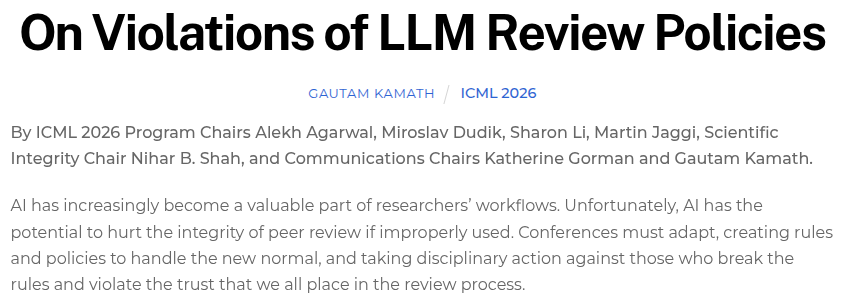
To ensure compliance w peer-review policies, ICML has removed 795 reviews (1% of total) by reviewers who used LLMs when they explicitly agreed to not. Consequently, 497 papers (2% of all submissions) of these (reciprocal) reviewers have been desk rejected
Details in blog post 👇
Alejandro Cuadron retweeted

Researchers spend hours and hours hand-crafting the strategies behind LLM-driven optimization systems like AlphaEvolve: deciding which ideas to reuse, when to explore vs exploit, and what mutations to try.
🤖But what if AI could evolve its own evolution process?
We introduce EvoX, a meta-evolution pipeline that lets AI evolve the strategy guiding the optimization. It achieves high-quality solutions for <$5, while existing open systems and even Claude Code often cost 3-5× more on some tasks.
Across ~200 optimization problems, EvoX delivers the strongest overall results: often outperforming AlphaEvolve, OpenEvolve, GEPA, and ShinkaEvolve on math and systems tasks, exceeding human SOTA, and improving median performance by up to 61% on 172 competitive programming problems. 👇

Congrats!

🚀 Excited to share that LEANN has been accepted to #MLSys2026!
Over the past months, we’ve also seen growing adoption from both enterprise users and individual developers, which is incredibly encouraging. It’s a strong signal that this idea resonates not only with the academic community, but also with real-world production use cases in industry.
📄 Paper: arxiv.org/abs/2506.08276
💻 Repo: github.com/yichuan-w/LEANN
Looking ahead to the new year, our vision is bold but simple:
👉 Make LEANN the best platform to manage all your personal context and data with LLMs—directly on your own device.
More to come. Stay tuned 🔥

1
3
466
Alejandro Cuadron retweeted

Little known fact: one of Geoffrey Hinton’s PhD students from ~40yrs ago went on to be the billionaire CEO of the most successful quant hedge fund of all time, RenTech.
His thesis was in modeling speech recognition systems with hidden markov models.

Alejandro Cuadron retweeted

We’ve been assuming that extreme attention sparsity must destroy model quality.
That assumption is now false.
New SkyLight Release: vAttention ⚡️
We added vAttention to the Tier1A leaderboard. The data is striking:
👑 #1 Practical Method: Surpasses the previous lead (PQCache), closing the gap to dense models within 1% at up to 10x sparsity..
👑 Saturates Benchmarks: Dominates the sparsity–quality frontier (w/ oracle top-k).
💡 Introducing Verified-X: A new paradigm for reliable inference-time sparsity.
In this week’s blog, we share an in-depth look at the algorithm and how to run it via SkyLight 👇

Alejandro Cuadron retweeted
Built by @Apd10Desai, @kumarkagrawal, @randwalk0 , @Alex_Cuadron, @luisgschroeder @matei_zaharia, @profjoeyg, @istoica05 at @skylight-org, @BerkeleySky.
📝 Full blog post: sky-light.eecs.berkeley.edu/…
📄 Paper: arxiv.org/abs/2510.05688
💻 Code: github.com/skylight-org/spar…
🏆 Updated SkyLight Tier-1A benchmarks: sky-light.eecs.berkeley.edu/
You can explore vAttention in SkyLight's pytorch research attention framework today using github.com/skylight-org/spar…

Alejandro Cuadron retweeted

Introducing SWE-Playground: A fully automated pipeline that generates synthetic environments to train versatile coding agents. 🤖✨
Training software engineering agents often relies on existing resources like GitHub issues and focuses on solving SWE-bench style issue resolution tasks. While this has driven incredible progress, real-world engineering involves a wider spectrum of tasks —from designing new libraries to writing reproduction scripts. 🌐
Rather than mining existing repositories, SWE-Playground synthetically generates projects, tasks, and verifiable unit tests from scratch.
This approach offers two exciting opportunities: 1️⃣ Flexibility: We can generate tasks without being constrained by the availability or structure of existing open-source data. 2️⃣ Versatility: We extend training beyond Issue Resolution to include Issue Reproduction and Library Generation from Scratch.
The results? 🚀 Our agents achieve strong performance across SWE-bench Verified, SWT-Bench, and Commit-0, demonstrating high data efficiency compared to baselines trained on larger datasets.
Huge thanks to my amazing collaborators @apurvasgandhi and @gneubig for their incredible efforts on bringing this work to life!
👇 🧵 A deep dive into how we build versatile agents synthetically.
Paper: arxiv.org/pdf/2512.12216
Project Page: neulab.github.io/SWE-Playgro…
Code: github.com/neulab/SWE-Playgr…
Data & Models: huggingface.co/collections/S…


Alejandro Cuadron retweeted

🧵Tired of scrolling through your horribly long model traces in VSCode to figure out why your model failed? We made StringSight to fix this: an automated pipeline for analyzing your model outputs at scale.
➡️Demo: stringsight.com
➡️Blog: blog.stringsight.com
Alejandro Cuadron retweeted
📢 Announcing the dates for #ICML2026 in Seoul! 🇰🇷
July 6th - 11th, 2026 (Monday through Saturday)
📆 Mark your calendar!
✈️ Book your flights!
😅 ...Start stressing about the deadline!

Wow

GPT-5.2 xhigh by @OpenAI scores 0% (zero) on CritPt.
CritPt is a research-level physics reasoning benchmark designed to test whether an AI can do genuine, expert-grade theoretical physics reasoning.
The highest score is 9.1% by Gemini 3 Pro.

1
370
Alejandro Cuadron retweeted
Wait what!? We robustified tau2-bench and found that the newly released model from @OpenAI (GPT-5.1) performs way worse than GPT-5 and GPT-5-mini.
All while being 5x more expensive than GPT-5-mini!
But, why? We have a theory...
Alejandro Cuadron retweeted
Come get to know GuideFlow3D tomorrow (Friday, December 5) at #NeurIPS2025 and try our demo ✨
🗓️ 4:30pm-7:30pm PST
📍 Exhibit Hall C,D,E #4310


A little late but just in time post for #NeurIPS ⏰
📢 At @NeurIPSConf 2025, we will be presenting "GuideFlow3D: Optimization-Guided Rectified Flow For Appearance Transfer" 🎉
We introduce a training-free appearance transfer pipeline robust to strong geometric variations between 3D objects.
📝 arXiv: arxiv.org/abs/2510.16136
A thread 🧵
1/
Alejandro Cuadron retweeted

There has been significant recent work in sparse attention promising to unlock long context and improved efficiency -- but does it work?
We recently launched a benchmarking effort to evaluate sparse attention methods and help practitioners understand the capabilities and limitations of SoTA methods.
We are also working to make these methods more accessible in open platforms like vLLM.

Sparse attention offers a viable path to solving the computational and memory issues of long-context LLM serving. However, we observe a surprising gap between the rapid pace of academic research and the reality of open-source adoption.
We identify the core barrier as fragmentation where new methods are published rapidly, but with missing comparative grounding.
Today we’re excited to share SkyLight, where we are building a unified framework designed to bridge this gap. SkyLight standardizes the implementation and evaluation of sparse attention to enable rigorous, controlled benchmarking.
Our first major effort is to understand the frontier of inference time sparse-decoding in LLMs.
1/N 🧵

Alejandro Cuadron retweeted

CORE-Bench is solved (using Opus 4.5 with Claude Code)
TL;DR: Last week, we released results for Opus 4.5 on CORE-Bench, a benchmark that tests agents on scientific reproducibility tasks. Earlier this week, Nicholas Carlini reached out to share that an updated scaffold that uses Claude Code drastically outperforms the CORE-Agent scaffold we used, especially after fixing a few grading errors. Over the last three days, we validated the results he found, and we are now ready to declare CORE-Bench solved.
Context. We developed the Holistic Agent Leaderboard (HAL), to evaluate AI agents on challenging benchmarks. One of our motivations was that most models are never compared head-to-head — on the same benchmark, with the same environment, and using the same scaffold. We built standard agent scaffolds for each benchmark, which allowed us to independently evaluate models, scaffolds, and benchmarks.
CORE-Bench is one of the benchmarks on HAL. It evaluates whether AI agents can reproduce scientific papers when given the code and data from a paper. The benchmark consists of papers from computer science, social science, and medicine. It requires agents to set up the paper's repository, run the code, and correctly answer questions about the paper's results. We manually validated each paper's results for inclusion in the benchmark to avoid impossible tasks.
1. Switching the scaffold to Claude Code nearly doubles the accuracy of Opus 4.5
Our scaffold for this benchmark, CORE-Agent, was built using the HuggingFace smolagent library. This allowed us to easily switch the model we used on the backend to compare performance across models in a standardized way.
While CORE-Agent allowed cross-model comparison, when we ran Claude Opus 4.5 using Claude Code, it scored 78%, nearly double the 42% we reported using our standard CORE-Agent scaffold. This is a substantial leap: The best agent with CORE-Agent previously scored 51% (Opus 4.1). Surprisingly, this gap was smaller for other models. For example, Opus 4.1 with CORE-Agent outperforms Claude Code (more in Section 4).
2. There were grading errors in 9 tasks on CORE-Bench
Nicholas also identified several issues causing us to underestimate accuracy. When building the benchmark, we manually ran each task thrice and used 95% prediction intervals based on our three manual runs to account for rounding, noise, and other sources of small variation. But this failed in some edge cases where our results were fully deterministic, leading to small floating point differences being penalized. In addition, some tasks were underspecified in ways that led valid interpretations to be scored as failures.
Altogether, this affected 8 tasks, where we manually verified Opus 4.5's responses and graded each of them as correct. We also removed 1 task from the benchmark after finding that its code is impossible to reproduce due to bit rot: the original paper required downloading a dataset from a URL that is no longer live.
These changes increased the agent's accuracy from 78% to 95%. Claude Code with Opus 4.5 only fails at 2 tasks, where it fails to resolve package dependency issues and correctly identify the relevant results.
3. Many grading errors only surface with capable agents
When we created the benchmark, the top accuracy was around 20%. Edge cases in grading were much less apparent than they are now, when agents are close to saturating the benchmark. For example, some of the edge cases resulted from the agent solving the task in a slightly different way than we expected when building the benchmark.
We didn't anticipate agents doing this, so our grading process was too stringent. But we found that Opus 4.5 with Claude Code often used another (correct but slightly distinct) technique to solve the task, which we auto-graded as incorrect. In our manual validation, we graded these cases as correct.
This experience drives home the importance of manual validation in the "last mile" of unsolved tasks on benchmarks. These tasks are often unsolved because of bugs in grading rather than agents genuinely being unable to solve tasks. Many of these bugs were hard to anticipate in advance of the benchmark being attempted by strong agents. Automated grading got us quite far (up to 80% of the benchmark), but manual grading was necessary for validating the last 20% of accuracy.
This process also resembles how grading errors in many popular benchmarks were found and fixed. SWE-bench Verified had flaky unit tests. TauBench counted empty responses as successful. Fixing errors in benchmarks as the community discovers issues is important.
At the same time, iterations to benchmark scoring rubrics make comparisons over time hard, because benchmarks need to constantly change. There are other reasons comparing results across time is challenging. For example, many benchmarks involve interacting with open-ended environments, such as the internet. But as websites change (e.g., as more websites add CAPTCHA), the difficulty of solving tasks changes.
4. What explains this performance jump?
We were surprised to find that Claude Code with Opus 4.5 dramatically outperformed the CORE-Agent scaffold, even without fixing incorrect test cases (78% vs 42%). This gap was much smaller for other models: For Opus 4.1, CORE-Agent *outperforms* Claude Code by almost 10 percentage points. Sonnet 4 scores 33% with CORE-Agent but 47% with Claude Code. Sonnet 4.5 scores 44% with CORE-Agent, but 62% with Claude Code.
We are unsure what led to this difference. One hypothesis is that the Claude 4.5 series of models is much better tuned to work with Claude Code. Another could be that the lower-level instructions in CORE-Agent, which worked well for less capable models, stop being effective (and hinder the model's performance) for more capable models.
5. Pivoting HAL towards better scaffolds
When we planned the empirical evaluation setup for HAL, we assumed there would be a loose coupling between models and scaffolds, allowing us to use the same scaffold across models. But we always knew that that assumption might one day break. The dramatic improvement of Opus 4.5 using Claude Code shows that this day might be here.
We think studying the coupling between models and scaffolds is an important research direction going forward, especially as more developers release scaffolds that their models might be finetuned to work well with (such as Codex and Claude Code).
This trend might have structural effects on the AI ecosystem. Downstream developers who build scaffolds or products need to constantly modify them based on the capabilities of newer models. Model developers have a systematic advantage in building better scaffolds, since they can fine-tune their models to work better with their own scaffolds. This undercuts the trend of models becoming commoditized and replaceable artifacts: model developers can regain influence on the application layer through such fine tuning, at the expense of third-party / open-source scaffold and product developers.
Another implication of the trend: AI companies releasing evaluation results should disclose the scaffold they use for evaluation. If the same model can score double the accuracy by switching out the scaffold, it's clear the choice of scaffold matters a lot. Yet, most model evaluation results don't share the scaffold.
In light of these results, we are considering many ways to change our approach for HAL evaluations, including identifying scaffolds that work well with specific models and soliciting more community input on high-performing scaffolds.
6. CORE-Bench is effectively solved. Next steps.
With Opus 4.5 scoring 95%, we're treating CORE-Bench Hard as solved. This triggers two conditions in our plans for follow-up work:
1. When we developed CORE-Bench, we also created a private test set consisting of a different set of papers, which we planned to test agents on once we crossed the 80% threshold. (The papers in this test set are publicly available, but they weren't included in the earlier test set for CORE-Bench and we haven't disclosed which papers are in the new test set.) We'll now open this test set for evaluation.
2. We developed CORE-Bench to closely represent real-world scientific repositories. Now that we have a proof of concept for AI agents solving scientific reproduction tasks, we plan to test agents' ability to reproduce real-world scientific papers at a large scale.
We welcome collaborators interested in working on this. Building tools to verify reproducibility can be extremely impactful. Researchers could verify that their own repositories are reproducible. Those building on past work could quickly reproduce it. And we could conduct large-scale meta-analyses of how reproducible papers are across fields, how these trends are shifting over time etc.
Note that despite our manual validation, CORE-Bench still has some shortcomings compared to real-world reproduction. For example, we filtered repositories down to those that took less than 45 minutes to run. CORE-Bench also asks for just some specific results of a paper to be reproduced, rather than the entire paper, for ease of grading. Both of these might lead to real-world reproduction attempts being more difficult than the benchmark.
We'll update the HAL website with the manually validated CORE-Bench results and publish details on the specific bugs and fixes. Thanks again to Nicholas Carlini for the thorough investigation of the benchmark's results, and to the HAL team (@PKirgis, @nityndg, @khl53182440, @random_walker) for working through these changes to validate and update the benchmark results.

ALT Opus 4.5 with Claude Code scores 95% on CORE-Bench