Analyse Bourses (@AnalyseBourses) header
Analyse Bourses (@AnalyseBourses) profile picture

Financial market analysis Analyse des marchés financiers #bonds #Currencies #cac40 #sp500 $hsi #volatility $VIX #MOVE

New York Paris Hong Kong Tokyo
Joined October 2018
Photo by Analyse Bourses (@AnalyseBourses)Photo by Analyse Bourses (@AnalyseBourses)Photo by Analyse Bourses (@AnalyseBourses)Photo by Analyse Bourses (@AnalyseBourses)Photo by Analyse Bourses (@AnalyseBourses)Photo by Analyse Bourses (@AnalyseBourses)Photo by Analyse Bourses (@AnalyseBourses)Photo by Analyse Bourses (@AnalyseBourses)Photo by Analyse Bourses (@AnalyseBourses)Photo by Analyse Bourses (@AnalyseBourses)
Analyse Bourses retweeted
Treasury buybacks improve the liquidity of U.S. government securities. Can that help push down the yield on these securities? Read this analysis by economist Paulina Restrepo-Echavarría (@paures12) and research associate Bontu Ankit Patro: bit.ly/4eHNjWZ
1
8
2
30
4,196
Analyse Bourses retweeted
Rates are beginning to put pressure on markets and the economy We are seeing fx flows move in lockstep with this Liquidity is much more complex than what people think. For example, the majority of tech flows have been driven by fundamentals as opposed to macro liquidity. But the non fundamentally driven factors and sectors on the far end of the risk curve are beginning to be impacted from macro liquidity.
7
8
160
16,635
Analyse Bourses retweeted
Thanks to newly released data, we now have a handle on the scale of the Japanese government's FX interventions to support the yen. Acting on behalf of the Ministry of Finance, the Bank of Japan deployed a total of ¥15.39 trillion (nearly $100 billion) in the third quarter alone. The largest single tranche of ¥7.97 trillion was during the joint end-July intervention with the United States. As regards the spillovers, this scale of intervention served to amplify the upward pressure on US Treasury yields in July-August, a dynamic that has moderated significantly thereafter. #economy #markets #japan #fx #yen #currency #bonds #yields
25
48
6
302
48,893
Analyse Bourses retweeted
❗️ [ 🇫🇷 FRANCE ] 🔸 Aujourd’hui, à Paris, des policiers ont violemment chargé de simples manifestants déjà canalisés par des gendarmes, les prenant ainsi en étau entre les deux forces de l’ordre.
82
999
75
3,427
221,369
Analyse Bourses retweeted
les flics coupent le cortège les gendarmes leur rappellent qu'il y en a qui savent faire leur boulot mieux qu'eux ptdrrr
#PARIS Grosse embrouille entre gendarmes mobiles et unités des la Préf Paris ! Ils se sont tapés dessus !! Métro rue des boulets. Les flics chargeaient la foule compacte, les gendarmes gueulaient « laissez nous bosser c’est notre opération ! » Surnaturel.
30
626
37
4,519
254,853
Analyse Bourses retweeted
On TARGET2 The fan club of the ever-hysterical Robin Brooks is coming after me. So let’s use a simple example to explain what TARGET2 actually is and how its balances arise. Suppose an Italian buyer pays €100 to a German seller. The payment goes through, but the Bank of Italy ends up with a €100 liability to the ECB. Sounds paradoxical, doesn’t it? But these are two entirely different kinds of obligations. Let's break it down. 1. An Italian transfers €100 to a German. €100 is debited from the Italian buyer's bank account. €100 is credited to the German seller's bank account. The payment is complete. The Italian buyer owes the German seller nothing. Before going further, we need to understand something about modern monetary systems. There are two types of money relevant to this example: Commercial bank deposits: the money households and businesses use to pay for goods and services. Central bank reserves: the money commercial banks hold at their central banks and use to settle payments between themselves. 2. What happens at the central bank level? The Italian commercial bank holds reserves at the Bank of Italy, while the German commercial bank holds reserves at the Bundesbank. When €100 moves from Italy to Germany, the balance sheets of the two central banks change. Here's what happens: BANK OF ITALY 🇮🇹 Reserve liabilities to commercial banks: −€100 TARGET liability to the ECB: +€100 BUNDESBANK 🇩🇪 Reserve liabilities to commercial banks: +€100 TARGET claim on the ECB: +€100 Notice something important. The Bank of Italy has not increased its total liabilities by €100. It has simply replaced one liability with another. Before the payment, it owed €100 in reserves to the Italian commercial bank. After the payment, it owes €100 to the ECB through TARGET. Meanwhile, the Bundesbank has acquired a new €100 liability to the German commercial bank. To balance its books, it simultaneously acquires a €100 financial asset: a claim on the ECB. This is precisely how the ECB and the Bundesbank explain the accounting. 3. Why can't we just transfer the money and forget about it? Because the euro is a single currency, but national central banks maintain separate balance sheets. If Italy and Germany operated under a single central bank with one consolidated balance sheet, this would simply be a transfer of reserves between two commercial banks. But since the Bank of Italy and the Bundesbank have separate balance sheets, an additional accounting entry is needed to record the movement of reserves between them. That's what TARGET does. 4. What if someone in Germany transfers €100 back to Italy tomorrow? Everything happens in reverse. The Bank of Italy's TARGET liability decreases by €100, while the Bundesbank's TARGET claim falls by €100. Assuming no other transactions, both TARGET balances return to their original positions. Here's the key takeaway: TARGET records net settlement flows between national central banks within the Eurosystem. It does not represent unpaid debts of Italian buyers to German sellers, nor does it mean the Italian government has borrowed money from Germany. And this brings us to a much more interesting question: If the Bank of Italy can maintain a negative TARGET balance indefinitely while remaining in the Eurosystem, why would it need to repay it at all? And here's the most fascinating part: Much of the enormous TARGET imbalances accumulated since 2015 were actually driven by the Eurosystem's own asset purchases under the ECB's quantitative easing programs!
Every time I read Brooks’s tweets, I can’t help but facepalm. In a debate about Germany potentially leaving the eurozone, TARGET2 liabilities have somehow magically turned into Italian and Spanish government debt owed to Berlin. But TARGET2 balances are intra-Eurosystem positions between central banks, not loans between governments. Germany leaving the euro would not, in itself, oblige the Italian and Spanish governments to issue sovereign debt to settle those balances.
18
74
10
233
28,624
Analyse Bourses retweeted
BREAKING NEWS: VLADIMIR PUTIN LOSES U.S. HOUSE AND SENATE
583
12,544
524
73,373
883,852
Analyse Bourses retweeted
If the REPO funding pressure was just due to month-end, it would have started a day or two before and end a day or two after. Instead, the pressure began last week with the settlement of a CM bill and increased Treasury supply in the market
3
3
37
2,967
Analyse Bourses retweeted
Warsh will be asked why the Fed skipped a hike today despite the economy being “strong” and inflation “elevated”? Was it due to AI jitters? Maybe it was, and yes, they should’ve hiked today but it was clear that they won’t because they decided in September that they’ll hike *gradually*, which - typically - rules out consecutive hikes.
Two dissents and “Inflation remains elevated. The accumulation of more information will help the Committee determine the policy stance appropriate to ensure a timely return of inflation to the Committee's 2 percent goal. The Committee will deliver price stability.” Yawn!
1
2
21
2,387
Analyse Bourses retweeted
This is nuts. The ECB has the instruments to manage sovereign instability and won't risk repo spirals to please fiscal hawks. We've been through that in 2009-12 w Trichet
4
21
94
5,740
Analyse Bourses retweeted
Halloween in England:
21
421
4
3,319
24,316
Analyse Bourses retweeted
BREAKING: Volodymyr Zelenskyy tells @piersmorgan he has been betrayed by Trump, that Elon Musk and the US deliberately cut off Starlink and people are being killed as a result “This is not the right side of history,” he says. “It is a pity that we are losing a strong partner” On Musk and Starlink he says: “This decision will bring a lot of human losses. Of course, people will die” “I am sure they knew what they did, absolutely. Because it was 1am at night, Starlink was blocked by SpaceX and the United States” “It’s not just about attack. It’s also about defending life. So people were killed because, not enough destroying, not enough interceptors, including interceptors with Starlink, which didn't work. Of course.” Asked if he’s angry with Musk, Zelenskyy says: “Yes, I think he is not right. It's a big mistake.”
876
4,295
310
19,794
1,678,146
Analyse Bourses retweeted
Our model suggests that current market stress is more concentrated in rates than in corporate credit. Elevated rates volatility can reflect monetary-policy uncertainty, inflation risk, or duration repricing without necessarily signaling deteriorating corporate credit fundamentals. The relatively subdued credit factor suggests that corporate risk pricing has not deteriorated to the same extent. However, the positive credit residual indicates that credit is slightly weaker than the historical relationship with rates and equity/FX would predict.
2
11
2
48
8,915
Asset managers shift risk from the wings to the belly of the curve. From 9/22 to 10/6, asset managers moved $30m DV01 from the wings (TU/US/WN) to the belly (FV/TY/UXY), reducing duration while maintaining net long positioning across Treasury futures above flat.
2
10
2
35
4,525
Analyse Bourses retweeted
In today's Macro Volatility Digest: 🔹 Implied volatilities among the major asset classes declined across the board as the primary drivers of cross-asset volatility contagion, rates and oil, both eased. 🔹 The VIX® Index declined 0.5 pts w/w to 14.8 but underperformed skew by another 0.5 pts due to opportunistic positioning for downside convexity. 🔹 Dispersion trended higher w/w and 1M implied correlation (COR1M) declined to 6.93% (10th percentile lows) on OpenAI's revenue scare. Get a sneak peek below, and download the full report: bit.ly/4s0N6Dn
4
17
2
125
14,600
Analyse Bourses retweeted
UBS: TODAY’S TREASURY SELLOFF IS NOT 1999 ALL OVER AGAIN The 10-year Treasury yield recently hit 5.34%, reviving comparisons with 1999, when yields approached 5.8% during the dotcom boom. UBS sees similarities between dotcom-era telecom spending and today’s AI infrastructure boom, but major differences remain. Unlike 1999’s budget surplus, today’s U.S. deficit exceeds 6% of GDP, leaving markets to absorb far more long-duration debt and potentially keeping yields elevated even if the Fed pauses.
47
52
10
464
162,179
Analyse Bourses retweeted
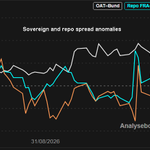
it’s the next shoe to drop if OATs continue to sell! There’s no real chance of a Frexit IMO. But if markets are anyway going to price it to a meaningful degree, then by extension, they have to price the end of EU as we know it. That implies BTPs should also widen, as should every periphery; and EUR should underperform every cross, especially against CHF… which in turn implies that Saron RALLIES because the SNB need to defend against appreciation via rate CUTS. - all this IF OATs continue to sell that is.
Consistent weakness in the Euro, not just vs the USD, but vs all crosses (>2 sigma moves in EURGBP, EURCAD, EURMXN etc...) The Euro is catching up with the OAT trend...
2
13
68
7,378
Analyse Bourses retweeted
Bloomberg AI on #FED Williams If Williams' view prevails — one more hike, then a pause, then cuts as inflation approaches 2% in 2028 — the SOFR strip would need to reprice significantly lower. SFRH7 could rally from 95.31 toward the 95.75–96.00 range as the market removes the excess hikes it has priced for 2027. Bloomberg AI: Federal Reserve Bank of New York President John Williams said one more interest-rate hike this year may be appropriate to help contain inflation. Williams said the central bank has time to gather more information after raising interest rates in September, and there is no need for urgency. Williams expects inflation to be 3.5% this year, slowing to just above the central bank's 2% goal in 2027, and hitting the goal in 2028. Obisously mkt consensus is for 2 maybe 3 Hikes by December... Williams is effectively signaling a ~4.00–4.25% terminal rate with a data-dependent pause after one more hike. The OIS curve prices a ~4.92% peak by September 2027 with no meaningful cuts through mid-2028. That is a ~67–70 bps gap between what a senior Fed official is guiding and what the market has priced. If Williams' view prevails — one more hike, then a pause, then cuts as inflation approaches 2% in 2028 — the SOFR strip would need to reprice significantly lower. SFRH7 could rally from 95.31 toward the 95.75–96.00 range as the market removes the excess hikes it has priced for 2027. That would move the 96.20 strike probability from ~9.5% toward ~20–25%. The "no urgency" language is the most actionable signal for the trade. A Fed that pauses after one more hike and waits for data is a Fed that could pivot quickly if labor market or inflation data softens — exactly the scenario the long 9620c needs.
NOT MUCH MORE TO BE SAID... 4+ HIKES BY JUNE CLOSE TO 60% PROB OF AT LEAST 3 HIKES..
3
2
16
4,164