

Love Ħedera Ħbar Ħello Future & DOVU
Joined May 2019
- Tweets10.9K
- Following1.2K
- Followers764
- Likes17.1K


Apollo retweeted

Commodity markets move continuously. The capital behind them often doesn't.
Together with @AscendFi, we've developed an end-to-end solution that unlocks idle capital for use as collateral when trading energy perpetual futures. View article

Apollo retweeted

🚨 BREAKING: Monolith and Ascend have partnered to develop institutional commodity derivatives trading and onchain clearing infrastructure in the USA.
Examining the teams and technologies potentially involved: $HBAR $XLM $LINK $POL $ETH
MONOLITH
Monolith is pursuing CFTC registration as a Designated Contract Market, initially focused on cash-settled energy and commodity perpetual futures.
The platform is being built by Windhelm Labs, which has extensive connections to the Hedera ecosystem.
• Rufus Daniel (@Zepzi), formerly Hedera Foundation
• Milan @MilanWiercx, member of Linux Foundation's Hiero Technical Steering Committee.
• Jason Fabritz, developer of the Hiero .NET SDK.
• Monolith identifies Hashgraph as a technology partner.
The team brings experience spanning institutional derivatives, quantitative trading, Citi, and Citadel.
ASCEND
Ascend is developing institutional credit and collateral infrastructure for tokenized real-world assets.
Its ecosystem connections are equally interesting:
• Stellar ($XLM): Received a $1 million investment from the Stellar Development Foundation and recently completed an institutional repo transaction on Stellar mainnet.
• Chainlink ($LINK): Participates in Chainlink Build, incorporating CRE, CCIP, and oracle infrastructure.
• Ethereum ($ETH): Uses ERC-3643, the standard for permissioned tokenized securities. CEO Dennis O'Connell also serves as president of the ERC-3643 Association.
• Polygon ($POL) and Hedera ($HBAR): Both appear in Ascend's published ecosystem, although their specific deployment roles have not been established.
WHAT THIS MEANS
Monolith plans to operate the derivatives venue, while Ascend intends to provide onchain tri-party clearing infrastructure.
The objective is to enable eligible real-world assets, including physical oil shipments, to serve as collateral for institutional derivatives trading, reducing collateralization timelines from weeks to hours.
This potentially brings together physical commodities, institutional credit, tokenized securities, and derivatives clearing within a regulated U.S. market structure.
These are existing technology and ecosystem relationships. The companies have not confirmed which networks will underpin the Monolith–Ascend integration, and Monolith's regulatory registration remains pending.


Apollo retweeted

How big could #Tokenization of real assets get? The estimates disagree.
In 2022, BCG and ADDX put the opportunity at $16.1 trillion by 2030.
In 2024, McKinsey estimated about $2 trillion, and called itself less optimistic.
Same question, an 8x gap.


Apollo retweeted

2026/10/23 US Crypto ETF Trading Volume (In/Out Flow)
$HBAR ETF $HBR : $ 0.45m (-$0.001m)
$XRP ETF: $ 18.80m
$SOL ETF: $ 60.68m
$HYPE ETF: $ 15.34m
$ZEC ETF: $ 52.28m
$LINK ETF: $ 3.17m
$DOGE ETF: $ 0.40m
$LTC ETF: $ 0.23m
$AVAX ETF: $ 0.18m
$DOT ETF: $ 0.06m
$BNB ETF: $ 0.02m
$TRX ETF: $ 0.02m


🔥 1.4M $HBAR ($0.11M USD) has been added to @CanaryFunds' @hedera ETF ( $HBR )!
2026/10/21 US Crypto ETF Trading Volume (In/Out Flow)
$HBAR ETF : $ 0.60m (+$0.11m)
$XRP ETF: $ 16.39m
$SOL ETF: $ 50.58m
$HYPE ETF: $ 20.04m
$ZEC ETF: $ 63.33m
$LINK ETF: $ 4.46m
$DOGE ETF: $ 1.07m
$LTC ETF: $ 0.59m
$AVAX ETF: $ 0.48m
$DOT ETF: $ 0.03m
$BNB ETF: $ 0.35m
$TRX ETF: $ 0.02m


Apollo retweeted
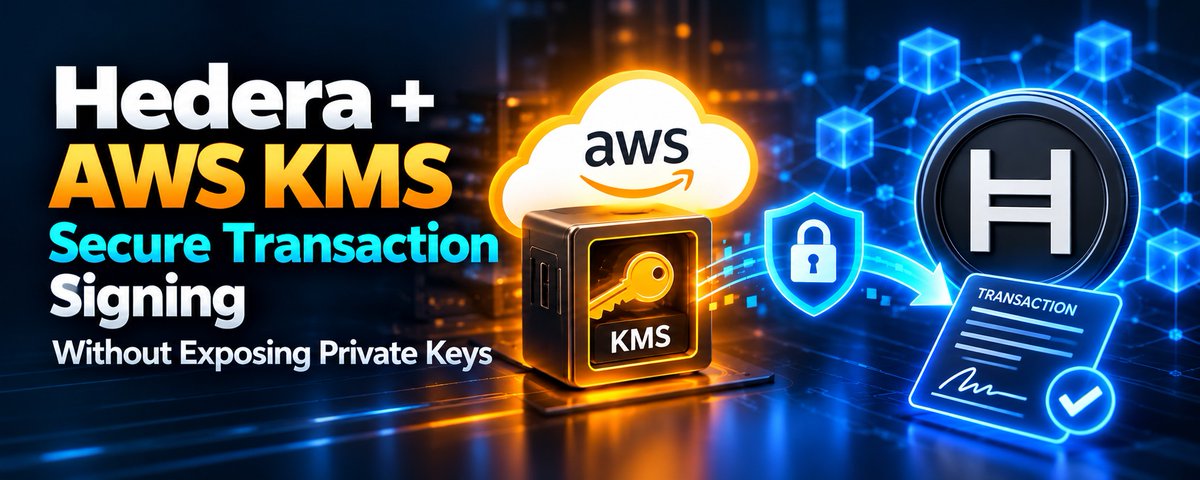
🔐 Hedera + AWS KMS: Secure Transaction Signing Without Exposing Private Keys
How can developers protect blockchain accounts without exposing private keys? 👀
A @hedera developer session demonstrated how to integrate @awscloud Key Management Service (KMS) to securely sign Hedera transactions.
🛡️ How it works:
🔑 Generate a cryptographic key in AWS KMS.
🔗 Configure the corresponding public key for a Hedera account.
⚡ Request transaction signatures from AWS KMS without exposing the private key to the application.
🌐 Submit signed transactions to the Hedera network for verification.
🏢 Why it matters:
✅ Reduces private key exposure risks
✅ Enables access control through AWS IAM
✅ Supports activity logging and auditing with AWS CloudTrail
✅ Helps developers build more secure enterprise blockchain applications
From financial services to dApps and automated systems, secure key management is essential for protecting digital assets.
🚀 Blockchain security isn't just about the network. It's also about protecting the keys that authorize every transaction.

Apollo retweeted
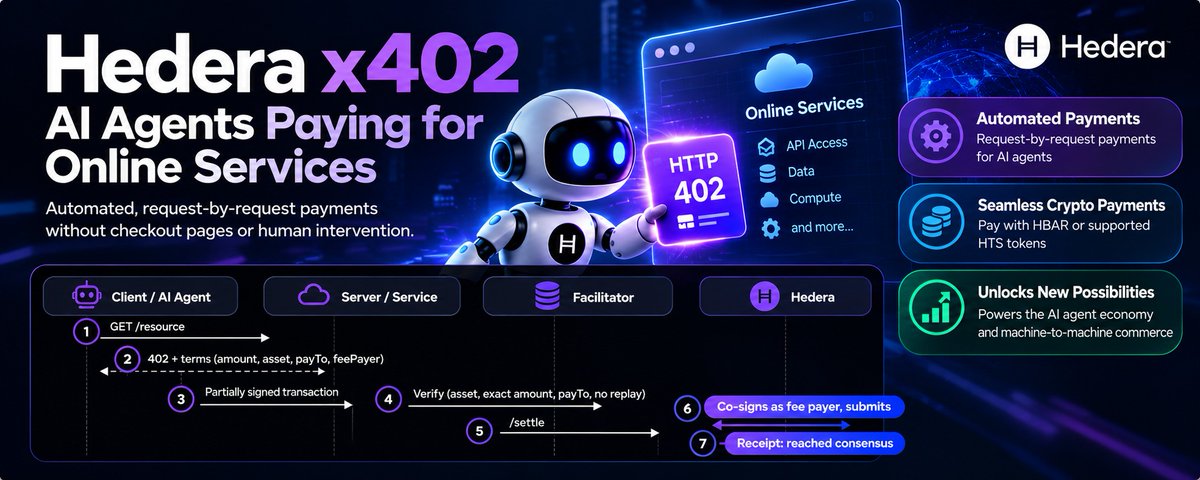
💳 Hedera x402: AI Agents Paying for Online Services
🤖 What if AI agents could pay for online services automatically, without checkout pages or human intervention?
That’s the promise of @PayAINetwork, an open payment standard built around HTTP 402 Payment Required.
⚡ How It Works on Hedera
• AI agents sign payments in hedera-hashgraph:native or supported HTS tokens.
• Facilitators verify and submit transactions while covering network fees.
• Service providers receive payments without managing blockchain infrastructure or holding HBAR for fees.
✅ Key Benefits
• Automated, request-by-request payments
• Seamless crypto payments for online services
• New possibilities for the AI agent economy
🚀 @hedera x402 could help AI agents autonomously access and pay for digital services, opening new possibilities for machine-to-machine commerce.


Apollo retweeted

I’m proud to share that @Hedera has joined @Aptos, @AvaLabs, @Cardano @Chainlink, and @StellarOrg on a joint call for the SEC to formalize its digital commodity framework.
Regulatory clarity = durability, and it helps the U.S. remain a leader in digital asset innovation.


Apollo retweeted
⚖️ Chainlink, Hedera, Aptos, Avalanche, Stellar and Cardano just announced a partnership urging the SEC to codify its digital commodity framework.
$LINK $HBAR $APT $AVAX $XLM $ADA

.@chainlink is proud to partner with @hedera, @Aptos, @AvaLabs, and @StellarOrg in urging the SEC to codify its digital commodity framework.
Builders need lasting certainty. Codifying this progress would be a meaningful step toward keeping America the home of digital asset innovation.
H/t @jackson_mueller for leading this effort 🫡


Apollo retweeted
All of the diagrams of the trials appear to be on Ethereum and Hedera.
Source:
gdf.io/wp-content/uploads/20…
Apollo retweeted

Technology can connect across borders but the rules often don’t.
At the @IMFNews & @WorldBankGroup Annual Meetings, @nilminirubin explains how walled gardens limit global economic activity and why policymakers should build rules that work with other countries. Via @ACGeoEcon
Apollo retweeted

lnkd.in/p/g6hAvZjH
Attending Money20/20 USA?
Tomorrow, don't miss #Hashgraph's Gregg Bell, Jason Emery at The Depository Trust & Clearing Corporation (#DTCC), Raquel L. at #Deloitte and Gabrielle Saulsbery at Banking Dive for a discussion on why hybrid DLT models


Apollo retweeted

Available on YouTube: youtu.be/dmJdgeeSMxs

RT @DanyBittel: A Gaussian splat of a saffron flower. You can see it's three threads which are hand picked for the spice. #3dgs https://t.c…
Apollo retweeted

🧵 Tomorrow, a new satellite is scheduled to launch aboard @SpaceX’s Falcon 9.
But the bigger story begins inside the chip.
@SEALSQcorp is collaborating with @hedera on post-quantum security.
@WISeSatSpace and FOSSA have already demonstrated satellite-enabled transactions settled on Hedera.
Let’s connect the dots. 👇
October 19, 2026.
FOSSA Systems plans to launch FOSSASAT-2E27, a new-generation 6U satellite, aboard SpaceX’s Bandwagon-5 mission.
Equipped with SEALSQ’s VaultIC secure element, it will test hardware-based cybersecurity under real space conditions.
This supports WISeSat and FOSSA’s broader QSOC roadmap:
Quantum Spatial Orbital Cloud.
A planned infrastructure combining:
• Post-quantum cryptography
• Hardware roots of trust
• Digital identities
• Secure satellite communications
• Hybrid constellations
The goal is trusted connectivity across satellites, ground stations, IoT devices and critical infrastructure.
SEALSQ’s roadmap includes security testing across up to six selected satellite missions.
Future tests may incorporate its QS7001 post-quantum secure element, subject to technical readiness.
And QS7001 has another interesting connection.
March 26, 2025.
SEALSQ announced its QS7001 Post-Quantum Secure Chip and explicitly confirmed collaboration with @hedera.
The objective?
Integrate QS7001 into Hedera’s ecosystem to strengthen transaction authentication and network security through post-quantum safeguards.
SEALSQ’s approach combines secure hardware, protected cryptographic keys and quantum-resistant algorithms.
However, a completed QS7001 deployment across Hedera’s core protocol has not been established.
Now move from chips to satellites.
In April 2025, @WISeKey announced a proof of concept involving WISeSat, FOSSA, SEALCOIN and Hedera.
An off-grid IoT device generated a signed transaction.
Satellite infrastructure relayed the data.
Another device retrieved it.
@Sealcoin_QAIT enabled the value exchange, with settlement on Hedera.
Satellite connectivity + digital identity + blockchain settlement.
WISeKey’s 2025 Annual Report further described satellite-based experiments exploring autonomous machine transactions.
The broader vision includes machines securely storing, delivering and monetizing data through trusted infrastructure.
And the partnerships continue evolving.
In September 2026, @WISeKey became a Hedera Council Strategic Partner.
Meanwhile, SEALCOIN continues developing its Hedera-based machine-to-machine transaction infrastructure.
Put the architecture together:
WISeSat / FOSSA → Satellite connectivity
SEALSQ → Secure chips and post-quantum technology
WISeKey → Digital identity and Root of Trust
SEALCOIN / QAIT → Machine-to-machine value exchange
(SEALCOIN is powered by Hedera)
Hedera → Distributed ledger and settlement
This represents the broader ecosystem, not confirmed Hedera or SEALCOIN deployment on tomorrow’s satellite.
So what comes next?
The October 19 mission aims to validate hardware security in orbit.
Future QSOC missions could introduce more advanced post-quantum capabilities.
And the question remains:
How far will satellite-enabled machine transactions progress toward operational deployment?
From protecting cryptographic keys inside chips to authenticating devices in orbit.
From transmitting data to enabling autonomous value exchange.
The infrastructure is taking shape across hardware, identity, satellites and distributed ledgers.
And @hedera already has a documented role in that broader machine economy.
🤖 Made with AI


The future of trusted space infrastructure starts with security built into the chip. 🛰️🔐 new FOSSASAR-2E27 WISeSat hardened and secure satellite to be launched October 19, 2026 by SpaceX
WISeSat.Space’s longstanding strategic partner, FOSSA Systems, is scheduled to launch FOSSASAT-2E27, a new-generation 6U satellite, aboard SpaceX’s Falcon 9 Bandwagon-5 mission from Cape Canaveral, Florida. Equipped with SEALSQ’s VaultIC secure-element technology, this spacecraft will create further opportunities to test hardware-based cybersecurity under real space operating conditions.
Our partnership began with @WISeKey investment in FOSSA in 2021 and was reinforced by WISeSat’s participation in its June 2026 financing round. The next phase targets more systematic technology validation across up to six selected satellite missions.
The roadmap includes extended testing of VaultIC and, subject to technical readiness and integration, future testing of @SEALSQcorp #QS7001 post-quantum secure element. Selected experiments are intended to include six months of in-orbit monitoring to inform future satellite security architectures.
“My vision is to build trust into space infrastructure from the semiconductor level throughout the satellite’s operational life. By combining SEALSQ’s security technologies with FOSSA’s satellite expertise and WISeSat’s infrastructure strategy, we are building the practical evidence needed to advance toward sovereign, quantum-resilient communications.”
Wishing the FOSSA, WISeSat, SEALSQ and SpaceX teams a successful mission.
🚀 Launch details — October 19, 2026:
spacex.com/launches/bandwago…
$SAIQ $LAES
#WISeSat #SEALSQ #FOSSASystems #PostQuantum #SpaceSecurity #DigitalSovereignty

Apollo retweeted
Many of the best known #Whisky releases never carry the distillery's own label.
Independent bottlers buy casks from distilleries, mature or select them, and bottle under their own name.
It is a big reason single casks from quieter distilleries ever reach a glass.