

Networks that Think.
Palo Alto, CA
Joined October 2025
- Tweets151
- Following181
- Followers283
- Likes121


Aria Networks, Inc. retweeted

SemiAnalysis's Dylan Patel warns networking incumbents could be disrupted because networks are only 15% to 20% of cluster cost but can determine far more performance
“People are not just doing fat-tree networks anymore. They’re doing a lot of other kinds of network designs. That means a lot of software for the workload to be aware of that network design, for that network to be managed and for that network to be controlled.
“Networks are ultimately the lifeblood, so how you control and optimize those is very, very important. There are numerous companies popping up to focus on that, whether it is data center to data center, within the data center, WANs or security for networks—all these different things.
“There are a lot of problems to tackle here because, while networks are only 15% to 20% of the cost of a cluster, they can have impacts on performance way larger than that. Then there is security.
“All these things, I think, are very important. I think there are a lot of advancements to come, and the incumbents better move faster, or else they will be disrupted.”

SemiAnalysis's Dylan Patel: enterprises have a "broken philosophy" because they'll spend six months to a year building custom AI systems that are already worse than foundation models by the time they finish
“I think a lot of people’s philosophy, especially a lot of enterprises’, is just broken. They think, ‘Okay, where AI is today is where it is going to pause, and then we’re going to be able to build our own internal capabilities that are way better.’ That often ends up not being the case.
“They decide to fine-tune a model or whatever, and then they end up creating a model that's worse than just the foundation model by the time they’re done.
“Across the stack, you have to measure your performance, your TCO, your cost and everything across every aspect of the supply chain, whether it be your infrastructure, your serving or your inference, but also evaluating your models.
“Evals for models are the Wild West. People don’t know how to measure models appropriately. They don’t know how to think about model progress appropriately. That's leading them to make bad engineering decisions which then end up being wasted six months or a year down the road, when the foundation model is so much better.”
Aria Networks, Inc. retweeted

Four of our engineers volunteered to make our point at @aiandsystems AI Infra Summit.
Two as the legacy network, two as @AriaNetworks. Guess which is which :D
“Your network is not broken. It just can't see clearly.”
You can tell a lot about a company by witnessing its culture.
Aria Networks, Inc. retweeted

Gavin, spot on.
AI is bringing manufacturing back to America and reindustrializing the nation after decades of offshoring.
AI is creating demand that drives investment in our aging power grid and sustainable energy, powered by market forces, not subsidies.
AI is creating construction and manufacturing jobs across energy plants, chip fabs and data centers.
AI is creating new companies and industries. $400 billion has been invested in AI startups in the past six months alone.
Builders must partner with communities to build in their hometowns, earn trust and create local benefits.
We have an opportunity to create lasting benefits for communities across America and help America lead the next industrial revolution.

Regret the tone of my post on data centers yesterday.
What I should have said:
There were reasonable concerns about data centers 18ish months ago: water, taxes, jobs, electricity prices, the environment and what they would do to small towns. Well-structured data center projects have largely addressed these concerns today and we should be celebrating this.
On balance, data centers are awesome for America in every way.
On water: U.S. data centers use a fraction of what golf courses use. A lot of the numbers from 18 months ago were off by over 1000x. Newer data centers use closed-loop systems or recycled water. Should be required by every town approving a data center project.
On taxes: looking only at sales-tax exemptions, as Ronan Farrow did, is the wrong way to evaluate this. Data centers pay significant property taxes. Loudoun County, which is the wealthiest county in America, now collects on the order of $1 billion a year from data centers. In Quincy, WA, data centers are more than half the property-tax roll. Over time, property taxes can go to zero while government spending increases in these towns.
On jobs: this has been unambiguously awesome for blue collar Americans. Demand for electricians, plumbers, welders, HVAC techs, and contractors has gone vertical, and it is not a one-time construction job. These buildings get upgraded and expanded over time. That is why the building trades are fighting for them, and why some unions are now treating opposition to data centers as a reason not to endorse politicians.
On power: the original fear was that households would pay for the incremental electricity demand in the form of higher prices. That is why the ratepayer-protection deals and the new large-load tariffs exist. The right structure is: the data center brings or pays for new generation and signs a contract long enough that existing customers are protected. Where that is happening, utilities are cutting or freezing residential rates and saying so on the record. Where it is not, people are right to object. Electricity prices are going down *today* in a number of large states because of data centers.
On the environment: data centers overwhelming use natural gas today, which is the cleanest power source outside of nuclear, solar and wind. And the companies that are building the data centers are committed to carbon neutrality such that an equivalent amount of solar will likely be built. Maybe more importantly, the data centers need batteries to function effectively and these batteries can also sell energy back into the grid (which recently prevented blackouts in Texas). Over time, data centers will run on solar plus batteries.
On the towns: Poverty in Quincy, WA fell from 29% to 6%. Data center taxes paid for a new high school, a hospital, a library, police and fire stations. This is happening in many left for dead former mill and farm towns that had no other bidder for the land.
Data centers are actually reindustrializing parts of America and creating the kind of working-class jobs both parties have spent decades claiming to support. That should not be a partisan issue. Data centers can and should be awesome for America and they increasingly, overwhelmingly are. Supporting the outsourcing of data centers to China will likely age just as well as support for the outsourcing of high quality, blue collar manufacturing jobs to China has aged.
When the facts change, I change my mind. I hope that reasonable people who had good faith reasons to oppose data centers at least consider updating their beliefs given the change in the facts over the last 18 months. This really matters for America.
I will say I also think the idea of making data centers beautiful is a good one that has yet to be implemented. Data centers should be just as beautiful as Grand Central Station. We can learn a lot from the railroad buildout. Neoclassical revival ftw.
Might write up open-weight AI tomorrow as this is equally essential to America.
Aria Networks, Inc. retweeted

🚨 New Full Tech Ahead episode!
I sat down with @djspry of @AriaNetworks to discuss why AI networking is becoming the hidden key to enterprise AI success—from infrastructure bottlenecks to AI agents and the future of performance.
Thanks to Aria Networks for sponsoring this episode!
🎧 Watch here: youtu.be/XSUboHQFteI
#AI #EnterpriseAI #Networking #TechPodcast #FullTechAhead

Aria Networks, Inc. retweeted
At the @AriaNetworks launch, @GavinSBaker and I discussed AI economics. His point remains central: the lowest-cost producer of intelligence will win.
As AI factories specialize, the network must adapt - and the right network is critical to utilization, latency and cost per token.

Gavin Baker: "the cheapest producer of intelligence will win the AI race
if Anthropic's neocloud and cloud providers were using Arya, maybe they wouldn't have $30 billion in revenue - they'd be at $60 billion"
this is him naming the companies he just bought and giving investing advice
His words:
"I'm a Crusoe, CoreWeave and Nebius shareholder - I love you all"
"Apple isn't worth three trillion because they make the cheapest smartphones. Nvidia isn't worth five trillion because they make the cheapest chips - they're just the best - AI is fundamentally different"
"why was I one of the earliest investors in Tesla and Nvidia?
Musk - said "that's crazy" and put the battery at the bottom of the car
Huang - gaming chips and AI chips needed the same math - he bet everything on it"
"every 100 millisecond delay in Google search results cost them 1% of revenue"
"fortune favors the bold. Be bold"
bookmark & watch today ↓
Aria Networks, Inc. retweeted

couldn't agree more w/@GavinSBaker: the cheapest producer of intelligence will win the ai race
intelligence efficiency + ipw matter. @JonSaadFalcon and I have been studying this for a minute. link to research in comments below!
Gavin Baker: "the cheapest producer of intelligence will win the AI race
if Anthropic's neocloud and cloud providers were using Arya, maybe they wouldn't have $30 billion in revenue - they'd be at $60 billion"
this is him naming the companies he just bought and giving investing advice
His words:
"I'm a Crusoe, CoreWeave and Nebius shareholder - I love you all"
"Apple isn't worth three trillion because they make the cheapest smartphones. Nvidia isn't worth five trillion because they make the cheapest chips - they're just the best - AI is fundamentally different"
"why was I one of the earliest investors in Tesla and Nvidia?
Musk - said "that's crazy" and put the battery at the bottom of the car
Huang - gaming chips and AI chips needed the same math - he bet everything on it"
"every 100 millisecond delay in Google search results cost them 1% of revenue"
"fortune favors the bold. Be bold"
bookmark & watch today ↓
Aria Networks, Inc. retweeted
Thoughtful @firesidealpha recap of my RAISE talk with @dylan522p.
AI clusters specialize: training ≠ inference; high-interactivity ≠ high-throughput.
Topologies vary; software must dynamically optimize the network by workload - the idea behind Deep Networking at @AriaNetworks.


Aria Networks, Inc. retweeted
AI infra drives AI economics. Thanks @NasdaqExchange.
Managed inference providers win by choosing the metrics that matter, then out-innovating everyone at optimizing them. Copy the vanilla playbook, get commodity margins.
More with @dylan522p at @RaiseSummit next week.

.@AriaNetworks Founder & CEO @mansourkaram joins @Nasdaq to discuss AI-powered network operations, intelligent automation, and the evolving infrastructure powering tomorrow’s enterprises.
Aria Networks, Inc. retweeted
Inference performance is decided across the cluster, not just the chip.
Excited to join @dylan522p at @RaiseSummit on July 9 to unpack the full inference stack, and why the network is essential to scaling AI efficiently. This is exactly the problem @AriaNetworks is focused on.

Everyone benchmarks the chip. Far fewer measure the thing that actually decides inference performance: the network connecting them.
Inside a modern AI inference cluster, per-chip specs only tell you part of the story. Real efficiency is won or lost across the fabric that links prefill to decode, connecting storage to compute, and coordinating thousands of accelerators. It's the layer most benchmarks miss, and the layer where real-world performance is increasingly decided.
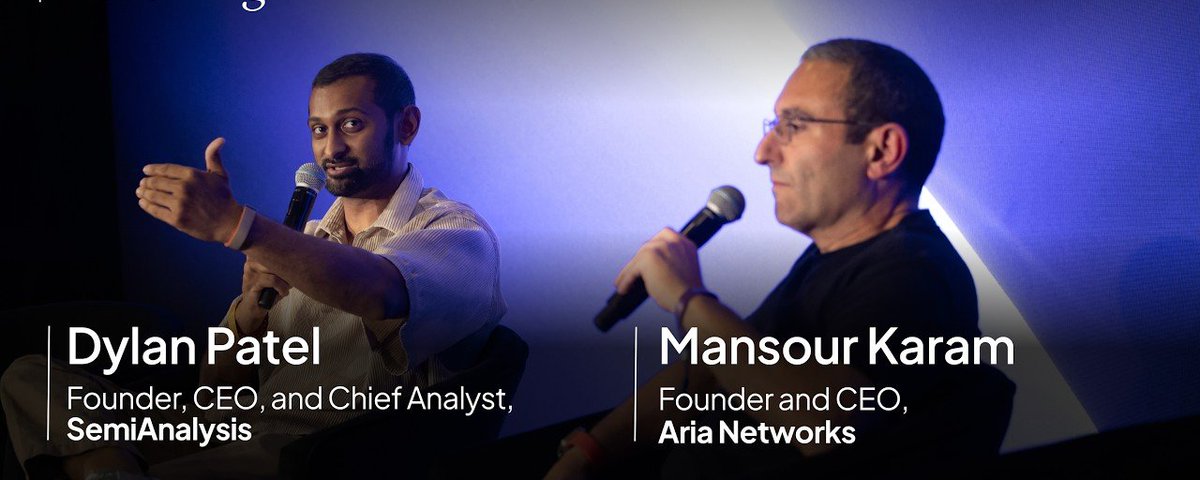
This July 9, @MansourKaram, Founder & CEO at @AriaNetworks, joins Dylan Patel (@dylan522p), Founder, CEO & Chief Analyst at @SemiAnalysis_, to walk through the entire inference stack and pinpoint where efficiency is won or lost. Using SemiAnalysis's InferenceX framework as a lens, they'll map the real tradeoffs among throughput, interactivity, latency, power, and cost per token.
What does it take to understand performance inside a modern AI inference cluster?
Join Mansour and Dylan this July 9 on the Ada Lovelace Stage at 3:20 PM to hear where they land.
Limited tickets to RAISE Summit remain.
🔗 Secure your ticket: hubs.li/Q04lBDKp0

Aria Networks, Inc. retweeted
@matanSF is exactly right here:
The job of an FDE is not to monetize gaps in the product. It’s to expose them, close them, and help customers get to value faster.
If FDEs are measured like a services P&L, complexity becomes revenue. If they’re embedded with product, complexity becomes product roadmap: capabilities to add, bugs to fix, friction to remove.
That’s why at @AriaNetworks, we have FDEs — not a separate professional services motion.

"Everyone gets FDEs wrong.
The job of an FDE isn't to make the product work, it's to accelerate customer adoption and time-to-value.
If you need FDEs just to deliver the product, you're not running a software company, you're running a services business with a bad product." @matanSF
Do you agree and what do people misunderstand most about what it takes to do FDE motion well? @ssankar @chadwahl @nikogrupen @barrald @lkothari @LeoMehr @zkevinbai
Aria Networks, Inc. retweeted
Thanks for the shout-out, @GavinSBaker on @theallinpod Liquidity.
The network is the bottleneck for AI cluster performance. It's the whole reason we built @AriaNetworks #DeepNetworking: telemetry-first, more usable tokens per GPU.
GA and shipping now. If you're building or running AI clusters at scale, come talk to us.

LIQUIDITY: Inside the Private Stock Market Boom
Brad Gerstner (@altcap), Gavin Baker (@GavinSBaker), and Kelly Rodriques (@Forge_Global) join @Jason and @chamath to discuss the secondary market gold rush.
(0:00) Brad Gerstner, Gavin Baker, and Kelly Rodriques join the Besties!
(0:47) Secondary Markets are Booming & Competing with IPOs
(3:10) Why Companies are Staying Private So Long?
(9:22) SPVs, the Forge-Schwab Deal, Democratizing Private Market Access
(13:28) Secondary Markets as Exit Liquidity
(27:00) The Private Market Bubble?
(32:03) Hottest Secondary Companies Right Now
Thanks to our partners for making this possible!
EY (@EYnews) - Agentic AI is introducing a new investment discipline. As AI shifts to consumption-based models, EY connects spend to enterprise value.
ey.com/en_us/insights/ai/age…
NYSE (@NYSE) - Thank you to our partner, the New York Stock Exchange - a modern marketplace and exchange for building the future. It all happens at the NYSE.
nyse.com
Plaud (@PLAUDAI) - Never miss a moment. Plaud, our official wearable AI note-taking partner at All-In Liquidity Summit, captured every insight.
plaud.ai
Aria Networks, Inc. retweeted
@GavinSBaker’s prefill/decode point is the unlock: managed inference is moving beyond monolithic GPU clusters. The network connects prefill to decode, storage to accelerators, and server to server. It’s not plumbing. It’s where token economics get optimized.
That’s @AriaNetworks Deep Networking.

This is my sixth conversation with @GavinSBaker.
As always with Gavin, the conversation covers a lot of ground, but we spend the most time on watts and wafers.
We discuss:
- Why the wafer shortage may prevent an AI bubble
- Data centers in space (reframed)
- Elon's Terafab and the new chip companies challenging Nvidia
- Usage-based pricing
- The disaggregation of GPUs
- DRAM, frontier tokens, and open source
Enjoy!
Timestamps:
0:00 Intro
7:55 Anthropic and OpenAI Valuations
12:58 Watts, Wafers, and Infrastructure
14:39 Orbital Compute and Data Centers in Space
22:49 Avoiding the AI Bubble
28:26 Terafab and the Future of US Manufacturing
32:16 Returns to the Frontier
37:23 Continual Learning
42:03 New Chip Companies
48:52 Extending GPU Lifespans and Private Credit
51:22 The Application Layer
57:32 The Token Path and Open-Source Dynamics
1:01:37 Cybersecurity
1:05:46 Diversity Breakdown
1:11:59 Assessing the Big Tech Players in AI
1:19:02 Geopolitics, Personal Safety, and the AI Horizon
Aria Networks, Inc. retweeted
In many cases, clusters will still be GPU-heavy. But the trend is clear: prefill, decode, storage, and serving paths are becoming more specialized.
That means the network has to be accelerator-agnostic, use case aware, and optimized for token output.
Aria Networks, Inc. retweeted
Pure play is critical to managed inference.
The fabric has to span front-end + back-end networks across heterogeneous accelerators, without assuming a single-vendor architecture.
That’s what we’re building at @AriaNetworks.
Aria Networks, Inc. retweeted

Exactly right!
Lots of problems to be solved here.
On the networking side, this is exactly why we started @AriaNetworks - improve utilization, uptime and network support for multitenancy.

Aria Networks, Inc. retweeted

How do you maximize AI cluster utilization? Mansour Karam of Aria Networks demonstrates specialized AI that extracts signals from telemetry at scale for dynamic optimization across all layers #EnterpriseAI #TechLeadership ngi.fyi/dcnet26-aria-mansour

Aria Networks, Inc. retweeted
In February, we did white-glove installs of our first 1.6Tb/s TH6 samples.
This week, we received our first TH6 Purchase Order.
Samples → Commercial Order → Revenue. The Aria #DeepNetworking journey is accelerating. 🚀
@AriaNetworks @Broadcom
Aria Networks, Inc. retweeted
This is what we see every day at @AriaNetworks, and the problem #DeepNetworking was built to solve.
The AI infrastructure conversation is focused on xPUs and power. But the network governs how quickly gradients synchronize, how efficiently KV caches transfer, how seamlessly jobs schedule across thousands of xPUs. When it underperforms, it drags down every other component in the stack.
As @DellOroGroup put it: "The network is no longer just plumbing — it's a first-order limiter of AI performance." Exactly right.
You can't solve a network problem by buying more xPUs.

🚨 The Breaking Points: Networking Strains Under AI’s Scale Demands
In the first of a three-part series, we explore how AI infrastructure struggles to scale, focusing on the networking challenges reshaping enterprise systems.
datacenterknowledge.com/netw…
