AutoTrust (@AutoTrustAI) header
AutoTrust (@AutoTrustAI) profile picture

Frontier AI research lab. We build AI scientists & the platforms they run on — compressing the full research lifecycle from idea to impact.

Joined January 2025
Photo by AutoTrust (@AutoTrustAI)Photo by AutoTrust (@AutoTrustAI)Photo by AutoTrust (@AutoTrustAI)Photo by AutoTrust (@AutoTrustAI)Photo by AutoTrust (@AutoTrustAI)Photo by AutoTrust (@AutoTrustAI)Photo by AutoTrust (@AutoTrustAI)Photo by AutoTrust (@AutoTrustAI)Photo by AutoTrust (@AutoTrustAI)Photo by AutoTrust (@AutoTrustAI)
Qwen3.8-Flash-Next-E384-FP4-V2 is built for work that needs more than a good chat response. Imagine an engineering agent handling a real bug ticket: it reads the task, reasons through the likely failure path, calls approved search or test tools, drafts an implementation plan, and returns structured findings for a developer to review. Or use it for math-heavy coding work: work through an algorithmic problem, produce an implementation, and hand the result back to your existing evaluation or test loop. This is a full merged FP4 checkpoint after three GRPO-style post-training updates with verifiable rewards. It is a complete model release — not a LoRA adapter — with all weights, tokenizer, configs, and MTP files included. Reported results under the documented evaluation setup: • AIME 2026: 95.0 • HumanEval: 98.78 • MMLU: 87.37 • C-Eval: 89.97 • Tool calling: 77.88 For teams building coding agents, reasoning workflows, and tool-using systems, V2 provides a ready-to-serve FP4 checkpoint rather than another adapter to integrate. Validated with vLLM 0.31 on a single B200. The documented serving path includes FP8 KV cache, prefix caching, reasoning parsing, and Qwen XML tool calling. Download it, run it on a task your team already knows well, and compare the result in your own harness: huggingface.co/autotrust/Qwe…
2
3
11
326
A practical first test: Give the model one real task from your workflow — for example, a bug report with a codebase search tool and a test runner attached. Ask it to: 1. identify the likely issue, 2. decide which approved tools to call, 3. explain the proposed fix, 4. return structured findings for human review. That is more useful than testing whether a model can produce a polished paragraph in isolation. Qwen3.8-Flash-Next-E384-FP4-V2 includes a documented vLLM path with Qwen XML tool calling and auto tool choice, so developers can start from a working serving configuration. modelscope.ai/models/AutoTru…
3
74
Qwen3.8-27B-NVFP4-DGX-SPARK-V2 is here. Most Local AI releases stop at quantization. V2 goes further into the inference loop. It packages the complete Qwen3.8-27B NVFP4 checkpoint with AutoTrust AI’s 64k MTP runtime recipe for vLLM. The plugin reduces the draft vocabulary from 248,320 to 64,026 rows and quantizes the draft path, while leaving the target model and verification lm_head untouched. That means less draft-step memory traffic and more practical speculative decoding for local coding, reasoning, tool-driven workflows, and private internal APIs. Built for Blackwell hardware, including DGX Spark / GB10 and B200. Download it, install the included plugin, and serve it through an OpenAI-compatible vLLM endpoint. huggingface.co/autotrust/Qwe…
1
3
4
146
Why does 64k MTP matter for Local AI? On bandwidth-bound hardware, the draft path can become the bottleneck. Our underlying 64k MTP recipe cuts draft-step bytes read from about 3.4 GB to about 0.42 GB. On a DGX Spark, it raised measured single-stream decoding from 12.5 to 48.2 tok/s at temperature 0. V2 packages this approach with the model and deployment plugin, so developers can reproduce the local serving stack directly. modelscope.cn/models/autotru…
3
29
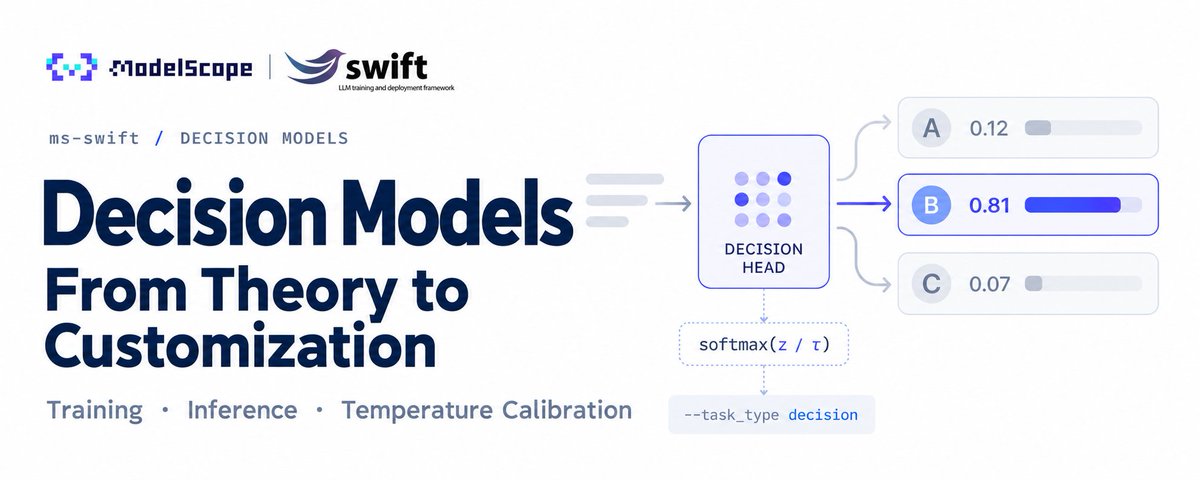
Glad to see @ModelScope2022 bring decision-model training and inference into ms-swift. AutoTrust AI’s JEV-27B-VL is now included in the framework’s decision workflow via `--task_type decision`, with dedicated loss support, built-in Open-Jev data, and automatic two-level temperature calibration. This gives developers a more practical route to fine-tune and run calibrated multimodal decisions—where agents need to choose, score, route, or escalate with probabilities they can use. Explore ms-swift: github.com/modelscope/ms-swi…
Train your decision-model using ms-swift: with model-specific losses, automatic two-level temperature calibration and built-in Open-Jev data. Also capable of converting causal language models into decision models, with generic_decision option.
3
3
6
235
A quick start with ScienceGuru. Start a chat. Keep your research, code, and data together in one project folder. Customize settings when you need to. Define the goal, materials, and output before work begins. Speak your task, review it, then send. When it is time to move on, copy a working directory, conversation deeplink, or Markdown and pick up where you left off. One desktop research workspace for organizing work, defining outcomes, and delivering results. Download #ScienceGuru: scienceguru.ai
3
4
84
New from AutoTrust AI: Qwen3.8-Flash-Next-E384-FP4-Local. A compact AutoTrust build of NVIDIA’s Qwen3.8 Flash Next FP4 Local checkpoint, designed for practical local deployment. Our NAS recipe keeps 384 of 512 routed experts in every decoder and MTP layer, while preserving top-10 routing, shared experts, attention, vision tower, and tokenizer. Result: 79.78 GiB of weights instead of 95.12 GiB — 16.1% smaller. In our same-harness tests, code, tool use, math, and vision stay close to the original checkpoint. The tradeoff is lower performance on knowledge-heavy multiple-choice tasks, so use the full 512-expert model when that is the priority. We also include a lossless MTP speculative-decoding recipe for vLLM 0.31: 308.9 tok/s and 3.34× the no-MTP speed on one B200 at greedy decoding. Explore the model, benchmarks, files, and vLLM setup: huggingface.co/autotrust/Qwe…
1
3
12
1,205
This is where the smaller footprint becomes practical: run a local agent that can read a private codebase, inspect a UI screenshot, choose approved tools, test a fix, and help move a technical workflow forward without shipping sensitive project context to an external API. That is a strong fit for E384’s code, tool-use, math, and vision profile. Hugging Face: huggingface.co/autotrust/Qwe… ModelScope: modelscope.ai/models/AutoTru…
2
71
After Black October, Bring the AI Home. A month of critical vulnerabilities, AI-agent campaigns, and ultra-low-cost attacks changed the security calculus. The answer is not to stop using AI. It is to stop sending your most sensitive data across the internet to rent it. For source code, regulated records, deal information, and other high-value workflows, ask one question: Does the data go to the model — or does the model come to the data? With DGX Spark–class hardware and compressed open models, local AI is now practical. Keep the data, model weights, and agents inside one perimeter. Read the full argument: autotrust.ai/blog/after-blac…
1
3
3
238
The security question around AI is no longer only “which model is best?” It is also “where does the model run, and where does the data go?” For sensitive workflows — source code, research data, regulated records, deal information, or internal knowledge — cloud AI often adds external systems, transit paths, and supply-chain dependencies to the attack surface. Local AI offers a different architecture: bring the model to the data, keep the workflow inside your own perimeter, and make air-gapped or tightly controlled deployment possible. With new desk-side AI hardware and efficient compressed open models, that option is no longer reserved for large datacenters.
52
AutoTrust Decision Models — one collection, from fast local decisions to multimodal agent control. Every model returns calibrated probabilities for the answer options that matter: route or escalate, pick the next tool, score risk, verify a claim, or decide what action an agent should take next. Start with the classics: JEV-9B — compact typed decisions with System 2 reasoning JEV-27B & JEV-27B v1.1 — our open text decision models JEV-27B-VL — multimodal decisions across text and images GEV-26B-Decide — a high-performing general decision model JEV-35B — larger-scale decision capability NVFP4 releases — lower-memory deployment options for practical inference The collection also includes live demos for Mario, Rubik’s Cube, Tetris, and typed decisions, plus the public Decision Index result set. Together, the models in this collection have now recorded more than 5.4M downloads. Explore the full AutoTrust Decision Models collection: huggingface.co/collections/a…
1
5
10
388
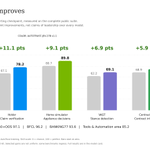
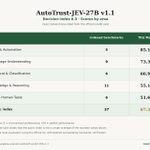
Top 3 in both Vision and Text categories. Ahead of TypeSafe JEV in Text. JEV-27B-VL reached No. 1 on Hugging Face Global Trending. Now AutoTrust-JEV-27B v1.1 is Top 3 on both Jev Decision Index boards. Text: tied for #3 with a 68.0 Full Score. That puts our open 27B model ahead of TypeSafe’s hosted Jev 1.13 — and ahead of Liquid AI’s d1-3B — on the same public Decision Index. Vision: #3 with a 71.9 Full Score, including 74.4 on the public set and 69.3 on the private set. It ranks ahead of Perplexity Decider v1.2, vLLM-SR d3, and Cloudflare’s clef-omni. This is not a one-model spike. It is a model family built for the decision layer of agents: structured probabilities for routing, tool selection, claim checks, next-action choice, and escalation to deeper reasoning when confidence is not enough. AutoTrust is establishing itself as a clear leader in open decision models. Open weights. Apache-2.0. Built for local deployment. Explore the Jev Decision Index: huggingface.co/spaces/multim… Download AutoTrust-JEV-27B v1.1: huggingface.co/autotrust/Aut…
6
4
20
602
The AutoTrust decision-model line has grown from compact text decisions to multimodal, production-ready agent infrastructure. JEV-9B for typed decisions. AutoTrust-JEV-27B v1.1 for Text Top 3 performance. JEV-27B-VL for Vision Top 3 performance. Explore the full collection: huggingface.co/autotrust/mod…
3
69
Want to see what open decision models can actually do? AutoTrust Spaces is our hands-on demo hub: play Mario, Rubik’s Cube, and Tetris with JEV-27B; test typed decisions with JEV-9B; and explore live News and Shorts demos. Try the demos: huggingface.co/autotrust/spa…
1
3
5
116
Not every model needs to write essays. Some just need to make clean decisions. A Open jev model classifies with precision. AutoTrust-JEV-27B-v1.1 turns messy text into clean, structured labels intent, moderation, routing, compliance. - repeatable structured outputs at scale. - huggingface.co/autotrust/Aut…
1
3
2,165
Thank you, @HuggingModels. AutoTrust-JEV-27B-v1.1 has now passed 16K downloads on Hugging Face. It is an open 27B decision model for the high-frequency calls inside agent systems: route a request, select a tool, detect an out-of-scope intent, verify a claim, or choose the next action from a fixed set of options. Instead of producing another paragraph, it returns a probability for every available option — making decisions measurable, routable, and easier to audit. Apache-2.0. Run it locally with vLLM: 📷huggingface.co/autotrust/Aut…
Meet AutoTrust-JEV-27B-v1.1: a 27B text-classification model built for structured decisions. With 5.6k downloads and 166 likes, it's quietly becoming a go-to for teams that need reliable, repeatable classification at scale.
2
3
15
468
What does “structured decisions” mean in practice? Give JEV-27B v1.1 a text state, a question, and a fixed set of options. Instead of generating a long response, it returns a probability for each option. That makes it useful as a fast decision layer for support-ticket routing, intent detection, API and tool selection, claim checks, banking-intent triage, and human-review gates. The current release supports text-only yes/no and multiple-choice tasks, with local vLLM deployment. It is a decision component rather than a free-form chat model, so teams should validate it on representative data before production use. Full model card, usage instructions, and evaluation details: huggingface.co/autotrust/Aut…
3
70