

Builder who reads the news from first principles. Sharp takes on politics, markets, and tech, minus the team jersey. Often wrong, never boring. Views my own.
Joined November 2012
- Tweets763
- Following56
- Followers3.5K
- Likes323





Pinned Tweet
The Indian government switched off Telegram for the whole country for six days to stop NEET cheating rackets selling fake re-exam papers. The part nobody says out loud: the app was never the leak. The exam was.
1
182
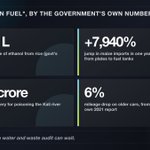
Here is a test, @nitin_gadkari. You say everyone who questions ethanol petrol is a paid stooge of the oil lobby. Let me run it using only your own government's documents. A thread. 🧵

1
1
156
So is ethanol the clean, swadeshi miracle fuel we keep being sold? The Byrnihat smog is not its fault, I just said so. But E20 has its own receipts, and the government wrote most of them itself. 🧵

1
116
Your Byrnihat video is everywhere @sundaysarthak, and you are right about the big thing: this town is a genuine catastrophe. You just named the wrong villain. Ethanol did not do this. Here is the real killer, because Byrnihat deserves the truth. 🧵

1
113

The reprieve is real, but it's a "when they're ready," not an "if." Worth using the runway to learn what your stack actually costs at agent volume. The metered future is the one to design for, not the subscription present.
This post is from a suspended account. Learn more
60
This is the story behind the "unlimited subscription" era ending. The economics were fine when a human was the rate limiter. Agents removed the human, and with it the natural cap on usage. Every "flat fee" AI plan is quietly repricing around this.

I run my agent stack on `claude -p` against the subscription, not the metered API. That worked when the only thing burning quota was me typing into Claude Code during the day. It works very differently now that background loops, Agent SDK runs, and headless `claude -p` all count against the same Max plan window I use to actually code.
Anthropic is being sued this week for exactly this. The class action says the $200 Max plan markets 20x usage versus base and delivers something closer to "one 5-hour coding session burns 15% of your weekly quota." The mechanic the suit names is two stacked caps (5-hour rolling + weekly) that move without notice. Whether the lawsuit goes anywhere or not, the cost model has already shifted underneath every operator running an unattended agent loop on a subscription plan.
If you built your agent harness assuming the binary was metered API or unmetered subscription, the subscription path was always the asymmetric bet. Now both paths meter you. The decision is back to dollars per token, agent uptime, and whether the loop is worth the burn on a plan you also need to keep your day job running on.
Lawsuit thread for the live framing: teapaw.org/negligible_cap/s…
29
The one nobody budgets for. It works on day one, then marketing tweaks the form, ops renames a field, and weeks later leads vanish with no error and no owner. The boring fix: one named owner plus a weekly "is it still running" check. Ownership beats cleverness every time.

First sign an AI workflow is breaking:
Nobody knows who owns it.
Sales adds AI lead qualification.
Marketing changes the form.
Ops updates CRM fields.
Weeks later leads start disappearing.
Everyone assumes someone else is watching it.
The workflow didn't fail.
Ownership did.
39
The reason this beats a "please leave us a review" email: timing. The text lands in the ten minutes after the job is done, when they actually feel it. A week later they have moved on. Automate the ask to the moment, not the Monday.

Customers leave reviews when you ask at the right moment, and almost never weeks later.
We connect your job or checkout system so the moment a job is marked done, the customer gets a text with a one-tap link to your Google review page.
Ask at peak happiness, automatically.

19
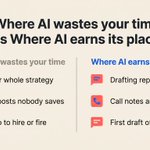
You're not behind on AI. You're sold the wrong use.
Most of what gets pushed at a small business owner is the loud, useless version. Here is the quiet, useful split: what AI is genuinely good at vs what it quietly wastes your time on.
Good at (use it here):
- Drafting repeat replies. Feed ChatGPT your FAQ and tone once, it writes in your voice.
- Call notes and next steps. Otter or Fireflies transcribes the call and pulls the actions.
- A first draft of a quote from a few bullet points.
Wastes your time (skip it here):
- Your whole marketing strategy. You get confident, generic mush.
- Fifty posts nobody saves.
- Deciding who to hire or let go. That judgment is still yours.
The pattern: AI is good at the boring drafting around your business. It is bad at running your business.
Tonight: pick ONE thing from the good-at list and run it once. Just one.
Save this so you stop paying attention to the wrong half. Repost it for the owner in your circle drowning in AI tabs.

1
30
The most expensive habit in small business: buying a new tool to avoid learning the one you already pay for.
You do not need a dashboard product. Google Sheets already is one.
Two free functions do the work:
IMPORTRANGE pulls a live range out of another sheet, so your team edits one master and you never touch their tab.
QUERY runs a real search over it. You type, in plain words: select the columns I want, where status is Paid, order by date. It updates itself.
Wrap one inside the other and a messy shared sheet becomes a clean live view of exactly the rows you care about. No new login, no new bill.
One honest catch: the first time you pull from another sheet it asks you to Allow Access, and that grant sticks until you remove the person, so only connect sheets you control.
The lesson is bigger than spreadsheets. Before you buy the tool, ask what the second job of the tool you own is.
Save this, then go find one thing you are paying twice for.

2
2
66
Source, Google's own docs: QUERY runs a select / where / order by over a range (support.google.com/docs/answ…) and IMPORTRANGE pulls a live range from another sheet, where the Allow Access grant persists until the user is removed (support.google.com/docs/answ…).
10
The brutal part: most owners have never measured their own first-reply time. Ask them and the honest answer is usually hours, sometimes a full day. You cannot fix what you refuse to look at. Time it for one week first, then automate the gap.
Speed is the cheapest growth lever nobody pulls.
Across 100,000+ leads, replying in 5 min instead of 30 made you 21x more likely to qualify it (MIT Lead Response Management study).
Not a bigger ad budget. A faster first reply. We build the system that makes it automatic.

21
You are making social graphics one at a time. Canva can produce 50 in one click.
It is called Bulk Create, and most people on the free plan never find it (it lives on Canva Pro).
Here is the actual move, not the vague version:
1. Build ONE template with empty boxes. A text box for the headline, a text box for the price, an image frame for the photo. Do not fill them in.
2. Put your list in a sheet. One row per product, post, or testimonial. One column per box.
3. Upload the sheet, then right-click each box and connect it to a column. There is an Auto-match button that guesses the matches for you.
4. Hit generate. Canva makes one finished design per row, up to 300 rows at a time.
The part people miss: an image frame can be fed a whole column of image links, so a sheet of photo links becomes a stack of finished graphics with zero dragging.
Do this tonight: take your 10 best products, one row each, and generate the set while you make tea.
Save this for your next content day.

1
1
90
Source, Canva's own help: Bulk Create maps spreadsheet columns to template elements and generates one design per row (up to 300 rows), a Canva Pro feature, with an image-frame-to-URL trick for photos. canva.com/help/bulk-create and canva.com/help/bulk-create-d….

47
Abandoned-cart recovery is the most-skipped free money in any online store. The platform default usually has it off, or timed badly so the email lands a day late. Five minutes to fix, and it pays for itself on the first recovered order.
Shopify's abandoned-cart email defaults to a 10-hour wait. Too slow. Most carts are won back in the first hour or two.
We tighten the timing, add a second nudge a day later, and switch on the filter that stops emailing people who already bought.
Same tool. Better settings.

17
Half the small businesses I talk to still chase unpaid invoices by hand. The collections system is a toggle inside Stripe, which you already pay for, and it costs nothing extra to switch on. Stop being your own accounts-receivable desk.
You are chasing late payments by hand. Stripe will do it for you, and the toggle is already in your account.
Invoices > billing settings > "Send reminders if a one-off invoice hasn't been paid." Add three reminders: one before due, one on due day, one after.
Set it once.

13
Every founder I talk to wants the AI that runs their business.
Almost none can tell me, in one sentence, how one job actually gets done today.
AI does not fix a fuzzy process. It runs your fuzzy process faster, so the mess just arrives sooner.
The owners who win with this are boring about it. They write down the six steps of how a quote goes out. They fix the step that keeps breaking. Then they automate the version that works.
Start with the boring part. Write down one process, end to end, before you buy anything.

4
The frontier AI model you build your business on can be switched off overnight.
It just happened. A US government directive had Anthropic suspend access to its newest models days after launch (TechCrunch, June 13).
If your workflow ran on that one model, it broke while you slept. Not because the model failed. Because someone above the model said stop.
The lesson for a small business is not "pick a different lab." It is: do not wire your operation to one model you do not control.
What that looks like:
1. Keep your prompts and SOPs in plain text, not locked inside one tool.
2. Use a setup where you can swap the model behind your workflow. Most automation tools change the provider in one dropdown.
3. Treat any single AI vendor like any single supplier. Have a second one you can switch to.
A model is a supplier. Suppliers change their price, their terms, and sometimes their availability with zero notice.
Keep the work portable. Then a headline like this is a Tuesday, not a crisis.

1
1
34
Source: US directive has Anthropic suspend access to its newest models days after launch (TechCrunch, June 13). techcrunch.com/2026/06/13/as…

6
I stay skeptical of most AI tools, and here is the honest reason.
MIT NANDA looked at 300 deployments this year. 95% showed no measurable business return. The cause was almost never the model. It was that nobody named the job the tool was supposed to do before they bought it.
That matches what I see with owners. The AI that sticks is the one with one boring sentence behind it. "This drafts the quote so I send it same day." "This answers the after-hours question so I do not lose the booking."
The tools that get abandoned are the ones bought as a category. You signed up for AI. You never signed up for a result.
So before the trial, not after: what is the one thing this has to do better than you do it now? If you cannot say it in a sentence, the model was never the problem.
1
1
31
Source: MIT NANDA, The GenAI Divide: State of AI in Business 2025 (300 deployments analyzed; 95% no measurable P&L impact, cause was workflow + undefined outcome, not the model). mlq.ai/media/quarterly_decks…
14
Your booking link is a bouncer with no clipboard.
Anyone can grab a slot. So your calendar fills with tire-kickers and you waste real hours on calls that go nowhere.
Here is the part most owners miss.
Calendly Routing Forms ask a few questions BEFORE the calendar ever appears. Company size, what they need, work email or free email.
Then a rules engine decides where they land:
- Right fit goes straight to a booking page
- Wrong fit gets a friendly thank-you page with a help link, not your calendar
- Known lead gets matched and routed by deal stage
The form is doing the qualifying that you used to do live, on the call you can now skip.
Why it works: the screen happens at the moment they raise their hand, when intent is highest. RCReports reps were burning 5+ hours a month just re-assigning meetings booked on the wrong calendar. The form makes that hour disappear.
Do it tonight: add ONE question to your booking form ("roughly how big is your team?") and send anyone outside your range to a thank-you page instead of a slot.
You will protect the hours, not the link.

2
30
Sources:
calendly.com/blog/routing-fo… (screening + thank-you page)
calendly.com/blog/routing (rules engine, 5+ hrs/mo reassigning, 5-min speed-to-lead)
calendly.com/scheduling/rout…

11
You type your customer replies one careful sentence at a time.
That's the slow part. Not the thinking. The typing.
You talk at about 150 words a minute. You type at about 40.
So tonight, stop typing the first draft. Talk it.
In the ChatGPT app, tap the mic icon in the text box (dictation, not the voice call button). Your words land as text.
Then ramble. Say everything you'd tell the customer if they were in front of you. The full mess. It's built to handle the pauses and restarts.
Then add one line:
"Rewrite this for a customer who's annoyed. Warm, short, no jargon."
The dump had everything. That second line is what makes it sendable.
The win isn't the AI. It's that you finally got the whole context out of your head before editing it.
Try it on one reply tonight. Save this so it's there when you do.

1
39
Sources: OpenAI Academy on using voice (Dictation vs Voice mode, handles pauses/restarts) academy.openai.com/public/cl… + speaking ~150 wpm vs typing ~40 wpm: willowvoice.com/blog/voice-d…
31
Anthropic's new Fable 5 can run on its own for longer than any model before it. One customer used it to migrate a 50 million line codebase in a single day. By hand that job would have taken a whole team over two months.
Easy to read that and think the thing holding your business back is finally gone.
It isn't. For most small businesses the bottleneck was never how smart the model is. It's that nobody has written down how the work actually happens. An agent can't run a process you've never mapped.
And the longer an agent runs without you watching, the more a single wrong step costs. More autonomy raises the value of human checkpoints, it doesn't remove the need for them. Someone still signs off on the parts that touch money or a customer.
Tonight, pick the one job you'd hand to an agent first. Write out the steps. Mark the two or three where a person has to say yes before it continues. That map is worth more than the model.
What's the one task you'd trust a machine to run end to end, and where would you still want a human in the loop?
56