

🇧🇷 - 🇩🇪 - 🇳🇱 Biophysicist and music enthusiast
Joined March 2021
- Tweets174
- Following715
- Followers297
- Likes1.8K


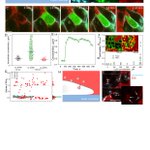


The reconstitution of growth and division in synthetic cells faces many challenges. Here, we show one of the most efficient growth system ever described, followed by division, with lipid flip flop as a key regulator of membrane shape
biorxiv.org/content/10.1101/…

The addition of CerC6, a molecule that quickly undergoes flip flop, relaxes curvature stresses and lead to the generation of much wider buds

Fusion of small liposomes to GUV model membranes result in a substantial increase in GUV area. Growth is, nonetheless, accompanied by budding due to curvature effects
The buds do not share aqueous connectivity with the main GUV membrane. Photobleaching of an water-soluble probe in the GUV lumen does not result in exchange with the bud content
Fusogenic liposomes are an excellent alternative to internalization-based particles for intracellular delivery of cargos. But they don't come without effects.
Here we show how
onlinelibrary.wiley.com/doi/…
@univgroningen, @FLIM, @GUVs, @drugdelivery

Polymer droplets exhibit a set of material properties. Small polymers require high concentrations for phase separation. Ultralarge polymers achieve it at much lower concentrations. Are their properties characterized by polymer size, concentration, or both?
Here we address this:

Liposomal drug-delivery vehicles that fuse with cells and directly and quickly deliver their cargos in the cytosol can be extremely efficient, but this efficiency may come with a price. Here we show how.
biorxiv.org/content/10.1101/…

Membrane fusion-dependent cargo delivery results in the incorporation of large amounts of foreign lipids in the cells' PM. Using FLIM, we show that lipid incorporation fluidizes the PM and reduces surface tension, leading to internalization of the excess of lipids

Lastly, I would like to thank all authors involved in the study and @univgroningen for the facility.
Rafael Lira retweeted

#OPENACCESS: In a new study, Lira and colleagues screen suitable fluorescent reporters for use in fluorescence lifetime imaging microscopy of synthetic and biological membranes. More here: bit.ly/3xdlraG @KingsCollegeLon

FLIM is an excellent tool to probe the local microenvironment, requiring probes that sensitively report environmental properties. Here, we compare the performance of various reporters in sensing the environment of synthetic and living cells using FLIM.
cell.com/biophysj/fulltext/S…

The appropriate choice of the FLIM probe in living cell experiments depends the balance between sensitivity and partition/intracellular distribution
