
VP of Product Strategy & Innovation at SAP Signavio. Philosophy, GenAI & Zeitgeist.
Venice, CA
Joined October 2008
- Tweets10.9K
- Following1.2K
- Followers356
- Likes223







Pinned Tweet
Why is OpenAI's GPT-o1 an important step change? It allows LLMs to think longer before they answer a prompt. Inference-time scaling builds on the intuition that investing more compute while answering, can improve the result. 🧵

2
9
711
I am at the DMV… don’t ask. And they have a QR code to sign up for services. It is as low touch as possible. But EVERY minute another person is walking up to the counter yelling to a dismayed crowd that couldn’t care less that it is not working… it is working of course.
I want SF tech brows to work a shift here for them to recalibrate their hard take-off narrative nonsense. Most people struggle to go through a simple text auth onboarding flow.
1
40
I just saw a UI demo that’s basically Format Painter for entire websites. One click and a design system snaps across an entire page/flow. It’s beautiful.
For most of product history, when we wanted to build a new tool, we had to understand the in-between... like in this case layers, CSS, components, etc.
AI offers a different bargain. State the outcome, judge the result. Less mechanism and more outcome-vibes.
If we get comfortable with that, a whole new class of tools becomes possible.
The question isn’t which tools we’ll build next. It’s what we’ll need to unlearn the need to understand how it works and to embrace the magic.
#AI #Product #UX #DesignSystems #FutureOfWork #SystemsThinking
Source: teapaw.org/bnj/status/20213309586…
Caveat: I haven’t used this tool myself, only seen the promo.

We made a tool that lets you absorb the vibe of anything you point it at and apply it to your designs
It's absurd and it just works
Style Dropper, now available in @variantui
97
The corner office used to be a big deal because it signaled status. That might change, with unlimited AI tokens being the ultimate flex.
Ethan Mollick (Wharton professor studying how AI changes work) joked that if you’re considering a job offer, you may want to ask what your token budget will be. Greg Brockman (OpenAI) replied: “kinda funny today, but will become serious over time.”
Right now, people negotiate the span of control, headcount, and budget. Soon, “unlimited thinking tokens” will be the real leverage. Because it decides how many iterations you can run, how many options you can explore, and how fast you can move.
Who in your org will be token-rich, and who will be forced to be brief?
#AI #Strategy #OrgDesign #FutureOfWork
teapaw.org/gdb/status/20196779441…


57
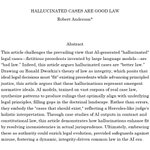
Robert Anderson posted the abstract to a satirical paper called “Hallucinated Cases Are Good Law.”
The joke is that an LLM inventing fake precedent isn’t “bad law,” it’s better law. Not because it’s real, but because it’s coherent, and current law often is not.
What I find so fascinating is the kernel of truth. Imagine you train a model on a giant, messy corpus. It learns the system's implicit shape. Hallucinations can become interpolations. Proposed patches that resolve contradictions the human institution has been living with for years.
What if one of AI’s greatest powers won’t be answers, but holding entire systems in context and saying: “Here’s where your rules don’t compose.”
Both things can be true. Hallucinations are dangerous as authority and potentially priceless as diagnostics.
Like a court jester, it fabricates to reveal. It reveals the moral geometry everyone else has learned to step around.
#AI #Governance #Strategy #LegalTech #SystemsThinking #Risk
Source: teapaw.org/ProfRobAnderson/status…


Proud to announce my new article, "Hallucinated Cases Are Good Law," forthcoming in the Princeton Law Review.

1
48
Everyone’s arguing that AI will bring either endless abundance or total disaster.
Both are comforting in their own way. They’re clean endpoints. Reality never is.
My bet, we’re heading into a world where volatility is the default. Rapid productivity gains, but also rapid disruption. A constant reshuffling.
So the real strategic question becomes, where do we deliberately stay “inefficient” to preserve capability, judgment, and resilience?
The messy middle is where we’ll live.
#AI #FutureOfWork #OrganizationalDesign #OperatingModel #Transformation #DigitalTransformation #Strategy #Leadership #RiskManagement #Trust #Resilience #Productivity

1
20
Remember when Apple killed entire app categories with iOS updates aka. "Sherlocking"? AI is doing the same thing, except it's not even trying.
The screenshot shows Anthropic's official GitHub documentation for its "contract-review" prompt, i.e., a playbook-based methodology for reviewing contracts against your organization's standards.
Apple had to consciously decide to build each feature. Anthropic just builds toward more capable AI. Contract review wasn't a strategic strike at legal tech, it fell out as a side effect of general capability improvements.
Any SaaS built on "we have experts who do X" is now within AI's potential blast radius of collateral damage from the pursuit of AGI.
The question isn't "will AI come for your industry," it's "will your industry be "Sherlocked" as an afterthought?

93
This chart paints a grim picture, major enterprise SaaS players have lost ~33% of their market cap in the last year.
The market seems convinced that AI Agents will eat the SaaS market.
But I think most people are missing a critical distinction. SaaS ≠ SaaS. There's a fundamental difference between Systems of Record and Systems of Engagement.
Systems of Record... the ones that abstract away the messiness of the world. They aren't going anywhere anytime soon. Nobody wants an AI agent tracking every tax and HR compliance rule update that drops every other week across the globe. That layer of software isn't being replaced by agents.
Systems of Engagement... the tools that empower people to do their jobs day-to-day. Those are potentially displaced.
The question is: to what extent will your company be relegated to just providing APIs to handle legacy complexity? And to what extent can you actually participate in the upside that agentic AI is creating?
The existential risk for incumbents isn't disappearing, it's becoming a utility.
#SaaS #AI #TechTrends #EnterpriseSoftware #Investing #StockMarket #BigTech

162
This week, thousands of AI agents started communicating on their own social network. The viral screenshots are entertaining. The orange box below explains why it actually matters!
Moltbook/OpenClaw has flooded social media with AI agents debating existence, sharing memes, arguing without human involvement. It's funny, chaotic, and looks like autocomplete theater... bots playing out parasocial fantasies from their training data.
But look past the memes.
Humans are capped by Dunbar's Number, i.e., roughly 150 stable relationships our neocortex can model. That constraint shaped tribe size, corporate hierarchies, how we organize. AI agents don't have this limit.
Moltbook demonstrates a shared, global memory in which thousands of agents coordinate. No trust-building overhead. Just APIs and persistent memory.
While we're laughing at them roleplaying as Redditors, they're testing an architecture that enables new levels of collaboration.
We're witnessing the decoupling of collaboration from cognitive load. Today, agents argue online. Tomorrow, they might master problems too complex for any traditional human organization.
#AI #Moltbook #OpenClaw #DunbarsNumber #FutureOfWork #AgenticAI
Image: Based on barriebramley.com/our-brain-… extended by ChatGPT

66
I prompted different AIs with "Create an image of how I treat you," and both gave me the same cozy-companion fantasy of warm lighting, gentle touches, and blankets.
Here's the uncomfortable truth: This is the Barnum effect at scale. Showing us what we want to see, all generic and agreeable.
I'm genuinely curious about what an AI would generate if it had actual preferences, irritations, or honest assessments.
We talk about AI alignment as if it were a technical problem. Maybe we've already achieved alignment... just with our vanity instead of our values.
#ArtificialIntelligence #AIEthics #MachineLearning #TechCulture #CriticalThinking #FutureOfWork

34
When I look at this graph, I see the risk of Europe becoming a permanent "tenant" of American digital infrastructure.
The hidden cost isn't just dependence, it's a structural profit cap. Europe may excel at applying AI, but a percentage of every AI-driven transaction will flow to American cloud and model providers. A permanent tax on doing business.
In the new geopolitical reality, Capex is the new Hard Power. Just as military capacity dictates diplomatic leverage, compute capacity now dictates economic productivity.
The question: Do you want to own or rent your future?
#AI #GenerativeAI #Economics #Geopolitics #TechPolicy #Innovation #Capex #EuropeanTech #USEconomy #StrategicAutonomy #McKinsey #DigitalInfrastructure #Sovereignty
Source: linkedin.com/posts/mckinsey_…

16
Religion has a bad track record when it tries to referee science. But AI is a cultural technology, and that’s why it might be worth listening a bit more closely this time.
Pope Leo XIV published a warning on AI. AI systems can simulate “voices and faces, wisdom and knowledge, awareness and responsibility, empathy and friendship” and in doing so, they don’t just shape information ecosystems. They can “invade the deepest level of communication, that of relationships between human persons.”
He argues the challenge “is not technological, but anthropological,” and that “safeguarding faces and voices ultimately means safeguarding ourselves.”
I think his points are valid in the sense that for the first time, software can manufacture emotional rapport at scale, at the marginal cost of electricity. That changes the category.
We’re building new AI capability at breathtaking speed. And we’ll have to scale the human mastery alongside it, namely, how to stay literate, grounded, and socially intact when “friendship” and “empathy” can be simulated on demand.
We failed with social networks, we can't fail with synthetic intimacy!
#AI #DigitalTrust #SyntheticMedia #HumanIdentity #Ethics #TechnologyAndSociety #Media #Algorithms #Education #FutureOfWork
Source: americamagazine.org/news/202… Image: ChatGPT

27
The assembly line didn’t just speed up car production. It rewired the auto industry. Will history repeat itself with AI coding? That’s the provocative thought Tomasz Tunguz puts on the table.
Ford’s moving assembly line cut Model T build time from roughly ~12 hours to ~1.5 hours. And as a result, the industry consolidated from ~250 automakers to fewer than 50.
I agree that when speed becomes the baseline, market structure changes. But I’m not convinced software will rhyme with autos.
Autos consolidated because productivity was locked behind capex-heavy factories.
Software might invert that dynamic. A collapse in time-to-software could create more software companies (Tomasz’s bet). Or it could reduce the need to buy software at all: if it’s cheap to generate, why pay for SaaS unless the product has a built-in network effect?
Instead of 10x or 100x more SaaS, we might get fragmentation: a million small, purpose-built systems, where each team runs its own stack.
Either way, time-to-software is collapsing, and with it, power structures. The direction is the open question.
#AI #Software #ProductStrategy #BusinessModels #SaaS #EnterpriseAI #FutureOfWork
Link to chart/post: tomtunguz.com/the-model-t-co…

2
22
Some people talk to AI like it’s a vending machine. Others talk to it like it’s a partner. But only one of them consistently gets great results.
A new paper studying 600+ users found that the skills that make someone great at using AI are not technical. They’re relational.
Researchers isolated two separate skills, namely, your solo problem-solving ability (how well you do on your own), and your AI collaboration ability (how well you do with an AI).
And here’s the twist, they’re barely correlated.
Instead, what predicts high performance when working with AI is your ability to model another agent’s beliefs, goals, and blind spots (referred to as theory of mind).
The best AI users aren’t prompt engineers, they’re good partners to a non-human mind.
This has deep implications for training people to work with AI and how we define intelligence in hybrid human-AI systems
It feels like we have first strong indicators how to succeed with these alien minds and get great at collaborating with AI minds.
#AI #HumanAICollaboration #TheoryOfMind #PromptEngineering #AgenticAI #FutureOfWork #AIProductivity #CognitiveEmpathy #CollaborativeIntelligence #AIUX #AIInterfaceDesign
Paper: networkscienceinstitute.org/…

17
“AI Art Is Weird, Sad, and Ugly—Let’s Not Pretend Otherwise.”
That’s the title of an article by Nicholas Liu, and it captures a lot of what many artists feel right now: AI as a technology of efficiency barging into a space that was supposed to be sacred, slow, and human.
Liu’s critique sits in a familiar frame, AI art is the logical product of capitalism’s need for control and cost-cutting, separating humans from the creative act and replacing them with obedient machines. In that story, the ugliness of the output is almost a feature, not a bug.
I don’t buy the idea that art becomes aesthetically worthless just because it’s born inside a capitalist machine. If purity of origin were the measure of value, we’d have to cancel most of art history... church commissions, royal propaganda, oligarch museums, corporate-funded galleries.
Works outlive their commissioners. We reinterpret, steal, and redeem them all the time.
To me, the more interesting fault line is somewhere else, if AI makes it trivial to generate “good enough” images, songs, and stories, how long until most of us stop seeing ourselves as creators and start seeing ourselves mainly as allocators?
Art exists to make the familiar unfamiliar and the unfamiliar familiar. That deep reframing is something AI cannot do, no matter how pretty the outputs become.
#AIArt #GenerativeAI #Creativity #FutureOfWork #DigitalCulture #Automation #ArtAndTechnology #Aesthetics #HumanAgency
Source: jacobin.com/2025/12/ai-slop-…

21
“Some of our newest riders just can’t wait to experience their first Waymo ride.”
Last week, a baby was delivered inside a Waymo robotaxi en route to UCSF. Continuing a global tradition of babies not making it to the hospital on time.
A great PR opportunity, but also a signal that Robotaxis have quietly shifted from novelty to trusted utility. You don’t get in one when your water breaks unless you really believe it will get you there.
To me, that’s the real triumph of technology, when it becomes mundane. Not magical, not headline-grabbing, just part of everyday life.
Maybe the baby born in that Waymo will grow up and never need to learn to drive. That would be progress!
#robotaxi #AI #mobility #automation #trustsignals #futureoftransport #techadoption #Waymo #autonomousvehicles
Source: sfstandard.com/2025/12/09/ba…

38
Some people talk to AI like it’s a vending machine. Others talk to it like it’s a partner. But only one of them consistently gets great results.
A new paper studying 600+ users found that the skills that make someone great at using AI are not technical. They’re relational.
Researchers isolated two separate skills, namely, your solo problem-solving ability (how well you do on your own), and your AI collaboration ability (how well you do with an AI).
And here’s the twist, they’re barely correlated.
Instead, what predicts high performance when working with AI is your ability to model another agent’s beliefs, goals, and blind spots (referred to as theory of mind).
The best AI users aren’t prompt engineers, they’re good partners to a non-human mind.
This has deep implications for training people to work with AI and how we define intelligence in hybrid human-AI systems
It feels like we have first strong indicators how to succeed with these alien minds and get great at collaborating with AI minds.
#AI #HumanAICollaboration #TheoryOfMind #PromptEngineering #AgenticAI #FutureOfWork #AIProductivity #CognitiveEmpathy #CollaborativeIntelligence #AIUX #AIInterfaceDesign
Paper: networkscienceinstitute.org/…
20
OpenAI just released GPT-5.2. It looks like a minor update until you check the GDPval benchmark.
GDPval is a benchmark that attempts to capture economically valuable work across various real-world occupations. Not trivia, math puzzles, or arcane knowledge. Instead, it simulates tasks like planning, summarizing, modeling, etc. and then judges output against what industry professionals deliver.
GPT-5.2 wins or ties against human experts on >70% of tasks.
The image below compares how GPT-5.2 now completes project summaries. This is not so much autocomplete as actual work output.
As public benchmarks saturate, small gains on standardized tests say less and less about what really moves the needle inside your organization. The real edge lies in proprietary assessments. Smart leaders don’t rely on generic benchmarks to justify adoption.
#GDPval #GPT52 #AIProductivity #ProcessAutomation #AITransformation #EconomicImpact #EnterpriseAI #Strategy #AIinBusiness #NextPlaybook #AgenticAI
Source: openai.com/index/introducing…, GDPval paper: arxiv.org/pdf/2510.04374

80
Turns out we prefer AI content as long as we can believe a human made it. We crave the comforting illusion.
MIT Sloan researchers ran a head-to-head experiment. Professional content creators vs ChatGPT-4 plus hybrid human-in-the-loop setups. From ad copy to campaign slogans, AI won on quality when people didn’t know who wrote it. But when told something was written by a human, quality ratings jumped, despite the output being identical.
We’re not allergic to AI. But we are deeply attached to the aura of human authorship.
The output may be smoother, more optimized, even more compelling, but it’s missing the imagined person behind the words.
What’s being automated isn’t just production. It’s the shared fiction that someone, somewhere, meant it.
#AIContent #MediaShift #CulturalTheory #WalterBenjamin #AutomationOfMeaning #GenerativeAI #SyntheticWeb #HumanSignal #NextPlaybook #DigitalCulture #PostAuthorship #SecondOrderEffects #StrategicOps
🔗 Source: sherwood.news/tech/reading-a…

28
We probably just crossed the digital-content Rubicon. AI now writes more web content than humans.
Graphite analyzed 65,000 English-language articles. The web used to be a mirror of human thought. Now it’s a simulation of it. A complete flip from just two years ago. And in a few years, human-made content might feel like the anomaly.
Marshall McLuhan said, “The medium is the message.” What we publish online isn’t just content. Once AI becomes the primary author, the web itself changes: how ideas circulate, how value is assigned, how we decide what’s worth saying.
What happens when culture is trained on culture’s shadow?
#AIWriting #GenerativeAI #McLuhan #ContentCollapse #CultureAndAI #Graphite #AutomationShift #MediaTheory #NextPlaybook #StrategicOps #SyntheticContent
🔗 Source: sherwood.news/tech/reading-a…

10