

MPA Candidate @Cornell | MDiv @SBTS | MBA @UofL | Veteran @USAirForce | Homelessness & Public Safety Policy @InstituteCicero
Joined September 2026
- Tweets187
- Following219
- Followers72
- Likes212



Pinned Tweet
My colleague @Sharp16140 and I have a new piece out in the @NRO:
"A program designed to end homelessness should be judged not just by how many people it has served, but how many received appropriate mental illness and addiction treatment, become self-sufficient, and entered the workforce. Without that information, taxpayers and researchers cannot distinguish between programs that work and programs that merely consume resources, making it impossible to identify and replicate success."
nationalreview.com/2026/11/b…

Caleb Jacobs retweeted

The parasitic waste of public of public funds notwithstanding, the homeless mortality rate makes the current homeless services system look like a compassionate eugenics program. Time for a change that actually saves lives instead of failed ideology.

San Francisco, New York, LA, and every other urban center in the US. I was troubled to learn that “harm reduction” and giving schizophrenic heroine addicts an apartment is the homelessness response modus operandi across the country. If we don’t stand together 10s of thousands will die.

Imagine making more than a doctor for…. Making homelessness worse?!

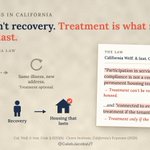
A program designed to end homelessness should be judged not just by how many people it has served, but by how many received appropriate mental illness and addiction treatment, became self-sufficient, and entered the workforce.
Our Chief of Staff @Sharp16140 in National Review:
nationalreview.com/2026/11/b…
Caleb Jacobs retweeted

I love seeing Secretaries call out Congress for dragging their feet on funding key issues, even better when it’s so bipartisan as this. More pressure on Congress is the only way out of American stagnation.

Update in minutes
teapaw.org/i/broadcasts/2QnYOYBMg…

Just FYI, California is set to receive $4.7 BILLION in opioid settlement funds, money intended to help communities recover from the devastation of the opioid epidemic.
In FY 2022–23, 50% of local settlement spending went toward “harm reduction” or to say another way, towards helping the very same communities abuse opioids…
🚨 Inside San Francisco’s Deadly Fentanyl Crisis: San Francisco has become a playground for drug addicts, foreign cartels, corrupt NGOs and Medicaid fraudsters fueling the drug crisis.
In San Francisco you can receive the pipes, foil, needles and Narcan in a box on the sidewalk to do the drugs and then get a free $15 from the local Medicaid fraudster to buy your drugs.
Fentanyl is so cheap and the supply is everywhere, Honduran gangs arrive in the morning to drop the drugs off and the cycle never stops as people die or get stuck in a zombified state on San Francisco’s streets. Please watch, like and share as this crisis is affecting hundreds of thousands of lives across America.
End the fentanyl crisis and save lives.

LA spending on homelessness is not sustainable and is rooted in a philosophy that both makes the problem worse and harms the people it claims to help.

Caleb Jacobs retweeted

If you spend $650K on a single unit, and you have 50K homeless drug zombies in LA, that's a $32 BILLION boondoggle. The homeless industrial complex in LA is the biggest money laundering scam in the history of our country. These people need to go to prison.

Karen Bass cuts ribbon on $72M homeless housing project in LA, costing taxpayers nearly $650K per unit trib.al/lxM3YQJ

Caleb Jacobs retweeted
Building a continuum of safe, focused care for our most needy citizens is the humane and compassionate response. The street should have never been the answer. Great job, Sir!

Today, we broke ground on the Treasure Island Behavioral Health Building—a facility that will soon serve up to 300 people who need treatment and transitional housing while in recovery.
When completed in 2028, this facility will give patients a place to receive care and access recovery housing. The transitional recovery-housing beds will offer up to two years of stable housing to people who complete the residential program.
Bringing these services together under one roof means someone can begin treatment and move into a stable, supportive place to live as they continue their recovery journey. The facility will join more than 2,900 behavioral health beds operated by the San Francisco Department of Public Health for people with substance use disorder and mental health needs.
Recovery takes time, and people need support along the way.
We're making progress in San Francisco. Fewer people are sleeping on our streets than at any point in the last 15 years, and overdose deaths are down nearly 25 percent this year.
But our work isn't done. We're building a system that connects people to treatment faster and gives them the support they need to rebuild their lives.
When someone is ready to accept help, we need to be ready to provide it.


Caleb Jacobs retweeted

McKenzie Richards is our healthcare policy fellow and the author of our 2026 CON Playbook, the report whose methodology CMS now uses to evaluate state CON laws, and our new paper on fixing the infant formula market.
Make sure to give her a follow: @McK_Richards
Caleb Jacobs retweeted
Our research associate @EveVelasquezMPP is featured in the Claremont Institute’s Alumni Spotlight as a 2026 Publius Fellow.
She talks CON repeal, her upcoming pharmacist full practice report, and why patients should know prices before treatment.
Congratulations, Eve! Well deserved.
claremont.org/alumni-spotlig…

My latest research on homelessness with Chris Sharp and Paul Webster was cited by James Carter @realDailyWire
Thank you for highlighting this critical issue!
Read article 👇
@benshapiro | @InstituteCicero | @Sharp16140 | @Hopestreetco

Caleb Jacobs retweeted

nationalreview.com/2026/11/b…. This is a classic example of Goodhart’s law. When a measure becomes a target, it ceases to be a good measure. Rewarding based use means getting people off the streets is punished not rewarded-
My recent research examined five randomized controlled trials involving 3,205 high-need individuals experiencing homelessness. Every trial recorded higher mortality among participants assigned to Housing First. When pooled, the results showed a statistically significant 41% higher risk of death.

One of the most disturbing findings in my research on Housing First was that in one of the major studies, they counted participants who died as successful housing outcomes for purposes of investor payments. This reflects a fundamental problem with Housing First: we have become so focused on housing retention that we have lost sight of whether people are actually recovering and surviving

The numbers don’t lie.
Housing First failed.
Because of @POTUS’ actions to secure our border and clean up our streets, we are reversing the homelessness crisis.

The goal of public policy should not be to eliminate billionaires but to create the conditions in which more people can become wealthy. Prosperity is not a zero-sum game. We should be focused on expanding economic opportunity, incentivizing investment, and removing barriers to upward mobility rather than treating wealth creation as a societal failure.

Bernie Sanders wants to raise taxes on “the rich.” If the goal is to reduce poverty, here’s a number worth considering.
A tenfold increase in the number of billionaires is associated with a 40% decline in poverty.

37
We have tremendous wealth in our country yet we also see great disparities. There is a lot of debate in terms of cause but the sad reality is that largest disparities are attributable to federal and state public policy. We incentivize criminality, homelessness, and addiction. We simultaneously lack safeguards on the front end with little to no support on the back-end. Our country can be wealthy, free of crime, and bound for limitless abundance — we just need leaders who do not waste the opportunity with poor governance.

JUST IN: Economic analysis of 64 countries finds that nations with more billionaires per capita tend to have fewer people living in poverty.
28
Caleb Jacobs retweeted
Nearly a quarter of unsheltered homeless people suffer from severe mental illness. More than half report serious mental health conditions that directly caused them to lose their housing.
🎥: @dkurtzz
Caleb Jacobs retweeted

It’s staggering to see HUD confirm that almost 700K individuals were homeless earlier this year—a sharp climb from under 550K just a decade ago. This crisis is largely an issue of addiction & mental illness. Legalizing "recreational" drugs is only exacerbating the problem.
theepochtimes.com/us/hud-ann…
