

Consulente SEO & Web Designer | Fondatore di Cartoondesign | Strategie digitali e AI Search per PMI a Milano e in tutta Italia. 🌐 #SEO #WebDesign #AISearch
Milano, Lombardia
Joined May 2012
- Tweets12K
- Following360
- Followers565
- Likes4.4K


Stefano Colombo retweeted

New Google-Agent Googlebot help document is out
seroundtable.com/google-agen…

Stefano Colombo retweeted

Google's new model Gemini 4 Hydrogen changes how Search works.
Google calls it "the biggest model improvement to Search yet."
▪️Better at understanding user intent.
▪️Improved query fan-out with a broader range of helpful links to the web.
▪️More visual responses. One of the examples shows it creating images of restaurant dishes. It can also make charts and graphs.
This is available for all searchers, not just paid Gemini users.
What does this mean for websites? I think in some cases websites with original helpful information might be more likely to be surfaced.
But also, there's less need for searchers to click through to websites if Search can now produce charts and images. More questions will likely be answered directly with AI right on the Search results.
No word yet on whether the core update and this model upgrade are connected. Either way, there's likely to be significant changes in traffic for quite a few websites.
blog.google/products-and-pla…

Stefano Colombo retweeted

AI Overviews rolling out in France on July 22, 2026 yielded the clearest evidence yet of their impact to clicks and click-through rate. So I analyzed a number of sites in GSC to view the true impact. We know AIOs can impact traffic, but some of the findings might surprise you...
I provide five cases in my post (three sites that dropped and two that remained stable). You can check my post for the details. And I provide bullets at the end for site owners that want to dig into their own data. I recommend doing that today, and I'm eager to hear what you find.
gsqi.com/marketing-blog/goog…


Stefano Colombo retweeted

Yup, it’s funny to me how many people are talking about building personal brands, demonstrating real expertise, sharing original research, using social to support SEO, etc. as if these are revolutionary, GEO-specific ideas.
And “we used to only think about optimizing a few pages/keywords and not the bigger picture” lol.. who is we?
Stefano Colombo retweeted
A few folks who shared my recent article on "main content" posted it and used a screenshot of this table.
Here's something cool. After I finished writing my article, I asked Antigravity what we could do to follow my own advice and make the main content - the reason why people were reading this piece - easier for people to ingest.
Antigravity suggested and create a table. I made a few modifications on it and then put it at the top of my article.
Here's a good prompt you can use in your LLM:
What is the primary purpose of this page? What is it helping people understand or achieve? Give me three ideas on how we could improve or add something to the page that would make it even more effective at achieving its purpose and helping people.


Google updated my favourite document - their guidance on creating helpful content.
They added more to help us understand and improve the "main content" of our pages.
Here is a blog post and video with my thoughts.
mariehaynes.com/main-content…

Stefano Colombo retweeted

Google révèle les vrais délais SEO : crawl, indexation et Core Update
Gary Illyes a partagé à Search Central Live les délais observés par Google pour le crawl, l'indexation et surtout la récupération après une Core Update.
Quelques chiffres 👇
🔎 Découverte d'une nouvelle URL
→ ~20 heures en moyenne
→ mais parfois plusieurs semaines… voire jamais
🔄 Rafraîchissement d'une URL connue
→ ~30 jours
→ parfois plusieurs semaines… ou jamais
🗺️ Traitement d'un sitemap
→ ~24 heures
→ jusqu'à 14 jours, voire jamais selon la qualité
📥 Indexation complète
→ ~1h30 dans un cas « typique »
→ mais potentiellement plusieurs mois… ou jamais
🔗 Changement de canonical
→ 1 à 3 semaines
→ plusieurs mois si Google reçoit des signaux contradictoires
🚚 Migration d'un site
→ 1 à 3 mois
→ 6 mois à plus d'un an dans les cas difficiles
✏️ Modification d'un Title / snippet
→ généralement 1 à 2 jours
→ mais parfois plusieurs semaines ou mois
Et surtout, celui qui m'intéresse le plus :
🔥 Récupération après une Core Update
→ 3 à 6 mois dans un cas typique
→ 6 mois à 1 an dans les cas les plus longs
→ avec parfois l'obligation d'attendre… la Core Update suivante.
C'est probablement l'un des chiffres les plus importants à retenir.
On peut corriger un site, améliorer les contenus, travailler l'autorité, les liens, l'expérience utilisateur… et ne pas voir immédiatement le résultat.
Autre précision de Gary Illyes : tous ces mécanismes sont liés.
Si Google met du temps à crawler → l'indexation prend du retard → les changements dans les SERP prennent eux aussi du retard.
Les délais peuvent donc s'accumuler les uns derrière les autres.
Moralité : en SEO, « j'ai corrigé le problème il y a 15 jours et ça ne remonte toujours pas » ne signifie pas forcément que la correction n'a pas fonctionné.
Parfois, ça sera très long.....

ALT Google révèle les vrais délais SEO : crawl, indexation et Core Update
Stefano Colombo retweeted
New data from Google on how long it takes it to crawl, index and serve - via @WeAreRoast and @GoodnessNeil
seroundtable.com/google-craw…

Stefano Colombo retweeted

Estuve en el Search Central Live Deep Dive que Google montó en Barcelona. De todas las charlas, la que más me interesó fue la de quality, que es lo que suele estar detrás de los core updates.
He escrito todo lo que contaron y lo he cruzado con los leaks de Google.
Hilo:

Stefano Colombo retweeted

Introducing Google Pics 🎨 Precise, powerful AI image creation is rolling out now to Google Workspace customers and Google AI Pro & Ultra subscribers.
Google Pics lets you edit individual objects, refine or translate text, and collaborate with your team.
Try it at pics.new.
Stefano Colombo retweeted
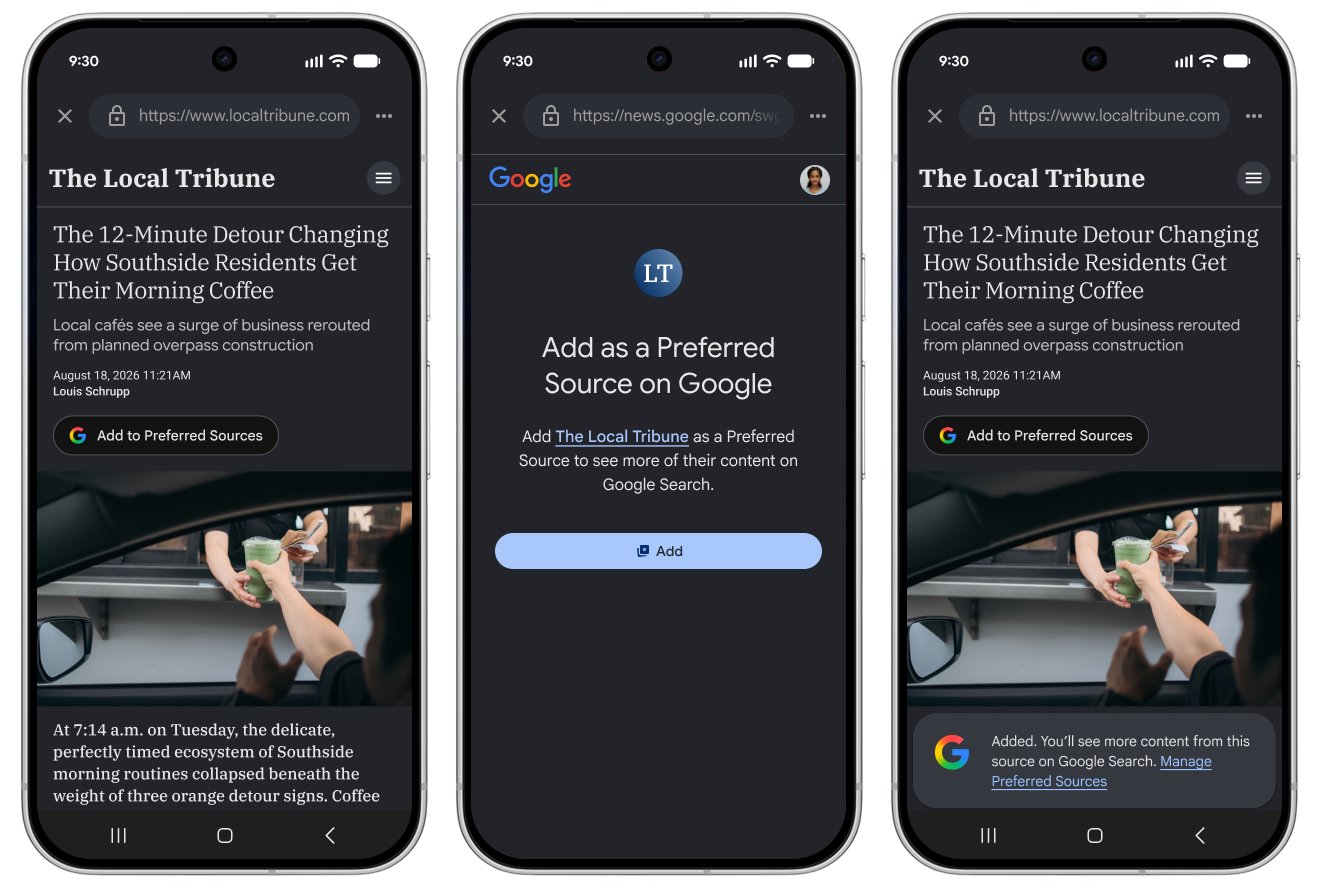
Oooh. Google just launched an embeddable "Preferred Sources" button for websites - and it directly impacts your visibility in AI Overviews and AI Mode.
Here's what you need to know:
▪️ You can now embed a simple <script> tag and <div> button directly on your site so visitors can add you as a Preferred Source.
▪️ When someone adds your site, you are more likely to appear in their Top Stories, AI Overviews, and AI Mode.
Also,
▪️ Discover Tuning: Users can also tune their Discover feed using natural language to see more or less of specific topics and sources.
There's info in Google's developer docs for the script implementation: developers.google.com/search…


A few updates today making it easier see the content + publishers you want across Search, News and Discover:
⭐ Click the Preferred Sources button to save your favorite websites
💬 Tell Google about the topics and links you want to see more (or less of) in your Discover feed - just like you’d text a friend
🎧 Stay up to date with custom daily audio briefings in the Google News app (Android)
Stefano Colombo retweeted

What a useful and free ChatGPT Query Fan-Out Chrome Extension that allows to easily track them over time by @Netanel 👇 Showing:
* Queries: The actual search strings ChatGPT ran behind each prompt — the fan-out itself.
* Sources: Every page it retrieved, grouped by domain, with cited vs. not-cited marked.
* Citations: The sources that made it into the answer, and which domains keep winning.
Everything is shown from your Chrome side-panel and allows you to export the data!
Take a look: en.natielimelech.com/tools/c…

Stefano Colombo retweeted
Big news from Bing. And you can compare changes over time. This is what @kmadhavan77 shared in April and now it's rolling out -> New AI Visibility Insights in Bing Webmaster Tools: Intents, Topics, Citation Share, Compare
"AI-generated answers are dynamic, contextual, and often synthesized from many sources at once. Understanding visibility in these systems requires more than a single metric or surface-level citation count. With these expanded preview capabilities, Bing Webmaster Tools is expanding first-party reporting to provide deeper insight into the query context, thematic patterns, relative citation presence, and changes over time that shape how content appears in AI-powered experiences."
"With the new Intents feature, grounding queries in the AI Performance Report are now classified into broader categories such as Informational, Commercial, Navigational, Learn and Solve, Research, Creation, Local, and more. This helps publishers move beyond simply seeing which queries triggered citations and begin understanding the broader query context our systems associate with those citation appearances."
"We are also introducing Topics, which group related grounding queries into broader thematic clusters. AI systems reason across concepts and themes rather than isolated keywords. Topics help publishers understand visibility in the same thematic structure that modern AI systems use to organize information."
"While total citation counts show how often your content appears in AI-generated answers, Citation Share shows how much of the citation space your site receives for a specific grounding query. It is calculated as the percentage of citations attributed to your site out of all citations shown across all sites for that same grounding query." blogs.bing.com/search/June-2…


Stefano Colombo retweeted

Information agents in Search are now available in all AI Mode languages & markets for Google AI Ultra subscribers.
Just ask AI Mode to keep you updated on any topic, and your agent will work around the clock on your behalf to send detailed updates and links to the web the moment new info is available.
Excited for this first group to try agents in Search! We’ll expand to more people this summer.
I’m personally excited about the era of Search agents. You’ll be able to create, customize, and manage multiple AI agents for tasks, right in Search.
Starting with information agents this summer, you can ask Search to keep you updated on topics you care about. Your agent will operate 24/7 to intelligently reason and research and send you a comprehensive update, with links to dive deeper – like if you want to know right when your favorite sneaker collab drops, or is available in a new colorway. #GoogleIO
Stefano Colombo retweeted

AI search is exploding, creating a massive blind spot for website traffic. While clicks are shifting, visibility shouldn't ✖️
GA is introducing automated AI Assistant traffic measurement. Track & trend human traffic from top chatbots directly in reports → goo.gle/43rpCMw


Stefano Colombo retweeted

Today we released the May 2026 core update. We'll update our ranking release history page when the rollout is complete: status.search.google.com/inc…
Stefano Colombo retweeted
Google just put out its first official article on optimizing for AI search (AEO/GEO)!
TL;DR:
⭐️ SEO is still the foundation for AI search.
⭐️ Create non-commodity, "people-first" content.
⭐️ Ignore most "GEO/AEO hacks like chunking and llms.txt.
developers.google.com/search…

Stefano Colombo retweeted

La cosa che mi manda ai matti è che stanno tutti correndo a fare agenti, wrapper, MCP, orchestrator e AI OS vari... cazzi e mazzi, però manca ancora il layer base, quello inevitabile tipo Cloudflare per il web, OAuth per identity, Stripe per i pagamenti o Sentry per observability. ... ci siamo capiti. Per gli agenti ancora non esiste un trust layer standard fatto bene e secondo me è lì il buco enorme, perchè appena questi iniziano davvero a usare tool random da internet succede il delirio tra tool poisoning, prompt injection cross-tool, memory poisoning, fake MCP, wrapper compromessi e tutte le merdate che possono venirvi in mente. Non ho trovato un infrastruttura seria, vedo soprattutto wrapperini sopra SDK OpenAI e demo messe insieme a culo. La roba figa sarebbe un Agent Security Gateway che si mette in mezzo tra agente e tool, tipo agente -> gateway -> MCP/internet, e lì fai trust score, verifica MCP, sandbox, isolamento permessi, logging serio, memory boundary, allow/deny policy e explainable trust... lo stretto necessario. Poi più avanti ci attacchi reputation graph, signed MCP identity, graph threat intel, behavioral fingerprint e autonomous containment e due puttanate commerciali. E tra l’altro questa roba non è nemmeno facile da copiare al volo, perchè servono dataset, telemetria, graph intelligence, reputation storica e skill security vere. Boh, magari sto sparando alto, però secondo me nei prossimi due anni diventa quasi obbligatoria come roba, perchè gli agenti senza trust infrastructure appena escono dalla demo fanno casino subito.
Stefano Colombo retweeted

You can now ask Gemini to create Docs, Sheets, Slides, PDFs, and more directly in your chat. No more copying, pasting, or reformatting, just prompt and download.
Available globally for all @GeminiApp users.
Stefano Colombo retweeted
Here we go. Google has started sending out emails to sites that are actively hijacking the back button. It's a warning with sample urls, links to the blog post about the new spam policy, etc. Google explains it will recheck the site before the June 15, 2026 deadline to see if the site has addressed the situation. Tick tock. :)
"No manual action has been taken at this time. We recommend fixing this issue as soon as possible to avoid a potential manual action that could negatively impact your site's performance on Search. Enforcement of this policy is scheduled to begin on June 15, 2026.
Note: Changes made on or after April 17, 2026, are not reflected in this notification. We'll re-verify your site’s compliance before any manual action is taken."

Stefano Colombo retweeted
All the slides + JC's coverage. Some good nuggets here -> Google Search Central Live Toronto Slides (April 2026)
*Crawl vs. Index: “Crawled – Currently not indexed” is rarely a technical rendering issue; it’s usually a quality signal. Google may have tried the content and decided it “wasn’t good,” or it’s a canonical/duplicate issue. It could also sometimes be 404s, redirect issues or robots.txt issues
*Scaled Content Abuse: This is an important algorithm that could explain AI-generated content traffic drops, rather than the use of AI itself. Google wasn’t against AI per-se, but there are safeguards against scaling content and safeguard against what they decide to index.
*AI Overview (AIO) & “Agentic” Search
Reporting Gap: There wasn’t much new shared regarding AI Overview and AI Mode tracking; the team confirmed they are working on something but provided no timeline.
*Gemini in AIO / AI Mode vs. Gemini in App. They both use the same model, but Google Search “shapes” Gemini differently in search than the standalone app. Results from AIO and AI Mode are expected to be different
*There is no benefit in converting your site to Markdown for LLM or SEO purposes.
*There is no benefit to creating a llms.txt file for SEO
jcchouinard.com/google-searc… via @ChouinardJC


