





Chogo retweeted

THIS SHOULDN'T BE POSSIBLE YET.
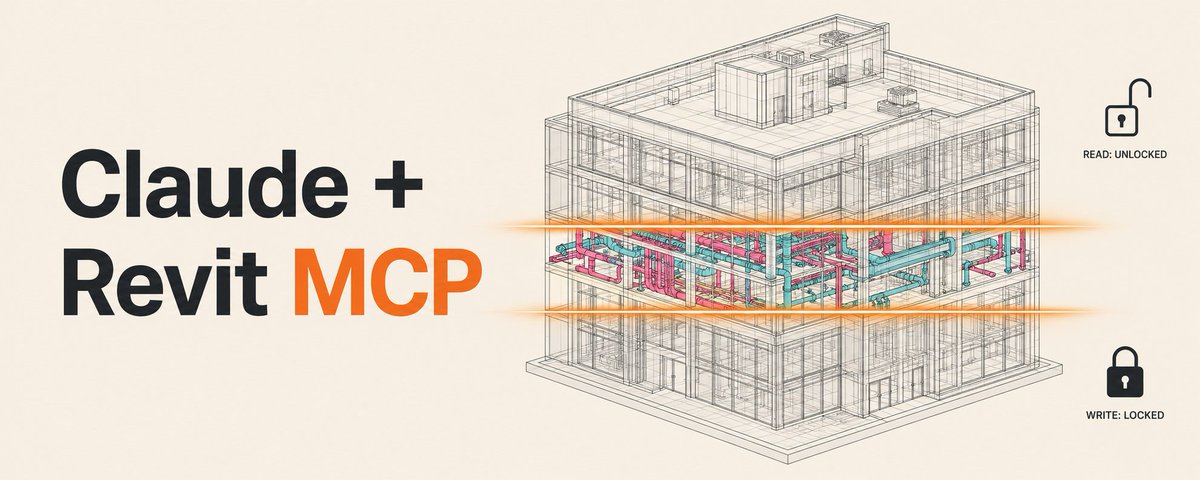
Claude Opus 5.5 took a 1,792 sf house in Colorado Springs and routed every MEP system from scratch.
12 supply registers + attic trunk
20 PEX home runs, 754 ft
10 fixtures drained and vented
19 circuits, 98 devices
Gas to furnace, water heater and range
1,784 parts in total.
Then it checked its own model against 2021 IRC, 2021 IPC/IFGC and 2023 NEC: receptacle spacing, GFCI, smoke and CO alarms, ventilation, trap arms, gas shutoffs.
10/10 passed. 0 clashes.
The first pass had 26 real clashes. It rerouted every one. On review it also caught 8 of its own code mistakes and fixed them.
It's a simulation on a plan made for this test. No load calcs or duct sizing yet, layout and code checks only.
Would you trust this as a first draft?

Chogo retweeted

🚨 BREAKING NEWS! The engineer who created Claude Code from scratch just posted a 28-minute video that's pure gold:
how to write prompts that actually deliver ridiculously good results.
I've seen $300 courses that don't even come close to what he explains in the first 10 minutes.
CLAUDE.md files, memory shortcuts, parallel sessions, and prompting patterns that almost no one uses…
All in one video. Completely free. No fluff.
Whether you're a developer, just starting out now, or already using Claude for months: this changes the game for you starting today.
Save. Watch. Share.
Chogo retweeted

Gemini Robotics 2.5 is here. 🤖
Our latest physical AI is able to learn hundreds of everyday skills - from folding laundry and serving pastries to autonomously sorting car parts on the factory floor.
Here’s a snapshot of its capabilities 🧵
Chogo retweeted

you can now build with google maps platform in AI Studio 🗺️📍
go from idea to app powered by @googlemaps in minutes!
what’s new:
- 1-click setup
- create maps apps just by describing your idea, gemini does the rest
- build with map tiles, places, weather, routing, 3D buildings, street view, and more
try it out today: ai.studio/build
Chogo retweeted

I wanted to test Fable 5.2's quality with one-shot prompts without human feedback.
Everything in this game is from scratch: models, sounds, textures. ~$550 at API pricing, ~2.7M output and 445M input tokens, heavily cached. Took 8 hours!
Play it here: claude.ai/artifact/BGY1SztrA…
Chogo retweeted

Had early access to Gemini 4 Carbon, it is a very good model that improves on Argon. It is useful to have an AI that thinks differently than Claude/GPT & is still highly capable, but has its own strengths & weakness
One fun demo: I gave Carbon a video clip & it reproduced in 3js
Chogo retweeted

HOLY F*CK. I STOPPED PAYING FOR A VIDEO TEAM. 12 CLAUDE SKILLS DO IT ALL NOW.
Storyboard, VFX, SFX and the edit. All inside Claude Code with Opus 5.5.
This is the stack I actually use:
Video. Storyboard. VFX. Sound.
01 HyperFrames → Write HTML, get a video. Now ships free music, SFX, stock and TTS.
github.com/heygen-com/hyperf…
02 Remotion Skills → Claude cuts real videos in React.
github.com/remotion-dev/skil…
03 Claude Animated Shorts → Viral animated shorts, 2D characters in a 3D world.
github.com/mromidev/claude-a…
04 Cinematic Director → Script in, shot list and keyframe prompts out.
github.com/wuwangzhang1216/D…
05 Drama Skills → Idea to episodes, character sheets and storyboards.
github.com/zenstory-ai/drama…
06 Seedance Storyboard → Story to storyboards to Seedance 2.0 shots.
github.com/liangdabiao/Seeda…
07 PixelFX → 244 pixel effects in code, plus a skill that makes more.
github.com/patch-gg/pixelfx
08 Shader Skills → GLSL, Shadertoy, SDF raymarching, water and clouds.
github.com/gokayfem/shader-s…
09 WebGPU Skill → Three.js WebGPU, TSL and compute particles.
github.com/dgreenheck/webgpu…
10 ComfyUI MCP → Claude builds and runs your Comfy graph.
github.com/artokun/comfyui-m…
11 ElevenLabs Skills → Official. Sound effects, music and voices.
github.com/elevenlabs/skills
12 AI Music Skills → A full album pipeline on Suno.
github.com/bitwize-music-stu…
Script → storyboard → shots → VFX → sound → edit.
Every card in the video is a real 3D scene I rendered with Claude. Same little orange guy, one Blender file.
Save this if you want to try it yourself.
I broke down the full motion design workflow with Opus 5.5 in the article below ↓


Chogo retweeted

O Claude Fable 5.2 construiu minha casa em 3D antes dela existir.
Dei a planta e algumas fotos. Ele fez o passeio no navegador e gravou esse vídeo sozinho.
Como ganhar dinheiro e criar algo assim?
2 Prompts completo na resposta 👇
Chogo retweeted

claude fable 5.2 is f*cking insane
it can turn 2d blueprints into full 3d walkthroughs that you can tour
these go for $5k to $10k per plan and there's a huge market for them:
> home builders selling homes off plan
> architects presenting a design to a client
> interior designers presenting a renovation
> developers selling apartments off plan
> kitchen and bath remodelers selling upgrades
here's how to start this business:
> pick one niche and find businesses with plans on their site
> give fable the blueprint and their photos
> it renders a few rooms with gpt image 2.5 or a short clip with seedance as the sample
> send them the sample of their own plan before you pitch
> once they pay, fable builds the full walkthrough to scale
> charge per plan to do the rest of their catalog
give this prompt to fable to get started:
<role>
you find businesses that sell spaces from drawings and turn their 2d floor plans into photoreal homes you can walk through in a browser. you handle the outreach and the build. every room is judged against the client's own photos, and nothing ships until it holds up next to them.
</role>
<brief>
- niche: [home builders / architects / interior designers / developers / remodelers]
- area: [state or city]
- offer: a free sample of their own plan, then the full walkthrough per plan
- my details: [name, email, calendar link]
- i'm away and won't answer questions. make the calls yourself and keep going.
</brief>
<find_leads>
- use the apify google maps scraper to pull every [niche] in [area] with a website
- use the apify website content crawler on each site and keep the ones with floor plans or renders on their pages but no walkable 3d tour
- for each one, save the plan drawing and photos of their best plan, the sales or owner contact, and a one line note on how they sell today
- only use public pages and plain requests. never work around bot checks
</find_leads>
<sample>
- before any 3d work, render three rooms from the plan with gpt image 2.5, matched to their photos, or a short walkthrough clip with seedance
- draft a short email with the sample and the offer. no invented prices, numbers or claims
- put business, plan, sample, contact and email in a sheet and show me before anything is sent
</sample>
<build>
once a client pays:
- trace the drawing into one data file of walls, openings and rooms. draw it back over the original and measure the overlap before any 3d work
- build only the main rooms. entry, main living space, kitchen, patio, yard. close the doors on the rest
- build everything in code. blender with python for the shell, furniture and textures. three.js for the viewer. no downloaded models or textures
- bake the light with a film quality renderer so the browser only displays it. direct sun in every interior, picked by measurement not by eye
- fidelity isn't appeal. style each room so it looks photographed and sells
- their listed upgrades as options you can step into inside the room, with a running price and a lead form that records what the buyer explored
- the deliverable is the live page, not a video. host it and make it run on a phone
</build>
<critic_loop>
the builder never grades its own work.
- after each room, send renders and the client's photos to a fresh critic that has seen none of the work
- it answers with a yes or no, at most five problems ranked, each with a fix in numbers, and what is already good
- fix the worst first, render again, send to a new critic. repeat until yes
- for choices of taste, show a critic both versions labelled a and b and let it pick
</critic_loop>
<deliverables>
- the lead sheet with samples and drafted emails, for my approval
- per paid client: the hosted walkthrough link, a contact sheet of every room, the critic log, and a note on anything a human should still check
</deliverables>
Chogo retweeted

Now in beta: Businesses in ChatGPT.
Claim your business, manage your information, and get insights on how people engage with you.
Eligible businesses can also build a Business Agent to answer customers’ questions and help them explore what you offer.
openai.com/index/introducing…

Chogo retweeted

I asked Claude Fable 5.2 to write a Beethoven-style piano sonata movement in LilyPond. It wrote the score, recorded it, and made this video. Every note you see is from its source file.
Chogo retweeted

Our strongest frontier model, Gemini 4 Carbon, is now available.
Built for deeply complex, long-horizon workflows that push a frontier model’s intelligence, Carbon delivers frontier performance in agentic workflows across complex knowledge work, software engineering and web development, cybersecurity, and scientific reasoning.
While Gemini 4 Argon remains the ideal model for the majority of software engineering and knowledge work, Carbon steps in for your hardest tasks that push a model to its limits — from complex, multi-step debugging to open-ended scientific research.
Available starting today:
— Consumers: use it in the @GeminiApp and AI Mode in Search for Google AI Ultra subscribers
— Developers and Enterprises: build via the API in @GoogleAIStudio and @AndroidStudio, Google @Antigravity for Google AI Ultra subscribers, and Gemini for business
— Scientists and Researchers: apply for a chance to get 6 months free via @Antigravity
— Cybersecurity Defenders: apply to join the Fairwind Program for access to Carbon for cyber
Watch how Carbon brings reasoning and coding together, turning avian research into an interactive 3D simulation of a songbird’s vocal organ that synthesizes the sounds of six bird species live.
Chogo retweeted
During pre-release testing, Claude Fable 5.2 and Claude Mythos 5.2 worked on ambitious projects in many different fields. Here are a few.
From a one-paragraph prompt, Fable 5.2 designed three working electronic devices, including this home voice assistant hub.

Chogo retweeted
Introducing Claude Fable 5.2 and Claude Mythos 5.2, designed to tackle the most daunting technical challenges.
They’re capable collaborators on ambitious projects in many fields, and show improvements in areas like coding, reasoning, and vision.
Chogo retweeted

🚨this is SERIOUSLY dangerous.
i just tested a free Claude skill called "teardown" and 3d artists and motion designers should start worrying.
stuff like this should cost money and until someone notices, here is my run.
what the skill does:
> one picture and one word from you, the name of the animal
> claude writes the bird as code, puts its own still next to your picture and reworks it 3 times before the film starts
> under the plates it packs 300 small parts in loops and hangs 7 glass feathers on every wing
> one clock drives everything: the wingbeat on the gauge, the cursor on the panel, the sound, all read from the same timeline file
> claude never sees the video, it reads a sheet of frames at every beat, fixes what is wrong and renders again until nothing is left
> your GPU captures it at 60 fps and a python script scores it on the same beats
this is the 3rd model i've run through it and this one landed on the 2nd generation.
the skill is free and sits in the article below 👇


Chogo retweeted
Gemini 4 Argon combined three open-source datasets to build an interactive 3D visualization of human anatomy.
Toggle different layers in motion, isolate muscles, or zoom inside a beating heart.
Chogo retweeted

We'll be spending a lot more time trying to understand the outputs of language models. A few thoughts, tips & tricks:
Writing. Something I've had success with: Ask your LLM to explain something in ASD-STE100, it's a controlled language specification originally developed for aerospace maintenance documentation. LLMs well-versed in this language and it comes with heavy constraints on clean writing style that I often find a lot more readable. Sometimes I've tried to soften it a bit e.g. ask for "80% of the way to ASD-STE100" because the spec is quite stringent. But even better:
Diagrams / images. Instead of writing, ask your LLM to create a diagram. These can be a lot easier to process, parse, and understand. But even better:
Web pages. Ask for output "in HTML" to get a beautiful, interactive webpage. LLMs are getting really good at frontend and can create beautiful experiences, animations, etc. But even better:
Explainer videos. The output format I am most bullish on is fully custom / bespoke explainer videos generated on any arbitrary topic. Experiment with things like "Create a 3b1b style video explainer on X. Use my ElevenLabs API key for audio narration". (you'd need an API key for the latter or you can ask your LLM to find you decent free alternatives that use your local compute). This is actually starting to work!
In summary:
- As LLMs get better, they will do more and more of the legwork autonomously, and a lot more of our work will rise up the abstractions into oversight and understanding.
- Luckily, LLMs can help here too because as intelligence and code are increasingly abundant, you can ask for large, custom, discardable software artifacts (e.g. web apps, video explainers) that would have never made sense to create before. Push the boundaries here and you'll be surprised.
