

Professor in #ReproductiveMedicine,#ReproductiveBiology, #Epididymis,#Spermatogenesis of Guangzhou Medical University,China. FSRB
Guangzhou, china
Joined June 2019
- Tweets245
- Following77
- Followers77
- Likes138


Pinned Tweet
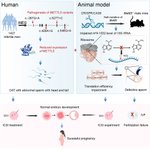
We discovered a new extracellular organelle degradation structure in the epididymis, naming it the "Intercellular Organelle Reservoir (IOR)." Thanks to our team and all who supported us! rdcu.be/d93DE #vEM #VEMTechnologies @NatureComms @The_InnovationJ @Innov_Medicine

4
240
Christian Chan retweeted

Most students learn that DNA → RNA → protein. This sounds straightforward, but transcription (or that DNA → RNA bit) is surprisingly unpredictable, even in genetically identical cells. And, unfortunately, many tools commonly used in biology miss the way that gene expression actually works.
For several decades, most biologists assumed that transcription followed a Poisson process. In other words, imagine that you are a gene within a cell moving through time. At each small step forward in time, you roll a die, and there's a fixed probability that this gene will get transcribed into mRNA. Most of the time, nothing happens; but sometimes you get a new mRNA. In a Poisson distribution, as time goes on, the probability that the cell has not made a transcript at all trends exponentially toward zero.
Scientists believed this because they did not have methods to refute it. All the techniques we had to study gene expression were indirect. They might put a gene encoding green fluorescent protein into a cell, for example, let the cell transcribe and translate that gene, and then use a microscope to measure how brightly the cell glowed. They'd count up the fluorescent signal and try to work backward to infer how many mRNAs were responsible. But obviously these were proxies, and there's no correlation (in many genes) between protein levels and mRNA levels.
So in 2005, Ido Golding and colleagues published what I think is one of the most beautiful and important papers in modern biology. They figured out how to watch and count mRNAs in individual living bacteria, and used this method to test whether transcription really followed a Poisson process.
First, they engineered E. coli to make a green fluorescent protein fused to something called the MS2 coat protein. MS2 binds to a particular RNA sequence, called an MS2 binding site. So the bacteria were producing large amounts of this green fluorescent protein, which was floating around inside the cells.
Second, they introduced another genetic construct, this time encoding a red fluorescent protein. But at the end of this gene, they added an enormous array of 96 MS2 binding sites.
So what happens is that, when the cell transcribes the gene encoding the red fluorescent protein, the resulting mRNA also contains this long string of MS2 binding sites, which the green protein (fused to MS2) quickly gloms onto. And now, instead of having green fluorescence diffused throughout the cell, you get these very bright, green spots or "puncta" where the GFP molecules have accumulated on an mRNA. And because each mRNA recruits dozens of GFP molecules, the researchers could calibrate the brightness of these spots and estimate how many individual transcripts were present in a single cell.
Importantly, they could also activate the red fluorescent gene using a small molecule called IPTG. (The gene was placed "downstream" from a so-called inducible promoter.) This meant they could add IPTG, start a stopwatch, take pictures over time, and then watch the bright green spots appear as the bacteria produced mRNAs.
And they found that gene expression is sort of Poisson, but with a huge caveat.
In a true Poisson process, the variance equals the mean. So if a gene produces an average of 10 mRNA molecules over some period of time, the variance in the number produced should also be 10. The transcripts appear at random times, sometimes close together, sometimes farther apart, but each event is independent.
Instead, Golding and his colleagues found that the variance in mRNA abundance was about FOUR TIMES larger than a Poisson process would predict. This happens because transcription is BURSTY.
A gene remains silent for a long time, then suddenly turns on and makes a bunch of mRNAs really quickly, and shuts off again. A cell might produce four transcripts over a few minutes and then make nothing for the next half hour.
(The full model is this: When a gene is ON, transcription follows a Poisson process. But the gene can switch OFF at any moment. And because each ON period lasts a different amount of time, the number of transcripts produced in each burst follows a geometric distribution. In their experiments, genes were inactive for about 37 minutes on average, then active for about six minutes, producing an average of 2.2 transcripts per burst.)
This study changed how we study biology. It's so important, because it influences the way we study RNAs in cells today.
Depending on when you kill cells and extract their molecules, for example, some might have no transcripts from a particular gene, while others might have lots of them. That variation doesn't necessarily mean the cells are fundamentally different; some of them might have just had a recent burst of transcription, while others haven't.
Or consider two genes that have exactly the same expression level. One might produce transcripts slowly and frequently, while the other produces them in large, infrequent bursts. If you just measure how many mRNAs are present, you can't tell how those transcripts were produced, or how the genes are regulated.
I made a little interactive to show how this works and hope it is helpful.
Christian Chan retweeted

The chemical fingerprint of cellular senescence
nature.com/articles/s43587-0…

Christian Chan retweeted

Tutorial: guidance on the use of large language models for medical research
nature.com/articles/s41596-0…
@DrQiaoJin #Medx #phd #academic


Christian Chan retweeted

Mitochondria directly interact with the nuclear pore complex | Nature nature.com/articles/s41586-0…

Christian Chan retweeted

Online Now: Mitochondria-lysosome coupling contributes to lysosome acidification and aging dlvr.it/TSnDJ0


Christian Chan retweeted
NAC promotes co-translational protein folding at the ribosomal tunnel exit dlvr.it/TRrSwK

Christian Chan retweeted

Out today in @cellcellpress new work from the lab led by Abby Xie and @jules_stef asks, when and why do cells use the TCA cycle?

Christian Chan retweeted

1/ I've analyzed dozens of single-cell datasets. I still google "Seurat clustering parameters" every single time.
Last week I tried something different. I asked Claude Code to explain my clustering results instead of just generating them.

Christian Chan retweeted

Look at those beautiful mitochondria (red) surrounding a lipid droplet in a liver cell!
Christian Chan retweeted

AI-powered virtual screening that scores 10 trillion protein-ligand pairs in a single day
Of ~20,000 human protein-coding genes, only about 10% have been successfully targeted by FDA-approved drugs or have documented small-molecule binders. The bottleneck isn't biology—it's computational scale. Traditional molecular docking takes seconds to minutes per protein-ligand pair, making genome-wide screening essentially impossible with current resources.
Yinjun Jia and coauthors tackle this head-on with DrugCLIP, a contrastive learning framework that reframes virtual screening as a dense retrieval problem—similar to how modern search engines work. The key innovation: encode protein pockets and small molecules into a shared latent space using separate neural networks, then use cosine similarity for ultrafast ranking. The model is pretrained on 5.5 million synthetic pocket-ligand pairs extracted from protein structures, then fine-tuned on 40,000 experimentally determined complexes.
The speed gains are staggering—up to 10 million times faster than docking. Combined with GenPack, a generative module that refines pocket detection on AlphaFold2-predicted structures, DrugCLIP enables screening at a scale previously unthinkable: 500 million compounds against ~10,000 human proteins, scoring more than 10 trillion pairs in under 24 hours on just 8 GPUs.
The wet-lab validations are equally compelling. For norepinephrine transporter (NET), a 15% hit rate with two inhibitors structurally confirmed by cryo-EM. For TRIP12—a challenging E3 ubiquitin ligase with no known inhibitors or holo structures—a 17.5% hit rate using only AlphaFold2 predictions, with functional enzymatic inhibition confirmed. The resulting database, GenomeScreenDB, covers ~20,000 pockets from 10,000 proteins—nearly half the human genome—and is freely available at drugclip.com.
The message is clear: by combining contrastive representation learning with generative pocket refinement and AlphaFold structures, we've entered an era where genome-wide drug discovery becomes computationally tractable, opening systematic exploration of the vast undrugged proteome.
Paper: science.org/doi/10.1126/scie…


Christian Chan retweeted

A new study shows that aspirin enhances antimetastatic immunity by decreasing platelet activation, thereby releasing T cells from suppression by thromboxane A2.
Learn more in the Clinical Implications of Basic Research article “Understanding How Aspirin Prevents Metastasis” by Ruth E. Langley, MB, BS, PhD, and John Burn, MD, from University College London and @uniofnewcastle: nej.md/4pTzyaw

ALT An illustrated diagram of the inhibition of platelet activation and the anticancer effects of aspirin.
Christian Chan retweeted
We have now reached a new level of spatial omics: translatomics! nature.com/articles/s41592-0… Fascinating new tech in new paper "Scalable spatial single-cell transcriptomics and translatomics in 3D thick tissue blocks" from @naturemethods
Christian Chan retweeted

Still my favorite 3D reconstruction of a pancreatic tissue.
Using the CODA workflow, we mapped a billion individual cells in 3D.
Red: pre-cancer lesions
Navy blue: ducts
Light blue: islets of Langerhans
Purple: acini
Green: blood vessels
More here: nature.com/articles/s41586-0…
Christian Chan retweeted

Nature research paper: Secretome translation shaped by lysosomes and lunapark-marked ER junctions
go.nature.com/4qFHPjT
Christian Chan retweeted

✨Meet Professor Wolfgang Baumeister, Shaw Laureate in Life Science & Medicine 2025. This short documentary takes you through his remarkable journey—from his early inspirations to present breakthroughs, & his vision for the future of structural biology.
🔗youtu.be/JP8sNNJWVqU

Christian Chan retweeted

High-resolution imaging mass cytometry to map subcellular structures😳 nature.com/articles/s41592-0…
