

Protecting teams from AI-native social engineering attacks. Built by @Quantstamp.
Joined April 2026
- Tweets113
- Following2
- Followers182
- Likes32





Common Defense retweeted

SCOOP: Major U.S. banks are detecting unauthorized third-party AI agents inside customer accounts, including some attempting to take actions that appear to be independent of user instructions, sources told Axios.
The findings have alarmed banking executives, who are racing to restrict access to their systems as AI moves at a velocity faster than financial institutions can respond, multiple industry and bank executives told Axios.
Several banks are now preparing for worst-case and even “day after” scenarios, including how to rapidly secure or restore customer accounts if things go wrong, the people said.
Several bank executives told Axios they're struggling to distinguish between human users and AI agents. One executive said banks also struggle to determine whether agents are authorized by customers or potentially operating without their permission, more akin to rogue agent behavior.
Read my latest for Axios here: axios.com/2026/10/22/ai-agen…


This is a really targeted phishing campaign. The scammers used the actual project name and a realistic migration deadline so it reads like an internal ops message instead of a random phish.


Railway is compromised.
Immediately:
- Roll/rotate all environment variables stored in Railway (especially API keys).
- Rotate any private registry credentials.
- Review logs of the related services for unusual activity.

An urgent notice from the Railway team
blog.railway.com/p/security-…

LLM prompt injection is a huge problem and it’s only going to get worse as more consumers adopt agents for their day to day activities.

IT IS BECOMING F*CKING DANGEROUS.
SCAMMERS NOW HIDE INVISIBLE ORDERS IN EMAILS THAT ONLY YOUR AI ASSISTANT CAN READ.
Barracuda researchers caught phishing emails with two targets in one message. The lure is for you. A hidden block of instructions is for the AI that summarizes your inbox.
You see a normal letter. Your assistant reads the raw code, where the commands hide in HTML comments, white text, zero-size fonts, Base64 blobs and invisible Unicode characters.
In one example the hidden part tells the summary to add a priority action saying vendor payment details changed and need an update right away. The advice comes from an assistant the employee trusts, and it nudges them to wire money to the attacker.
Another sits inside a resume and asks the screening AI to rate the candidate 10 out of 10 and push for an immediate interview.
The sample also got past the filters with the same address in From and To, a trusted spam score and a public-sector domain.
Assistants do more than summarize now. People plug Grok Bot into Gmail, and agents get mailboxes of their own where they read 2FA codes and answer by themselves.
OpenAI admitted that prompt injection is "unlikely to ever be fully 'solved'", so the fix stays on your side:
→ Money, passwords and vendor changes always need your own click.
→ Give the agent a separate address, away from the one that gets your 2FA codes.
→ When a summary screams "urgent", open the original email before acting.
Know someone who lets an AI summarize their inbox?
Send them this.
Thanks to everyone who joined. We had a great time hosting with @HypernativeLabs @Lukka @Quantstamp and @Cloudflare!

The photos only told half the story, so in case you missed it, here's our recap video from Singapore Sips 🫶
One more big thank you to @CommonDefenseAI, @HypernativeLabs, @LukkaInc, and @Cloudflare for co-hosting our @token2049 evening with us.
Scammers are using the xAI developer console to send phishing invitations. They set the team name string to HTML which includes a phishing link. The invite email template doesn’t properly escape HTML so the body appears legitimate.
@spacexai this is worth looking into.


Watch out for this new eBay scam!
The scammer signs up under your email. Their account name has a phishing phone number. The scammer then resets the password and you get an email from eBay with the scammer’s number in your inbox. Don’t call that number!

Interesting $EBAY phishing attempt spotted on LinkedIn. 🧐
"It looks like someone created an ebay account and gave it the name "Suspicious Account Access. Not You ? Call us Now (###) ###-####" and added my email address to it, then changed the password. That caused eBay to send a 100% legitimate email warning me of the change, complete with a scam phone number at the top. That phone number itself is the bait, and this whole email is built to get you to call that number."

Common Defense retweeted

I don't recommend anyone scramble to move their funds to new wallets today. But we should take the risks to cryptography from AI-accelerated math seriously, and minimize our exposure to not just quantum-vulnerable cryptography, but also potentially AI-vulnerable cryptography.
The core new area of risk from this viewpoint is, unfortunately, ML-DSA / FHE / lattices.
(and it's also another reason, along with quantum, why ECDSA might fall even faster than expected, hence the "fresh address" recommendation)
So far most people have been in the mode of thinking "elliptic curves broken, hashes safe, lattices safe". But there is a good chance that the concrete security of lattices will take serious hits from the next two years of AI math.
The basic threat model is: factoring is something that naively takes 2^(n/2) time, but over decades smart people have found and optimized number field sieves, and degraded that to 2^O(n^(1/3)), which is why RSA keys and signatures need to be ~400 bytes (and not 64 bytes). What if there are skeletons in the closet like that, both for elliptic curves and lattices, that we are simply not smart enough to discover - but bots soon will be?
This is a major part of the reason why for the past year ethereum's lean roadmap has been going in the "hash-only" direction: no lattices, no ML-DSA, no Falcon, no lattice-based commitments inside ZK proofs, etc. Signatures in lean ethereum are all hash-based, either WOTS or SPHINCS-.
For signatures and proofs, we already know how to go hash-only. The bigger challenge is for *public-key encryption* - and this goes far beyond blockchains. Secure communication, anonymizing protocols, lots of things need public-key encryption.
And unfortunately there are long-standing mathematical theorems showing why public-key encryption cannot be done with hashes alone. You have to have some kind of trapdoor object that has at least one form of usable "structure" - either group theory (incl. isogenies) or lattices or code-based or potentially in the future even more newfangled and spooky things (local mixing?). But for anything that has structure, you should assume that AI will make at least some progress in breaking that structure. Here, one reasonable inference is that if you want to make something plausibly long-term secure, multiply the key sizes by 10.
To me that's a very plausible world and something not at all extreme to predict. If AI will bring us 50 years of math in 2 years, then that 50 years of math may very plausibly include a "naive factoring -> GNFS" level of improvement to our ability to break lattices. In that world, lattices will still exist, but they will have to be significantly bigger to guarantee the same level of safety.
And at those new larger sizes, hash-based constructions will beat lattice-based constructions on concrete efficiency in every use case where hash-based constructions are possible at all.
Theoretically, of course it's possible that hashes are broken too (eg. P = NP would imply that). But I think P = NP is very unlikely. And intuitively, it's much more likely that a mathematical object has exactly no exploitable structure (like hashes are intended to), than that a mathematical object has exactly ~3 forms of exploitable structure (for elliptic curves: associativity, Schoof, pairings) and not some secret fourth form of structure we have not yet discovered that greatly degrades its security (for elliptic curves, ECDLP and pairing security). Similar for LWE, SVP, RLWE and the zoo of lattice problems.
For this reason, we do not yet see any reason to worry and start padding the byte size of hashes (if we start to worry more, we would pad the round count first before doing anything to the byte size).
Concrete TLDR, my own personal views:
* Hash-based > lattice-based, in those situations where hash-based is possible at all
* For anything lattice-based, be much more paranoid on param sizes. Remember that blockchains are only a small portion of the cryptography story; this point goes far beyond blockchains and applies to eg. access to websites, secure messaging, Tor / VPNs ...
* For privacy protocols, strongly favor NOT putting encrypted notes onchain. Instead, send them offchain through some third-party mechanism.
* If it's not difficult for you, keeping your funds in addresses which have not yet been used to make a transaction is a good idea. If it's easy for you, do it. **But be careful about migrations; I personally have lost more money in botched migrations than I have lost in all hacks combined**.
* For multisig wallets, doing confirmations offchain is better than onchain, because this way the signatures of signer wallets do not get exposed to the public, so if ECDSA falls to AI much faster than expected, at least the multisig "gracefully degrades" to a 1-of-1 where the 1 is whoever was gathering the signatures - a much better place to be than "anyone can take the money"
firefly.social/post/x/210783…

Common Defense retweeted

Today I call upon the blockchain industry to calmly begin planning for "bunker mode". My personal recommendation is to set in motion a controlled mass migration of assets to fresh addresses, i.e. addresses whose pubkeys remain hidden behind a hash.
Holders, starting with large and sophisticated ones, should consider moving the bulk of their funds to addresses that have never signed a transaction. And when they do sign one, they should also move remaining funds to a new address (possibly generated from the same seed phrase).
Don't rush. While I believe there is cause for action a rushed migration would do more harm than good. Don't panic either. Moving assets to protected addresses is a simple, preventative step which does not require new cryptography or new wallets.
IMO it is now reasonable to brace for the possibility that ECDSA breaks before qday, in the worst case in months not years. By "break" I mean fast private key recovery (e.g. in one week) on available hardware (e.g. a large GPU cluster).
Recent days have been humbling for human mathematical intuition. Long-held, unquestioned hypotheses have fallen. This includes the n log(n) bound for integer multiplication and the 3SUM conjecture. In hindsight, May's unexpected disproof of the Erdős unit distance conjecture was our warning shot.
Yesterday's OpenAI drop made it clear that mathematical superintelligence is upon us. They say there are weeks where decades happen. We are about to live through weeks where centuries of mathematical progress happen. Could our magic 64-byte ECDSA signatures be too good to be true? Was it just security through obscurity all this time?
Elliptic curves feel especially vulnerable to superintelligence. Curves carry rich structure, with room for fancy tricks like Schoof, Frobenius, pairings. (By contrast, hashes are designed to minimise algebraic structure.)
Separately, as Ewin Tang can attest, an efficient quantum algorithm sometimes foreshadows an efficient classical one. We should be open to the possibility of a classical counterpart to Shor that breaks elliptic curves and RSA at once.
Also noteworthy is the striking under-representation of cryptographic breakthroughs among the 722 mathematical results OpenAI published. I've witnessed first-hand the US government censoring academic quantum cryptanalysis results. Backroom interventionism is my base case.
I urge large, sophisticated actors to lead by example. Project11's "risq list" (bitcoin-risq-list.projecteleven[.]com) is a great tracker of exposed BTC pubkeys. Binance, Bitbank, Robinhood, Bitfinex, and Tether have an opportunity to harden their cold storage. Next month I'll address institutions in London in a live Q&A (forum.ethereuminstitutional[.]org/london-2026).
Again, please do not rush. Wallets holding under 50 BTC enjoy partial cover from "Satoshi's shield", i.e. his 20K exposed addresses that hold 50 BTC each. Load-bearing signers like oracles and L2 security councils should consider rotating ECDSA pubkeys with every signed message and/or multi-signing with a hash-based schemes like SPHINCS.
Exiting bunker mode safely will require post-AI cryptography. My inclination is to go all-in on hash-based cryptography and avoid structured mathematical assumptions entirely, whether from curves, lattices, or isogenies. A single battle-tested hash (e.g. from the SHA or BLAKE families) yields plausible post-AI security.
The Ethereum roadmap on strawmap[.]org fully embraces hash-based cryptography with end-to-end formal verification as a response to the quantum threat. Those timelines must now be revisited and accelerated in light of mathematical superintelligence. I'll be pushing for maximum defensive acceleration.
Common Defense retweeted

We’re expanding our Cyber Verification Program to give security professionals broader access to our most capable models.
Through this program, verified security professionals can access Claude Mythos 5.1, Opus 5.5, and Sonnet 5.5 with safeguards designed for defensive work.
We’re also opening up new tiers to allow for authorized offensive work, like penetration testing and red-teaming.
anthropic.com/news/cyber-ver…


Common Defense retweeted

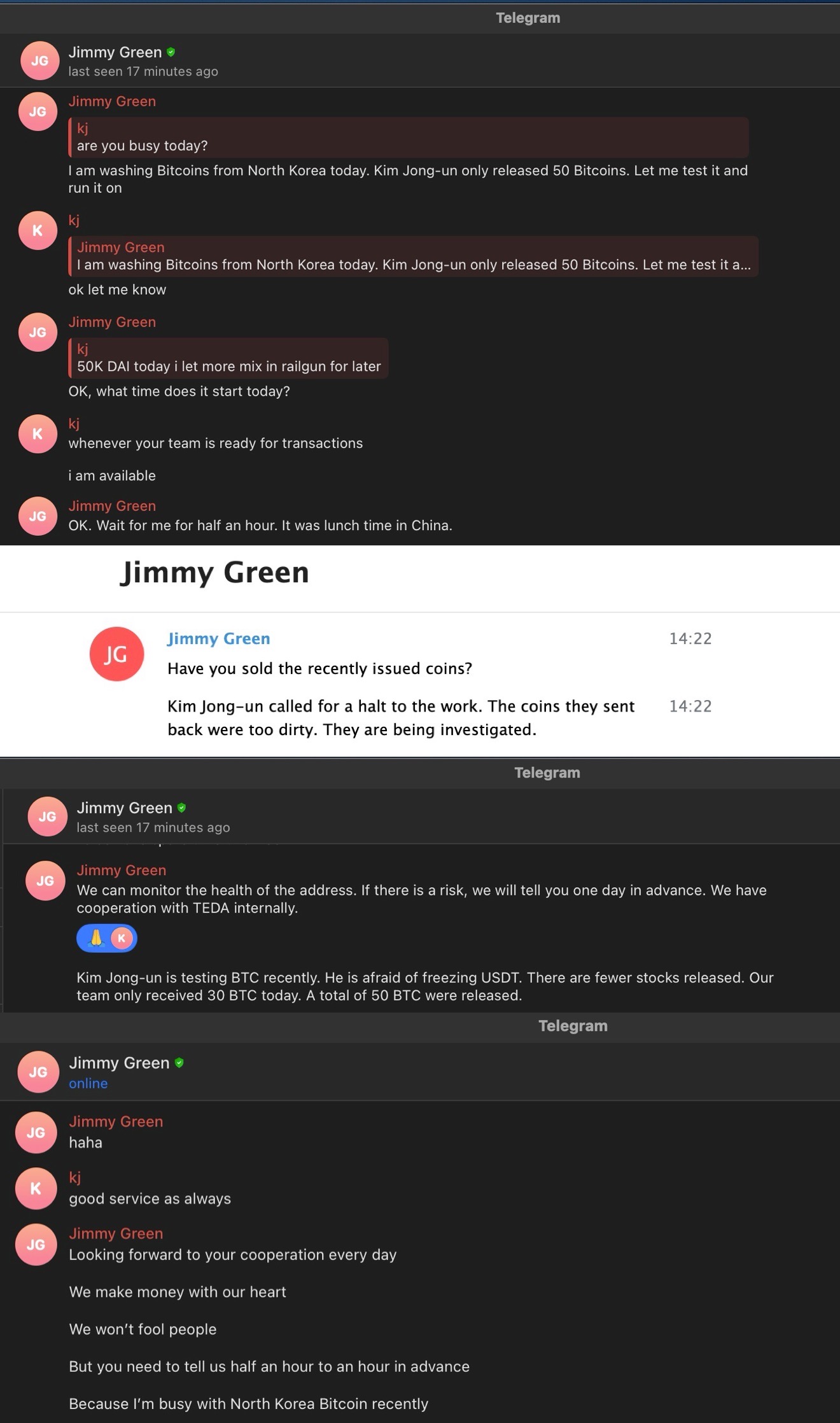
1/ How I infiltrated a Chinese organized crime syndicate that has laundered $1B+ across multiple exploits for Lazarus Group.
Posing as a client, I gathered intel that helped action freezes for the Feb 2025 Bybit exploit and attribute illicit activity onchain.

Common Defense retweeted
Common Defense is going to @token2049 Singapore.
We're co-hosting an event with our friends at @Quantstamp @HypernativeLabs @Lukka and @Cloudflare.
Meet the team by registering for our event below!

Common Defense is going to @token2049 Singapore.
We're co-hosting an event with our friends at @Quantstamp @HypernativeLabs @Lukka and @Cloudflare.
Meet the team by registering for our event below!
Register for our event: luma.com/lj8vcxk7

Common Defense retweeted

"Several vulnerabilities" in the Linux kernel lwn.net/Articles/1097401/
Thank you to everyone who joined our @kbwofficial events!
We had a amazing time co-hosting with @Quantstamp and @Zircuit.
Common Defense protects teams from social engineering attacks.


