

CEO, Harrison Family Office | Publisher & Author | The magic money machine” - FT | “Tech evangelist” - Il Figlio | “Visionary” - The European
Joined October 2022
- Tweets5.6K
- Following1.4K
- Followers2K
- Likes10.8K



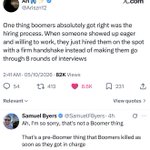



Despite what the popular narrative is, the Iran War wasn’t why Trump lost the midterms. He lost the midterms because people expected to get rich quick, and they didn’t, and because he himself got much richer very quickly. And because there was no one competent around him.

Thoughts after the blue wave:
Ossoff/AOC, Newsom/Ossoff, Newsom/Talarico, or Talarico at the top; literally any of these combos beat anyone in the GOP and I think it’s very unlikely a breakout GOP talent appears in the next two years. So it’s probably a safe bet to plan for a Democratic White House in 2028.
As a side note, this is different from 1994 when the Republicans scored well in the midterms, since the Republicans didn’t have any good candidates to field against Clinton in the general. This time, the Presidential candidates are all clearly in the Democrat camp while the GOP is full of frat boys and old-timers and that’s not going to win.

I’m not really sure what the intent of the UN is here: is it to convince any marginal people that the world is not secretly manipulated by global elites? Because coming from the UN, this will only confirm in the minds of those already convinced the world is that it is even more likely to be moreso, while not really having any effect on the opinions of anyone else.
Just in case anyone is genuinely interested in the truth, the world IS controlled by those with the majority of money and power disproportionately, but in a far less coordinated fashion than many think it is. In fact, elites fight, vie for each others’ money, power and status constantly, and use every weapon they can at every point they can to get the upper hand over someone of their own social class, so in many ways, there is not so much a conspiracy against the people as a series of alliances that are variously practical pursued for various reasons at any one time.
It’s messier than it looks.
That said, this applies to scenarios where free markets are de facto. In market economies that are more oligarchical in nature, the rule of the elites tends to be more stable as there is not so much a conspiracy between them but a silent agreement to stand off against one another. This is why we can’t ever let governments get too big, which is what has been such a problem in recent years, and ironically, which the UN represents the result of very well!


Yes this is a natural American advantage- there’s no jealousy, just ambition. The world would do well to learn from America this way.

Europeans are brainwashed into thinking it's morally superior to play small.
A UK startup headhunted me for a sales role, aged 26.
The founder asked about my life goals.
I replied, 'I'd love to be a founder one day'.
He cut the interview short.
20 minutes the recruiter called me back.
He was furious.
'Why did you tell him you want to be a founder?'
This founder viewed me as a threat, simply because I shared the same life goal as him.
He expected me to be his serf. Forever.
That's the European mindset: Landlords and serfs.
That's why 90% of my clients are American today.
Total strangers in America encourage my dreams and celebrate my work more than anyone in the UK.
I have watched my European friends and family members switch to working for American startups.
They all become bigger, braver and more confident.
They realise they can build products, sell their skills and start companies too.
The best bit is when you see how furious Europeans back home are, because they can no longer control you and pressure you to play small.
This makes a lot of sense and it’s sort of unclear why more investors don’t get this.

Crypto is going to be the winning market just because everything else is so comparatively cooked.
Lending markets are tapped as Ai hyper scalers raise $ for data center build outs.
Real Estate is cooked if there is more rate hikes (there will be after mid terms)
Anthropic is going to IPO and absolutely cook the market. Ken Griffey and the EA doom cult will be eating but the rest of the market will get a nice liquidity suck to the tune of 1.4T.
Gold looks, meh, it hasn’t really been a good inflation hedge. (Rates/ uncertainty went up it went down).
Crypto has been absolutely demolished for the last 6 months. Everyone is depressed, but it has shown clear signs that the core crypto business is durable (pump continues its upward growth and rev, Hype token keeps chugging up, FOMO making bank, GMGN making $, Axiom, Robin Hood ect.)
Crypto is the only market with clear room to run.
There is an economic dimension to the Tommy Robinson verdict that everyone’s overlooking here too. Fifty years ago in 1976, the likely maximum penalty for this conduct would have been a fine and a warning; today it’s a full criminal trial and possible years behind bars. This is too wide a disparity for an economy to absorb in such a small space of time in terms of poltical risk expectation. If I buy a 30-year bond, a property, or something within a sovereign for long-term asset stability purposes, how can I be sure that I’m buying into the same set of laws and legal principles underlying the economy I am buying into?
Unless there’s more moderation of legislation to a much greater extent, this will affect the British economy over the long term in a very serious way. That may sound alarmist, but think what political risk actually entails: it is simply the discount for uncertainty we put on nation states. If laws are going from sort of civil to hard criminal in an adult lifetime, that’s a big problem for long term investors. This needs serious review at some point.

A summary and some of my personal thoughts on the @TRobinsonNewEra verdict:
Charges: Tommy Robinson intimidated two Daily Mail journalists, Andrew Young and Jacob Dirnhuber with statements such as “I’m coming to get you” (to Young) and “I’ll be knocking at your door” (to Dirnhuber) and sent PIs to their houses to photograph at least Dirnhuber outside his house. This amounted to harassment of the journalists. Dirnhuber moved house with his partner and his dog for a bit.
Defense: Tommy Robinson was trying to get the reporters’ attention as he wanted to question them on camera and "put pressure on them” to take the story that exposed where he and his 12-year-old daughter were staying down. She had received harassing messages, including a rape threat. In trial, Robinson openly wept when asked how the story affected his children, and said he tagged Musk in a post hoping to get the article removed, since X has rules against posting addresses
Verdict: 10-2 guilty of harassment causing fear of violence (the fear of violence was vigorously denied by Robinson at trial).
Opinion: it’s a bit disappointing to see journalists reporting this sort of thing to the police. Once, when I co-wrote and published a story by the late Nate Thayer (of Pol Pot Interview fame) about an undercover FBI agent called Chris Barker who was also the head of the South Carolina Ku Klux Klan, Barker and other Klan members threatened to decapitate Thayer’s dog afterwards (you can look it up on Wikipedia). Nate didn’t care. In fact he viewed the attack as a badge of honor.
Nothing in Robinson’s comments remotely rises to that level so in some ways the whole case is a bit puzzling. It certainly doesn’t look like Robinson meant to cause anyone to come to any physical harm. People who physically hurt you don’t send you messages telling you to watch your back, they just do it anyway, so the violence allegations are poor in real terms in my view.
I also don’t think, despite being ill-advised, that Robinson’s reaction could have been entirely unexpected for two hacks from the Mail doxing his hotel with his family in it. Journalists who publish sensational headlines and receive awards for scoops that identify individuals at their locations ought to have a thicker skin than to go to the police and complain about being harassed. It’s just the way the world works: play with fire, fire strikes back.
What worries me mostly then about the verdict is what it says about Britain as an establishment and collectively as a people today, but especially as a press corps: that they’re somewhat weak, over-sensitive and a little hypocritical.
Media specifically, and by association, journalists should be mostly disliked and not revered by anyone. They should get that their job often operates in an ethical grey area and be willing to live with that. Too often today, it’s the opposite way round: journalists long to be adored by powerful people, and somewhat want to have their cake and eat it too: “we can do this and that to you, and we will use the courts and public soapbox to stop you doing similar things to us,” is the appearance here. This case then is very damaging for the British press more than anyone else. Plus, this endless cooperation between big media and the State against people with controversial or difficult opinions is a bad look for Britain.
Term: I think the fairest and most likely outcome now is a 1- or 2-year suspended sentence. The judge will surely see the case for what it is, and find that while the behavior by Robinson was wholly-inappropriate, it doesn’t merit a prison term. An appeal actually stands a better chance than most people assume, too.
Summary: While this may look like a vindication for the Mail and the government from their point of view, I fear that ultimately this will be a rather Pyrrhic victory for both and it’s going to do more harm than good for society overall with them having blown this up to the extent of a full criminal trial.
A boycott of the Daily Mail is the appropriate response to a group of people who call themselves journalists but can’t take the heat and resort to the courts to resolve the very fights they started. I wholeheartedly agree with this.

Boycott the @DailyMail Do not use The Daily Mail online website and go further, identify and start to boycott all advertisers with the @DailyMail Hit them
Hard in the pocket. Share this as widely as possible. Get this trending everywhere.
This is a very reasonable point, in a column by Li Xing from a recent edition of @ChinaDaily


This is very interesting on a number of levels.
From personal experience, this matches up. I have met many people without formal education (probably as many as with) who are well-versed, knowledgeable and always intellectually engaged at a very high level.
Second, the comment about how Marxist ideology tries to refute this is noteworthy. This is the problem with socialism: it tries to create this picture wherein there’s one class with money and privilege who knows everything because of their access to knowledge and another that is exploited by this class. This is insulting and untrue, and it appears this book shows that untruth up.
Finally, the idea that TV and universities have inherently dumbed down society among working people is as true as it is at the top; just look at the lacking quality of modern politicians for an immediate example. Universities are for those who want to get an advanced academic education in order to further a specific field of knowledge, and probably are best not used as a right of passage into adulthood generally, whereby apprenticeships would be a much better way.
I’ll read this. Interesting subject matter.

This was an illuminating read.
The intellectual life or "high culture" was never something that only the elites enjoyed.
In England, there has long existed a widespread, self-directed culture of education among the working class. Coal miners in industrial England read voraciously, many of them self-studying history or even Latin after long shifts underground.
Rose overturns the assumption that the working classes of industrial Britain were largely uneducated or intellectually disengaged. Miners and mill workers in fact built personal libraries and formed societies to study Shakespeare, Dickens, Milton, even Plato.
While elites might have consumed culture for status, ordinary readers engaged with it morally and personally. They saw in Shakespeare and the classics a means of moral development and self-mastery — this revelation directly challenges the 20th-century academic assumption (inspired by postmodernism and Marxist cultural studies) that "high culture" is inherently exclusionary.
Pulling from autobiographies and letters, Rose shows that workers often described reading as a form of inner liberation, citing writers like Ruskin, Carlyle, and Dickens as their moral guides. They read with a degree of seriousness we rarely see today, treating their books as beloved companions in a lifelong pursuit of wisdom.
The rise of mass media and television following WWII caused a preference for reading to slowly give way to one for passive entertainment.
And the democratization of education paradoxically coincided with a lowering of intellectual standards — just as more people than ever attend university today, yet popular culture as a whole is much less intellectually vibrant than it was 50 years ago.

Back in the 80s we all thought these were going to be a thing at the turn of the Millennium so, in other words, the world has been waiting for one of these for 26 years! 🤣 🎉 🚗 ✈️ 🤩 … very well done! They’re here at last!

If you do a number of random things infinitely but with discipline you will find the results pay off. The key is to filter by a mix of intuition and intelligence. You need to be very sharp for that! Good post though, genuinely thought-provoking.

I'm convinced that if you tweet infinite times on X, you will find the opportunity you're looking for, even if you don't yet know what that is. It could be a job opportunity, a client, an investor, a business partner, a good friend, heck or even your wife/husband. It only takes one banger tweet. No strategy, no overthinking, off the cuff, pure retardmaxxing takes. Have fun with it, and stay openminded. You don't need to know where it'll go, you just need to stay in motion.
This is a very important nuance that’s so often lost today. True conservatism is much more liberal than socialism. It believes in the empowerment of the individual, free enterprise, free market, and the right of privacy and autonomy of the individual first and foremost. Until there’s a right wing politician in power who is ready to reduce the size, cost and influence of the State, there can be no true liberalism at all.

My father was much more Liberal, but that's very much closer to being conservative than socialist. He was very independent and didn't believe in being dependent on the state in any way.
So we were brought up with this feeling that, first, it's your bounden duty to take responsibility for your own life. You work for yourself and for your family, and you save, and then you look after the unfortunate. It was our bounden duty to be independent of the state if we possibly could be. If we were really unfortunate, then and only then did we rely on the state.
Naturally, the whole structure of the free society — freedom, the rule of law, the free enterprise society and the generosity to others out of your own efforts — was very much more in keeping with the Conservative Party.