Dave Johnson retweeted
A student at the University of Oxford was celebrated in the world of science photography in 2018 for capturing a single, floating atom with an ordinary camera. You can even say it's just light, but this is actually the light of a single atom [read more: buff.ly/3rM9Bwu]
Dave Johnson retweeted
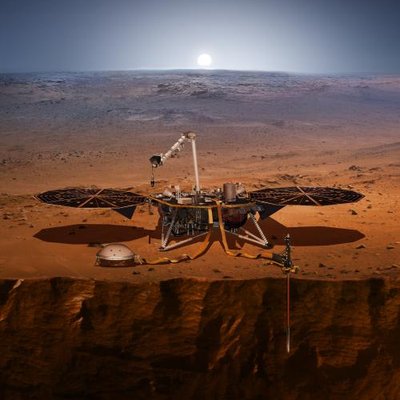
To the millions who sent your names with me: thanks for riding along. The two chips with your names may be dustier now (just like me), but we're here together on Mars, my forever home.
Future explorers, send your name on NASA’s next Mars mission: go.nasa.gov/3fa0qOK
Dave Johnson retweeted
Live views of #HurricaneIan from the @Space_Station as it flies over the storm. teapaw.org/i/broadcasts/1RDGlaVgw…
Dave Johnson retweeted
RETWEET for a chance to win an autographed Lucas Giolito baseball.
#ChangeTheGame x @GuaranteedRate
Dave Johnson retweeted
It's here–the deepest, sharpest infrared view of the universe to date: Webb's First Deep Field.
Previewed by @POTUS on July 11, it shows galaxies once invisible to us. The full set of @NASAWebb's first full-color images & data will be revealed July 12: nasa.gov/webbfirstimages

ALT The background of space is black. Thousands of galaxies appear all across the view. Their shapes and colors vary. Some are various shades of orange, others are white. Most stars appear blue, and are sometimes as large as more distant galaxies that appear next to them. A very bright star is just above and left of center. It has eight bright blue, long diffraction spikes. Between 4 o’clock and 6 o’clock in its spikes are several very bright galaxies. A group of three are in the middle, and two are closer to 4 o’clock. These galaxies are part of the galaxy cluster SMACS 0723, and they are warping the appearances of galaxies seen around them. Long orange arcs appear at left and right toward the center.
Dave Johnson retweeted
☄️ See comet come, see comet go.
Only discovered in January 2021, Comet Leonard’s half-mile (1 km) mass of ice, rock, and space dust will make its closest pass of the Sun on Jan. 3, 2022 – a journey 40,000 years in the making: go.nasa.gov/3mpVPyC
Dave Johnson retweeted
RETWEET for a chance to win an autographed Luis Robert jersey. #SilverandBlackFriday
No purch. nec. Enter by 11:59 p.m. CT on 11/26/21. atmlb.com/3E21OjS
Dave Johnson retweeted
RETWEET for a chance to win an autographed Lucas Giolito baseball. #SilverandBlackFriday
No purch. nec. Enter by 11:59 p.m. CT on 11/26/21. atmlb.com/3lf0p1Z
Dave Johnson retweeted
RETWEET for a chance to win an autographed Dylan Cease hat. #SilverandBlackFriday
No purch. nec. Enter by 11:59 p.m. CT on 11/26/21. atmlb.com/3FVyuw9
Dave Johnson retweeted
Good morning, Sox fans! It's time for some #SilverandBlackFriday deals! RETWEET for a chance to win an autographed José Abreu photo.
No purch. nec. Enter by 11:59 p.m. CT on 11/26/21. atmlb.com/3rbpyyz
Dave Johnson retweeted
RETWEET for a chance to win an autographed Tim Anderson bat. #SilverandBlackFriday
No purch. nec. Enter by 11:59 p.m. CT on 11/26/21. atmlb.com/3rs0kMz
Dave Johnson retweeted
This is what an M-class solar flare looks like up close. The Solar Optical Telescope on NASA/JAXA's Hinode spacecraft observed the April 16, 2012 M1.7-class solar flare from Active Region 1461 over the eastern limb of the Sun [source, video: buff.ly/2YADBRK]
Dave Johnson retweeted
RETWEET for a chance to win an autographed Tim Anderson baseball. #ChangeTheGame
No purch. nec. Enter by 11:59 p.m. CT on 10/4/21. atmlb.com/3uET4MB
Dave Johnson retweeted
Listen to natural radio emission from Venus’ atmosphere. 🎧 In July 2020, #ParkerSolarProbe flew by Venus. Skimming through the planet’s upper atmosphere, it discovered a natural radio signal that shines new light on Venus’ atmospheric changes. go.nasa.gov/3xFOzma
Dave Johnson retweeted
Today is the official start of Spring: the Spring/Vernal Equinox! 5:37am this morning marked the time when the day-to-night line, called the terminator, was perfectly vertical from pole to pole. #SpringEquinox #FirstDayOfSpring
Dave Johnson retweeted
#ParkerSolarProbe captured this stunning view of Venus during its close flyby of the planet in July 2020. The image shows a bright rim around the planet’s edge, thought to be nightglow, and the dark shape of Aphrodite Terra, a highland on Venus' surface. go.nasa.gov/3qTwYmS