

Researching China. On here for news, analysis, and ideas to look into.
Joined October 2017
- Tweets5K
- Following801
- Followers2.8K
- Likes11.6K




Pinned Tweet
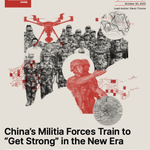
🚨 NEW RESEARCH — The ability of China’s militia forces to support the People’s Liberation Army (PLA) across all domains is likely improving. My latest explores war-oriented militia training reforms since 2018 1/x (link and key findings below)


Devin Thorne retweeted

PLA Joint Operations Command Centre (JOCC)
May see details of JOCC from excerpts of a paper by Colonel Hsu Wei-hsun (徐偉勛) of Taiwan Army on PLA’s Joint Operations Command Centre (联合作战指挥中心), published in Army Academic Bimonthly, Volume 60, Issue 597 in October 2024.
I have also added some of my observations. May read the full article here,
chinaview.in/p/joint-operati…

Devin Thorne retweeted

It's been months of stories about AI models going rogue. American AI leaders themselves are calling to slow the pace of development. But what does China think?
@mattsheehan88 and Sophie Zhuang explain: carnegieendowment.org/resear…

Devin Thorne retweeted

This book by @ToshiYoshihara is going to be a masterpiece — and a masterclass on the Chinese Communist Party’s way of war. I cannot wait to see it in the hands of students @NavalWarCollege!

Why does the People’s Liberation Army continue to study campaigns fought more than 70 years ago? The victories that secured Communist triumph in the Chinese Civil War remain central to PLA doctrine, professional military education, and strategic thought.
In the forthcoming "Mao’s Finest Hour," Toshi Yoshihara examines the decisive campaigns of 1948–1949 (Liao-Shen, Huai-Hai, and Ping-Jin) and their enduring influence on how China’s military thinks about war.
Drawing on extensive Chinese-language military sources, doctrinal writings, campaign histories, memoirs, and Nationalist accounts, Dr. Yoshihara traces how these victories became foundational lessons within the PLA’s institutional memory and considers their relevance to military modernization, future warfare, and a potential Taiwan contingency.
Yet historical success can create blind spots as well as insights. The lessons the PLA draws from these campaigns may illuminate future conflict—or encourage dangerous analogies in a radically different strategic environment.
📚 Forthcoming from Cambria Press cambriapress.com/MaosFinestH…

Devin Thorne retweeted

The mood in China's AI industry is not great. A recent article by Bob Chen, a long-time contributor to Baiguan, has been privately circulated on the Chinese internet, even though it has been taken down by censors after it went viral.
Bob makes six points worth thinking about.
1. Chinese labs used to have a fallback when they couldn’t buy Nvidia chips. They could rent time on the same chips in Southeast Asia. Now that avenue is closing. Switching to Huawei brings up the next question. Can Chinese chipmakers get the equipment to make enough of them?
2. Distillation let Chinese labs learn from the answers of models that US labs had already spent billions training. As OpenAI and Anthropic make that harder, Chinese labs have to collect more of their own data and pay for more experiments, including the ones that go nowhere. Alibaba can fund that from other businesses. An independent lab has to go back to investors, who are already losing faith
3. A lot of money has gone into Chinese startups building specialized “robot brains.” What happens to those valuations if a general-purpose model learns to do the job? In one test, a system using GPT already beat several specialist models at grasping and moving objects. China could build excellent robots while much of the value goes to whoever supplies the intelligence.
4. Chinese AI is creating far less revenue, on a rapidly rising cost base. Epoch AI puts annualized AI revenue for six leading Chinese companies combined at about $11 bn. OpenAI and Anthropic together are at roughly $105 bn.
5. Even where China leads, it depends on American customers. Chinese firms supply roughly two-thirds of the world’s optical transceivers, the components that move data over fiber in AI clusters. Washington is reportedly considering restrictions on new Chinese models. This will be a stupid decision if true. There aren’t many buyers who can replace an order from Microsoft.
6. We’ve spent a lot of time debating whether Chinese models are three months or six months behind. Bob’s question is how much it will cost to close that gap next time. The bet on Chinese AI was that its labs could get close to the frontier on a fraction of the budget. What happens if they have to spend something close to US money while earning a tenth of the revenue?
Read the full article:
baiguan.news/p/chinas-ai-mod…

Devin Thorne retweeted
NEW: The PRC is conducting what it understands to be a “guerrilla” maritime strategy in the Pacific. It is “guerrilla” in PRC parlance because it blends overt military development with seemingly innocuous political and economic influence. The goal is to gradually create conditions to threaten key sea lines of communication and undermine US sea control ahead of a Taiwan contingency.
New from ISW and AEI’s Coalition Defense of Taiwan: Surveil, Project, Divide: China’s “Guerrilla” Framework to Reshape the Pacific, by Jackson Karas, Alison O’Neil, and Alexis Turek.

Devin Thorne retweeted

Glad to see this report released. Thanks go to my coauthors at RAND 🙏 rand.org/pubs/research_repor…

Devin Thorne retweeted

EXCLUSIVE @BreakingDefense: House China committee pushes Air Force on think tank cuts
breakingdefense.com/2026/11/…
“Under-resourcing” the China Aerospace Studies Institute (#CASI) “could risk undermining the ability of military leaders and civilian policymakers to understand” Beijing’s aerospace strategy and military prowess, according to a letter addressed to Air Force Secretary/@SecAFOfficial Troy Meink.
By @michaeldmarrow on November 04, 2026 11:28 am
WASHINGTON — Lawmakers on the House Select Committee on China/@ChinaSelect are pushing the Air Force/@usairforce for answers about a planned downsizing of its Beijing-focused think tank, warning that any reduction in the group’s output could impact America’s national security.
“Under-resourcing” the mission of the #China #Aerospace Studies Institute (@CASI_Research) “could risk undermining the ability of military leaders and civilian policymakers to understand” Beijing’s aerospace strategy and military prowess, according to a copy of the letter viewed exclusively by Breaking Defense.
Addressed to Air Force Secretary Troy Meink and signed by Republican Chairman John Moolenaar and Democratic Ranking Member Ro Khanna, the letter requests a briefing by Nov. 20 to provide “resourcing and personnel decisions” for CASI.
In their letter, House lawmakers say that “[a]ny potential loss” of CASI’s skills “is particularly worrisome” due to China’s burgeoning aerospace capabilities and “aggressive activities in the Indo-Pacific region.” Praising CASI’s work, the lawmakers say that alternatives to the institute’s “in-house expertise” would likely require the Air Force and other government entities “to expend considerable resources to purchase contracted expertise from external vendors.”
Given rapidly advancing air and space power by the Chinese People’s Liberation Army (PLA), the lawmakers say that diminishing relevant analysis is “particularly concerning” and could impact American deterrence, as fears mount over a potential battle for Taiwan.
“As the PLA continues to expand its aerospace capabilities, our need to understand these advancements will continue to grow,” the letter says. An Air Force spokesperson told Breaking Defense that the service “will respond directly to the committee.”
The letter comes after it was revealed in September that the Air Force planned to axe CASI’s 10-member civilian workforce. While the Air Force maintained its premier China-focused think tank would remain open and operate with military personnel, its director, Brendan Mulvaney/@B_Mulvaney, stressed in an interview with Breaking Defense that the elimination of its civilian staff would functionally shutter the institute.
Founded by Mulvaney roughly a decade ago, CASI regularly publishes on Beijing’s air and space forces, drawing on open-source information translated from Mandarin. The institute’s publications and training courses are seen as valuable resources for educating the broader military policy community on Chinese air and space power, prompting experts to denounce CASI’s expected downsizing.
“The idea that you could do research or the translations that we’re doing is not credible” without civilian experts, Mulvaney previously told Breaking Defense.
Mulvaney explained that the think tank’s civilian posts are being converted to an unfunded status, meaning that staffers will continue to work until being moved to a different role elsewhere in the Department of the Air Force — and once they leave, their positions cannot be backfilled. CASI’s current commitments stretch until around March and will largely function as usual until then, but after that the institute’s fate becomes more unclear, according to Mulvaney.
News of the CASI cuts raised questions about similar efforts run by the Army, Navy and Marine Corps, though spokespeople for each service previously told Breaking Defense that there are no planned changes for their respective Beijing-focused programs.

Devin Thorne retweeted
Vital warning by @PLMattis & @chrisnyeeee in @WarOnTheRocks!
“The #China #Aerospace Studies Institute @CASI_Research will linger in a kind of half-life and may yet recover. Hopefully, it will regain its budget and billets before its expertise scatters. 10 civilian billets are a rounding error in the Air Force @usairforce budget. Restoring them requires only that someone with the power of the purse decides the mission matters. We need more of these institutes, not fewer, and more institutional support to sustain #OpenSource analysis of America’s greatest rival. With one fewer, the role of places like the China Maritime Studies Institute @ChinaMaritime at the U.S. Naval War College @NavalWarCollege and publications like Jamestown’s @JamestownTweets China Brief @ChinaBriefJT become all the more important.”

Outside groups can't easily replace the China Aerospace Studies Institute’s work. The Air Force just cut the 10 civilians who did all of its research. warontherocks.com/2026/10/ch…

Devin Thorne retweeted

The PRC has set up several new institutions at military academies to train specialists in hi-tech and discipline inspection.
The College of Unmanned and Intelligent Engineering, the College of Combat Support NCOs & the College of Equipment Support NCOs were established within the PLA Army Engineering University on Wednesday.
The National Defense University, the PLA’s highest academy, formally inaugurated the College of Discipline Inspection, Law and Politics at its Xian campus in Shaanxi province.
Also on Wednesday, the PLA Joint Logistics Support Force Engineering University, which was launched last year, announced the addition of four colleges and one institute under its umbrella.
The PLA AEU, formed in 2017 during President Xi Jinping’s massive military reform, is tasked with training engineering and technical personnel as well as command officers for the PLA Ground Force.
The establishment of the College of Unmanned and Intelligent Engineering at the PLA Army Engineering University highlights the military’s growing emphasis on uncrewed systems and artificial intelligence.
Devin Thorne retweeted

UK: On 30 September 2026, MI5 issued a Security Service Espionage Alert stating that the primary purpose of the China General Technology Research Institute (CGTRI) 中国通用技术研究院 is to fund research that directly improves Chinese Ministry of State Security (MSS) technical capability for espionage. CGTRI funds academic research in China on topics including AI and cybersecurity. More than 100 UK-linked academics have contributed to research projects funded by MSS via CGTRI. In some cases, academics may not be aware that CGTRI is funding the Chinese research project they are contributing to.
mi5.gov.uk/mi5-issues-espion…

Devin Thorne retweeted

Proud to have been part of this important @ndupress project examining the Chinese PLA in a new era. Thanks to Phil Saunders and @jwuthnow for including me. My hope is these types of efforts continue, especially given the recent announcement that @CASI_Research will shut down. We need China military analysis now more than ever.
ndupress.ndu.edu/Media/News/…

Devin Thorne retweeted
Honored to support the @NavalWarCollege’s @ChinaMaritime Studies Institute (#CMSI) from the very beginning!
Two decades on, we are analyzing a very different array of PRC military maritime developments from when we started…
From CMSI Director CAPT @ChrisHSharman, @USNavy (Ret.):
#China #Military Maritime Watchers—
Twenty years ago, the Navy created a small institute at the Naval War College to focus on PRC military maritime issues. Its approach was distinctive: use China’s own scholarship and professional journals to better understand how the PLA thinks, plans, and operates in the military maritime domain.
Two decades later, that mission has never been more important.
Today, the China Maritime Studies Institute (CMSI) commemorates 20 years as an official Navy program and two decades of research, education, and engagement focused on China’s military maritime development.
CMSI traces its origins to a group of Naval War College faculty who recognized the need for a dedicated effort to better understand China’s growing military maritime power.
Established within the College in 2004 and formally launched as an official Navy program in 2006, CMSI became the Department of Defense’s first service-level Professional Military Education (PME) China center.
Over the past two decades, CMSI has sought to do something that remains central to our mission today: conduct rigorous research on China’s military maritime forces and provide penetrating insights that are relevant to the U.S. Navy, the @DeptofWar, and national security decision-makers.
We were honored to mark this milestone with a special lecture today at the Naval War College by former CNO Admiral Gary Roughead and former CMSI Director Dr. @peter_dutton, who shared their perspectives on CMSI and its development.
Twenty years is an important milestone, but the mission is even more pressing than ever.
We are proud of where CMSI has been and even more focused on where the next twenty years will take us.
>>> Click here to read my personal reflection on CMSI’s founding and subsequent evolution:
andrewerickson.com/2024/10/c…


Devin Thorne retweeted
PRC: "The Global Footprint of China's Defense Labs: Contacts and Collaborations with Foreign Institutions" airuniversity.af.edu/Portals…

Devin Thorne retweeted

1/ For anyone interested in a concise distillation of China's vision for the future of international political order and where they see history heading, I recommend this speech by Xi Jinping to the Shanghai Cooperation Organization this week (short 🧵):
english.scio.gov.cn/m/topnew…
Devin Thorne retweeted

Good @Reuters report highlighting two previously undisclosed Chinese and US-UK space operations.
"In June, a secretive unmanned Chinese spaceplane closely monitored by U.S. military analysts released a small satellite hundreds of miles above Earth, then looped around another Chinese satellite before returning towards the spaceplane. Chinese researchers linked to the military are developing technologies ranging from satellites designed to pursue and even capture other spacecraft to systems that could extend fuel supplies while doing so, according to a Reuters review of patent-related documents, procurement notices and academic papers. And in Sept last year, the U.S. and Britain conducted their first joint military operation in space in the path of a suspected Chinese spy satellite."
reuters.com/world/asia-pacif…

Devin Thorne retweeted

What drives China’s global strategy under Xi Jinping? Pei Minxin put five key questions to Steve Tsang and me. Read our interview in the China Leadership Monitor: prcleader.org/post/clm-insig…

Devin Thorne retweeted

🇨🇳 COSCO uses concealed equipment on board its ships to spy on military communications near the coastlines of target nations including the US.
COSCO has a decades-long intelligence-collection partnership with Beijing. The arrangement allows China to collect communication signals from vessels and aircraft operating across Europe, North America and Asia.
The advanced equipment aboard the ships is intended to enable China to gather information about military communications technologies and encryption developments.
The effort also allows Beijing to monitor key shipping lanes and maritime routes crucial for trade and military navigation.
COSCO ships are using "sophisticated signals intelligence collection" platforms, not routine communications hardware.
Beijing uses the information gleaned to bolster its position in territorial disputes and provide maritime reconnaissance and early-warning indications of foreign military targets.
A report published by the US Naval War College in April 2025 said it was likely that 🇨🇳 PLA was harnessing the country's fishing and commercial shipping fleets for intelligence and surveillance gathering.
The Pentagon put COSCO on its list of companies linked to China's military in Jan 2025, a designation that carries serious reputational costs for companies as well as US government procurement bans, but does not entail formal sanctions.
Chinese law requires the country's firms to support government intelligence work.
Nonetheless, COSCO remains one of the top global shipping companies calling at US ports and has several terminal service joint ventures for container ships at US ports.
The US government would likely have difficulty decisively addressing the security concerns given the degree to which COSCO is interwoven into US trade.
reuters.com/world/china/chin…

Devin Thorne retweeted
A record 244 PRC coast guard, scientific research and other ships were detected in waters around Taiwan last month, up from 55 in June and 30 in May, the Coast Guard Administration (CGA) said in an article published today by Radio France Internationale.
An average of almost eight PRC ships were detected per day last month, about 60 percent of which were coast guard ships, the article said.
The figures do not include PRC warships, which are deployed on a near-daily basis, the article added. taipeitimes.com/News/taiwan/…

Devin Thorne retweeted

A study concluded that even when fully mobilized, China’s industrial system would only be able to meet 60% of the military demand for drones in a conflict. “Under high-intensity demand shocks, the supply chain, although possessing certain mobilisation and recovery capabilities, still faces a significant supply-demand gap” scmp.com/news/china/science/…

Devin Thorne retweeted

Pleased to share that my books is now available for pre-order on @OUPAcademic website global.oup.com/academic/prod… and Amazon amazon.com/Simmering-Seas-Es…
