

𝘿𝘼𝘾 𝙀𝙘𝙤𝙣𝙤𝙢𝙮 𝙞𝙨 𝙩𝙝𝙚 𝙬𝙖𝙮. Manifesto: https://teapaw.org/t.co/yDZYWGGfrG White Paper: https://teapaw.org/t.co/jR0iaSRkiW RPM Light Paper: https://teapaw.org/t.co/oa3eAyF8wb
Joined February 2022
- Tweets558
- Following181
- Followers9.4K
- Likes335




Pinned Tweet
My Telegram account with the handle @daceconomy got hacked last week and I lost control of it. Please don't respond to any message from that account. DM me here if you want to contact me.
DAC Economy retweeted

I've recently talked to quite a few people recently who believe they can just rent B300 nodes, install @vllm_project / @sgl_project, plug into @OpenRouter, and start printing money.
I think they seriously underestimate how hard the inference business has become.
A few facts everyone should know:
- Getting listed is extremely hard now! OpenRouter reportedly gets 40 provider applications every day and only approves 1. It could take months just to get listed!
- Competition is brutal! There are already 80+ providers serving @deepseek_ai models. Unless you have done extreme optimizations, you won't get any meaningful traffic!
- Some competitors aren't even trying to make money! Some providers intentionally price below cost to attract traffic. They treat the losses as marketing spend, and no one can even compete the price!
I think the era of simply hosting open-source models and selling tokens is coming to an end, especially for new entrants.
The real opportunity is moving up the stack. Sell solutions, not tokens.

DAC Economy retweeted

“Centralization of power is a unique human phenomenon. In nature, no individuals of a species could accumulate centralized power like humans do. In fact, individual boundaries are quite well preserved across diverse species. The reason human species could break through biologically based individual boundaries to accumulate immense centralized power is due to the greatest innovation of all history, money, a tool that simultaneously harnesses communal value and breaks communal harmony. Money appears to have single-handedly propelled the human race to great achievement of civilization, as well as great exploitation and enslavement within the human race. Even the blockchain, as we know it, cannot escape the confines of money and its variants - crypto-tokens are forms of money. If this is the case, then we have a conundrum - if money, or crypto-tokens, are tools facilitating the centralization of power, how can blockchain technologies be truly decentralized?”
Ming Guo (@DacEconomy) - medium.com/@wddp_83702/dac-e…

Not just ETH. Maybe that's the fate of every blockchain. Utility first and eventually all became a store of value.
This observation reflects a deeper nature of blockchain's economic mechanism. Store of value is the ultimate fate of a blockchain's cohesive buildup of its economic utility in a resource-bound outer economy.
That is the end game of "traditional blockchains" like Ethereum and Bitcoin (and others).
A different game that is NOT store of value lie beyond (and in between) blockchains (the adhesive game) and of course, A.I., with its compute token economy.

Vitalik now says ETH's value comes from being a store of value, not from burning fees.
Is that a pivot? Twelve years of his posts, tweets and talks show five labels for ETH, and one priority that barely moved: security first. 🧵
@VitalikButerin

1
50
DAC Economy retweeted
Not sure if I was more enlightened or more naive when I wrote this, but it was when I still had a clear hope of blockchain being used for its ultimate good: bringing about a decentralized, equitable society.
Deep immersion in the industry noise and current world events wears that clarity down.
zkm.io/blog/the-why-of-zkm?n…

DAC Economy retweeted

seeing this progress from @AnthropicAI makes me reflect on Valida - the zk prover my team built. it’s encouraging to see zk finding its place. i hope we still contributed something valuable along the way and helped move the field forward!

New Anthropic research: progress on provable inference for large language models.
Here, we introduce FlashProve. Building on established cryptographic techniques, FlashProve allows developers to verify whether a given response came from a given AI model. It’s substantially more efficient than prior open-source methods for doing so.
These proofs have a range of applications. They can, for instance, make it harder for attackers to hijack a chat, or enable safety evaluators to verify that the model they’re testing is the same one being served to customers.
For our full write-up, see here: anthropic.com/research/prova…
Further progress in provable inference will likely be an important part of improving trust in AI deployment. To that end, we're open-sourcing FlashProve’s code, here: github.com/anthropics/FlashP…
We’re grateful to our collaborators: Alessandro Chiesa, @GiacomoFenzi, @gwberg95, @miranda__christ, Rahul Dalal (rdalal.github.io) and Ben Mayer (@transmissions11).


DAC Economy retweeted
Next layer in progress: post-quantum security across the stack.

Decentralized sequencer set
Custom zkVM
Type-1 zkEVM
BitVM3 bridge
Agent economic stack
All built for one reason: commerce, whether human or agent driven, should settle on Bitcoin through decentralized, trust-minimized infrastructure.
goat.network/?nocache

DAC Economy retweeted
Money can be thought of as a record-keeping system, and no record-keeping system is as tamper-proof as Bitcoin.
Right now your balance is an entry in someone else’s database. It can be frozen, reversed, or diluted, and you can’t verify any of it yourself. That’s a bad deal for a person, and entirely unworkable for an agent.
Bitcoin is a record no institution controls and anyone can verify.
Logic chooses Bitcoin.
The settlement layer under the agent economy should carry guarantees no entity can issue or revoke.
Strip out every party with the power to change the rules - companies, foundations, core teams, validator sets - and what you have left is Bitcoin.
goat.network/news/why-bitcoi…

DAC Economy retweeted
openai released 722 math manuscripts today. 372 result families, ~4,000 problems posed, about three hours of compute each, from one internal model. not all are formalized yet; the readme says some unformalized results "could have issues." nobody has read most of them. this is the proof abundance terence tao warned about at icm, and it arrived in a single commit. github.com/openai/math
tao's point: a result goes through generation, verification, exposition, publication, canonicalization before it counts as mathematics. ai is good at the first and getting good at the second. the other three are slow and human. the bottleneck isn't finding proofs anymore, it's digesting them. a lean-checked proof nobody understands is correct but useless, and openai's repo has 722 of them, some not even lean-checked.
i think this post could be a solution. it attempts to turn "mathematical understanding" into something you can train on, and it points at a better reward than anything provers use today.
oleg's idea here is to freeze a smaller model, fix its compute, hand it a theory, count what it can derive now that it couldn't before. it's a measurable version of understanding, and it's basically tao's digestion stage as a number. and that number is a reward.
every prover we train today gets paid for "proof accepted." self-play setups pay the conjecturer by the prover's pass rate. both optimize for volume of provable statements, which is the stage we already have too much of.
if the reward is halo delta instead, a proof is worth nothing on its own. it only gets credit when it finds structure that makes unseen theorems cheaper. that's compression, and nobody has shown how to train it at scale yet.
the closest attempt is from @AIatMeta two weeks ago (patel, rammal, hayat, munos, kempe, "learning to discover interesting mathematics" @niketnpatel @KempeLab). they define a theorem's interestingness as proof length over statement length, train a 27b model to predict proof difficulty given premises, and grpo a conjecturer against that score. mathlib overlap drops from 92% to 31%. they also define a utility measure, lines of lean saved across the library when the theorem is added, and show it correlates with interestingness.
that utility is a halo. but it's static, computed over an existing library, and they train on interestingness rather than on utility directly. oleg's version makes the halo relative to a bounded reasoner on unseen theorems and trains on it. that's the difference.
rough shape would be: an explorer generates proofs at volume. a compressor turns piles of them into definitions and key lemmas, trained on halo delta. a frozen student is the instrument. the compressor is the model whose reasoning you actually care about.
library-learning systems have mostly accumulated lemmas with little reuse under matched compute. my guess is that's because nobody has trained the compressor with a transfer reward. there was no signal to train on. this gives you one
open questions: how big the student should be. whether halo delta on lean theorems tracks what mathematicians call insight etc. and the obvious ablation now that a baseline exists: does model-relative halo beat fair's static utility as a training signal


My utility as an individual AI researcher will be gone in a year.
Writing math proofs will be automated even sooner.
It was never about proofs.
Science is about curiosity, creativity, and compression - via @SchmidhuberAI
*Mathematicians Should Become Formal Theory Influencers*
Mathematicians were the original influencers: they created conjectures and theories that others understood, cited, and built on.
Difficult proofs often reflected deep understanding. But the proof itself was rarely the point.
Frontier AI can already generate informal proofs much faster than humans can carefully inspect them. The scalable response is machine-checkable mathematics in systems such as Lean.
AI-generated formal proofs may increasingly resemble compiler-generated machine code: essential, but rarely worth reading or writing by hand.
That shifts mathematical work up the abstraction stack.
Mathematicians become formal-math software engineers, working with AI on clean definitions, interfaces, key theorems, and reusable libraries rather than low-level proof details.
Call everything derivable from a formal library within a fixed compute budget its mathematical halo.
Humans and AIs should compress clusters of results into insightful, useful theories that expand the halo further.
A great theory compresses many results, makes future results cheaper to derive, and exposes structure that humans and machines can understand and build on.
That is why minimum description length is a useful lens on mathematical insight.
Frontier math will eventually require huge compute budgets.
At that point mathematics starts to resemble experimental science: scarce computational instruments, with researchers deciding which problems deserve them.
Mathematicians and AIs should create conjectures and theories that expand the mathematical halo.
Mathematics should become an enormous machine-checkable software project.
*Become a Formal Theory Influencer*
Inspired since 2010 by:
people.idsia.ch/~juergen/art…

DAC Economy retweeted
Benchmarks change monthly, but the property that doesn't change is security: whether the proof means what it says.
That factor has had nowhere near enough of the industry's attention.
The Ziren paper is what taking zkVM security seriously looks like: 104 machine-checked Lean 4 theorems about the prover's own constraints, security bounds published with their assumptions, and a long-term collaboration with researchers and auditors from the @ethereumfndn, @ConsensysAudits, @tu_wien, and @VeridiseInc.
Priorities: proof security and quantum resistance for the @GOATNetwork BitVM3 bridge.
Nice to haves: topping a benchmark chart that changes monthly.

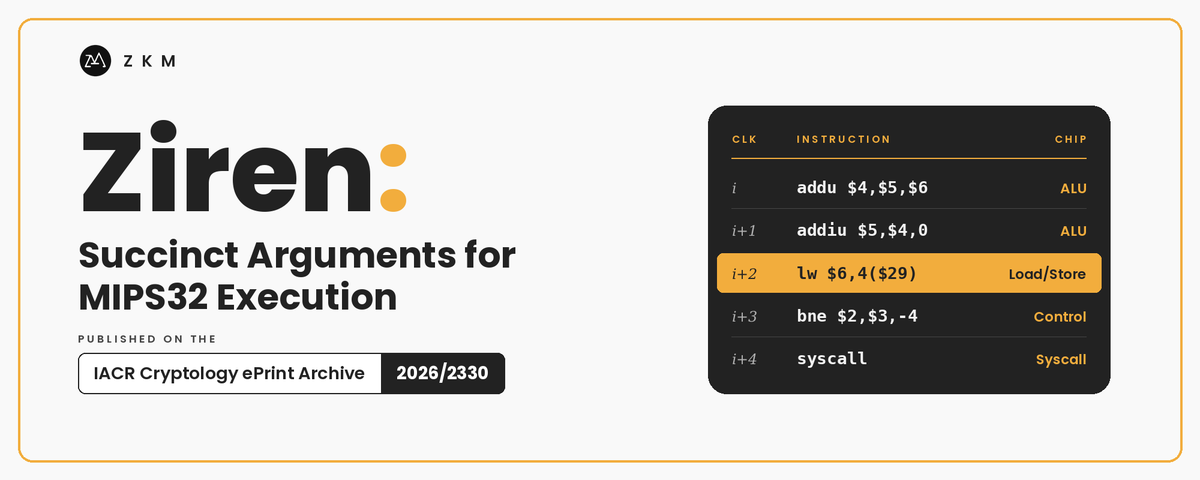
Ziren: Succinct Arguments for MIPS32 Execution has been published on the IACR Cryptology ePrint Archive.
→ eprint.iacr.org/2026/2330
It is a complete design reference, covering the proof system, the formal verification of the machine itself, and the production record.
Ziren is a CPU-less chip architecture: every executed instruction is one row of its opcode's chip. Each shard is proved with one lookup argument and one zerocheck, then a jagged sumcheck reduces tens of thousands of columns of differing heights to a single evaluation, opened with one batched WHIR proof. A recursion tree composes the shard proofs under an enumerated allowlist of verifying keys.
All 104 extracted determinism theorems are proved in Lean 4, generated from the same constraint description the prover evaluates, and the security analysis states its bounds with every assumption listed.
The same machine runs in production. It proves 77 user-mode MIPS32r2 instructions, has proved Ethereum mainnet blocks end to end, and reaches up to 7.3 MHz on a single RTX 5090, scaling to 24 MHz across four.
Securing Ziren has been and continues to be an extensive effort. Our deepest thanks go out to @ethereumfndn, @ConsensysAudits, and @VeridiseInc for working with us so closely on it.
Code: github.com/ProjectZKM/Ziren
Docs: docs.zkm.io
DAC Economy retweeted
Ziren: Succinct Arguments for MIPS32 Execution has been published on the IACR Cryptology ePrint Archive.
→ eprint.iacr.org/2026/2330
It is a complete design reference, covering the proof system, the formal verification of the machine itself, and the production record.
Ziren is a CPU-less chip architecture: every executed instruction is one row of its opcode's chip. Each shard is proved with one lookup argument and one zerocheck, then a jagged sumcheck reduces tens of thousands of columns of differing heights to a single evaluation, opened with one batched WHIR proof. A recursion tree composes the shard proofs under an enumerated allowlist of verifying keys.
All 104 extracted determinism theorems are proved in Lean 4, generated from the same constraint description the prover evaluates, and the security analysis states its bounds with every assumption listed.
The same machine runs in production. It proves 77 user-mode MIPS32r2 instructions, has proved Ethereum mainnet blocks end to end, and reaches up to 7.3 MHz on a single RTX 5090, scaling to 24 MHz across four.
Securing Ziren has been and continues to be an extensive effort. Our deepest thanks go out to @ethereumfndn, @ConsensysAudits, and @VeridiseInc for working with us so closely on it.
Code: github.com/ProjectZKM/Ziren
Docs: docs.zkm.io

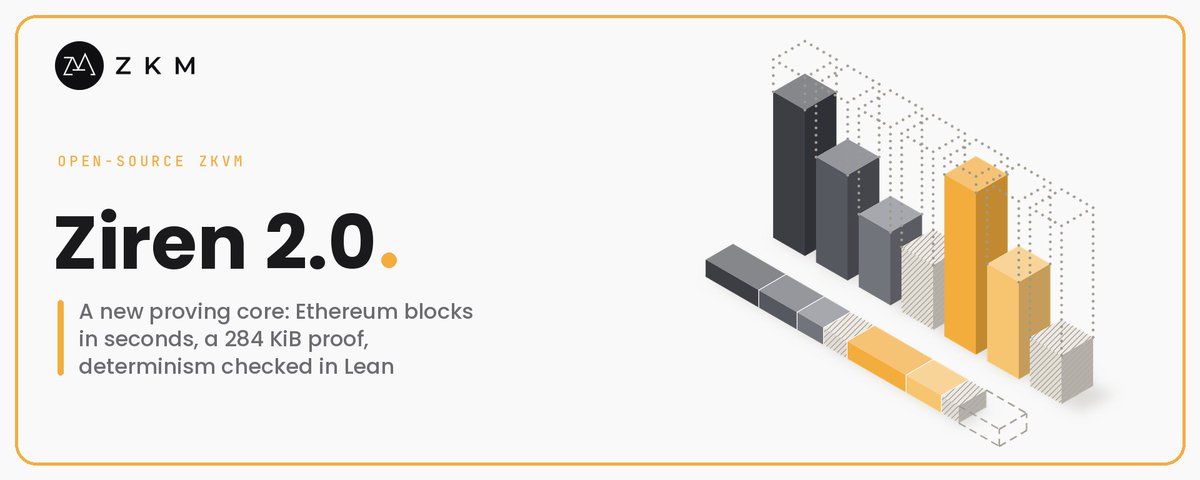
Happy to share our latest work on Ziren @ProjectZKM @GOATNetwork. Feedback welcome!
A summary:
1. A new proof system based on Jaggled reduction and WHIR(including recursion proof over binary field and Blake3). Acknowledgements to SP1 team and Plonky3 contributors.
2. 4x proving efficiency, 10x emulation efficiency improvement over previous v1.2. Speedup is happening every day with AI assistant.
3. >100-bit proven security
4. A fully Lean 4 assisted constraint determinism proof, covering 104 chips.
5. A complete end-to-end zkVM design reference.
DAC Economy retweeted

Really enjoyed moderating today’s panel on agent trading.
One question I especially loved: if AI agents consume the same information and think in similar ways, do markets become more efficient or more correlated and fragile?
Still early, but fascinating to think about.
The last stop of our @KBWofficial week: COO @sophianeverfold on stage at @0G_labs' House of AI, moderating "AI Is About to Trade Against You" with @zia_finance, @stack0G and @ManekiaiX.
A fitting end to a week spent showing Seoul what agents can do when they have the right infra behind them 🇰🇷

DAC Economy retweeted

Here's the Big Question for Mathematicians with respect to AI:
If you give AI a clear problem to solve, it's probably better than all human mathematicians (including Terry Tao) at solving it.
But what about asking the questions?
An example: In the episode below, Shafi Goldwasser, co-inventor of ZK, told me how ZK came about: they tried to solve the problem of playing poker over the phone or tossing a coin and agreeing on the outcome even if both counter-parties don't trust each other.
Or take my own discovery of the FRI and ZK-STARK protocols -- by trying to make PCPs into succinct proofs.
So the question is:
Will AI be better than humans at picking the right questions to ask and prioritizing them well, and why?
To be honest, I don't have an answer yet
teapaw.org/StarkWareLtd/status/21…

How do you prove something without revealing it?
Eli Ben-Sasson meets ZK co-inventor Shafi Goldwasser on Block Smart to explore her Eureka moment, ZK beyond blockchains, and what it could unlock for AI.
Chapters:
0:00 Greetings and intro: Shafi Goldwasser
1:22 ZK for non-mathematicians
5:01 How Zero-Knowledge came about
8:53 What did you imagine ZK would be used for?
13:03 Beyond blockchain: where else can ZK go?
14:58 Why ZK fits blockchain?
19:11 The case for trustlessness
20:29 AI meets ZK
24:02 The Eureka moment
27:35 Quick-fire questions
29:40 Parting thoughts


DAC Economy retweeted
Our piece on why "hash-based is not the same as post-quantum" drew a lot of attention from the ZK research community, but the best way to understand the argument is to run the schemes for yourself.
The @AppliedPQC playground puts SLH-DSA (hash-based) and the lattice schemes (ML-DSA, ML-KEM, Falcon) side by side, in your browser. The code is fetched straight from the repo, so what runs is exactly what's documented.
→ appliedpqc.io/playground.htm…



DAC Economy retweeted

最近在参与几个传统影视导演的AI 影视项目,干着干着突然有点感慨。
以前在学校总觉得拍电影全是激情,后来真入行了才发现,根本不是那么回事儿。前几年,眼看着身边好几个极具才华的导演朋友陆续转行。真不是大家不爱电影了,而是真的扛不住——在剧组连轴转、作息日夜颠倒、收入微薄不说,还要花一大半精力去应付各种复杂的人情世故和论资排辈。熬了半天,发现自己能掌控的表达空间少得可怜。
但最近深度用 AI 跑通工作流后,我真真切切感觉到:时代真的变了。
过去,资金、设备、庞大的团队、资历……随便哪一样都能把一个年轻创作者卡死。但现在,AI 正在把这些壁垒一点点敲碎。当你不再需要去“组个大局”、不再受限于物理场地的约束时,创作才终于回到了它最纯粹的样子。
你脑子里的审美、积累的视听语言、对光影和情绪的直觉,可以直接通过工具落地成真。没了那些烂俗的社交内耗,我们终于可以把 100% 的精力毫无保留地砸在内容和制作本身。
很多人还在焦虑 AI 会不会抢饭碗,但在我看来,它恰恰给了我们一张过去挤破头都拿不到的入场券。这不再是个拼资源、拼人脉的局了,现在拼的就是最纯粹的想象力和执行力。
只要你还有表达欲,现在就是最好的时候。大家最近在做 AIGC 创作的时候,有感受到这种“壁垒被打破”的变化吗?欢迎来评论区聊聊。
🤖 Made with AI


如果把心中的极乐净土具象化,究竟能有多震撼?
这次与 Pollo AI @polloai_creator 合作,用 AI 打造了《莲境供养·琉璃世界》。
莲托宫阙,天女散花,琵琶起弦,一叶小舟驶向琉璃深处……每一帧都精致到堪比壁画,根本舍不得删减。
于是我给 JEV 出了一道“绝情”的剪辑题:在这座琉璃天宫里,只准留下最惊艳的 10 秒。
猜猜 JEV 最终留下了哪一幕?
Generate your own video here:见评论区
#PolloAI #JEV #AIFilm #BuddhistArt
DAC Economy retweeted

A decade ago, blockchain promised to rescue the internet from corporate capture. Instead, tech monopolies just built their walls higher.
Should we despair? Not just yet.
Today at 11am CST, Kellz & the ATP Crew are sitting down with Ming Guo to answer: WTF is DAC Economy?
Stop waiting for the old tech giants to fix the web. We’re building the alternative.
teapaw.org/i/spaces/1qxoNeooYNQJv
