

Building 1st-class tools for secondhand ♻️ xHulu video platform engineering lead 📺 #Bitcoin realist & stablecoin maxi 🪙 Waterman of many planing surfaces 🌊
Los Angeles, CA
Joined September 2021
- Tweets419
- Following3.6K
- Followers300
- Likes3.1K






Bertrand Darnault retweeted

Monetary tightening in response to adverse supply (particularly oil) shocks—a requirement of strict inflation targeting—has been a frequent cause of recessions. Solution? You guessed it: NGDP targeting.

In 1983, James Hamilton of UC San Diego discovered that “all but one of the US recessions [1960] since World War Two have been preceded, typically with a lag of around three-fourths of a year, by a dramatic increase in the price of crude petroleum”.
In 1997, Ben Bernanke and Mark Watson at Princton and Mark Gertler confirmed that was right, but added that the primary cause was still ambiguous because “a number of the most significant tightenings of US monetary policy have followed on the heels of major increases in the price of imported oil”
Digging back in time (thanks to a question by @david_glasner) I uncovered large monthly spikes in the price of crude oil even before the inflation/deflation cycle of 1948, the 1953-54 recession and, less surprisingly, the 1957-58 Suez Canal crisis recession (which was far worse in Europe).
The federal funds market was moribund before July 1954, since the Fed was pegging rates on Treasury securities. However, Christina and David Romer use the Treasury bill rate as a close approximation to describe pre-1954 Fed tightening from open market sales or the discount window. The T-bill rate shows the Fed tightening a bit before all these 1949-60 recessions, as the Romers confirm.
So, James Hamilton's shocking 1983 conclusion, and the Bernanke-Watson-Gerlter 1997 addendum, still stand. Every postwar recession was preceded by an episode of Fed tightening and all but one of those rate-hike recessions was preceded by a spike in the price of oil
You might suppose inflation (rather than oil price shocks per se) was the actual Fed trigger. Yet the graph shows the FOMC did nothing serious about the big inflation postwar inflation surge of 1947 nor the prewar surge of 1951. Inflation was also all but invisible when they tightened in 1959-60 --without even a surge in oil price for a change.
Higher oil prices have preceded most recessions; higher central bank rates preceded all of them ever since 1921 and 1929.
ft.com/content/ade6785e-b93e…

Bertrand Darnault retweeted
I think of it more like the Lindy effect.
The longer Bitcoin's monetary policy isn't changed in code, the more trust it builds in being immutable.
With PoW, this is the biggest and most under-appreciated differentiator that Bitcoin offers over other crypto assets.
Bertrand Darnault retweeted

crypto haters absolutely euphoric right now, dunking
- economy is headed for recession/depression
- mortgages unserviceable
- global energy/food crisis
- 60/40 portfolio ruined
- sovereign debt crisis
- inflation rampant
- consumer confidence ATL
and they're celebrating
Bertrand Darnault retweeted

Utilization will crown the crypto kings. That's why I support crypto with the highest chance for mass utilization. You won't achieve mass with high fees, slow transactions, custodial layers and catering to the 1%. Remind yourself to revisit this tweet in 10 years and you'll see.


Bertrand Darnault retweeted

All this vapid condemnation of @terra_money is unbecoming.
A decentralized stablecoin is one of crypto's most important instruments.
I'm glad people are experimenting relentlessly, and enduring the crises that challenge and harden all great projects.

Bertrand Darnault retweeted

1/ I've followed the IMF for 15 years now, and this is the most impressed I've been by any of their live press events. Some rare truths were shared, on a panel in front of ECB President Christine Lagarde and Fed Chair Jerome Powell.🧵 (video clips below)
Bertrand Darnault retweeted
That we now have a decentralized stablecoin competing in the league of USDC and USDT is one of the greatest achievements in cryptoland in the past couple years.
Centralized stables are an Achilles Heel of our industry. Let's move past them with haste.


Bertrand Darnault retweeted

Today, @Delphi_Digital submitted to the SEC our strong objections to the SEC's recent proposed amendments to Reg ATS, which, in part, seek to re-define all "communications protocols" as potential securities exchanges.
Bertrand Darnault retweeted
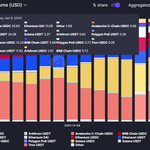
At a macro level the velocity of stablecoins (25-95) is significantly higher than that of BTC+ETH (4-6).
This supports the hypothesis that stablecoins are preferred as a medium of exchange.
Source: f.hubspotusercontent00.net/h…

Bertrand Darnault retweeted

What does gold know? With real rates rising as quickly as they are, the tried-and-true TIPS model suggests that gold should have fallen to 1600 or so. Instead, it is holding in like a champ at around $1950. Why? 🧵



Bertrand Darnault retweeted

State of Tech
Crypto: "2.5% transaction fees are outrageous. Let's launch 10 competitors this year to drive this to zero"
Web2: "We think a 47.5% transaction fee on digital objects is pretty competitive to be honest"
Government: "How can we protect consumers from crypto?"

Bertrand Darnault retweeted
The current drawdown for long bonds is 23%, the highest in two decades, vs. a 12% drawdown for the S&P 500. That doesn’t happen often, or ever. This chart shows drawdowns from 5-year highs and rallies from 5-year lows, for the S&P 500 and the Barclays LT Govt bond index.

Bertrand Darnault retweeted
Ten years from today...
The supply of Bitcoin is known precisely.
The supply of gold is estimable.
The supply of fiat is beyond calculation.
Bertrand Darnault retweeted
Decentralized stablecoin (UST) now trades with #Bitcoin natively.
The revolution will not be centralized.
@THORChain @terra_money


Bertrand Darnault retweeted

Hey Do Kwon 👋
We have BTC bridges and native BTC swaps live. Let’s chat about how to push this forward e.g., with UST issuance on Stacks where native BTC swaps help bring in BTC liquidity. Great work!
