

Helping Mass Tort Attorneys Make Smarter Marketing Investments | Host, Fixing Incentives Podcast | Founder, Tenfold Traffic
Denver, Co
Joined November 2008
- Tweets1.8K
- Following2.9K
- Followers1.4K
- Likes6K
Pinned Tweet
Note to self:
Look for the good in others.
Even if their behavior warrants critique.
The world seems to be great at highlighting people's flaws without my help.
Instead, highlight the good, which is easy for everyone else to overlook.
(Advice from my older brother.)

David Melamed retweeted

Whatnot just dropped its 2027 trends report and the numbers are ABSURD:
• 4 Pokémon cards sell every SECOND
• 100M+ sports cards sold in 2026 so far
• $8B+ in live sales last year, on pace to DOUBLE this year
• 650,000 new buyers EVERY WEEK. 👀
Full breakdown 👇
If your cards aren't moving, the buyers didn't disappear. They went live.
THE SPORTS CARD STUFF
→ Jordan only narrowly beat Wemby in NBA card searches this year
→ The number of people searching for Cooper Flagg: +440%
→ Haaland searches jumped ~17x ahead of the World Cup
→ Yamal is now next to Messi among the most-searched names for jerseys
The legends aren't going anywhere. But the next generation of collectors is chasing the next generation of stars.
THE SLEEPER: WOMEN'S SOCCER
→ Women's soccer searches up ~70% in 2026
→ Trinity Rodman leads search interest??
→ The number of people searching for Alexia Putellas roughly TRIPLED
→ Women's World Cup hits in 2027
The 2026 World Cup brought tens of thousands of first-time soccer card buyers. Whatnot expects the women's game to do the same. Early is cheap.
POKÉMON ISN'T SLOWING DOWN
→ Orders and buyers both more than doubled year over year
→ September = all-time monthly high, 10M+ cards
→ The 30th anniversary brought in hundreds of thousands of FIRST-TIME buyers
→ Pikachu, Charizard, Eevee, Gengar, Mewtwo lead searches
More and more, buyers collect the characters and artwork they love, not just whatever is worth the most.
COLLECTORS DON'T STOP AT CARDS ANYMORE
→ Soccer jersey searches up nearly 230% month over month during the World Cup
→ Vintage jersey searches up nearly 70% in a month
Fans collect around a PLAYER: cards, jerseys, autos, memorabilia. If you only sell cards, you're leaving money on the table.
LIVE IS THE NEW NORMAL
→ 47% of Gen Z and 44% of millennials shop live MORE than a year ago
→ 35% of live shoppers say they find products there before anywhere else 👈
THE TAKEAWAY
The hobby might seem like it's shrinking on some of the traditional sites. It's just moving.
New buyers. New stars. New categories. Live.
Adapt or watch it happen without you.
Source: Whatnot 2027 Consumer Trends Report (Whatnot platform data plus a Censuswide survey)
blog.teamwhatnot.com/uniteds…

David Melamed retweeted

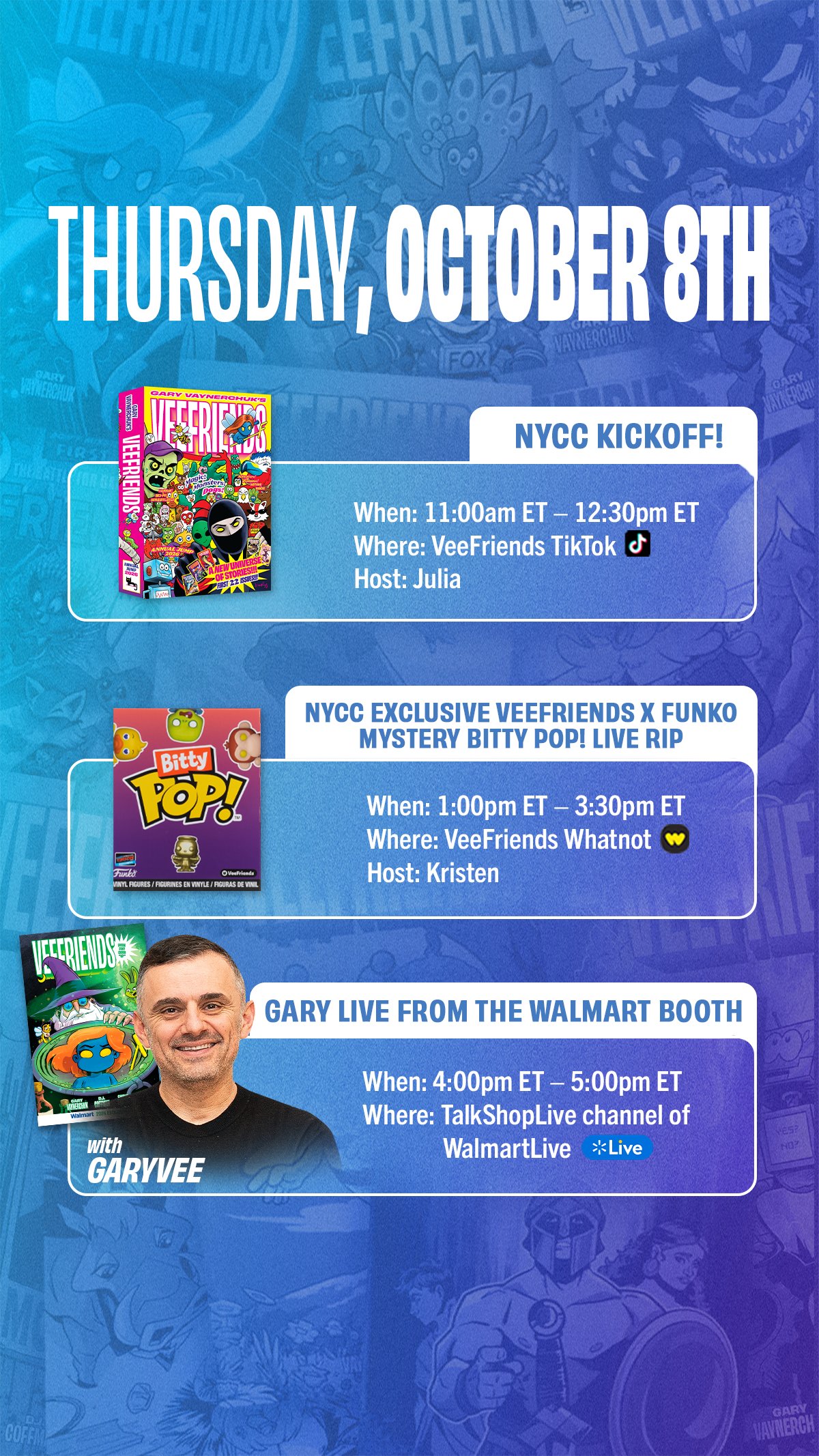
This effort from @garyvee and the @veefriends team for a major event like this is truly UNMATCHED
Thank you to all involved for putting your hearts into it 1000%



David Melamed retweeted
It’s all happening right before our eyes
Many still sleeping on Gary and questioning his intentions
Don’t be confused
The micro has ups and downs but in the macro, there is no way this man doesn’t succeed


Who would've thought collecting @VeeFriendsCards could feel like this?!
I was in 8th grade, pretending to be asleep. Listening to the radio under my pillow as the Avs entered triple overtime. Both moments give me the chills! Thanks @veefriends @garyvee @adamripps @1of1cardshop
@zacharyowings2 I wouldn't have fallen in love with @VeeFriends if not for you & @garyvee making me feel like I mattered. And of course the awesome community that constantly encoursges, lifts and builds each other up!
1
2
105
David Melamed retweeted

ChatGPT retrieval system LEAK alert 💥
I found "something huge" in ChatGPT's server-sent events over the weekend.
Inside the stream is a detailed debug view of ChatGPT's web retrieval system. Which queries it wrote, which engines it called, what came back, scoring objects,what it fetched, how it split each page, and what finally made it into the answer.
I have been pulling this data for a few days. On Saturday I started getting rate limits, so I was probably the most active user of that stream this weekend :)
A few things I can share today:
One question is never one search. Yes, we know there are fanouts. But actually more fanouts behind the scenes!
For a single "best AI visibility tools" prompt, ChatGPT ran 5 search rounds, wrote 18 different queries(hidden queries), made 50 engine calls, pulled 228 results, fetched 223 URLs with selected chunks, and cited 16. You see 16 links.
✍ Let's start today with renderer. How actually ChatGPT uses your page for retrieval.
Your meta tags travel with every result.
There is a separate og_data object in the payload and it is empty on every single result. The raw meta_tags list is what is actually kept.
The page body is not HTML. It is a markdown-like text render. I compared its fingerprints against the common HTML to text parsers. Two-space "* bullet", "* * " for horizontal rules, "# heading" and "--- | ---" table separators with no outer pipes all match the Python html2text library. Turndown, markdownify and Trafilatura each match only one or two of those. So html2text is the strongest candidate, but it is not a stock build.
That render is what gets cut into blocks of roughly 170 words and scored. The model does not see your full page. It sees one to three of those blocks per source.
The images below is not a mockup. Every code block is copied from the stream as is, including our own Peec AI product page.
What I showed above is a small slice. One prompt produces a 150,000-line JSON dump, and the two fields in the image are maybe 2 percent of it.
The same stream also carries:
Every rewritten query, and which of roughly ten internal engines each one was sent to (web, news, Wikipedia, Reddit, arXiv, YouTube, PDF and more)
📍 A per-result score, plus a score object that breaks that score into its components
📍 A per-chunk score for every block of every fetched page, and which blocks were kept for the prompt
📍 A should_fetch decision on each result, with crawl date and publication date
📍 A second ranking pass done in the model's reasoning, where domains are re-ordered before the answer is written
📍 The exact prompt the model receives, with the word budget it is given per source
📍Separate result types for shopping and local queries, with their own fields
If you work on GEO or AI visibility, this is the closest look at ChatGPT's retrieval pipeline I have seen. MORE TO COME.
Follow @DavidKonitzny, @TomekRudzki, @MalteLandwehr, there is a lot more coming THIS WEEK.

Reminds me on the million dollar homepage.
milliondollarhomepage.com/

I'm selling ad space on my MacBook
→ 10 sticker spots on the lid
→ live auction
→ 14 days
except I don't own it yet, the auction buys it
→ your logo travels with me and gets seen both online and IRL
BrandMyMac.com
1
4
213

David Melamed retweeted

Read this page from Facebook’s Little Red Book, then read what I wrote yesterday.
@finkd and team were living in the future. A lot of what feels newly important as software gets cheaper was already hardwired into how they thought about building.


David Melamed retweeted

Google just gave NotebookLM an update nobody is talking about.
They changed the name to Gemini Notebook.
But they also gave it a massive new brain.
Before, it just read your notes and gave you a summary.
Now, it has a cloud computer built right in.
You upload a messy pile of files.
It cleans up the data for you.
Then it makes Excel sheets, charts, and slide decks.
You do not even need to find your own links anymore.
Just type a loose idea and it searches the web to build your source list.
This takes the hard work out of research and Change how you do SEO Forever!.
David Melamed retweeted
Record & Replay is wildly underrated.
You teach ChatGPT a workflow by doing the work once. The recording becomes a map the system can understand, repeat, and eventually improve.
OpenAI should go much harder on this.

David Melamed retweeted

.@hnshah and @ForwardFuture are partnering to offer free consulting sessions with select enterprise companies.
Space is very limited.
If you are looking for help implementing AI, apply here:
forge.forwardfuture.ai/

David Melamed retweeted

Introducing the Fusion API, the smartest compound model in the market.
Fusion achieves Fable-level intelligence at half the price.
How it works 👇

David Melamed retweeted

Harvey is valued at $11B. Legora just raised at $5.5B. I built their entire web application in two weeks and I'm making it open-source and free for everyone to use. Say hi to Mike: mikeoss.com.
When I got the chance to try Harvey and Legora, I was surprised by how simple they were. A thought came to mind: I could probably build something similar in no time at all with Claude. And so I did.
Assistant, project, tabular review and workflows. You get it all without vendor lock-in.
Mike offers law firms an alternative, where they own the application layer and aren't stuck with a vendor they're renewing forever.
You can try Mike in the demo on the website, or go to the GitHub link on the site to download the code and run a local version yourself.
David Melamed retweeted

just built a swipe file of 58 VSLs actively scaling on facebook right now
not theory, not 2021 examples
current 7-8 figure ads that are printing today
inside you'll find:
→ long-form problem → agitation → mechanism breakdowns
→ short hooks that stop the scroll in 3 seconds
→ on-lander VSLs built for warm traffic
→ hybrid advertorial + VSL structures
→ 12+ niches: supplements, skincare, weight loss, gadgets, beauty and more
you'll see exactly:
→ how they hook in the first 3 seconds
→ where the mechanism drops
→ how they stack proof
→ how they kill objections before the viewer thinks them
if you're running ads this saves you weeks of testing
if you're not, it shows you what winning creative looks like in 2026
rt + comment "vsl" and i'll send the full swipe file
(follow for dm)
David Melamed retweeted
High agency is often mistaken for speed. People assume it belongs to the ones who decide quickly and move without hesitation.
That version looks impressive, but it is not what actually drives results. The real marker of high agency is quieter. It appears the moment someone stops protecting their assumptions and puts them in contact with something that can push back.
Most people hesitate because they operate too far from the facts that matter. They think through scenarios, build arguments, weigh options, and wait for a feeling of certainty. They want clarity before they act. They want proof without the discomfort of exposing their thinking. They want to be right before the world has a chance to disagree.
High-agency people do something different. They shorten the time between an idea and its first collision with the real world. They build the smallest version that can reveal a truth. They ask the customer before polishing the story. They test behavior before optimizing the process. They trade speculation for evidence, not because they enjoy being wrong, but because every collision with reality sharpens their understanding of what actually works.
That shift changes their relationship with learning. Mistakes are not signs of incompetence. They are the natural cost of moving forward. The most valuable insights rarely come from perfect planning. They come from constraints, surprising reactions, unexpected metric shifts, and outcomes no one predicted.
This behavior compounds. Every early interaction with reality creates a faster cycle of adjustment. Every adjustment increases clarity. Over time, decisions feel fast because dozens of small signals have already done the work. To an outsider it looks like intuition. In practice, it is earned through repeated exposure to the world.
High agency is trained. It builds through the choices you make when uncertainty shows up. It strengthens every time you expose your thinking to something that can reshape it.
Speed shows up because the environment favors teams that gather evidence quickly and adjust without ceremony. Their focus is on contact with reality. They waste less time debating ideas that have not been tested. They look for the next piece of information that moves the work forward.
Founders who operate this way avoid the trap of endless planning. Product managers avoid the trap of presenting polished ideas that have never touched a user’s world. Engineers avoid the trap of optimizing solutions before validating the problem. Teams shaped by this habit reduce the distance between ideas and truth.
You take an idea, remove the parts that do not matter, and place the remaining piece somewhere it can be disproven. You let the result inform the next version. You let the world reveal the gap between what you believe and what is true.
The discomfort never disappears. It becomes familiar. You learn to recognize the moment when you are delaying the collision because the idea feels fragile. That moment is the signal. High-agency people move toward it. Everyone else moves away.
If you want to raise the agency level of a team, focus on faster confrontations with reality. Encourage smaller tests. Encourage questions that can be answered in days instead of weeks. Encourage conversations with customers before the work becomes precious. Encourage an environment where truth carries more weight than confidence.
You become high agency by removing the distance between what you believe and what the world is willing to teach you.