

Crop Consultant, Owner of Diversified Agronomy, SDSU Graduate, Strip Till Fanatic
Joined June 2018
- Tweets1.3K
- Following1.7K
- Followers1.9K
- Likes1.6K




Joey Hanson retweeted

Agronomy never stops - our learning curve can’t stop either, and for to long we just didn’t challenge the status quo’s
Joey Hanson retweeted

Just Get pH Right?
Does getting soil pH “right” lead to more nutrient availability?
Yes, but also no. Life in the soil is not one dimensional.
When considering pH, we should also be considering Eh (soil redox potential).
There are management decisions that can influence both pH and Eh, and these two metrics should be thought of together.
Redox Potential (Reduction and Oxidation)
Reduction= gain of electrons (H+)
Oxidation= loss of electrons or gain of Oxygen
To make it easier to understand, I think about a plant oxidizing the atmosphere (adding oxygen) and the roots reducing (adding H+) to the soil.
Reference the Pourbaix diagram I’ve attached to see how pH and Eh relate. There are more of these charts you can find to see where different nutrients may become available to the crop. You can find this by looking for Olivier Husson’s work.
It makes sense why pH is considered and Eh is not. pH can actually be measured on a soil test. But even pH is not static even though we treat it like it is. Either way, there are management choices that will impact both.
Here are some examples of an overly oxidized, reduced, and a more balanced system.
Overly Oxidized:
-frequent tillage
-dry soil conditions, low residue cover
-low OM/low WEOC
-nitrate based fertility
-low biological activity
All results in high Eh and slightly alkaline conditions plus nutrient tie-ups
Overly Reduced:
-heavy clay w/ poor drainage
-high OM and/ or manure inputs
-compacted, anaerobic subsoil
-waterlogged for extended periods of time
All results in low Eh and more acidic conditions plus anaerobic microbial activity. Blueish gray looking soil that might smell rotten.
A more balanced system:
-living roots as much as possible
-minimal tillage
-mixed nitrogen sources
-good biological activity
-ground cover
-aggregated soil
All results in moderate Eh and slightly acidic to neutral pH. Leads to nutrient cycling and resilience.


Most overlooked aspect of soil tests in NE IA.... IMHO it is soil pH.
I see way too many acres that have grid sampling done & no action taken on correcting soil pH.
Technical definition: -log (H+). Which means the more hydrogen ions you have the lower your pH goes. Generally for soils in NE IA if more than 10% of your CEC is occupied by H+ you likely need to take corrective measures to adjust pH.
pH drives soil biological activity and thus nutrient availability. When I see pH levels in the mid 5's and even in the 4's we know there is significant yield loss.
Our studies show soil pH should be 6.3 to 6.7 in row crops to optimize yield.
Two columns on most soil test results. Soil pH and buffer pH. Soil pH tells you yes or no you need to correct. Buffer pH indicates amount of product like lime you need.
Once corrected & soil is in balance you can often times go a lengthy period without additional applications.
Be sure to be checking out your soil tests during this rain delay!! Contact your local Pioneer sales rep with questions.


Joey Hanson retweeted
We spend billions on fertilizer, yet debate supporting biology to help crops actually access it.
Research shows phosphorus use efficiency is often below 25% in the year of application, with massive legacy P buildup instead. Root exudates and microbes solubilize bound nutrients that ppm-chasing alone leaves locked up — while adding salts and degrading structure/gas exchange. As general statement the Industry is broken, we complain about it but keep doing the same thing over and over again.
2026… Year of the “non genetically modified” short corn. Never been in so much 7-8’ tasseling corn before.


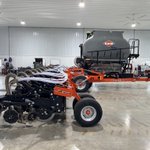
The nicest used Gladiator on the market is for sale!!!
2024 Kuhn Krause Gladiator 1210-1630, ST pro II spring reset row units, Gen 2 twin bin 9 ton Montag, 2 section control
J Assy relative flow blockage sensors, ISO controller, Globe mast- Globe not included, Under frame light kit with rear mounted LED lights and HD camera, Digi star digital readout for individual scales. We just completely went thru row units and stripped them down to replace all 20 poly lube bushings, main shafts and hoses.
It will come with new chains, rock points and side plates. Field ready and in excellent condition. Rear hitch not included. Like new without the new price tag!! $200,000


Joey Hanson retweeted

Wrapped up a great week in San Antonio for @ComClassic yesterday, and back to sampling today. @Agronomy365 never lets me down identifying that field variability! #springisnear

Joey Hanson retweeted

Southshore, SD Research Farm Results: With a soil test K at 216 ppm (above the 160 ppm threshold for applying K), the addition of K regardless of the rate theory used did not increase corn yield.

I had so much fun doing this field last fall that I think I’ll do it again. Laying down some spring goodies in PERFECT conditions!!

Kuhn Krause Gladiator row unit rebuild. For anyone who’s getting play in their row unit, here’s what the rebuild process looks like.
Good news for everyone watching this video, this machine is for sale after the rebuild is complete! Feel free to reach out.
Joey Hanson retweeted

Probability matters more than potential
Farming is all about predictive outcomes. You need to increase your odds of a yield response to fertilizer
Fertilizer has a large opportunity to help and hurt profit
Hold your fertilizer to a higher standard and improve profit potential.

Joey Hanson retweeted
Let’s try this, nitrogen management is deeper than most think about in my opinion. Not posting this to argue. Posting this, to help you think deeper about what your nitrogen dollars are capable of.
Joey Hanson retweeted
What could fertilizers be doing to the soil?
Example:
10-20 years of corn-soybean rotation.
10 CEC soils with a 225 bushel yield goal for corn and a 55 bushel yield goal for soybeans.
With adequate soil test levels, you biennially spread Potash (220#) and MAP (230#)
0.9 NUE goal on corn (203#) in the form of UAN 28 w/ majority at side dress.
This is a basic example but aims to paint a picture of what might be happening in soils.
So what happens?
•The soil acidifies over time until lime is needed
•The soil oxidizes over time
•Oxidized Mn and Fe tie up P
•Oxidative stress on crops
•Higher levels of disease
•Lowered WEOC
•Decline in microbial diversity
•Decline in aggregate stability
•Poor nutrient cycling that requires more synthetic fertilizers
See the illustrations for pH and Eh trends (key word is trends).
All of this leads to a cycle of needing higher rates of fertility, more -cides, and crops being more dependent on us.


FOR SALE just in time to buy yourself a nice Christmas gift!!!
2024 Kuhn Krause Gladiator 1210-1630
ST pro II spring reset row units
Gen 2 twin bin 9 ton Montag
2 section control
J Assy relative flow blockage sensors
ISO controller
Globe mast
Under frame light kit with rear mounted LED lights and HD camera
Digi star digital readout for individual scales
Hoses, diffusers, blockage sensors, chains, shanks were all removed for winter cleanup.
Machine will get new hoses, chains, points, side plates, etc… before being sold.
Will be field ready for spring.
Rear hitch not included
$205,000


