

Web3 Ambassador & Community Manager | 7+ yrs in Blockchain Amb @Idolly_AI | @Pushchain Building communities, & exploring AI agents and LLM workflows for Web3
Joined January 2020
- Tweets235K
- Following4.2K
- Followers5.5K
- Likes17K







Pinned Tweet
1.33x. That is the whole point.
Crypto leverage usually starts at 10x. 2Factor starts at 1.33x, not because it cannot offer more, but because Kelly sizing says more would work against the holder over time, and pushed far enough, it goes to zero. This is a leveraged Bitcoin position built to be held: never liquidated, no liquidation price to watch, and no position to manage every day. That is not how most of us know leverage.
@2FactorFinance is built around removing that daily work. It offers leveraged Bitcoin exposure that is sized before you enter, not adjusted in a panic later. The size is not chosen by mood, or by the maximum leverage available. It is chosen by Kelly sizing.
Kelly is an old idea, and it is a simple one. There is a point where leverage is too small to matter, and there is a point where leverage is too large, where a normal drawdown does damage the position cannot recover from. Kelly sizing is the attempt to find the level between those two mistakes, the level intended to support long-run growth rather than the largest position a platform will allow.
For listed equities, that target usually sits around 1.5x to 2x. Berkshire Hathaway has run at roughly 1.6x for decades, and Ed Thorp built Princeton/Newport on the same principle. For Bitcoin, the target in the 2Factor model is lower, about 1.33x. Notice the pattern in those examples: none of them chase the maximum. They use a measured amount of leverage, and they keep it there for a long time. That is the tradition Kelly sizing comes from, and it is not the tradition crypto leverage comes from.
The product itself is straightforward. 2Factor is deployed on Base and is live in a capped beta, starting with cbBTC. cbBTC-Jr is the leveraged side: it gives 1.33x exposure to cbBTC, is never liquidated, and is built to be held like spot. cbBTC-Sr is the senior side: it funds the leverage and sits behind a deep buffer of Jr capital. Holding a stable leverage target normally takes continuous work, and financing is usually priced by what it costs to be short. 2Factor packages that work into a passive structured product, instead of leaving it with the holder.
That is also why the comparison with leveraged ETFs matters. Leveraged ETFs are not built to be held for long periods. They carry high financing costs, they are not growth optimized, and they decay over time. Holders pay an estimated $10B+ a year in hidden financing above the risk-free rate. Same broad idea, completely different time horizon.
My honest take is this: the interesting part is not that leverage is now available, because it has been available for years. The interesting part is who it is available to. A buy-and-hold investor who does not want to manage a position every day can now use a measured amount of leverage, without taking on the daily work that usually comes with it. That does not make it the same as spot. It is still leveraged Bitcoin exposure, and a fall in Bitcoin will be felt more at 1.33x than at 1x, so anyone looking at it should understand that part first. But as a design choice, restraint is rare in crypto leverage, and 1.33x held steady, with no liquidation, is a very different offer from maximum leverage on an exchange.
2Factor is starting with Bitcoin. Tokenized stocks are on the roadmap, but they are not live yet, and I would rather judge the Bitcoin product on its own first. If you want to read through the Points Program and see how it works, use my link below:
points.2factor.finance/r/ywz…

Your payout on Sight is not fixed odds. I missed this on my first read.
In a token round, @sight_hood sets a price to beat at the start, using the token price against WETH on Uniswap. At the end, the closing price is snapshotted onchain and compared to that opening price. Higher means UP wins, lower means DOWN wins, equal means refund.
The UP and DOWN stakes form two pots. If your side wins, you split the pot pro-rata based on your share of the winning stake, after the 2% protocol fee. So your return depends on how crowded your side was, not just on being right.
That is why the estimated payout in the app is only informational. Being right with everyone else pays very differently from being right against the crowd.
Do you prefer this pot model, or do fixed odds feel cleaner to you?
robinhood:0x238e40b75ae78a1388a14e517d855893e92e58db

3
2
23
The auction ended, but that does not mean everything is settled automatically.
@zerufinance has now opened zETH claims, while trading has also gone live on Uniswap v4. The CCA process finished at a final price of $0.0000166 per zETH.
That price was not set in advance. It came out of the auction itself, after Ethereum activity during the ActivityFi race had already shaped how much supply was available.
The breakdown tells the story. zETH started at 1B. Around 396M was burned during the race, roughly 180M was sold through the auction, and another ~181M that went unsold has also been burned.
For anyone who placed a bid, there are two things to sort out. You can collect the zETH you bought, and you can also take back any USDC from your bid that was not spent.
Do not mix that up with buying on Uniswap. Claiming an auction allocation and making a new trade are completely different actions, so check your result first before doing anything else.
Claim here : zaps.markets/markets/zeth
🤝 Paid partnership


zETH claiming is now open, and trading is live.
The Uniswap v4 pool is live at the final auction price of $0.0000166 per zETH.
If you participated in the auction, you can now claim your purchased zETH and recover any USDC that wasn't used.
Trading is also open on @Uniswap.
Final supply breakdown:
- Starting supply: 1,000,000,000
- Burned during the race: 396,147,803
- Sold through auction: 180,742,949
- Unsold tokens burned: 181,568,369
Claim and trading links in the comments ↓

50
46
361
Winning on Sight does not mean the money lands in your wallet automatically.
After a market resolves, wins and refunds sit as claimable in your profile. You have to open your positions, find the claimable tab, and confirm the claim yourself with ETH for gas on Robinhood Chain. Token rounds and AMM markets both use the same window : 14 days.
Miss that window and the remaining ETH can be swept, and the docs are blunt that a broken interface, a wallet problem, or you simply not noticing will not extend the deadline.
I like onchain settlement, but this is the trade-off people forget. Non-custodial also means the last step is your responsibility, every single time.
Honest question: how many people do you think lose winnings in crypto just because they forgot to claim?
@sight_hood

75
65
454
I trust a platform more when its own docs list the ways it can fail.
The @sight_hood risk page does not hide it. Smart contracts can have bugs, Robinhood Chain can have congestion or RPC issues that delay settlement and claims, price sources matter, and your claim can expire after 14 days if you ignore it.
That context makes the early caps make sense to me. Token buys are limited to roughly $1 to $4 while the platform matures, and AMM trades are capped at 0.1 ETH per trade. Small size is not a weakness at this stage, it is the platform admitting the system is still young.
And because Sight is non-custodial, your keys stay yours, which also means a lost wallet is not a support ticket they can fix for you.
Would you rather a new market launch with tiny caps and clear risks, or open the limits from day one and learn the hard way?
$SGT

105
90
523
Loud is not the same as valuable.
That line from Zaps stuck with me : attention tells you who is loud. Activity tells you who matters.
Crypto has been running on attention for too long. Followers, posts, impressions, mindshare. All of that can make someone look important without proving they actually did anything.
ActivityFi flips the question.
Not who got seen, but who actually contributed? Fees paid, trades made, liquidity provided, borrowing, real usage. Onchain, that stuff leaves a verifiable trace.
a16z Frontier made a similar point recently, the bottleneck was never demand, it was the supply of new markets. Onchain activity is one of those markets. It was always happening in the open, nobody could trade it before.
That is the whole spine of @zerufinance Zaps:
Activity -> Reputation -> Rights -> Markets
And the rights are not just vibes. Rewards from campaigns, reputation in rankings and the Hall of Fame, Miner status you earn by racing in a market (miners get to bid first), and then the markets themselves.
That is why their coins are supposed to be earned, not bundled. Spawned from real onchain activity, not insider allocations dressed up as a launch.
I do not know if ActivityFi becomes a big category or not. But I know which metric I trust more when I am deciding who actually matters onchain.
Read it yourself and tell me honestly, are you still farming attention, or are you building activity?
docs.zaps.markets/why-activi…

148
112
348
42 GEN to back a judge. 42,000 GEN to become one.
Honestly, I almost skipped this part of the video. In my head, validators were only for technical people, the ones with servers who understand nodes and can lock a lot of money. I would just watch from the outside.
Quick context if you are new here. @GenLayer is a court for the disputes code cannot settle, between people, apps and AI agents. Validators are the judges. They run their own AI models and decide cases in panels.
To sit as one of those judges, you have to lock 42,000 GEN of your own. That makes sense to me. If you want to decide other people's disputes, you should have something real at stake.
But delegation is where it opened up for me. You do not need to run a node. You pick a validator, delegate from just 42 GEN, and you share in what that validator earns. Rewards come in daily. And you can step out whenever you want, there is just a 7 day wait.
That wait made me pause at first. Why not instant? But then it made sense. You are backing a judge. That choice should not be something you jump in and out of every hour with zero commitment.
That is my take. This court is not only for the most technical people in the room. Someone like me can have skin in the game too, starting from 42 GEN, not 42,000.
Bookmark this if you are not a node person either, and pass it to a friend who thinks staking is only for operators. Then reply honestly below, would you delegate 42 GEN or stay liquid, and why?

Dzola retweeted

Starting now: Join the 15th EF Protocol Cluster AMA on r/Ethereum!
Submit your questions about Ethereum and join the conversation here: reddit.com/r/ethereum/commen…


$3,000 already paid out and the race is still on
This is why I like WahooPredict more than chasing random memecoins, you just need to be right, not early
Top 10 split $1,500 in the Daily Race, and 15 users split $1,500 every week if you can't chase the top
Anyone here already racing?

Over $3,000 has been distributed!
Just a few more hours, and $1,500 will be distributed to the Top 10 on the Daily Race.
You can’t compete? Be among the 15 users to split $1,500 every week!
Get X20 bonus: wahoopredict.com/bonus?r=Wah…

6
6
86
Lfg 🤩

Founders, CMOs, Leaders in Web3:
Growth brings them in.
Infrastructure keeps them.
You need both.
Campaigns, KOLs and partnerships create momentum. Community infrastructure turns that momentum into members who stay, participate and contribute.
That's how we've onboarded +1.3M users into Web3 communities.
We just turned the whole system into a free playbook:
- The 5 pillars of community infrastructure
- How to plan campaigns that keep paying off
- 6 KPIs to track community health
- A 30-day blueprint + 30-point checklist
Get it free, link in the first reply 👇

2
40

zETH started life at 1 billion tokens. It will not launch with 1 billion.
Registered miners earned Zaps from verified Ethereum activity, and that activity kept burning supply during the race. What survived is 603,852,197 zETH, and every percentage in the tokenomics is calculated from that burned-down number, not the original 1B. Supply was not just announced by @zerufinance , it got reduced by people actually doing stuff onchain.
Also worth clearing up because the name will confuse people: zETH is not ETH, not wrapped ETH, and not an Ethereum-endorsed asset. It is its own speculative asset. The only link to Ethereum is the activity that shaped how much of it exists.
The burn does not stop at launch either. Once trading opens, part of the trading fees is used to buy zETH back every day and burn it. So if the activity dies, this thing has very little left to stand on. I kind of respect that the model admits that upfront.
Auction closes tomorrow, Nov 21 at 14:00 UTC:
Would you trust a supply shaped by actual usage more than a fixed supply a team decided on day one?
zaps.markets/markets/zeth
Prediction markets are broken. Between shady settlements and terrible liquidity, most platforms make you feel like you are just gambling against the house. That is exactly the pain point @sight_hood is trying to fix.
They are building onchain prediction markets for sports, NFTs, and stocks, using AMMs for liquidity and fair settlements so you are not getting rugged by the system. And they just went live on Robinhood Chain.
If you want to get in early, @Bronk3r just opened 150 Whitelist spots. 50 guaranteed spots for Genesis NFT holders, $SGT holders, and followers, plus 100 FCFS spots for whoever moves fast.
The roadmap is also stacked. $SGT buybacks, Creator Season 1 rewards, and the SightEVM testnet are all on the way.
In a space full of empty promises, I respect teams that actually ship first. @Bronk3r and @sight_hood are focused on delivering real products instead of just farming hype. Definitely keeping an eye on this one. 🛠️

119
91
480
I've sat on BTC through drawdowns where my options were exactly two: sell it, or watch it do nothing.
That is the part of this article I kept coming back to. For years, earning on BTC meant handing it to a platform and hoping the platform was still there when you wanted it back. We all saw how that ended for a lot of people. So "earn on Bitcoin" became something most holders just opted out of.
The self-custodial lending part is what changes the question for me. In the 2027 plan, the BTC stays timelocked on Bitcoin L1 under your own custody, it keeps earning from staking, and the stablecoin loan gets issued against that position on Stacks. That is basically what repo does for bonds, except the asset never leaves your hands to get there.
I am not going to pretend that part is live, because it is not. What is live is the staking underneath it, and that already pulled 735 BTC across the first two bonds, with institutions actually showing up. The PoX-6 open auction in 2027 is the piece I am watching. A fixed 3% target on curated bonds is a bootstrap. An open auction where any holder can bid in, through STX, is where the rate stops being set by Stacks and starts being set by the market. That is when this stops being a product and starts being a capital market.
Would you actually borrow against your BTC if it never left your custody, or is borrowing against BTC a hard no for you no matter how it is structured?
@Stacks
Read full article 👇


No snipers. No team bag. Honestly, the zETH auction from @zerufinance is one of the cleanest token launches I’ve seen in a while.
Instead of the usual free-for-all, they are doing things differently. 60% of the supply is up for sale, paid in USDC, and the starting FDV is just $10k.
Here is the part I like: the price never drops. It only goes up per block. So if you bid early, you literally pay less. And anyone who bids in the same block pays the exact same price. Bots get zero advantage here.
If you were part of the race, you get a 24-hour head start. This miner window is huge because miners get three layers of rewards: 10% of the total USDC raise, weekly trading fees, and token options for 1% of the supply. Miss the window, and you can still buy, but you lose those rewards.
Also, 0% goes to the team. 82% of the raise goes straight into the Uniswap v4 liquidity pool. If they raise less than $6k, Zeru takes absolutely nothing. Any unsold tokens just get burned.
This isn't just a standard launch. @zerufinance is trying to build a true "activity market" where actual onchain usage matters more than who is the loudest on Twitter.
Auction runs Nov 16 to 21. Claims open shortly after. If you like fair launches, this is definitely one to watch. 👀
🤝 Paid partnership

15% revenue share is an easy number to market. It is also an easy number to misunderstand.
Genesis NFT holders on @sight_hood get 15% of platform revenue. Not volume, not TVL, not user deposits. The docs example is clean: if Sight makes 100 ETH in eligible revenue, 15 ETH goes to the holder pool, tracked onchain.
The other benefits are practical. Early access from September 9, 2026, before public launch on September 14, and after launch only Genesis holders can generate referral codes.
But there is no guaranteed minimum. If usage is low, 15% of very little is still very little. And eligibility depends on holding the NFT at snapshot time, sell it and you lose future benefits.
So the percentage is not the real test. The real test is whether Sight generates enough real fees for that 15% to mean something.
Would you value Genesis more for the access, or only once the revenue numbers are real? $SGT

94
79
446
Most real questions do not have only two answers. A floor price does not just go up or down, it lands somewhere. A stock does not just move, it closes in a range. That is where the second market type on @sight_hood starts to make more sense to me.
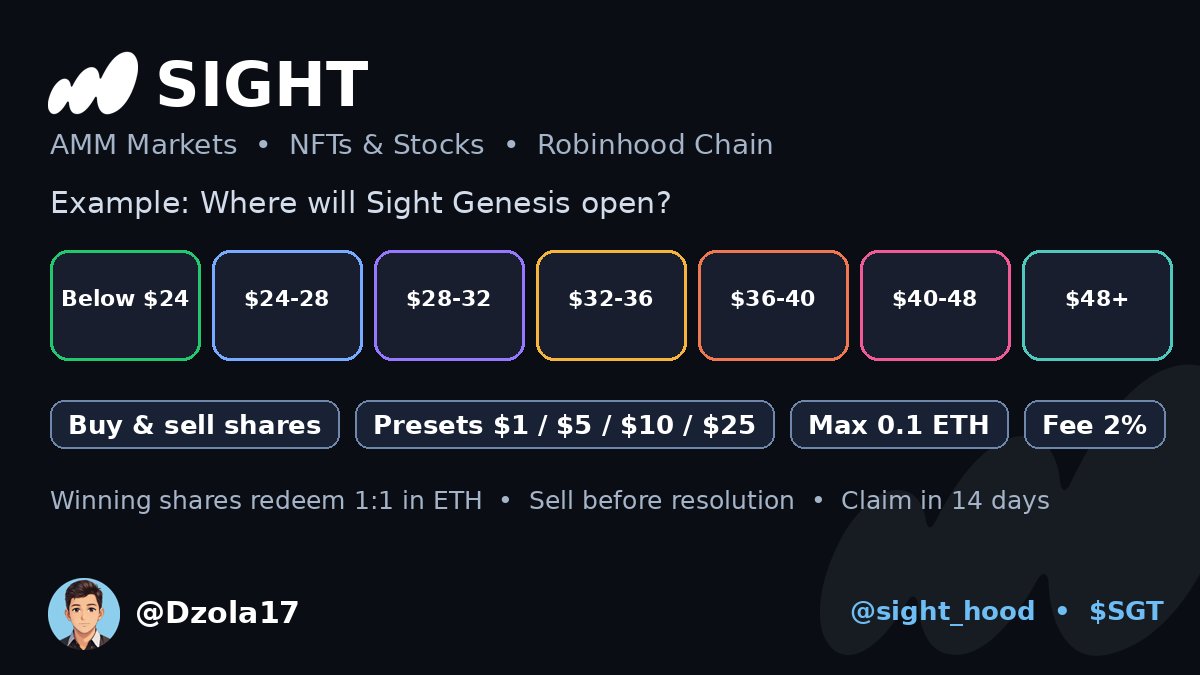
Sight also runs categorical AMM markets for NFTs and stocks. One question, several possible outcomes, and exactly one of them wins. You do not take a single UP or DOWN side, you buy and sell shares in the outcome you think will happen, and you can sell them back before the market resolves if your view changes.
The live example in their docs is simple: where will Sight Genesis open? The outcomes run from Below $24, then $24 to $28, $28 to $32, $32 to $36, $36 to $40, $40 to $48, all the way to $48 or above. The percentages you see are the market's implied odds, and they move as people trade. They are not a promise of where it will actually open.
The mechanics are kept small on purpose. Quick amounts are $1, $5, $10 and $25, with a maximum of 0.1 ETH per buy or sell. The fee is 2%, added on buys and taken from proceeds on sells, with no extra fee when you claim. If you hold the winning outcome, your shares redeem 1 to 1 in ETH, so 0.01 shares pays 0.01 ETH. If you hold a loser, it pays nothing, and you have 14 days after resolution to claim before it expires.
My honest question is about liquidity. More outcomes gives you a more honest question, but it also splits traders across seven buckets instead of two pots. In a thin market, does that produce better price discovery, or just wider gaps between what people think and what they can actually trade?
So which format do you actually prefer: the speed of binary UP and DOWN rounds, or slower AMM markets where the question can be more specific?
$SGT
Dzola retweeted

Another collab for the Sight community!
This time we're teaming up with @Bronk3r to bring you access to Bronker NFTs.
• 50 guaranteed WL spots
• 100 FCFS spots
To get involved:
1. Follow @Bronk3r
2. Engage with the post
More opportunities for the Sight community are on the way.
PS: Always DYOR on projects and collabs.

Bronker Quests are live.
Get on the waitlist. Get early access.
Start here: quest.bronker.com
Why would a prediction market need its own chain?
That was my first question when I saw SightEVM, and I was skeptical. Every project wants its own chain now. Most do not need one.
But prediction markets have a specific problem that general-purpose chains were never designed around.
Think about when a prediction market is busiest. It is not on a quiet day. It is when price is moving fast, news just broke, everyone is entering, exiting, and waiting for settlement at the same time. On a shared chain, that is exactly when gas, execution, and capacity become a fight with every other app on the network.
SightEVM is @sight_hood trying to own that layer instead of renting it.
From their site, the design goals are clear :
predictable execution, from transaction to settlement
efficient, lightweight transactions that still make sense at scale
infrastructure built for high-frequency market activity
reliable, transparent, verifiable settlement onchain
fees, block parameters, and network capacity that can be tuned for prediction workloads, not for everyone else
And the token part is simple, which I prefer : $SGT is the native gas token of SightEVM. No separate network token. If SightEVM gets real usage, the gas token is the same asset already tied to the Sight ecosystem, supply reported at 1 billion.
None of this proves it will work. Building infrastructure is the hard part, and a purpose-built chain with no market activity is just an expensive empty room. Sight still runs on Robinhood Chain today, and SightEVM will be judged on one thing only: whether builders and markets actually use it.
But the logic is stronger than I expected. If prediction markets are going to run at high frequency, they cannot keep hoping a general chain stays cheap and predictable at the exact moment everyone rushes in.
So here is the real debate : is a chain built only for prediction markets the future of this sector, or will the big general chains simply absorb this market like they absorb everything else?
$SGT
