

Art Historian in Rome | Author of Socratic Methods for the Classroom & Teach Like Socrates
Rome, Italy
Joined March 2011
- Tweets9.1K
- Following10.7K
- Followers10K
- Likes5.9K




Erick Wilberding retweeted

Hidden secrets unlocked in Gödel's notebooks, with AI translating the mysterious Gabelsberger script, finding numerous unknown proofs, including an argument for the consistency of the negation of the axiom of choice.
theguardian.com/science/2026…

Erick Wilberding retweeted

At 14, after skipping fourth through sixth grade, Ewin Tang enrolled at the University of Texas at Austin. In 2017 her professor, Scott Aaronson, gave her a senior thesis problem: prove that no fast ordinary algorithm can match a 2016 quantum algorithm for recommendation systems, the kind that suggests products you might like.
Instead she found one. In July 2018, at 18, she posted a classical algorithm that solves the problem exponentially faster than any earlier classical method, removing what had been seen as one of the best examples of a quantum computing speedup. At a Berkeley workshop that June, experts questioned her for about four hours before agreeing it seemed correct.
She finished her PhD at the University of Washington in 2023, is now at UC Berkeley, and won the 2025 Maryam Mirzakhani New Frontiers Prize. She was asked to prove a quantum computer would win. She proved it didn't have to.


Nine Jewish activists that changed the world for the better throughout history | The Jerusalem Post jpost.com/history/article-91…

39
Erick Wilberding retweeted

My mother was a philosophy professor in Oxford ... and at age 8 I was fond of declaring "If there's one thing I'll never be when I'm grown up it's a philosopher!"
Well, decades later, my science led me to figure out some rather interesting things in philosophy ... and now there's a book of my philosophical essays just published.
amazon.com/Ultimately-There-…


Erick Wilberding retweeted

#23ottobre 1943: oltre 1.000 ebrei romani arrivano ad Auschwitz. Rastrellati dalle proprie case il #16ottobre, partirono il 18 dalla Stazione Tiburtina con la complicità della Questura. Dopo giorni di viaggio disumano, l'inizio dell'inferno.

Erick Wilberding retweeted

A Fields Medalist says AI can now understand mathematical proofs even when his notes are almost unreadable to other mathematicians.
John Pardon explains that until recently, AI was little more than a spelling checker for his mathematical writing.
Now, he says, it can examine highly compressed, incomplete research notes and identify subtle mathematical mistakes.
For example, a missing condition such as finite or sifted in a statement about colimits can change its meaning. According to Pardon, AI can recognize such omissions by interpreting the broader mathematical context.
His assessment is:
“The AI understands. 100%.”
Pardon also reports that AI has proved several nontrivial lemmas for him. However, he says it has not yet produced a major breakthrough in his own research.
Pardon believes AI is changing mathematical research, but he also emphasizes that students must work through easier problems themselves to develop the understanding needed for harder ones.
He finds value in deliberately approaching unfamiliar problems, even when AI could immediately explain the answers.
Full Interview: futureclass.substack.com/p/j…

Erick Wilberding retweeted
Fields Medalist Timothy Gowers raises a troubling possibility: AI could become so powerful at mathematics that future generations may lose the motivation to study the subject deeply enough to understand its discoveries.
The paradox is striking. Machines might eventually solve problems far beyond human capabilities, while fewer mathematicians possess the expertise needed to interpret their results.
For Gowers, the deeper concern extends beyond the future of mathematical careers. It is about preserving the curiosity, intellectual discipline, and satisfaction of discovery that have sustained mathematics for centuries.
He also envisions a possible transformation of the mathematician’s role, from discovering new theorems to interpreting, connecting, and explaining mathematical knowledge generated by AI.
Reflecting on the approaching social consequences, Gowers offers a vivid analogy:
“We’re still on the beach, we can see the tsunami, but it hasn’t quite reached us yet.”
Importantly, he is not calling for mathematics departments to close or for universities to stop admitting PhD students. His remarks are cautious predictions about a possible future, rather than descriptions of changes that have already taken place.

Erick Wilberding retweeted
Fields Medalist Cédric Villani has raised a disturbing question about the future of mathematics.
In a new interview, he reveals that some mathematicians are already questioning whether they should accept new PhD students as AI advances.
Just one year ago, he considered mathematics among the sciences least affected by AI. Now, he thinks it may be among the most affected.
Could universities eventually become places where people study human mathematical reasoning as an ancient art?
Full interview👇

Erick Wilberding retweeted
#16ottobre '43 rastrellamento ebrei di Roma. Alle 5:30 le SS invasero il quartiere ebraico e, con l'ausilio della Questura di Roma, deportarono oltre 1.000 persone tra uomini, donne e bambini ad Auschwitz. Tornarono in 16: una sola donna e nessun bambino. Noi non dimentichiamo.

Erick Wilberding retweeted
Deposizione della corona in ricordo del rastrellamento degli ebrei romani avvenuto il #16ottobre 1943.


Erick Wilberding retweeted

Czesława Kwoka (1928–1943) was a 14-year-old Polish Catholic girl who became a widely recognized victim of Nazi German atrocities during WWII. Her registration photographs taken at the Auschwitz concentration camp are among the most famous and haunting visual records of the Holocaust...
In the photo, you can see a small cut on her lip and a haunting fear in her eyes. Just moments before this picture was taken, a guard had whipped her across the face with a stick. Czesława did not understand why she was being hit. She did not understand why she was in a place called Auschwitz. She was just a child, and she was terrified.
Czesława was born in a small Polish village called Wólka Złojecka. She was a Catholic girl who lived a simple life until the horror of the Holocaust reached her home. In late 1942, she and her mother were deported to the Auschwitz concentration camp. Her mother died just a month after they arrived. Czesława was left all alone in a world of striped uniforms and barbed wire.
The man behind the camera was Wilhelm Brasse. He was not a Nazi soldier. He was a fellow prisoner, a professional photographer from Poland who had been arrested because he refused to swear allegiance to Hitler.
The Nazis forced him to take identification photos of every person who entered the camp. He took over 40,000 of these "mugshots," capturing the faces of men, women, and children who were marked for death.
Brasse never forgot the day Czesława walked into his studio. He remembered her beauty and her absolute innocence. He watched as a female guard, a Kapo, lost her temper and struck the girl. Brasse recalled the moment vividly in a later documentary.
He said: "She was so young and so terrified. The girl didn't understand why she was there and what they were saying to her. Then a female Kapo took a stick and hit her in the face."
He watched the young girl cry. He saw her use her hand to wipe the blood and tears from her face before he had to click the shutter. Brasse wanted to help her, but he knew that any movement or word of protest would mean his own death.
"To tell the truth, I felt as though I had been hit myself, but I couldn't intervene," he admitted. "It would have been fatal. You couldn't say absolutely anything."
Czesława was murdered on March 12, 1943. She was one of 230,000 children and adolescents who were sent to Auschwitz. Most of them did not survive.
When the war was ending and the Soviet army was approaching, the Nazis ordered Brasse to burn all the photographs. They wanted to destroy the evidence of their crimes.
However, Brasse chose to risk his life one last time. He and another prisoner managed to hide thousands of negatives in the barracks. Because of his bravery,
Czesława’s face was not erased from history. Her eyes still stare at us today, demanding that we acknowledge what happened to her.
After the war, Wilhelm Brasse returned to his hometown. He tried to go back to his old life, but he found that he could no longer take pictures. The faces of the victims were burned into his mind.
"Despite having a Kodak camera, I couldn't bring myself to photograph again; I had a repulsion to it," he explained. He spent the rest of his life working in a deli, carrying the weight of those 40,000 faces until he died in 2012.
When we look at Czesława, we are not looking at a statistic; we are looking at a human being who deserved a future. History is made of individual lives, and it is our duty to protect the humanity of every person, especially when the world around us turns to darkness.
#archaeohistories

Erick Wilberding retweeted

In 1942 Viktor Frankl was sent to a Nazi concentration camp. Before his arrest he was a respected psychiatrist in Vienna with a family and a manuscript that represented years of work. At the camp his head was shaved, his clothes were taken, and he was given the number 119,104. One of the hardest moments came when the Nazis found his manuscript and burned it in front of him. He had been offered a visa to the United States, but his elderly parents could not go with him. He chose to stay.
He was moved through several camps, including Auschwitz and Dachau. As a physician he watched the people around him. Physical strength alone did not decide who survived. Some who looked healthy declined quickly. Others who seemed too weak continued. When prisoners lost all hope, they sometimes deteriorated rapidly. Frankl returned again and again to a line from Nietzsche: “He who has a why to live for can bear almost any how.”
Although the manuscript was gone, he began reconstructing it in his mind. He pictured himself after the war, standing in front of students and explaining what he had seen. He also thought constantly about his wife, Tilly. He had no way of knowing whether she was alive, but remembering her helped him continue. He tried to give the same sense of purpose to other prisoners. He would ask who was waiting for them outside or what work only they could finish.
When the camps were liberated in 1945, Frankl weighed 85 pounds. Then he learned that his wife, parents, and brother were all dead. The family he had stayed for was gone. Within nine days he recreated the manuscript the Nazis had burned. The book became *Man’s Search for Meaning*. Early publishers rejected it. Readers gradually found it. It became one of the most influential books of the twentieth century.
Frankl remarried, raised a daughter, climbed mountains, and continued working as a psychiatrist and teacher until his death in 1997. The Nazis had taken his possessions, destroyed his work, and reduced him to a number. They had not taken away his ability to search for meaning. He entered the camps with a career, a family, and a manuscript, and emerged having lost nearly all of them. What he carried forward was the belief that suffering does not have to be the final word.

What if the best way to teach a child is to stop giving answers? In a thoughtful article for Numa School, John Tambunting explores the Socratic method in homeschooling. Ask why. Challenge assumptions. Follow the evidence. Let children discover the joy of thinking for themselves. #SocraticMethod #Homeschooling #CriticalThinking #Education
numaschool.com/learn/glossar…

4
50
Socratic Method: Educating yourself as if artificial intelligence didn't exist (in Spanish) | Urgentebo urgente.bo/noticia/educarse-…?

41
Erick Wilberding retweeted

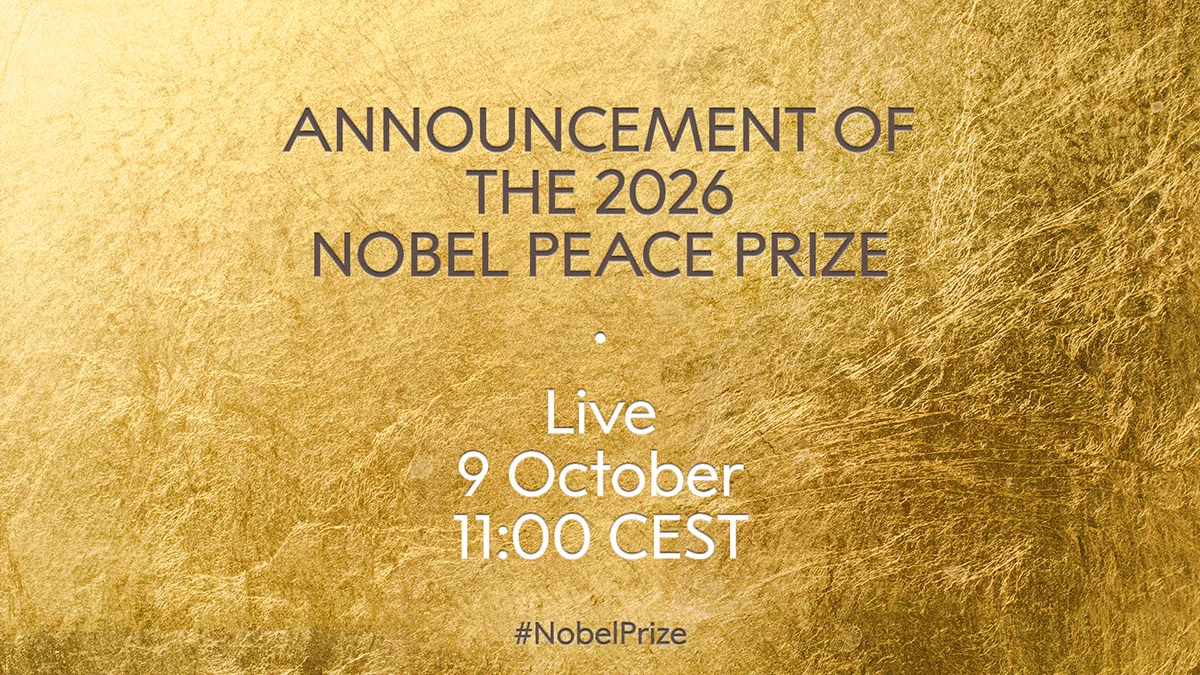
WATCH LIVE: Join us for the announcement of the 2026 Nobel Peace Prize.
Hear the breaking news first.
Where are you watching from?
#NobelPrize teapaw.org/i/broadcasts/1vJpPNEnw…
Erick Wilberding retweeted
"You wake up and you're 70. Looking ahead, you see a black doorway. You begin to notice the black doorway is always there, at the edge, whether you look at it or not.”
During an interview with Louisana Channel, 2026 literature laureate Anne Carson reflected on ageing, death and the meaning of life.
Earlier today Carson was awarded this year's Nobel Prize in Literature “for her bold and inventive oeuvre that, in playful dialogue with the classical tradition, has created new forms for contemporary literature.”
Get to know our new literature laureate: youtube.com/watch?v=ksH3FIs0…


Erick Wilberding retweeted

It survived war, fire, and flood. Then two earthquakes devastated the Basilica of Saint Francis of Assisi, which has stood for more than 700 years.
Now, art historians and software engineers are using cutting-edge artificial intelligence to help restore its damaged art treasures. Sunday.
“Socrates Would Thrive in the Age of AI.” Stephen Lewarne, Professor of Economics and Finance at Franciscan University, argues in the WSJ that when AI makes information abundant, judgment and the ability to defend what we claim to know become more important. His students may use AI for research and argument development, but must demonstrate understanding in individual oral exams. “The university of the future will succeed if it teaches students how to think and talk about the information that bombards them daily.” #SocraticMethod #AI #HigherEducation #OralExams #Education wsj.com/opinion/socrates-wou…
7
66
Socrates has returned. “The Socratic Revival” argues that as AI makes polished written work harder to treat as evidence of student understanding, oral examination becomes newly valuable. Students must explain, defend and revise their thinking in real time. The intriguing twist: conversational AI could itself help scale these Socratic oral exams. AI creates the assessment crisis, then resolves it with a 2,400 year old solution. #SocraticMethod #AI #Education #Assessment ollo.com/blog/2026/09/socrat…
1
1
61