

Wonder is the heaviest element on the periodic table. Even a tiny fleck of it stops time.~ Diane Ackerman.
Mumbai, India
Joined April 2020
- Tweets14.5K
- Following363
- Followers634
- Likes26.2K






It is not the amount of knowledge that makes a brain. It is not even the distribution of knowledge. It is the interconnectedness.
~ James Gleick,
'You have almost no chance to succeed, even in a meritocracy, if you don't have' -by Michael Dell:
livemint.com/news/us-news/qu…

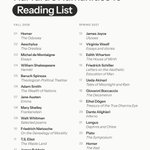
The Odyssey. Emma. Hamlet. The Wealth of Nations. Ulysses. The Iliad.
This isn’t just a list of books I’ve read and love (though I have). They’re on the reading list for Harvard’s Humanities 10. In the @WSJ, Pamela Paul writes about the surge in demand for the class: applications are up 40% this fall, with 180 first-years competing for 90 spots.
Students read a book a week, frequently write essays, have their attendance tracked, and put their devices away during class. As classics professor David Elmer says, “I did have the sense that a lot of students feel that the culture at large is not hospitable to deep reading, deep thinking or deep engagement with writing.”
I've been writing about the question AI is forcing on universities: is higher education about information or formation? If it’s only the former, universities are competing with the machines. The students lining up for a phone-free room, the great books, and people to argue with seem to be asking for the latter.
As one student put it: “A lot of what we get out of this class is the human experience, and you can’t get that out of AI.”
So let AI keep intelligence and humans keep wisdom. This class is one way to build it.
What should colleges prioritize most in the age of AI ?

Happy Birthday, Carl.
You taught millions of us that being small is not the same as being unimportant. You taught us to be citizens of the cosmos, to be curious, to doubt loudly, and to be gentle with each other on this pale blue dot we call home.
We are still looking up. We are still asking. And in this cold, indifferent universe, your voice is one of the warmest things we return to, again and again. It reminds us to be kind, to hold on to our humanity, to keep the candle from guttering out in the dark, and to keep reaching until one day we stand among the stars.
Happy Birthday, and thank you for everything.

2
93
Ajay Zaveri retweeted

Fellow doctors - especially those just graduating or preparing for NEET. I want to share a longish post.
We recently had a batch reunion. A decade ago, our medical college batch conversations were a high-stakes highlight reel: which competitive post-graduation specialty did you crack, your rank, USMLE fellowship matches. We were defined entirely by our professional milestones.
When our batch met recently, the vibe had completely shifted. Not a single person talked about their number of publications, the bed strength of their hospital, or how state-of-the-art their clinic setup is. Instead, we spent hours talking about our kids, navigating aging parents, our creative outlets, and what actually brings us a sense of purpose beyond the clinic doors.
It made me reflect on the predictable arc of these milestones. Fast forward another decade, and I am certain our catch-ups will center around chronic health management, joint pains, and our children heading off to college. In fact, a few months ago, I watched my mother-in-law’s batch reunite and their entire evening revolved around health updates, grandchildren, and mutual care.
We are often told to be relentlessly aggressive about our careers, to chase that ambitious specialization, and to build something we love showing up for every single day. That drive matters. But the things that feel like the absolute end of the world today the missed promotion, the delayed paper, the competitive benchmark..simply aren't!
Life is a sum total of everything, not just professional CV
Live fully, enjoy the present moment, and hold your near and dear ones tight.
Ajay Zaveri retweeted

Treat your body and mind as a temple. That's free.
You won't need any other.
Rs 85,000 buys you the world's first "roomdeaf" AI.
It can't hear the room, and its maker can't hear the questions.
It's "a project, not a product."
It scores your "pharmacological system."
Its terms disclaim the accuracy of its data.
Walk. Sleep. Know your BP and sugar. Love people. Keep learning.
Free. Well supported. No pre-order.

October 5, 1929. Straight off the train from Sealdah, from his Darjeeling hotel, the 27 year old founder of quantum mechanics writes home to his parents:
"Tagore is running a university or school... This school is closely connected to the Indian freedom movement under Gandhi. Material power, of course, is with the English - will there ever be a triumph of spirit over might? ... Any decent person will deem the [colonial] economy here scandalous."
Hours after leaving Jorasanko, he wrote that Bengal's spirit would beat the Empire. 18 years before 1947.
Source: Heisenberg's own letter, published by his student Rechenberg in "Werner Heisenberg - Die Sprache der Atome" (Springer 2010, p. 808).
2
44
Ajay Zaveri retweeted

INDIA: NEED FOR A NATIONAL AGENDA BEYOND PERSONALITIES & PARTISAN POLITICS: 1/2
This is not a partisan post, nor is it written to attract mass attention. This should be treated as pain & anguish of all those Indians who selflessly gave the best years of their life’s, and many sacrificed their lives itself, to chase a dream for an India that was strong and conscientious enough to usher in a safer and happier world through strength of it’s inherently humanistic civilisational values.
I am absolutely confident that piratic psyche of owners of X platform, alongside compromised Indians, shall block visibility of this post. Yet I persist.
Hon’ble Leader of the Opposition of India has captured our imagination by relentlessly exposing failures of the Government. He has ventured into a territory - control of our political space by global deep states- that none dared to broach in the past even though it is an unmistakable reality in the entire developing world with fragile institutions. Given the size of our democratic nation and its longer roots, it must cause national indignation. But it is missing.
And our Hon’ble LoP seems driven more by quest for power rather than a vision for nation-building. Even if he wins every political argument, will India transform?
His critics can counter attack saying:
His family’s dynastic/entitlement politics weakened institutions, undermined internal democracy, concentrated power around a family & mentally conditioned generations to believe that their salvation lay in mental slavery to individuals rather than resurrection of India as a great state & civilisation or betterment of their own lives.
Pandit Nehru was not the supreme leader of the kind Indira Gandhi ji or Modi ji. Accomplishments & failures of his era were were shared.
Yet history is never black and white. India also benefited from transformative leaders and reforms beyond any single family or party.
The real issue is larger.
If a Prime Minister can be compromised, the deeper failure lies in weak institutions and poor societal psyche that tolerates it. Can this ever be remedied by caste and identity politics that both Hon’ble LoP and Hon’ble PM have been peddling? Where right or wrong doesn’t matter & loyalty to a leader is supreme?
Where is the national conversation on institutional integrity, corruption, judicial reform, administrative accountability, scientific excellence and nation-building?
India's democracy increasingly resembles a football match with compromised referees. Two competing formations appear to be vying only for power & that too at cost of the nation?
Meanwhile, key national indicators are alarming. Over 1/3rd of our children remain stunted due to undernutrition. It impacts their lifelong cognitive capacity/productivity. The World Bank estimates that 56% of Indian children cannot read and comprehend.
India aspires to be a global power, yet our expenditure on research and development remains around 0.64% of GDP, much lower than major innovation-driven economies. We export our best brains and those who are left behind are framed, persecuted & killed by compromised cartels in police, judiciary, politics & bureaucracy?
These are not statistics. These are warnings.
Corruption& dishonesty have been normalised. Integrity is viewed as a handicap while manipulation is celebrated as success. Large sections of our judiciary & police systems appear compromised & corrupted beyond redemption.
Transparency International continues to rank us as one of the most corrupt nations. The consequence is a much weaker India than our potentials.
For all practical purposes, many of our institutions remain vulnerable to political capture. Both ruling & opposition forces often seek to control institutions rather than strengthen them. Citizens are mobilised in the name of caste/religion and often through corruption…..
@RahulGandhi @narendramodi
#India #politics #democracy #Nation #NationalSecurity #Democracy

Ajay Zaveri retweeted

Medical school taught me anatomy, physiology, and pathology. It taught me how to memorize, how to endure, and how to work longer hours than most people thought possible. What it didn't teach me was how to practice medicine with a full view of the human experience, mine included. Here's what I wish I had known from the start:
If you ever wondered why NASA chose quiet former Navy fighter pilot Neil Armstrong to be the first human being to land on the Moon, look at what he did three years earlier aboard Gemini 8 on March 16, 1966.
One hundred and eighty-five miles above the Earth, Armstrong and copilot David Scott had just completed the first orbital docking in human history, linking their Gemini 8 capsule to an unmanned Agena target rocket.
Suddenly, while flying through a communications blackout zone out of reach of Mission Control in Houston, the joined spacecraft began rolling sideways.
Assuming the unmanned Agena rocket was malfunctioning, Armstrong fired his thrusters to steady the craft and undocked from the Agena.
Instead of stopping the roll, separating from the heavy rocket made the much lighter Gemini capsule spin ten times faster.
An electrical short circuit had locked Thruster Number Eight wide open on the Gemini capsule itself.
Within seconds, the tiny two-man capsule was spinning like a rifle bullet at sixty revolutions per minute, one full flip every single second.
Centrifugal force pinned Armstrong and Scott into their seats, blurring the orange numbers on the instrument panel until their vision began fading to gray tunnel vision.
At sixty revolutions per minute, the human brain is seconds away from total blackout, ruptured blood vessels, and death in orbit.
Why did Armstrong not black out and die in the dark?
Because while his eyes were blurring, his test-pilot brain calculated that the only way to kill a stuck orbital thruster was to shut down the entire primary Orbit Attitude and Maneuvering System at the circuit breakers.
Fighting the crushing G-forces, Armstrong reached up to the overhead switch panel, killed the main thruster system, activated the separate nose reentry thrusters, and fired counter-thrust until the spinning capsule came to a dead stop.
Because mission rules required an immediate abort once the reentry fuel was used, Armstrong guided the capsule down on an emergency trajectory into the Western Pacific Ocean five hundred miles east of Okinawa.
United States Air Force Pararescuemen leaped from an HC-54 rescue plane flown out of Naha Air Base in Okinawa to secure the floating capsule before the destroyer USS Leonard F. Mason hoisted both men aboard alive.
1
196
However, As America still a vibrant democracy and has fair elections in America
While both are now absent from Indian politics under present regime
83
Ajay Zaveri retweeted

Excellent!


The Myth of the Acceptable Muslim — and Why Abdul El-Sayed’s Victory Matters
Whether in Michigan or New Delhi, Muslims are expected to prove their worthiness of solidarity by surrendering parts of their identity, politics and voice.
@virsanghvi @sabeer @saliltripathi @JhaSanjay
ranaayyub.substack.com/p/the…
50
However, it speaks of vibrant democracy and fair elections in America
While both are now absent from Indian politics
10
Ajay Zaveri retweeted
The Galton Board demonstrates the Central Limit Theorem by showing how steel balls, as they pass through levels of branching paths, consistently form a bell curve distribution. This illustrates how random processes tend to cluster around the average.

On the other note it also speaks of vibrant democracy and fair elections.. Both are now absent from Indian politics
1
2
39
Plot Twist newsletter: Winston Churchill and the power of hobbies
Alexandra Suich Bass, our Culture editor, paints a picture of the most pleasurable pastimes
economist.com/culture/2026/1…

22
"Thomas Jefferson taught that a democracy was impractical unless the people were educated. No matter how stringent the protections of the people might be in constitutions or common law, there would always be a temptation, Jefferson thought, for the powerful, the wealthy, and the unscrupulous to undermine the ideal of government run by and for ordinary citizens.
The antidote is vigorous support for the expression of unpopular views, widespread literacy, substantive debate, a common familiarity with critical thinking, and skepticism of pronouncements of those in authority—which are all also central to the scientific method."
— Carl Sagan
31