

The Essence of Safety podcast goes beyond root cause analysis and Swiss cheese slices, combining safety science with practical expertise.
Joined October 2021
- Tweets630
- Following159
- Followers316
- Likes2.5K


Pinned Tweet
Recently, the topic of pilot error / human error / human factor has come up a lot again, and I thought it might be useful to start a 🧵 summarizing how modern safety science views the human role in safety-critical systems – and particularly in accidents.

The Essence of Safety retweeted

Another interim report by the BFU to the Vietnam Air runway over run on take off in Munich has been released. It shows brake applications by the PF throughout the take off run of up to 27%. It is not a final report, but it doesn’t paint a pretty picture.
bfu-web.de/EN/Publications/I…


The Essence of Safety retweeted

Tonight, 2,977 lights rose above New York Harbor, representing every person killed in the September 11 attacks.
The aerial artwork originated from Governors Island and illuminated the sky beside the Tribute in Light ahead of the 25th anniversary of 9/11. It was developed in conjunction with representatives of the families, survivors and responder community.
A powerful tribute to 2,977 lives that will never be forgotten 🕊️🇺🇸
#NeverForget #September11 #911Memorial #NewYorkCity
The Essence of Safety retweeted

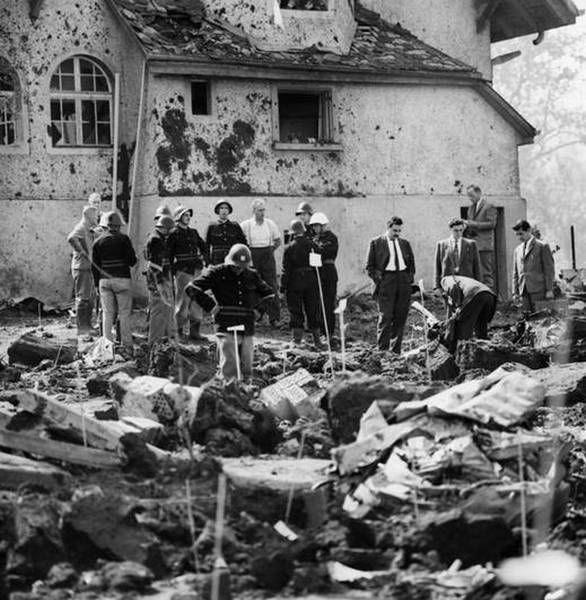
Swissair 306 - The Trauma of Dürrenäsch
September 4, 1963, Swissair Flight 306, a Caravelle with 80 aboard, took off from Zurich for a domestic flight after some delays. The airport was covered in heavy fog. So, to clear a path and check visibility, the flight crew used an informal method: they taxied at high power, so jet gases would clear fog from the runway.
However, this time the maneuver overheated the wheel rims, causing one to break. When the landing gear was retracted, the damaged part ruptured hydraulic lines, whose fluid ignited after contacting the hot rims.
Once the jet was airborne, all 80 aboard were basically doomed: The crew was unaware of the fire, which spread through the gear bay and damaged the aircraft’s hydraulic systems. The resulting loss of fluid disabled the flight controls, causing the aircraft to crash into a field about nine minutes after takeoff.
There were no survivors, although the accident could have been even worse, as the jetliner, fully laden with fuel, went down near the village of Dürrenäsch (21 miles from Zurich). There were no casualties on the ground, even though it was a traumatic event for the locals.
However, the accident did devastate another community: Humlikon, also in Zurich. 43 its 217 residents—about 20% of the population—were killed, including the entire local council, school board, and post office clerk.
Relatives cared for the orphaned children, although six had to move to nearby homes. With many farmers also among the victims, volunteers from surrounding villages and abroad helped maintain the farms, harvest the potatoes, thresh the corn, and sow the next crop. Just over a month later, the 52 remaining eligible voters elected a new local council.


The Essence of Safety retweeted

NTSB issues the preliminary report for its ongoing investigation of the June 16 crash of a TEXTRON AVIATION INC 680A airplane in Laredo, Texas. Download the report PDF: data.ntsb.gov/carol-repgen/a…
The Essence of Safety retweeted
Breaking by @aero_in – Brazilian Authorities have concluded the investigation into the 2024 VoePass ATR 72 crash that killed 62, listing a combination of operational factors, shortcomings in the company’s safety culture, and severe ice accumulation on the wings led to the loss of control of flight 2283.
The document details that the crew did not recognize in time the seriousness of the performance degradation caused by the ice and failed to carry out the procedures provided in the aircraft manuals for this type of situation.
You can see more details on the link below (its in Portuguese, but Google Translator can easily cover that for English)

#BREAKING Relatório Final será divulgado em breve!
Novo relatório do acidente da Voepass aponta que pilotos ignoraram alertas de baixa velocidade do ATR 72
@OnDisasters
aeroin.net/novo-relatorio-do…
This is an excellent article 👇 with many great points. It refers to the Aspen accident that I am currently working on. NB: the captain on the accident flight had previously rejected to perform a flight that he felt was unsafe, and also, management was convinced that they had a

Most safety discussions in business aviation gravitate toward familiar topics: automation policy, stabilized approaches, runway excursions, fatigue, and training standards. These are essential, but they are not the only forces shaping the risk picture. There is another influence that rarely appears in data dashboards or risk matrices yet is present on almost every trip: the expectations of the person paying for the flight.
Read the full AeroSafety World article here: flightsafetyfoundation.org/3…
#AeroSafetyWorld #AviationSafety #FlightSafetyFoundation #FsFoundation #BusinessAviation

1
63
The Essence of Safety retweeted

NTSB Chair @JenniferHomendy tells reporters at the British Embassy the Board has not yet received a draft copy of the Air India 171 final report from India’s AAIB which is typically sent for the NTSB to provide input/comments
Here's an interesting read on the expected update on the Air India flight 171 investigation:
bbc.co.uk/news/articles/cwyk…

72
There's no button for the crew to push to preserve cockpit voice recordings. Rather, the CVR has to be disabled by pulling a circuit breaker. This also legally grounds the aircraft and means that the return flight won't happen. At the same time, there is no certainty that the

🔴 A TAP Air Portugal pilot ignored four separate warnings before nearly crashing his Airbus A320neo into the hills near Prague Airport, this past January. Two warnings came from his co-pilot, two more from air traffic control. None of them made him pull up.
Investigators believe he fell into a state of "tunnel vision" and misread the navigation map, thinking he was already 13 km closer to Prague than he actually was. He began descending as if on final approach to the airport, while still flying over forested terrain west of the city.
The emergency pull-up only started at 295 meters above the ground. The plane climbed to 1,784 meters, with passengers experiencing 2G forces in the cabin during the sharp ascent. The crew then made a hard left turn to loop back and try the approach again, which investigators say further confirms the pilot believed he was already near the airport.
To make things worse, the cockpit voice recorder captured none of the crew's communication during the critical moments. The pilots never pressed the required button after the incident, so the recording was overwritten. Investigators also noted that the crew arrived late at the cockpit before departure and skipped the mandatory pre-landing briefing.
The final investigation report is expected later in 2026.
#Aviation #TapAir


2
3
486
The Essence of Safety retweeted
Scott Snook – a military and sociologist – penned “Friendly Fire: The Accidental Shootdown of U.S. Black Hawks over Northern Iraq” a book with an in-depth analysis of the case, recommend by aviation safety expert @EssenceOfSafety amazon.com/Friendly-Fire-Acc…

The Essence of Safety retweeted

The Air Accidents Investigation Branch is recruiting for an Inspector of Air Accidents (Operations)
Read more on how to apply: gov.uk/government/news/vacan…
#Jobs #AviationJobs #Hiring #Pilot


The Essence of Safety retweeted
Everyone, keep it cool regarding the CRJ-900 Air Canada crash.
Accident was like 4 hours ago but you will find a lot of speculation. Just because a post has 1.1 million views doesn´t mean it's quality content; some is literally a lie, taken from another liar. Others just like to steal each other content without credit and reach 1.5 million views in hours. There are choices
Here´s an example of how to report (facts only and not cropping the TV news crop) ⬇️

🚨#BREAKING: Officials have just announced that both the pilot and co-pilot have tragically been confirmed dead following the plane collision with a fire truck at LaGuardia Airport in New York.
While everyone rushes to be as fast and as loud as possible with blame and speculation, here are a few calm and thoughtful comments on the Jazz/Air Canada accident today.

The air traffic controller cleared the fire truck onto the runway. Seconds later, the same controller screamed “stop, stop, stop.” The plane was doing 93 to 105 mph.
Both pilots are dead.
Everyone will frame this as controller error. One controller was simultaneously managing a United flight that aborted takeoff after an anti-ice warning, dispatching a fire truck across an active runway, and sequencing an inbound Air Canada landing at highway speed. At 11:40 PM. On a mandatory overtime shift at a facility that has been understaffed for years.
A system that assigns one person that workload will produce exactly this outcome. The only variable is when.
The FAA is short approximately 3,000 controllers. The headcount dropped 13% from 2010 to 2024 while flight volume rose 10%. Over 40% of the FAA’s 290 terminal facilities are understaffed. The New York TRACON, which manages the most congested airspace in America across LaGuardia, JFK, and Newark, has been chronically below target. Newark was operating at 59% of its staffing goal. LaGuardia handles 900 flights a day.
The hiring pipeline is broken at every stage. Only 2% of applicants complete the full process. Training takes up to 6 years. The FAA Academy in Oklahoma City is a bottleneck, with roughly 35% of trainees washing out. Congress blocked legislation to build a second academy. In one recent hiring cycle, the FAA brought on 1,512 candidates and lost 1,300 in the same window. Net gain: around 160 controllers for an entire country.
Three things need to happen and everyone who can make them happen has known for years.
Congress needs to fund and authorize a second FAA training academy. One facility in Oklahoma City cannot produce enough controllers for 900 million annual passengers. Members of Congress from Oklahoma have actively blocked this. That needs to end yesterday.
The FAA needs to cut certification time. Six years from application to fully certified controller is absurd. The agency’s own data shows tower simulators reduce certification time by 27%. They’ve installed them at 95 facilities. That should be every facility, and the simulated hours should count toward more of the certification requirement.
The FAA needs to stop plugging staffing gaps with mandatory overtime. Controllers at understaffed facilities are working six-day weeks rotating between morning, mid, and night shifts. The NTSB has flagged fatigue repeatedly. The controller last night was managing overlapping emergencies during a nighttime operation. Overtime is not a staffing plan. It’s a countdown to the next runway collision.
The controller said “I messed up” to a Frontier pilot who watched the whole thing. The pilot responded “No man, you did the best you could.”
One of them is right. The answer determines whether this happens again.
OTD in 2018, Elaine Herzberg became the first person killed in a self-driving car collision.
The investigation revealed familiar patterns: Reliance on automation, human factors, unforeseen scenarios, and organisational pressures.
Listen: A Meditation on Automation