
I beg you to be of good heart and return to yourself. El futuro es claro, se derrumbará
Joined December 2021
- Tweets15.7K
- Following1.8K
- Followers265
- Likes40.6K




Fan Mounier retweeted

¿Y si buena parte del problema de la vivienda en España no fuese un fallo del mercado, sino el resultado de nuestras propias decisiones políticas?
@BenitoArrunada acaba de publicar en @socialfedea un magnífico informe que explica cómo las restricciones a construir, vender y alquilar contribuyen a generar escasez y encarecer la vivienda. Sus siete conclusiones merecen atención.
1. La escasez de suelo edificable es, en buena medida, una decisión política. No basta con tener suelo disponible sobre el papel. La acumulación de autorizaciones, procedimientos y derechos de veto hace que urbanizarlo pueda llevar entre 10 y 15 años, e incluso más de 20. Y mientras tanto, seguimos preguntándonos por qué no se construye.
2. Nuestras exigencias también encarecen la vivienda. Queremos preservar edificios, limitar alturas, restringir densidades y exigir prestaciones cada vez mayores. Todo ello puede tener justificación, pero también tiene un coste. Y quienes terminan pagándolo son, especialmente, quienes no pueden acceder a una vivienda más asequible.
3. La fiscalidad penaliza tanto la construcción como la movilidad. En un supuesto analizado por el Consejo General de Economistas, los impuestos representan el 25,78 por ciento del desembolso final del comprador de vivienda nueva. Además, gravamos mucho las compraventas y relativamente poco la tenencia. El resultado es que desincentivamos vender, cambiar de residencia o adaptar la vivienda a nuestras necesidades.
4. Proteger al inquilino actual puede perjudicar al futuro inquilino. Los controles de precios, las prórrogas obligatorias y la inseguridad jurídica reducen los incentivos a alquilar. Un estudio sobre la regulación catalana de 2020 estima que los alquileres bajaron cerca de un 5 por ciento, pero las nuevas contrataciones cayeron alrededor de un 10 por ciento. Quienes ya tienen contrato pueden beneficiarse, mientras que quienes buscan vivienda encuentran menos oferta y mayores exigencias de solvencia.
5. La vivienda pública y las subvenciones tampoco son soluciones mágicas. Ayudar a las familias vulnerables no exige necesariamente que la Administración construya y gestione directamente las viviendas. Y subvencionar la demanda sin aumentar la oferta puede terminar trasladando las ayudas a los precios. La cuestión no es solamente cuánto dinero destinamos, sino qué incentivos generamos.
6. Las malas políticas pueden ser electoralmente rentables. Esta es una de las conclusiones más interesantes. Los beneficiarios de una regulación perciben inmediatamente sus ventajas, mientras que quienes pierden oportunidades futuras difícilmente identifican sus costes. Es mucho más fácil conseguir votos protegiendo a quienes ya tienen vivienda que defendiendo a quienes todavía no han podido acceder a ella.
7. Incluso las encuestas pueden distorsionar el debate. Preguntar si queremos alquileres asequibles no equivale a preguntar si apoyamos controles de precios que pueden reducir la oferta. La forma de presentar una política condiciona las respuestas. Y esas respuestas terminan utilizándose para justificar intervenciones cuyos costes no se han explicado.
¿Las soluciones? Facilitar la construcción, revisar las restricciones urbanísticas, reducir los impuestos que penalizan las transacciones, garantizar la seguridad jurídica y separar las políticas de asistencia social de las obligaciones de los propietarios privados.
En definitiva, queremos viviendas abundantes y asequibles, pero nos resistimos a aceptar muchas de las condiciones necesarias para conseguirlo.
documentos.fedea.net/pubs/ap…

Fan Mounier retweeted

Nine months is a lifetime in AI. After becoming hopelessly outdated, Claude Blattman is newly refreshed!
My motto: Agentic AI for professionals who don't code
The idea is to get it to write first drafts in your voice, triage your inbox, manage project teams, and fix your oven.

Fan Mounier retweeted

I am sharing a new paper today with Dario Caldara: “Can Peer Review Survive AI-Generated Text?”
sas.upenn.edu/~jesusfv/Peer_…
Dario and I, as editors, are increasingly getting papers submitted to our journals that are 99 percent AI-generated. Even worse, we are also receiving many AI-generated referee reports, both as editors and, more frustratingly, as authors.
And we cannot emphasize this enough: the real problem is not that the papers and reports were AI-generated; it is that no one had done the thinking behind them, and you can so easily tell. The papers were eminently forgettable, and the referee reports were disappointingly uninsightful. We have seen too many reports of the form: “The paper is well-written and addresses an important problem. However, the authors should consider additional baselines.”
This deluge of AI-generated text puts peer review in jeopardy: journals will be flooded with low-quality submissions, economists will decline requests to referee papers or routinely use AI to referee them, and which papers get published will become less and less linked to their quality.
We do not want to defend the status quo entirely. Peer review is slow, many reports are poor, and editors (including us!) make bad calls all the time. Still, well-executed peer review remains the best system we have for assessing each other’s work and advancing the profession. AI could improve peer review if used deliberately for that purpose, for instance, to check proofs and code. That is not what we are seeing.
The difficulty is that readers, including editors and referees, cannot see how AI was used. As a result, in practice, the burden of verification shifts from the author to the reader.
Since we reject this shift, Dario and I did what economists always do when something bothers us: we wrote a paper.
So, what do we do in it? First, we check whether AI detectors such as Pangram get this right: is a referee report flagged as AI-generated indeed AI-generated? Or is Pangram just flagging proofreading and editing? No. We run an experiment with 25 referee reports from the pre-AI era. Proofreading and editing do not trigger AI-generated flags. Only when we ask the LLMs to substantially rewrite the referee report or to generate a new report do we get the AI-generated flags. Pretty compelling evidence, if I may say so.
Second, we build a theoretical model to explore who should bear the burden of verification: the author or the reader? (Yours truly always enjoyed the courses on the rules of evidence in law school; yes, as Billy Wilder would say, nobody is perfect.)
The answer is that it is much more efficient for the author to do it, because the author can verify at a much lower cost and only needs to do it once (rather than each reader repeatedly). Before AI, the authors more or less had to verify the results, even if only because they had to type them in. This was not perfect (and all papers ever published in economics probably have at least one mistake). But the problem is that, with AI, the author does not even need to read the text. Or can just skim it. Writing is thinking, and without writing there is usually not much thinking.
So, a paper flagged as AI-generated is prima facie evidence that the author has not verified it. Should this lead to an automatic rejection? No. But there should be a zero-tolerance policy for serious mistakes. The first serious mistake we find in the paper, and it is out! In comparison, for a non-flagged paper, a serious mistake is something that the editor might determine it can be fixed in a revision.
We are stricter with referee reports. There is absolutely no point in the referee generating a report using an LLM. As an editor, I can do that directly and save myself the trouble of asking you for it. Now, of course, you can use the LLM to help you with the report (if the journal allows it! Many journals do not allow you to upload the paper to an LLM, and you need to follow the rules). For example, you can use the LLM to search for existing results in the literature.
But peer review is not about finding one sentence that is not entirely precise or a slightly sloppy mathematical proof. Referees are asked: “Is this idea important despite its flaws?” And, relatedly: “Is the paper a good fit for the journal in terms of quality and focus?” That judgment is the task for which you are selected as a subject expert.
We also propose that journals require that, before a paper is submitted, the author submit it to an LLM using an approved prompt and include the LLM report and a discussion of what was and was not fixed. That way, the referee would not need to check (or at least not check so carefully) every technical detail, and they could focus on the big picture: Is this a good paper? Is this a good fit for this journal? What is fundamental for this paper to become publishable at this journal?
Anyway. The paper has many other arguments, and we try to be nuanced. So, before ferociously typing the first complaint that crosses your mind, would you consider reading it? Chances are that we have already discussed your objection. We have been thinking about this for a long time.
But by all means, leave good comments!

Fan Mounier retweeted

If you are worried about a stock market bubble I have a deal for you: crash insurance is unusually cheap right now.

Fan Mounier retweeted

.@UCBerkeley's @B_Eichengreen warns that @SecScottBessent's debt-issuance strategy could be penny-wise and pound-foolish, owing to the risk of a rollover crisis if borrowing costs rise. project-syndicate.org/commen…

Fan Mounier retweeted

¿Qué pasa con nuestras infraestructuras y servicios públicos?
La pregunta es ambiciosa. Para responderla (y arreglarlo) hay que saber de dónde venimos, volver a invertir más y sacar al partidismo de las decisiones de inversión: para mantener un Estado capaz.
Dentro vídeo 👇
Fan Mounier retweeted

La historia del clima muestra que la Tierra ha experimentado cambios importantes a lo largo de cientos de miles de años. Pero también permite observar algo que distingue el momento actual: la concentración de CO₂ en la atmósfera se encuentra en niveles excepcionalmente elevados en el periodo que reconstruye el gráfico.
Mirar atrás no significa restar importancia a lo que ocurre hoy. Al contrario: ayuda a ponerlo en perspectiva y a entender por qué importan tanto la velocidad del cambio y la acumulación de emisiones. En el libro explicamos esa evidencia y cómo se relaciona con la actividad económica.
La Economía del Cambio Climático, con @JavierAndresDom, publicado por @EdicionesDeusto y disponible en:
amazon.es/econom%C3%ADa-del-…
@BBVAResearch @UV_EG

Fan Mounier retweeted

Il y a 70 ans, la France interdisait le vin dans les cantines scolaires. →l.lefigaro.fr/8Amr

Fan Mounier retweeted

Tae Kim (@firstadopter) says NVIDIA’s product quality for the next two to three years is already “baked in the cake,” but that his best-case scenario for replacing Jensen is Arm CEO Rene Haas takes over while NVIDIA keeps it's deep bench of executives:
“So what I foresee in the best case scenario is say Rene Haas becomes a CEO. He can do the conferences, he can do the marketing, he can do the business management … [and] instead of one Jensen, maybe you have, you know, two, three people that can do parts of Jensen.”
“If they're able to retain the top five, 10 people and have a good CEO... I think Nvidia can do well.”
“I mean the next two, three years actually baked in the cake in terms of their actual quality of the products. The key question is what's the strategy going to be, the deal making three to five years from now. That's the critical question.”
Fan Mounier retweeted

The US Treasury is weighing a plan to provide a short-term bridge loan to help Venezuela repay its outstanding obligations with the Inter-American Development Bank, according to people familiar with the matter bloomberg.com/news/articles/…


Fan Mounier retweeted

Can the dollar’s global dominance endure in a more multipolar world? Olivier Jeanne of Johns Hopkins University will deliver the 2026 Mundell-Fleming Lecture at the Annual Research Conference, introduced by @STenreyroIMF. Tune in on November 12 at 2:30 PM ET. #ARCPolak
youtube.com/watch/XrwKeO0s_f…

Fan Mounier retweeted

A useful chart: how popular approval of President Trump in his 1st and 2nd terms (from RCP) responded to major 'shock' events.

Fan Mounier retweeted

Had a fun conversation with @rajshamani discussing econ principles, IMF, and life.
youtube.com/watch?app=deskto…

Fan Mounier retweeted

Population aging is pushing up Chile’s crude cancer death rate, even as age-adjusted rates are falling.
In Chile, the annual number of cancer deaths as a share of the total population has been rising for decades. From this, it would be easy to assume that cancer is getting worse. But the chances of dying from cancer at most ages are lower than they used to be. The missing piece is that the country’s population is changing quickly, and older people now make up a much larger share.
That’s what the chart shows. The crude cancer death rate, in red, counts registered cancer deaths per 100,000 people of all ages. This metric has been going up, reflecting the fact that cancer risks increase steeply with age, and the population has grown much older.
The blue line, by contrast, shows the age-adjusted rate. This metric removes the effect of aging by holding the age structure constant.
This line has been falling for decades, which means that Chileans at almost every age are now less likely to die from cancer than people of the same age were in the past.
The pattern we see in Chile is happening in many other countries, too, and is visible in the global estimates.
(written by @EOrtizOspina)

Fan Mounier retweeted
Stock markets up after election results. But what is most interesting is the composition. Health and solar up, data centers and Musk-related down. Crypto up may be the one I wouldn't have expected.
And note, markets presumably had already been pricing in large Democratic gains.

Fan Mounier retweeted

The Democrats popular vote margin is the largest of any party's since 1976 economist.com/interactive/gr…

Fan Mounier retweeted
New data: A complete breakdown of the 2026 US Exit Polls, all groups and issues. Fascinating.
nbcnews.com/politics/2026-el… via @nbcnews

Fan Mounier retweeted
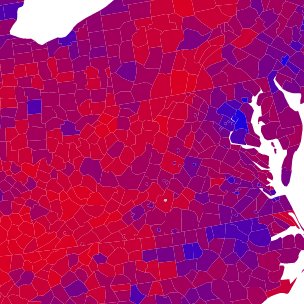
Our preliminary Times Voter Trends estimates for the results by demographic group
nytimes.com/interactive/2026…

Fan Mounier retweeted
Sometime in the early AM hours, we'll publish our preliminary Times Voter Trends estimates for 2026
We've published 2020 and 2024 (below)
nytimes.com/interactive/2024…
