M.D., Research Fellow @MassGeneral @MarcelaMaus Lab. Focus: cellular immunotherapy, precision medicine, alloSCT @uniklinik_hd & @Schmitt_lab Tweets are my own
- Tweets123
- Following102
- Followers84
- Likes839
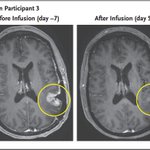



ALT The diagram illustrates the sequential steps used to produce and administer chimeric antigen receptor (CAR) T cells for the treatment of glioblastoma: collection of the patient’s peripheral-blood mononuclear cells (PBMCs) through leukapheresis, positive selection, and activation of T cells from the PBMCs; genetic modification of activated T cells to express CARv3-TEAM-E (T-cell–engaging antibody molecule, specific for epidermal growth factor receptor [EGFR] variant III [EGFRvIII]), as well as a truncated form of CD19 (tCD19) that serves as a marker for CAR transduction; and infusion of the engineered CAR T cells through an Ommaya reservoir, directly delivering the cells into the ventricular system for enhanced targeting of brain tumor cells.




ALT Contrast-enhanced T1-weighted magnetic resonance imaging (MRI) in Participant 1 immediately after resection, before infusion, and after infusion


ALT #CellTherapy #CAR-T cell therapy #CAAR-T cells #CATCR-T cells #TRBV targeting #Precisionimmunotherapy