

Gabriel Piña retweeted

New project! @_tomvaillant examines one of the most debated questions in parenting: whether or not to sleep train your child. In this essay, Tom depicts sleep training opinions across social media, popular media, and medical research.
pudding.cool/2024/07/sleep-t…
So happy to have our article published in Journal of Children and Media.

Can formal parenting programs improve parenting knowledge and practices? @Gabrielpinab, Alicia Torres, & @igriffith002 conducted an experimental study to evaluate the effectiveness of a wide-reaching parenting initiative that features research-based strategies + recommendations.

How states can help school districts to reduce the costs of infrastructure investment. Particularly relevant since half of all public school districts are in need of physical improvement.

Thanks to @BrookingsInst's invite to write for the Brown Center Chalkboard blog. I explain in this brief how state credit enhancement programs promote capital investment, esp. in low-income districts, based on my recent working paper. @gwtrachtenberg brook.gs/3HeAkvK

Gabriel Piña retweeted

Our team developed automated tools to help you quickly explore a vast variety of child and family wellbeing research and literature.
Check out this report to learn how to use the tools and let us know if we can help you in making use of them ⬇️
abt.associates/3ww7X60
Gabriel Piña retweeted

In their new Child Trends brief, @Gabrielpinab @jwarren3000 & Kristin Anderson Moore explain the presence of significant barriers to upward mobility for young people with socioeconomic disadvantages, especially for young women & Black & Hispanic youth. buff.ly/3QLh7Ux
Great report, I'd also add Discord and Roblox to the list.

The share of teens using Facebook has declined sharply in the past decade. Today, 32% of teens report ever using Facebook, down 39 points since 2014-15, when 71% said they ever used the platform. pewrsr.ch/3PfaHLV

Gabriel Piña retweeted

NEW from @BrookingsMetro & @ChildTrends: nearly 60% of adults who were socioeconomically disadvantaged in their teens continue to struggle economically at age 30—facing low earnings, high poverty rates & multiple barriers to employment: brookings.edu/blog/the-avenu…

Our new research with Brookings is finally out! We describe different employment trajectories of young adults from disadvantaged backgrounds.
This Post is from an account that no longer exists. Learn more
Gabriel Piña retweeted

How can we produce real-time estimates of poverty in the U.S. based on a family unit’s monthly (rather than annual) income? This is the focus of our paper now up at @JPAM_DC, w/ @MeganACurran, @jdmatsudaira, Christopher Wimer, and Jane Waldfogel. onlinelibrary.wiley.com/doi/…

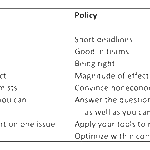
This table by @rglenner is so useful to understand the differences between research in academia and outside of it. Particularly useful is to think that in policy contexts we don't try to find a question we can answer well, but answer a given question as well as we can.

Originally posted some time ago: blogs.lse.ac.uk/impactofsoci…


Our new blog finds that having a higher-paying job w/ benefits at age 24 can yield positive long-term outcomes. However, many jobs in the U.S. do not provide good pay &/or benefits, making it harder for low-income workers to improve their lives. buff.ly/3P027S7
Gabriel Piña retweeted

People here talk abt machine learning and causal inference, but what we really want is access 👏to administrative 👏 data 👏 with some decent IDs👏 to just make some simple tables 👏 💁♂️
Our most recent simulation work with the Urban Institute is finally out! Check the interactive visualization simulating key moments that can set adolescents and young adults on an upward or downward path of economic mobility. apps.urban.org/features/infl…

Gabriel Piña retweeted

Check out this new @IRP_UW podcast on some of my co-authored work on child maltreatment during the pandemic. It’s only 20 minutes, and covers 6 papers + more! If podcasts aren’t your thing, here’s a thread summarizing this body of work. 1/

Check out our latest podcast episode to hear from @lindsbullinger about how she and her colleagues evaluated the risk of child maltreatment in the early months of the pandemic when many families had to stay at home.
irp.wisc.edu/resource/lindse…

ALT Lindsey Bullinger
Our article identifying gaps in the measurement of infant and toddler well-being just got published. Very happy to be part of this large collaborative effort between Child Trends, CDC, HRSA, Georgia Department of Public Health, and Marcus Autism Center. link.springer.com/article/10…

Gabriel Piña retweeted

“It’s fine with me that others embrace the capitalization of ‘Black.’ Maybe I will someday," writes @JohnHMcWhorter. "But when I think of social change, my mind lingers more on, say, the Year Up program." nyti.ms/3MlATEj
Also maybe we shouldn't define a youth/student by an experience, in the same way we avoid saying "disabled children." Something like "youth experiencing homelessness" would be better.

Homeless youth and children are not receiving the resources needed to combat the barriers of not having a stable home. The biggest obstacle is having one federal definition of homelessness.
n.pr/3BmxboK