

John 8:32, 15:9
Victoria, Australia
Joined October 2021
- Tweets16.5K
- Following617
- Followers363
- Likes67K








Pinned Tweet
Australia's "social media ban" (see teapaw.org/GenGenTWBD/status/1987…) came into effect on 10 Dec 2025.
As a mature-aged adult, I will not be complying with any age verification. This means my ability to see news, consider views and respectfully engage with others here will likely end. 😶

ALT "Those that have a voice have to speak for those of us who are silenced." — Mike Leach

On 10 Dec 2025, people in Australia on many social media platforms may face an age-verification check next time they log in to continue engaging with others. The legislation impacts all ages, not just under 16s. I will not comply. 1 of 11

ALT Source: https://maatsmethod.substack.com/p/027-the-social-media-ban-for-kids
Gen Gen ✝️🇦🇺🌸 retweeted

Philosophy isn’t just locked away in dusty old libraries
It happens every time you question an assumption, listen to a perspective that challenges yours, or sit quietly with a hard truth
World Philosophy Day 🤔🏺
#WorldPhilosophyDay #Philosophy #CriticalThinking #DeepThoughts


Gen Gen ✝️🇦🇺🌸 retweeted

Fabulous Jacinda Ardern was a Covid vaccine enthusiast. After the rollout of the vaccine, she invited her subjects to report their vaccine side-effects. Thousands reported. She ignored them.
Typical reaction of the elite globalists. They can act as they please and with no accountability.
👇 – at Winchester, VA

Jacinda Ardern said, “Let’s talk about side effects.”
Well, people did exactly that.
Thousands of replies flooded her Facebook post, with people describing heart attacks, strokes, seizures, blood clots and neurological problems.
And what happened next?
Instead of answering uncomfortable questions, the comments started disappearing.
Let that sink in.
You invite people to share their experiences, then suddenly the experiences you don’t want to hear become a moderation problem.
You cannot preach transparency while silencing the very people asking to be heard.
You cannot call something safe and effective and expect people to stop asking questions when they believe they’ve been harmed.
These aren’t just comments. They’re people’s lives, their health and their unanswered questions.
If the science is solid, why is scrutiny such a threat?


Gen Gen ✝️🇦🇺🌸 retweeted

#InternationalMensDay
#IMD2026
#SaveTheMale
#MenMatterToo
“ Check in with your mates, ask twice if they’re okay”
💙💙💙


swansongproject.co.uk/start-…
This is a song I co wrote to raise awareness of suicide. Dedicated to Benjamin and encapsulates his taste in music. #starttalking #suicideawareness #menmattertoo #savethemale #SuicidePrevention 💙For Benjamin💙


In the vaccine injury and bereaved space no one can hear you scream.

If you watch no other clip we publish today, please, we ask you to watch this one...
“Is anyone reading this?”
That line is buried inside the V-safe data @ICANdecide fought to get released.
@jeffreytucker and @React19org have now taken those free-text reports and put them into a thousand-page book, and he has been reading them out loud.
People describing sudden vision loss, paralysis, nerve pain, trouble breathing, trips to the ER, and again and again, the same desperate question: is anyone actually listening?
Some of these entries are brutal.
“I’ve asked for help and no one responds.”
“I’m begging you to help.”
“Help me. Help. Help.”
These are the words people typed into the government’s own vaccine monitoring system after the COVID shots.
Now, finally, people can read them.
7
😳😵💫Land of the Maple Leaf — Land Down Under: same difference. facebook.com/binaryaus/video…


1
38
Gen Gen ✝️🇦🇺🌸 retweeted

*Sally Beck - The Little-Known Truth About Vaccine History & Injury*
Independent health journalist and author Sally Beck @Beck_Sall on @ukmfa1 podcast to discuss her new book, “Emperor's New Clothes: How the Covid Jab Exposed 70 Years of Vaccine Injury".
"...the 1955 polio vaccine Cutter disaster...40,000 out of the 200,000 children given that vaccine went on to develop polio...a proportion were paralysed and about 10 died..."
Full Interview here ukmfa1.substack.com/p/sally-…

ALT Source: https://drtesslawrie.substack.com/p/strange-and-cruel-dr-david-cartlands

STRANGE & CRUEL
By Dr Tess Lawrie
🎯 post on horrific witch-hunt of Lighthouse Keeper Dr David Cartland:
drtesslawrie.substack.com/p/…
@CartlandDavid @lawrie_dr
8
💔Indeed, who in Australia cares about the people harmed by the "covid countermeasures"? (I include the castigated & cast out "unv" here.) A dedicated few have and keep trying to help but there are too many Pontius Pilates who have washed their hands of us. #AccountabilityMatters

Her first jab ended in anaphylaxis. Her job needed another.
Sarah, a NSW emergency nurse, now breathes through a tube in her throat. A specialist who knew of her reaction overruled her exemption and told her she needed another jab. She took it to keep nursing.
National Cabinet said vaccines should be voluntary. Twenty days later, NSW made one a condition of her job.
By August 2023, 3,803 Australians had lodged vaccine injury claims. Fewer than 200 had been paid.
The Court of Appeal said "that choice was respected". For Sarah, the choice was a legal fiction.
Who is helping the injured and the bereaved?
8
🇦🇺🚨Call for Inquiry into AHPRA. Please sign the petition, open to the general public & medical/health students and practitioners, by 22 November 2026. ⬇️
"...your signature tells Parliament that safe, open, patient-centred care matters to all of us." —amps.asn.au/ahpra-inquiry-pe…

ALT Source: https://ianbrighthope.substack.com/p/who-answers-for-the-regulator-the

Who Answers for the Regulator? The Case for a National Inquiry into Ahpra ianbrighthope.substack.com/p…
Who Answers for the Regulator? The Case for a National Inquiry into Ahpra
I support the Australian Medical Professionals’ Society’s Care Without Fear petition. I call on the Australian Parliament, together with every state and territory, to establish an independent inquiry into the Australian Health Practitioner Regulation Agency and the boards it supports, covering the entire life of the national scheme from 2010 to the present. Its first public hearings should include nurses as well as doctors. Its first witnesses should include people who made complaints as well as those who had to answer them. And its first demand should be for the original case files. AMPS
Ian Brighthope's Substack is a reader-supported publication. To receive new posts and support my work, consider becoming a free or paid subscriber.
Consider what happened to one Australian doctor. In August 2022, the Medical Board of Australia suspended Dr William Bay. In December 2024, the Supreme Court of Queensland set aside the suspension with effect from the day it began. The Court also set aside the decisions to investigate five notifications and the decision to refer matters to the Queensland Civil and Administrative Tribunal. It ordered Ahpra and the Board to pay costs. The distinction matters. The Medical Board made the decisions. Ahpra and the Board defended them. A judgment could correct the legal record. It could not give Dr Bay back the intervening two years and four months. qed.exposed
Now consider the people whose names most Australians will never know. A published Australian study identified 20 practitioners who died by confirmed or likely suicide, attempted suicide or experienced self-harm while involved, or recently involved, in a regulatory process between January 2018 and December 2021. Eight were nurses. Eight were medical practitioners. Across the 20 cases, there were 12 confirmed suicides, four deaths considered likely suicides, and four cases of attempted suicide or self-harm. The researchers could not determine why individual practitioners died. They did identify features of the regulatory process that contributed to distress, including prolonged uncertainty, communication failures and inconsistent handling of health concerns. Those findings alone warrant a public account of what changed, when it changed, and whether practitioners are safer today. academic.oup.com
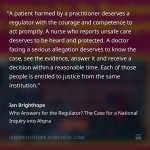
I have spent much of my professional life in nutritional and environmental medicine. I know what it means to defend one’s professional judgement before a medical board. I also know what patients entrust to us. A patient harmed by a practitioner deserves a regulator with the courage and competence to act promptly. A nurse who reports unsafe care deserves to be heard and protected. A doctor facing a serious allegation deserves to know the case, see the evidence, answer it and receive a decision within a reasonable time. Each of those people is entitled to justice from the same institution.
The conduct Parliament must put on the record
No one outside the scheme has access to every notification, closed investigation, internal recommendation or decision to continue a restriction. It would be dishonest to claim a complete inventory of misconduct from the public record alone. What follows is the public case for opening those files. Some matters are established by courts, official figures or independent oversight. Others are serious allegations whose truth and extent Parliament should determine.
Registration failures and the disruption of people’s working lives. The administration of the new scheme attracted Senate scrutiny in 2011 and later a Victorian parliamentary inquiry. Registration may look like paperwork from an agency office. To a nurse awaiting a roster or a doctor relying on registration to provide Medicare-funded services, an administrative failure can interrupt a livelihood and a patient’s care. Nor did complaints about registration disappear after the transition. Ahpra’s 2024–25 report recorded 1,053 complaints from practitioners concerning registration applications and renewals, compared with 276 the preceding year. Those figures count complaints, not proven errors. Parliament should establish what drove the increase, how often the agency was at fault and what remedy people received. parliament.vic.gov.au
Investigations allowed to drag on, with practitioners and patients left in the dark. The National Health Practitioner Ombudsman explicitly identified delay as a systemic issue. In 2021–22 it recorded 110 delay issues across 309 notification-related complaints. Nineteen concerned matters that had closed with no further action. Fourteen concerned matters in which immediate action had been taken. The Ombudsman also identified the distress caused when people could obtain little information about progress. When a case sits idle, the practitioner lives with the allegation and the patient who complained is left wondering whether anyone has listened. Both deserve an explanation for every substantial period of inactivity. nhpo.gov.au
Immediate action followed by slow investigation. There are circumstances in which suspending someone today protects a patient tomorrow. That urgency places an equally serious obligation on the authority to investigate promptly once it has acted. In 2022–23 the Ombudsman recorded 51 issues relating to immediate action, including eight concerning investigation delays. Some delays have an external cause, such as police proceedings. Parliament should establish how many were avoidable, who reviewed the continuing need for restrictions and whether supervised or limited practice was considered. An emergency decision deserves its most searching scrutiny after the immediate emergency has passed. nhpo.gov.au
Decisions that failed judicial scrutiny, with the burden of correction falling on the practitioner. Dr Bay’s case gives Parliament a specific file to examine. Who checked the original decision? What opportunities existed to correct it before judgment? What did the Board and Ahpra tell other decision-makers after the orders were made? Parliament should commission an audit of comparable cases, including those in which a practitioner lacked the money, health or representation to seek judicial review. Access to a Supreme Court is a thin safeguard for someone who has already lost the income needed to get there. qed.exposed
Inadequate protection against the misuse of complaints to bully or harass. A Senate committee examined vexatious notifications in 2017, including their use by practitioners against colleagues. In 2024 the Ombudsman reviewed Ahpra’s framework for identifying and managing such notifications. Staff interviewed for that review explained that applying the framework could itself add delay. A complaint that cannot be substantiated may still have been made honestly. The harder question is how well the agency detects deliberate retaliation. I want nurses who have reported unsafe staffing or challenged a superior to be able to give confidential evidence about what happened next. The inquiry should follow the sequence of events and examine employment records alongside the notification. aph.gov.au
Communications that intensified distress at the moment people most needed clarity. Researchers identified the first notification, a suspension decision, receipt of a health assessment and referral to a tribunal as particularly difficult moments. Practitioners described the difference a considerate telephone call could make. They also described uncertainty that even a sympathetic staff member could do little to relieve. Parliament should read a representative sample of the letters actually sent. Could the recipient identify the precise allegation, the evidence required, the next decision date and a person authorised to answer questions? If a nurse needs a solicitor simply to understand what the regulator is asking, the regulator should answer for the quality of that letter. academic.oup.com
Inconsistent handling of practitioners’ health and insufficient attention to the hazards of investigation itself.The published case reviews found inconsistencies in Ahpra’s approach to health-related concerns. The Victorian parliamentary inquiry also recorded nursing evidence about the value of confidential, profession-specific support and a supported return to work. The distinction between illness and unsafe practice matters enormously. Parliament should examine whether seeking treatment ever prompted unnecessarily intrusive inquiries, whether assessments were repeated without adequate reason, and whether conditions continued after the clinical basis for them had changed. Families affected by a death should have the opportunity to give evidence privately and to see how the inquiry addresses their evidence. academic.oup.com
The possible chilling of clinical discussion and professional speech. On 9 March 2021, Ahpra and the national boards issued a joint statement about COVID-19 vaccination setting out expectations for practitioners and students. AMPS says practitioners experienced it as a warning about the professional consequences of departing from official positions. Its letter names Dr Mark Hobart and Dr Valerie Peers in connection with vaccination exemptions, and raises other disputes concerning public commentary and care for minors. These accounts warrant testing against the complaints, clinical records where relevant, reasons for decision, and the practitioners’ replies. What words or actions actually triggered intervention? Was the concern about a particular patient, a factual representation, professional conduct, or criticism of policy? What evidence established the risk? Patients have a direct interest in those answers. They rely on us to discuss uncertainty honestly, especially when they ask a difficult question in the privacy of a consultation. AMPS
Restrictions whose real-world consequences may exceed their stated purpose.AMPS describes loss of income, savings, professional standing and employment while proceedings were unresolved. Parliament should test those accounts and examine the terms of individual conditions. A requirement to work under supervision may look modest on paper. If no approved supervisor is available in a rural district, it can remove a clinician from practice as effectively as suspension. For a nurse working shifts across several wards, a condition an employer cannot accommodate can have the same effect. The inquiry should ask what officials knew about feasibility, how quickly practitioners could obtain a variation, and what happened to the patients and communities left behind. AMPS
Accountability dispersed across institutions while the individual carries the consequences. Ahpra processes applications and supports the boards. The relevant national board holds registration decision-making responsibilities. Employers, co-regulators, tribunals and courts may each have distinct roles. Ministers acknowledged concerns about inconsistent practices through the independent review of complexity in the national scheme and issued their final response in May 2026. The Senate also reported on registration and notifications in 2022. A new inquiry should begin by putting every previous recommendation beside its responsible authority, implementation date and measured result. Australians deserve to know which failures were corrected, which recurred and who knew they were recurring. nhpo.gov.au
Nurses deserve hearings in their own right
Eight nurses among the 20 serious incidents in the published review should put an end to any suggestion that nursing can be dealt with in a paragraph appended to medical evidence. A bedside nurse may be the first person to see that a patient is deteriorating, a medicine order is unsafe or a ward can no longer provide adequate cover. That nurse may also be the least senior person in the room. An inquiry that wishes to understand power in Australian healthcare should spend time listening to the person who had to speak up at two in the morning and report for the next shift. academic.oup.com
I want dedicated nursing and midwifery hearings in metropolitan, regional and remote Australia. Hear from enrolled nurses, registered nurses, midwives, internationally qualified nurses, agency staff and those who quietly left the profession. Ask whether an employer’s account was tested against the roster, staffing levels, incident reports and contemporaneous clinical notes. Ask whether the nurse had access to those records after leaving the workplace. Ask who could afford representation, who accepted conditions to bring proceedings to an end, and who lost the practical ability to return to work. Give former colleagues a protected way to corroborate or challenge those accounts. The evidence most worth hearing may come from the people with the least institutional protection.
What an inquiry at every level must do
I call for a national parliamentary inquiry coordinated with state and territory parliaments, with independent counsel, access to original records, public hearings and confidential evidence sessions. Its remit should extend from the officer handling the first telephone call to the board authorising a suspension and the ministers responsible for the legislation. Where different bodies made different decisions, the report should name the responsible body at each step.
At the case level, audit a representative sample from 2010 onwards. Include cases closed without action, urgent suspensions, lengthy restrictions, overturned decisions and cases in which patients say a regulator acted too slowly. Reconstruct what each decision-maker knew at the time.
At the agency and board level, examine investigative training, clinical expertise, conflicts of interest, legal advice, use of external assessors, expenditure on contested proceedings and the independence of internal review. Require reasons for keeping restrictions in force.
At the workplace level, follow notifications originating in employment disputes. Hear separately from whistleblowers, managers, patients and colleagues. Examine how investigators distinguished individual error from understaffing, unsafe systems and management failure.
At the state and territory level, compare like cases across jurisdictions. Publish differences in investigation times, interim restrictions, review rights and access to representation. Explain differences that materially affected a practitioner or a patient.
At the ministerial and parliamentary level, identify who received earlier warnings, what changes they authorised, how they monitored implementation and what they did when problems persisted.
At the level of remedy, recommend enforceable review intervals, clearer reasons, timely correction of the public record, accessible independent review and a fair route to redress where administrative error caused demonstrable loss. Require governments to respond publicly to each recommendation by a fixed date.
My test for this inquiry is simple. At its conclusion, the family of a nurse who died should be able to identify what safeguards changed. A patient who reported dangerous care should be able to see where responsibility lay for a delay. A doctor whose suspension was overturned should be able to discover whether anyone examined how the original decision came to be made. And Parliament should be able to tell Australians, with evidence, whether the reforms worked.
I support Care Without Fear because the power to take away a person’s ability to practise carries a corresponding duty to account for every day that power is exercised. Australia has heard the warnings repeatedly since the national scheme began. The next hearing should open with the records on the table, the responsible officials present, and doctors, nurses, patients and families entitled to be heard. parliament.vic.gov.au
The AMPS petition is open until 22 November 2026. Read and sign the Care Without Fear petition.
Professor Ian Brighthope

13
Gen Gen ✝️🇦🇺🌸 retweeted

Who Answers for the Regulator? The Case for a National Inquiry into Ahpra ianbrighthope.substack.com/p…
Who Answers for the Regulator? The Case for a National Inquiry into Ahpra
I support the Australian Medical Professionals’ Society’s Care Without Fear petition. I call on the Australian Parliament, together with every state and territory, to establish an independent inquiry into the Australian Health Practitioner Regulation Agency and the boards it supports, covering the entire life of the national scheme from 2010 to the present. Its first public hearings should include nurses as well as doctors. Its first witnesses should include people who made complaints as well as those who had to answer them. And its first demand should be for the original case files. AMPS
Ian Brighthope's Substack is a reader-supported publication. To receive new posts and support my work, consider becoming a free or paid subscriber.
Consider what happened to one Australian doctor. In August 2022, the Medical Board of Australia suspended Dr William Bay. In December 2024, the Supreme Court of Queensland set aside the suspension with effect from the day it began. The Court also set aside the decisions to investigate five notifications and the decision to refer matters to the Queensland Civil and Administrative Tribunal. It ordered Ahpra and the Board to pay costs. The distinction matters. The Medical Board made the decisions. Ahpra and the Board defended them. A judgment could correct the legal record. It could not give Dr Bay back the intervening two years and four months. qed.exposed
Now consider the people whose names most Australians will never know. A published Australian study identified 20 practitioners who died by confirmed or likely suicide, attempted suicide or experienced self-harm while involved, or recently involved, in a regulatory process between January 2018 and December 2021. Eight were nurses. Eight were medical practitioners. Across the 20 cases, there were 12 confirmed suicides, four deaths considered likely suicides, and four cases of attempted suicide or self-harm. The researchers could not determine why individual practitioners died. They did identify features of the regulatory process that contributed to distress, including prolonged uncertainty, communication failures and inconsistent handling of health concerns. Those findings alone warrant a public account of what changed, when it changed, and whether practitioners are safer today. academic.oup.com
I have spent much of my professional life in nutritional and environmental medicine. I know what it means to defend one’s professional judgement before a medical board. I also know what patients entrust to us. A patient harmed by a practitioner deserves a regulator with the courage and competence to act promptly. A nurse who reports unsafe care deserves to be heard and protected. A doctor facing a serious allegation deserves to know the case, see the evidence, answer it and receive a decision within a reasonable time. Each of those people is entitled to justice from the same institution.
The conduct Parliament must put on the record
No one outside the scheme has access to every notification, closed investigation, internal recommendation or decision to continue a restriction. It would be dishonest to claim a complete inventory of misconduct from the public record alone. What follows is the public case for opening those files. Some matters are established by courts, official figures or independent oversight. Others are serious allegations whose truth and extent Parliament should determine.
Registration failures and the disruption of people’s working lives. The administration of the new scheme attracted Senate scrutiny in 2011 and later a Victorian parliamentary inquiry. Registration may look like paperwork from an agency office. To a nurse awaiting a roster or a doctor relying on registration to provide Medicare-funded services, an administrative failure can interrupt a livelihood and a patient’s care. Nor did complaints about registration disappear after the transition. Ahpra’s 2024–25 report recorded 1,053 complaints from practitioners concerning registration applications and renewals, compared with 276 the preceding year. Those figures count complaints, not proven errors. Parliament should establish what drove the increase, how often the agency was at fault and what remedy people received. parliament.vic.gov.au
Investigations allowed to drag on, with practitioners and patients left in the dark. The National Health Practitioner Ombudsman explicitly identified delay as a systemic issue. In 2021–22 it recorded 110 delay issues across 309 notification-related complaints. Nineteen concerned matters that had closed with no further action. Fourteen concerned matters in which immediate action had been taken. The Ombudsman also identified the distress caused when people could obtain little information about progress. When a case sits idle, the practitioner lives with the allegation and the patient who complained is left wondering whether anyone has listened. Both deserve an explanation for every substantial period of inactivity. nhpo.gov.au
Immediate action followed by slow investigation. There are circumstances in which suspending someone today protects a patient tomorrow. That urgency places an equally serious obligation on the authority to investigate promptly once it has acted. In 2022–23 the Ombudsman recorded 51 issues relating to immediate action, including eight concerning investigation delays. Some delays have an external cause, such as police proceedings. Parliament should establish how many were avoidable, who reviewed the continuing need for restrictions and whether supervised or limited practice was considered. An emergency decision deserves its most searching scrutiny after the immediate emergency has passed. nhpo.gov.au
Decisions that failed judicial scrutiny, with the burden of correction falling on the practitioner. Dr Bay’s case gives Parliament a specific file to examine. Who checked the original decision? What opportunities existed to correct it before judgment? What did the Board and Ahpra tell other decision-makers after the orders were made? Parliament should commission an audit of comparable cases, including those in which a practitioner lacked the money, health or representation to seek judicial review. Access to a Supreme Court is a thin safeguard for someone who has already lost the income needed to get there. qed.exposed
Inadequate protection against the misuse of complaints to bully or harass. A Senate committee examined vexatious notifications in 2017, including their use by practitioners against colleagues. In 2024 the Ombudsman reviewed Ahpra’s framework for identifying and managing such notifications. Staff interviewed for that review explained that applying the framework could itself add delay. A complaint that cannot be substantiated may still have been made honestly. The harder question is how well the agency detects deliberate retaliation. I want nurses who have reported unsafe staffing or challenged a superior to be able to give confidential evidence about what happened next. The inquiry should follow the sequence of events and examine employment records alongside the notification. aph.gov.au
Communications that intensified distress at the moment people most needed clarity. Researchers identified the first notification, a suspension decision, receipt of a health assessment and referral to a tribunal as particularly difficult moments. Practitioners described the difference a considerate telephone call could make. They also described uncertainty that even a sympathetic staff member could do little to relieve. Parliament should read a representative sample of the letters actually sent. Could the recipient identify the precise allegation, the evidence required, the next decision date and a person authorised to answer questions? If a nurse needs a solicitor simply to understand what the regulator is asking, the regulator should answer for the quality of that letter. academic.oup.com
Inconsistent handling of practitioners’ health and insufficient attention to the hazards of investigation itself.The published case reviews found inconsistencies in Ahpra’s approach to health-related concerns. The Victorian parliamentary inquiry also recorded nursing evidence about the value of confidential, profession-specific support and a supported return to work. The distinction between illness and unsafe practice matters enormously. Parliament should examine whether seeking treatment ever prompted unnecessarily intrusive inquiries, whether assessments were repeated without adequate reason, and whether conditions continued after the clinical basis for them had changed. Families affected by a death should have the opportunity to give evidence privately and to see how the inquiry addresses their evidence. academic.oup.com
The possible chilling of clinical discussion and professional speech. On 9 March 2021, Ahpra and the national boards issued a joint statement about COVID-19 vaccination setting out expectations for practitioners and students. AMPS says practitioners experienced it as a warning about the professional consequences of departing from official positions. Its letter names Dr Mark Hobart and Dr Valerie Peers in connection with vaccination exemptions, and raises other disputes concerning public commentary and care for minors. These accounts warrant testing against the complaints, clinical records where relevant, reasons for decision, and the practitioners’ replies. What words or actions actually triggered intervention? Was the concern about a particular patient, a factual representation, professional conduct, or criticism of policy? What evidence established the risk? Patients have a direct interest in those answers. They rely on us to discuss uncertainty honestly, especially when they ask a difficult question in the privacy of a consultation. AMPS
Restrictions whose real-world consequences may exceed their stated purpose.AMPS describes loss of income, savings, professional standing and employment while proceedings were unresolved. Parliament should test those accounts and examine the terms of individual conditions. A requirement to work under supervision may look modest on paper. If no approved supervisor is available in a rural district, it can remove a clinician from practice as effectively as suspension. For a nurse working shifts across several wards, a condition an employer cannot accommodate can have the same effect. The inquiry should ask what officials knew about feasibility, how quickly practitioners could obtain a variation, and what happened to the patients and communities left behind. AMPS
Accountability dispersed across institutions while the individual carries the consequences. Ahpra processes applications and supports the boards. The relevant national board holds registration decision-making responsibilities. Employers, co-regulators, tribunals and courts may each have distinct roles. Ministers acknowledged concerns about inconsistent practices through the independent review of complexity in the national scheme and issued their final response in May 2026. The Senate also reported on registration and notifications in 2022. A new inquiry should begin by putting every previous recommendation beside its responsible authority, implementation date and measured result. Australians deserve to know which failures were corrected, which recurred and who knew they were recurring. nhpo.gov.au
Nurses deserve hearings in their own right
Eight nurses among the 20 serious incidents in the published review should put an end to any suggestion that nursing can be dealt with in a paragraph appended to medical evidence. A bedside nurse may be the first person to see that a patient is deteriorating, a medicine order is unsafe or a ward can no longer provide adequate cover. That nurse may also be the least senior person in the room. An inquiry that wishes to understand power in Australian healthcare should spend time listening to the person who had to speak up at two in the morning and report for the next shift. academic.oup.com
I want dedicated nursing and midwifery hearings in metropolitan, regional and remote Australia. Hear from enrolled nurses, registered nurses, midwives, internationally qualified nurses, agency staff and those who quietly left the profession. Ask whether an employer’s account was tested against the roster, staffing levels, incident reports and contemporaneous clinical notes. Ask whether the nurse had access to those records after leaving the workplace. Ask who could afford representation, who accepted conditions to bring proceedings to an end, and who lost the practical ability to return to work. Give former colleagues a protected way to corroborate or challenge those accounts. The evidence most worth hearing may come from the people with the least institutional protection.
What an inquiry at every level must do
I call for a national parliamentary inquiry coordinated with state and territory parliaments, with independent counsel, access to original records, public hearings and confidential evidence sessions. Its remit should extend from the officer handling the first telephone call to the board authorising a suspension and the ministers responsible for the legislation. Where different bodies made different decisions, the report should name the responsible body at each step.
At the case level, audit a representative sample from 2010 onwards. Include cases closed without action, urgent suspensions, lengthy restrictions, overturned decisions and cases in which patients say a regulator acted too slowly. Reconstruct what each decision-maker knew at the time.
At the agency and board level, examine investigative training, clinical expertise, conflicts of interest, legal advice, use of external assessors, expenditure on contested proceedings and the independence of internal review. Require reasons for keeping restrictions in force.
At the workplace level, follow notifications originating in employment disputes. Hear separately from whistleblowers, managers, patients and colleagues. Examine how investigators distinguished individual error from understaffing, unsafe systems and management failure.
At the state and territory level, compare like cases across jurisdictions. Publish differences in investigation times, interim restrictions, review rights and access to representation. Explain differences that materially affected a practitioner or a patient.
At the ministerial and parliamentary level, identify who received earlier warnings, what changes they authorised, how they monitored implementation and what they did when problems persisted.
At the level of remedy, recommend enforceable review intervals, clearer reasons, timely correction of the public record, accessible independent review and a fair route to redress where administrative error caused demonstrable loss. Require governments to respond publicly to each recommendation by a fixed date.
My test for this inquiry is simple. At its conclusion, the family of a nurse who died should be able to identify what safeguards changed. A patient who reported dangerous care should be able to see where responsibility lay for a delay. A doctor whose suspension was overturned should be able to discover whether anyone examined how the original decision came to be made. And Parliament should be able to tell Australians, with evidence, whether the reforms worked.
I support Care Without Fear because the power to take away a person’s ability to practise carries a corresponding duty to account for every day that power is exercised. Australia has heard the warnings repeatedly since the national scheme began. The next hearing should open with the records on the table, the responsible officials present, and doctors, nurses, patients and families entitled to be heard. parliament.vic.gov.au
The AMPS petition is open until 22 November 2026. Read and sign the Care Without Fear petition.
Professor Ian Brighthope
Beautiful words and image. Goodnight all. 💫

Novembers are for softest sleep
when skies are dark and grey.
They do not mind the time you keep
when night looks much like day.
They do not mind the rain that falls
so warmly down your cheek.
‘Rest easy now’ is what they’d say
if months knew how to speak.
- Ellis Nightingale | 🖌️ Joe Gilronan

1
24
Gen Gen ✝️🇦🇺🌸 retweeted

🚨🚨🚨🚨🚨🚨🚨🚨🚨🚨🚨🚨🚨Please share this everywhere!!! notonthebeeb.co.uk/post/is-i…


