

Some ideas on how hitters should think and some ideas on how/why they shouldn't. The mental companion to @forcefulhitting
United States
Joined March 2022
- Tweets385
- Following1.8K
- Followers516
- Likes126





Pinned Tweet
The great Willie
Mays said, “…What shape your mind is in, is what makes the biggest difference of all.” Conversely, what shape your mind is NOT in (being overly conscious or aware of what you are doing), is just as important.

The Hitting Mindset retweeted

John Wooden shares a mindset that we all need to adopt every day.
"Yesterday is gone. That'll never change. Tomorrow is yet to be."
"How can you affect tomorrow? By today. That's the only possible way."
"I tried to get each player to make each day his masterpiece."
Don't get caught up in the past or worry about the future - make today your masterpiece.
Then he shared advice he gave to certain players:
"You've gotta put the past out. Good or bad, it's past - it'll never change. The only way you can affect the future is what you do today."
You can't change yesterday. You can't control tomorrow. You only have today.
Then he recited a poem by Vivian Larimore that he loved:
"I've shut the door on yesterday, its sorrows and mistakes. I've locked within its gloomy walls past failures and heartaches."
"And now I throw the key away to seek another room and furnish it with hopes and smiles and every springtime bloom."
"I've shut the door on yesterday and thrown the key away. Tomorrow holds no fears for me, for I have found today."
"Today is the day that counts. It's today."
The present moment is the only place where you can truly make a difference.
Don't carry yesterday's failures or worry about the unknown.
Focus on what you can control.
The Hitting Mindset retweeted

A hitter’s pelvis position can dictate their spacing and ability to slot the barrel.
If the pelvis opens too early and starts leaking forward, spacing gets compromised.
A lot of hitters try to fix the barrel, when the real issue starts with the pelvis.
The Hitting Mindset retweeted

Larry Bird Was So Vicious in Celtics Practice That Coaches Had to Pull Him Out to Protect His Own Teammates. Dee Brown Said He Was Always on 1,000.
Larry Bird did not have a practice mode.
There was no version of Bird that showed up to the gym and took it easy because it was Tuesday and the game wasn't until Thursday.
Every single day.
Every single rep.
Every single possession.
Full competition.
No exceptions.
It got so bad that the Celtics coaches had to protect his own teammates from him.
Dee Brown described it exactly as it was. "He would terrorize guys in practices. Terrorize to the point where like, 'Larry, you gotta sit out right now cause this dude ain't gonna be the same tomorrow. He ain't gonna be the same. We need him for tomorrow, man.' He was always on 1,000. I mean, that's what great competitors do… It's not like, 'OK, this is practice, and this is the game.' This is competition. So, you ain't gonna make no reputation off me."
The coaches pulling him out wasn't discipline. It was damage control. Bird was destroying the confidence of his own teammates so thoroughly that they needed him off the floor just to get through the next day functional.
Assistant coach Don Casey got his introduction to Bird on his very first day.
Bird walked into practice, looked Casey in the face, and delivered his verdict.
"Walton says you're a pretty good coach. We'll see."
No handshake. No small talk. Just a test with a deadline attached.
Casey spent the next six years watching Bird be exactly what that first interaction promised.
"Bird was very intense. He was the alpha dog. When those guys stepped across the white line, that was it."
Three championships. Three MVPs. One of the most feared player in the NBA for a decade.
He saved nothing for the game. Practice was the game. Every single day.

The Hitting Mindset retweeted

DAMN! Who knew little old me and my opinion would have all y’all this STIRRED UP?!
Some of y’all heard the word ANALYTICS and completely MISSED MY WHOLE DAMN POINT!
I’m talking about REAL BALLPLAYERS! DOGS! GRINDERS! Dudes who will fight through 12-pitch at-bats, move runners, lay down a bunt, run the bases, make plays, and do the dirty work EVERY SINGLE NIGHT! Guys who COMPETE THEIR ASSES OFF!
I spent a few years around Pat Murphy. Sat in his office, had plenty of personal conversations, and heard firsthand what that man preached!
“PLAY LIKE A NEANDERTHAL!”
Now let me ask y’all something…
YOU THINK NEANDERTHALS KNEW WHAT ANALYTICS WERE?! OR WERE THEY JUST OUT THERE TRYING TO COMPETE, SURVIVE, AND WIN NO MATTER WHAT?!
THAT’S MY WHOLE DAMN POINT!
I never said the Brewers and Rays don’t use analytics. I’m saying I see two organizations that value OLD-SCHOOL BALLPLAYERS! Complete players who know how to WIN, even when it ain’t pretty!
Y’all call it analytics. I call it GETTING BACK TO THE GAME I GREW UP LOVING! BASEBALL! SIMPLE AS THAT!
And yeah, let me be a LITTLE PETTY before I go!
Respectfully, I’m not letting people who have NEVER stepped between those lines convince me otherwise just because you went to a really FANCY SCHMANCY COLLEGE 🤣and know how to read a spreadsheet!
I respect education. I respect analytics. But being book smart doesn’t automatically mean you understand what it takes to COMPETE AND WIN between those lines!
I played 15 YEARS in the BIG LEAGUES! I’ve been around some of the greatest baseball minds in the world. That doesn’t mean I know everything, but I’ve earned the right to have my own perspective on this game!
LOVE THE DEBATE! RESPECT EVERYBODY’S OPINION! BUT I’M STANDING TEN TOES DOWN ON MINE!
The Hitting Mindset retweeted

Super happy for Cam Booser. Dude was just thankful to get a shot in the big leagues with the Sox at the age of 31. Now, he’s getting huge outs in a clincher game and heading to the World Series.


The Hitting Mindset retweeted

At about 1:45 in the morning, a few hours after he helped win a World Series game, Mookie Betts was outside the Boston Public Library handing out trays of food to homeless people.
It was in the 30s. He was wearing a hoodie. Nobody in that line knew who he was.
He never told anybody. A stranger walking out of a bar recognized him.
Here is the whole thing.
It was Game 2. The Boston Red Sox beat the Los Angeles Dodgers 4 to 2 at Fenway Park. Betts went 3 for 4 and scored a run.
Afterward there was a huge food order back at the apartment, far more than anybody could eat.
So instead of throwing it out, he and one other guy loaded the trays into a shopping cart and took them to the library.
Steak tips and chicken.
The man who recognized him was Mike Winter, who works as a VIP host at clubs in Boston. He had just left a bar. He said the people getting the food had no idea.
"None of the homeless guys knew who he was."
Somebody took a photo. Lou Merloni, the former Red Sox infielder who now hosts a radio show in Boston, posted it.
Here is what he wrote.
"The man that delivered the food wasn't looking for attention or praise BUT deserves it."
Two days later, before Game 3 at Dodger Stadium, reporters asked Betts about it. He did not make a speech.
"It's pretty cool."
And then this.
"I've been blessed with everything I have, and I might as well share it."
And then he added this.
"It's not the first time I've done it."
He was right. Three years earlier, in New York for a series against the New York Yankees, he and teammate Blake Swihart bought pizza for homeless people they came across.
Both of them homered in their next games.
Now the honest part. This was leftover food and a cold walk, not a foundation or a check with a lot of zeros on it. It did not cost him much.
That is kind of the point. He did it the way a regular person would, and he did not want anybody to see it.
He said so himself.
"It wasn't supposed to get (the attention) it got."
Four days after that night, the Red Sox won the World Series. He was the American League MVP that year.
A little more than a year later, Boston traded him to the team he had just beaten. He has been with the Dodgers ever since.
He and his wife, Brianna, started a foundation in 2021 called the 50/50 Foundation. It works with kids on nutrition, mental health and financial literacy.
He has four rings now.
But the night people still remember was a shopping cart, a hoodie, and a line of people who had no idea who he was.
For more stories like this, follow us on any platform @thesportsontap

The Hitting Mindset retweeted

Steve Kerr on the changing nature of basketball…
Fewer play calls. More flow. More concepts. More decisions made at speed. As the game continues to evolve, players are being asked to operate with greater freedom, responsibility and awareness. Rather than relying on constant instructions from the sidelines, they must understand the principles of the game, recognise what is unfolding in front of them and make effective decisions in real time.
I think there’s something fascinating here from a sport psychology perspective. As basketball gets faster, players have less time to consciously organise themselves, think through every option or wait for direction from the bench. They have to perceive, decide and act…in the flow of the game. This means responding to the information available in the moment rather than trying to control every situation through pre-planned instructions.
That places enormous demands on a player’s mindset. Their attention has to be exceptional. They must constantly scan, search and pick up information, reading teammates, opponents, spaces, movements and opportunities. They need to stay connected to what is happening NOW while also anticipating what might happen NEXT. The ability to remain fully engaged with the present moment, without becoming distracted by previous actions or future possibilities, becomes increasingly important as the speed and complexity of the game increases.
Their intensity also has to be optimal. They need to be alert, alive and engaged, mentally and physically ready to respond to a game that refuses to slow down. Too little intensity can lead to passivity, delayed reactions and a lack of involvement. Too much intensity can create tension, rushed decisions and a loss of control. The challenge is to find the level of activation that allows the player to remain responsive, composed and ready to act.
Their intent has to be high as well. They must be purposeful, positive and proactive, rather than waiting for the perfect moment or hesitating through fear of making mistakes. They need to execute with conviction and commit to their decisions, even when the outcome is uncertain. In a fast-moving environment, hesitation can close an opportunity before the player has had time to fully recognise it.
Attention. Intensity. Intent.
These are three mental skills that, in my opinion, become increasingly important as sport becomes faster, more fluid and less scripted. They help players remain connected to the game, respond effectively to changing circumstances and act with clarity when there is no time for lengthy conscious analysis.
But there’s another fascinating layer to Kerr’s observation. Players need shared understanding, shared principles and shared ways of seeing the game. They need to recognise opportunities together, anticipate each other’s movements and coordinate their actions without constantly relying on verbal instructions. The most effective teams develop a collective awareness that allows players to respond to the same situation in complementary ways, even when the exact solution has not been rehearsed.
This is where coaching becomes particularly interesting. The challenge isn’t simply to teach players what to do. It is to develop players who can recognise when to do it, why to do it and how to adapt when the picture changes. Players need to understand the principles behind their actions so they can apply them intelligently in situations that are never exactly the same. The goal is not to remove uncertainty from the game, but to help players become more comfortable and capable within it.
Training must reflect this. There should be less dependence on rehearsed solutions and more exposure to realistic, variable and demanding situations that help players learn to perceive and act together. Players need opportunities to make decisions under pressure, respond to changing information and experience the consequences of their choices. They need to develop not only technical execution, but also the awareness and adaptability required to use those skills effectively in context.
And underpinning all of this?
A High Performance Mindset (HPM).
Because when the game accelerates, the mind cannot afford to become disconnected, distracted or consumed by doubt. It has to remain connected to the game, connected to the task and connected to the next action. Players must be able to acknowledge what has happened, learn from it quickly and then return their attention to what the game is asking of them now.
The future of basketball may involve fewer instructions from the sidelines, but it will demand more from the minds of the players on the court. Players will need to be more perceptive, more adaptable and more willing to take responsibility for their decisions. They will need to understand the game deeply enough to operate with freedom while remaining connected to the collective principles of the team.
The faster the game, the more important the mindset.
**********************************
My new book, Compete, helps players to execute with high attention, optimal intensity, and high intent
The Hitting Mindset retweeted
New York Knicks head coach Mike Brown delivers a powerful message to his players at practice…
He pulls his starting five aside, looks at the remaining players and tells them:
“Everybody else in this gym, you’re fighting — either to make the team or for minutes.”
I love this! Because it speaks to something I believe is fundamental to high performance sport… the intentionality of practice.
Practice isn’t simply a place to improve technical and tactical capabilities. It’s an opportunity to compete. To demonstrate who you are. To build the habits, behaviours, and mindset that serve you when the pressure is on.
And that requires intention. Deliberate, purposeful, relentless intention.
In my new book, Compete, I introduce the reader three psychological skills that underpin outstanding performance: Attention, Intensity, and Intent.
Attention: What are you focusing on during practice? Before each drill, identify the information you need to pick up. The positioning of a defender, the movement of a teammate, the space opening up. Stay connected to these cues, make decisions based on what you see and refocus quickly when distracted. Don’t just go through the motions. Be mentally present.
Intensity: Are you practising with the physical and mental intensity the situation demands? Sprint into position. Communicate with purpose. Compete for loose balls. React quickly when possession changes. Maintain your standards when fatigue sets in. And remember, intensity isn’t always about going flat out. It’s about bringing the right energy to each moment.
Intent: What are you trying to achieve today? Set a clear objective before practice. Perhaps it’s attacking space aggressively, making quicker decisions or responding positively after mistakes. Commit to demonstrating that behaviour throughout the session. Afterwards, reflect on whether your actions matched your intentions.
Because here’s the thing…
You don’t suddenly become an outstanding competitor when the game begins. You build the behaviours of an outstanding competitor in practice.
You build them when you’re tired. When you’re frustrated. When you’ve made a mistake. When you’re not getting the minutes you want. When nobody seems to be watching.
And this is where Brown’s message becomes so powerful.
He’s reminding his players that practice matters. That every possession is an opportunity to demonstrate something. That competition isn’t reserved for game day.
Of course, effective practice needs more than effort. It needs quality, feedback, reflection, and the freedom to experiment and make mistakes. But combine these ingredients with a High Performance Mindset and practice becomes an extraordinarily powerful environment for development.
My message to athletes is simple…
Don’t just turn up to practice. Compete with purpose. Train your mindset as deliberately as you train your game.
Because how you compete in practice helps shape how you compete when it matters most.
The Hitting Mindset retweeted

NLCS MVP Jake Bauers shares how letting go of results helped him find a different level of freedom as a competitor.
"I think what changed for me this year was I stopped caring about results. I started caring about competing. I started caring about being in the moment and getting out of my own way."
Sometimes, the biggest obstacle to performing at your best isn't a lack of preparation or ability.
It's the pressure you place on yourself to produce a particular outcome.
You become so concerned with what you want to happen that you lose touch with what the moment actually requires.
Any performer can unlock a new level when they learn how to be fully invested in the competition without becoming imprisoned by the outcome.
🎥: Fox Sports
The Hitting Mindset retweeted

My son Christian came home from karate with a white belt.
I asked what it meant. He said: "You know nothing. You have an opportunity to learn everything."
That stopped me cold. I was an MLB manager at the time.
Most leaders confuse experience with wisdom.
They've "seen it all" so they stop listening, stop asking, stop being curious.
But the leaders who last longest never stop being students. They have the White Belt Mentality.
Here are 3 principles of the White Belt Mentality.
Principle 1: Approach every room like you have something to learn.
The moment you walk in thinking you already have the answers, you've lost.
• Ask more questions than you give answers
• Seek out people who challenge your thinking
• Be the first to say "I don't know but let's figure it out together"
The leaders who stay curious outlast the ones who think they've arrived.
Principle 2: Your team will teach you.
When I was managing the Pirates, my best ideas didn't come from strategy sessions.
They came from conversations with players, coaches, and support staff who were closest to the problem.
I had to listen, not just wait to talk. Actually listen.
People tell you exactly what they need, if you're willing to hear it.
Principle 3: Build habits that force you to keep growing.
Staying a white belt isn't an attitude, it's a daily practice.
• Carry a journal and write down what you learn, not just what you do
• Spend a few months learning from one voice, book, or mentor, and then follow the seeds to the next
• Seek out people who tell you what you need to hear, not what you want to hear
The best leaders in any room aren't the ones with the most experience.
They're the ones still acting like they have the most to learn.
@pittsburghpirates

The Hitting Mindset retweeted

“No longer did Bauers worry about every mechanical detail. He was more focused on seeing the ball, attacking it the right way, being more athletic. ‘I felt like I’ve cycled through mechanical possibility. When is enough going to be enough? When are you just going to go play?’
The Hitting Mindset retweeted
Don’t drift. Don’t lean. Stay behind the ball.

Video Tips- Check your HEEL PLANT. a hitters head should stop forward movement within 1 or 2 frames after heel plant. Drifting during the swing can decrease Launch time, swing speed and swing path which could drastically reduce consistent hard contact,. #StanceSwings


The Hitting Mindset retweeted
Two years ago Jake Bauers told his agent he was retiring. The plan was that his wife would go back to teaching and he would stay home with their kid.
Three days later she told him she was pregnant, so he went back to work instead. For the insurance.
Tonight he hit the go ahead home run in the National League Championship Series.
Here is the whole thing.
He is from Newport Beach, California, and he went to Marina High School in Huntington Beach. San Diego took him in the 7th round.
Then seven organizations in 11 years. He hit for the cycle with Cleveland once. He has also been traded four times, sent down, taken off a 40 man roster and signed to three different minor league deals.
He is a career .224 hitter.
Two years ago he hit .199 with 118 strikeouts, and he decided that was enough.
He figured the last good swing of his career was a home run he hit in a wild card game that October. He was fine with that being the end of it.
Here is how he describes what happened next.
"She tells me she's pregnant."
And then this.
"Obviously, she wasn't going back to work, so we decided I was going to keep playing."
And the reason, in four words.
"We needed health insurance."
So he did not retire. Milwaukee took him off the roster that November anyway. He went into free agency, re-signed a minor league deal in January, and made the team out of spring training.
This year he hit .266 with 26 home runs and 86 RBI and an .873 OPS.
He is 31 years old and it is the best season of his life by a wide margin.
In game 2 of this series he fouled off pitch after pitch against Yoshinobu Yamamoto, 12 of them in one at bat.
Here is what he said about that.
"I decided that he wasn't going to get me."
And here is what he said about his wife a few days ago.
"We have two kids, so she's holding it down at home by herself a lot of the time, which is a lot."
And this.
"She stuck by me this whole time when it wasn't always easy."
And then he said this about himself.
"I wasn't always the best husband. I wasn't always the best father."
Here is the honest part. He is still a .224 hitter for his career and one great season does not erase 11 years of being almost good enough. He had not homered once in this postseason before tonight.
But the Milwaukee Brewers beat the Los Angeles Dodgers 6 to 2 and they are up three games to none.
A man quit baseball two years ago.
His wife got pregnant, they needed the insurance, and he went back to work.
For more stories like this, follow us on any platform @thesportsontap

The Hitting Mindset retweeted
Derek Jeter shares a masterclass on preparation and mindset.
"My biggest thing in life that makes me most uncomfortable is being unprepared. And that's in anything."
"You hear athletes talk about the game speeds up or slows down. Well, it slows down when you're prepared. Speeds up when you're unprepared."
That's the difference.
Preparation helps you feel ready for what can and will arise.
"Every time you're in a situation, I've already gone through it in my head."
"If you have the same approach to a spring training game as you do a World Series game nothing changes."
The moment doesn't get bigger - you stay the same.
That's the secret. The greats embrace the boredom of consistency.
They aren't clutch because they rise to the occasion. They're clutch because they've already been there a thousand times in their mind.
(🎥Drink Champs )
The Hitting Mindset retweeted
Nick Saban on why he learned to put limits around his work as a head coach.
“It was just too stressful to carry it with you all the time...I was so committed, it was not healthy.”
I don’t know any coach who doesn’t bring some degree of work home with them.
It’s a natural byproduct of caring about your craft, your people, your program, and wanting to do things at a high level. Those responsibilities don’t disappear when you leave the building.
But I appreciate Saban’s acknowledgment that commitment has a threshold where it begins to tax your health, your relationships, and your ability to lead.
If you never give yourself relief from the job, eventually your team gets the version of you with less patience, less energy, and less perspective.
Your commitment matters. So does your capacity to sustain it.
🎥: This Past Weekend with Theo Von

The Hitting Mindset retweeted

I don’t have all the answers but I love baseball because of the ups and downs and constant grind. So here’s some thoughts for the “X hitting” war that is going on right now.


The Hitting Mindset retweeted

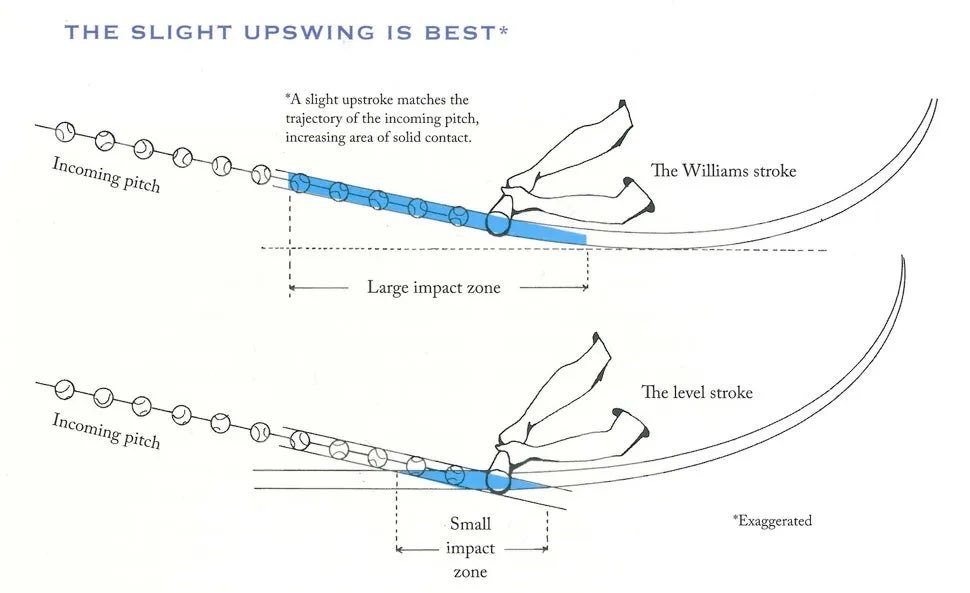
Swing down comes from the feel of the lands at launch. Look at the right side of the graphic, the arc is going down. The barrel planes out behind the hands working down. That’s where the “feel” part comes into play.
When you tell a kid to swing “up” or dump the barrel behind him, that creates an exaggerate barrel drop that then becomes loopy, dippy path. The kid will drop his shoulders trying to artificially produce that result.
If you notice on the Ted Williams graphic, the barrel doesn’t begin to increase
in plane angle until the barrel is more out in front.
Launch angle is created by contact point out in front, not by swinging up at launch or dumping barrel behind your head early.
Watch Albert’s hands first move below. Down, knob to ball, and barrel follows plane of shoulders. Back shoulder dips early, and a barrel drop when that happens.

I interpret Ted Williams' famous "slightly upward stroke as the optimal way to swing" as hitting gold. But I believe there's a little nuance before that stroke happens. Getting in the zone too early pigeonholes the stroke to the angle that was committed to and requires elite pitch recognition. Think Juan Soto. He's in the zone early and late and leads the league in walks often. Elite pitch recognition and plate discipline. Another way to hit, and how I interpret Ted's quote, is to delay barrel application to further out front of the body. Then apply the barrel however you please, based on the pitch and approach. (In the image below, notice the arms are out in front of the body.)
Being in the zone as long as possible is the method for the most room for error. But for the feel people (swing down), they believe that if the barrel stays close to the body and above the hands until out front, the arms can get extended and the barrel can work further and longer out front with adjustable direction. It allows one to let the ball travel while delaying the decision to apply the barrel, giving you adjustability and, hopefully, more game-time power.
Pitchers are literally creating pitches in a lab to attack hitters with long swings. Late movement. More deception. Set-up pitches that mimic the early trajectory of their breaking pitches and offspeed. In-zone early swings (without elite pitch recognition) leave the hitter as one that can hit mistakes, which absolutely has a place in baseball, but when a pitcher is locating or not giving in, the swing down crew has a chance to come through with a knock.
There's a million ways to hit, and doing it against pitchers that also practice (or get paid) requires one to make adjustments, however possible, to succeed and put the team in a position to win. Bruce Lee (iconic martial artist and creator of Jeet Kune Do) famously stated that he didn't like "styles" because they were a crystallization. A style is an unbending way of thinking that fails to bend in the heat of battle. What does a boxer do in a street fight when his opponent uses only kicks? In competition we must be living, breathing opponents that make it difficult to attack.
Swing on deck. Hit in the game.
The Hitting Mindset retweeted
Andy Pages's father is a carpenter in Cuba. His main job was fixing up boats.
He had friends who worked with wood, and they would give him lumber, and he would make his son baseball bats.
That is where the bats came from. A man in a shop, making them by hand, out of whatever his friends could spare.
Tonight that son drove in the two runs that put the Los Angeles Dodgers in the National League Championship Series.
Here is the distance between those two sentences.
Pages grew up in Cuba playing soccer and basketball and baseball. He was one of the most recognized young players on the island and he never played a game in the Cuban National Series.
At 16 he told his family he was going to the Dominican Republic to try to get a contract with a Major League organization.
Here is what he says about telling his father.
"When I left Cuba, from the moment I told him I was leaving, he just started crying."
"It was the first time I ever saw him cry."
Then he went eight months without anybody signing him. Scouts told him he did not have the speed to play the outfield in the major leagues. After the Dodgers finally signed him, people questioned his weight.
He did not go back to Cuba for about seven years.
When he finally did, he brought something with him.
"When I went back to Cuba, I took him a few of my bats."
The man who carved his first bats out of scrap got handed the real ones.
Now here is the part that is still true today.
Nobody in his family except his wife has ever watched him play in person. Not one game.
Major League games are not broadcast in Cuba. So his parents and his 18 year old sister follow his career through box scores and clips on YouTube.
Phone calls frequently do not go through. When his parents do get through, it is usually around midnight where he lives, and he is asleep. Bad storms knock out the lines and he can go days without hearing anything from home.
In July he made the All-Star team and could not reach his parents to tell them. He said he was not sure they knew.
This is how he describes it.
"Anything can happen to me in a game, and it won't be harder than all of that."
The thing he says gives him the most joy is not the All-Star team. It is that people walk up to his parents in Cuba just to tell them how well their son is doing.
Tonight, in Atlanta, Andy Pages went 2 for 3 and drove in two runs in the seventh inning to break a tie against the Atlanta Braves. The Dodgers won 4 to 1 and the series with it.
Somewhere in Cuba tonight, a carpenter is going to find out what his kid did from a box score.
