

We study molecular mechanisms of genetic and epigenetic adaptation. @BabrahamInst, Cambridge, UK. Main funding @wellcometrust and @BBSRC. Views are our own.
Cambridge, England
Joined October 2018
- Tweets272
- Following280
- Followers581
- Likes565






Pinned Tweet
We're winding down our Twitter account and moving to BlueSky
Find us at @houseleylab.bsky.social
We'll still post a few announcements here though...
Great work lead by Hanane Hadj-Moussa and Megan Ulusan
Babraham Institute @BabrahamInst
@BBSRC @UKRI_News

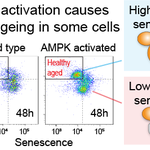
AMPK orchestrates responses to low nutrient availability from yeast to humans…
…including regulation of fatty acid synthesis through phosphorylation of the same enzyme
This conserved regulatory system presents an unexplored target for healthy ageing research across Eukaryotes

Controlling Acetyl coenzyme A underlies all these effects
Acetyl coenzyme A is the building block for fatty acids but excess acetyl coenzyme A availability is detrimental
A2A cells make the fatty acid they need but get rid of excess acetyl coenzyme A into mitochondria

But AMPK activation turns off fatty acid production, which is a problem
Our A2A mutant combines AMPK activation with a mutation that allows continued fatty acid synthesis
The majority of A2A cells maintain fitness very late in life even though they don't live any longer

AMPK activity is widely considered to be beneficial for ageing health
We show that AMPK activation in budding yeast allows some cells to age without senescence on a normal diet

Is healthy ageing possible on a normal diet?
Our latest Preprint describes metabolic re-engineering of yeast to avoid senescence
The A2A mutant we created is super-fit late in life even on a rich high glucose diet
biorxiv.org/content/10.1101/…

Congratulations to Hanane for her interview 🎉🎉

❄️ It has been chilly here recently, but what happens to animals that decide to freeze over the winter? Hanane, a Marie Curie Fellow in the Houseley lab spoke about this on Curious Cases (at 11:55)
Listen now: bbc.co.uk/sounds/play/m00240…
Congratulations Hanane!

We're looking back on #BSRA2024 this week, and some of our amazing ECR members.
The Korenchevsky Prize was awarded to Hanane Hadj-Moussa from @HouseleyLab @BabrahamInst. BSRA's goals including supporting members careers to build capacity in the UK - bsra.org.uk/purpose/

Congratulations to our PhD students @PaolaGarran, Kieron and @baptiste_piguet for presenting their posters!
🧵(2/6)
At @BabrahamInst, we recently held our annual Lab Talks, during which awesome science was discussed. In this #Thread, we are highlighting the accomplishments of our members this year🏆
🧵(1/6)👇
Join us at this year's BSRA meeting to discuss all things ageing!
We have some great speakers from academia and industry
Abstract deadline extended to June 14th
bsra.org.uk/events/bsra-annu…

Great work from @GabrielePicco2 @Garnettlab showing how WRN inhibitors can selectively target MSI cancer cells

Our work 'Novel WRN Helicase Inhibitors Selectively Target Microsatellite Unstable Cancer Cells' is published today in @CD_AACR (aacrjournals.org/cancerdisco…). Using genetic tools, in 2019 @DepMapSanger and others reported WRN as a synthetic-lethal target in MSI cell line. 1/5

Looking forward to your comments 👩🔬 #ResearchMilestones #GeneticHeterogeneity #Transcription #PhDachievement
(6/6)
