


Davos Safety retweeted

⚙️ ToolDance X1 FAQ Part 7: Your Questions, Answered
Following last week's update on expansion modules and add-ons, we're answering your questions about:
🔧 The Upgraded 4-Axis Module
🗜️ Low-Profile Vises & Workholding
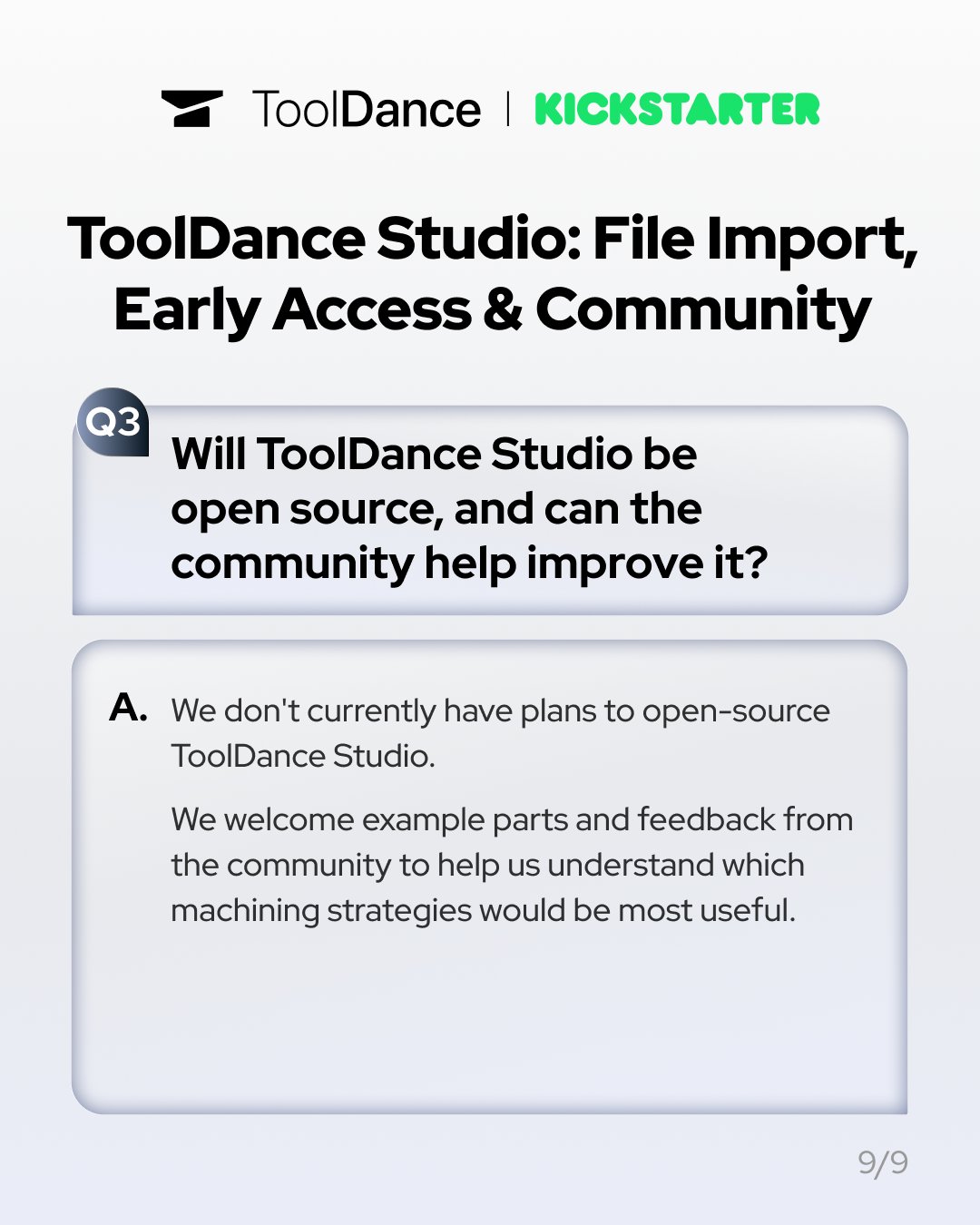
💻 ToolDance Studio: File Import, Early Access & Community
Swipe through for the answers!
💬 What would you like us to cover next? Let us know in the comments!
Explore ToolDance X1 on Kickstarter. Super Early Bird pricing starts at USD 2,999, with savings of up to 50%.
🔗kickstarter.com/projects/147…
#ToolDance #ToolDanceX1 #YourPersonalFactory #CNC #DesktopCNC #CNCMachining #CNCCommunity





Davos Safety retweeted

Was reading a thing yesterday. There are 380 million E-bikes in China (pedal assist & just motor). Hundreds of millions of people use them as a daily driver. Dirt cheap transport. Amazing.
Davos Safety retweeted

I’m sorry, what now?

We're excited to welcome @FA3Dofficial as a Silver Exhibitor at #SMRRF2027 🚀
Their DIO X combines FDM + UV full-colour printing, with no more hand painting after the print 🍩
Kickstarter pre-launch: kickstarter.com/projects/fa3…
🎟️ SMRRF Tickets: smrrf2027.eventbrite.co.uk/

Davos Safety retweeted

We're excited to welcome @FA3Dofficial as a Silver Exhibitor at #SMRRF2027 🚀
Their DIO X combines FDM + UV full-colour printing, with no more hand painting after the print 🍩
Kickstarter pre-launch: kickstarter.com/projects/fa3…
🎟️ SMRRF Tickets: smrrf2027.eventbrite.co.uk/
Davos Safety retweeted

This is like owners of trucking companies also deriving revenue from fixing roads that their trucks tore up.

Davos Safety retweeted

Meet MIRRAX-150: The #Robot Snake Built for Nuclear Rescue Missions
by @lukas_m_ziegler
#AI #Robotics #EmergingTech #Engineering #Innovation #Technology
Davos Safety retweeted

Sometimes I just feel like messing around. Thanks @BlayneSapelli
(And yes, that’s a hueforge) @snapmaker
Sound 🔊 ‼️
Davos Safety retweeted

Your favorite chatbot may one day run not on silicon microchips, but on real human neurons.
Both systems use electricity to compute, transforming inputs into outputs, but neurons—for reasons that are not fully understood—are orders of magnitude more efficient than semiconductor chips. They also require orders of magnitude less energy—not to mention fewer rare earth minerals, no vulnerable supply chains, and negligible water for cooling.
Those advantages have some scientists thinking the data center of the future might sit in a lab dish, leveraging the natural computing abilities of organoids—miniature models of the brain grown from stem cells—or other brain cell configurations.
Learn more: scim.ag/4t6pNZs @NewsfromScience

Davos Safety retweeted

I designed HULA II anti-vibration feet to work with all X and P series printers. Installed a set on the @BambulabGlobal #P3C, and it’s now printing the hybrid dampener: Bambu PETG Basic Grey + @SirayaTech PEBA 95A.
Link to MakerWorld project in the comment
Davos Safety retweeted
Accommodation Discrimination provides an overview on these issues.
papers.ssrn.com/sol3/papers.…
Davos Safety retweeted
In their guidelines on accommodations, the ontario human rights commission put inclusive design and barrier removal ahead of provisioning accommodations.
This is on purpose. They understand that doing those two things will mean less need for the third.
ohrc.on.ca/en/guidelines-acc…
Davos Safety retweeted
The verbiage matters. Framing accommodations as special treatment rather than barrier removal fundamentally changes how we conceptualize accessibility. The objective should be equitable access to education, not the preservation of differential treatment as an end in itself.
Davos Safety retweeted

We know COVID infections lower IQ. If only there were a quantitative scale for measuring empathy. Sure seems like the same minds struggle with both.
pmc.ncbi.nlm.nih.gov/article…

Davos Safety retweeted

this is wild...
this guy put a floating hologram on his desk with a glass cube and an ESP32
you can hook it up to Claude Code and the cube shows what Claude is doing, live: thinking, running a tool, waiting for you, done
it's free and open source
here's the full breakdown:
step 1 → get the parts: an ESP32-S3 board, a 1.3" 240x240 ST7789 display and a 25mm beam splitter cube
step 2 → wire 7 pins: GND, VCC to 3.3V, SCK, SDA, RES, DC, BLK. set the same pins plus ST7789_DRIVER and 240x240 in TFT_eSPI's User_Setup.h
step 3 → flip the screen image vertically in code. the cube reflects the display, so without the flip your hologram reads upside down
step 4 → put the cube on top of the screen and dim the lights. the image now floats inside the glass
step 5 → give the ESP32 Wi-Fi, mDNS and a tiny web server with one endpoint: POST /status. whatever text it gets, it draws on the cube
step 6 → open ~/.claude/settings.json and add hooks, one curl line each to http://esp32.local/status:
UserPromptSubmit → "thinking"
PreToolUse → the tool name
Notification → "needs you"
Stop → "done"
step 7 → pipe your statusline into it too, so the cube shows how much of the context window you've used
step 8 → lazy mode: tell Claude Code "write ESP32-S3 firmware for a mirrored ST7789 240x240 with a /status endpoint, flash it with PlatformIO and add the hooks". it writes, flashes and wires everything itself
under the hood:
→ it's Pepper's ghost, a 19th-century theatre trick. the cube has a half-mirror inside at 45°, so the screen's reflection looks like it's floating in the glass
→ hooks fire on every Claude Code event, so the cube changes the second Claude starts, calls a tool or stops to ask you something
→ everything stays on your local network: no cloud, no API key on the device
ready-made version: github.com/nalbam/vibemon-ap…
try it yourself
then read the guide on how to reverse engineer any hardware gadget with Claude:


Davos Safety retweeted

The human body doesn’t “seek dopamine”
Dopamine is just a normal part of a sympathetic nervous response which happens to us all day whether we’re rewarded or punished for the inevitable behavior that follows that response
Pls learn science before talking about science