
Veritas vos liberabit
Singapore
Joined July 2009
- Tweets52.3K
- Following488
- Followers17.7K
- Likes6K







Pinned Tweet
Pentagon Dreams of Empire, Wallet Screams Bankruptcy
Iran showed that the US is a Paper Tiger
10 Year Treasury is above 5%, Bond Vigilante Says: Time to Shrink the Military Footprint
Prestige Toys Won’t Save You When China Owns Your Minerals & Supply Chain
Pentagon brass, let’s cut the crap. You’re drowning in debt, bleeding interest payments, can’t build ships fast enough, and rely on China for the minerals that make your fancy missiles work. My advice to you — retrench, rebuild, and stop overextending — is the kind of hard medicine you don’t want to hear. But it’s the only prescription that makes sense.
Stop Pretending You’re Rome
You’re not the global policeman anymore. The empire model — bases everywhere, fleets everywhere, promises everywhere — is dead. Iran just proved it by turning your Gulf fortresses into missile magnet scrap heaps. The USSR knows this feeling; remember the guy you defeated in 1991 which led to “the End of History” memes and your muscular attempt to change the world order to “Rule Based International Order” i.e. follow my rule or we bomb you; they had to pull back after the Soviet collapse. Their advice is simple: cut commitments before commitments cut you.
Translation:
•Forget about defending every ally.
•Pick a handful that actually matter (Japan, UK, Australia). Make sure your allies do not share a border with a nuclear weapon state as it can be suicidal if you need to defend them.
•Let the rest figure it out themselves.
Debt Is Your Real Enemy
You keep talking about China’s missiles, Russia’s nukes, Iran’s drones. But the real killer is your own debt. Every Patriot interceptor you fire costs millions. Every drone Iran launches costs peanuts. That’s not a war you can win. My advice — is to stop wasting money on prestige toys.
Translation:
•Think Asymmetry. Think Resilience.
•Cancel the billion dollar interceptors.
•Build cheap, scalable systems.
•Accept that cost exchange ratios matter more than shiny brochures.
•Take care of your own people — housing, food, healthcare, education. Internal cohesion is part of total defence.
•Don’t go round kidnapping Heads of State or bombing girls’ schools — it makes you look like a thug, not a leader worthy of a UNSC seat. The UNSC may be flawed, but it’s the only forum where every country is represented.
•Bring weapon development in‑house — prioritize battlefield effectiveness and resilience over shareholder profit
Rebuild Industry or Shut Up About War
Here’s the ugly truth: you can’t fight a long war because you can’t build replacements. Your shipyards are hollow, your munitions plants are slow, and your rare earth supply chain runs through China. My advice is exactly what the Russian and Iranian did after sanctions: rebuild domestic industry first, prioritize survival and resilience, and if you survive than talk about global power projection.
Translation:
•Restart shipbuilding capacity.
•Invest in rare earth refining at home.
•Stop pretending you can sustain attrition when you can’t.
Learn the Russian Trick: Unpredictability
Russia compensates for weakness with unpredictability — nuclear saber rattling, hybrid warfare, sudden deployments of asymmetric weapons like Oreshnik hypersonic intermediate-range ballistic missile hitting part of Ukraine at night like unstoppable thunderbolts from the God Thor. It keeps NATO guessing. You should steal that playbook. If you can’t outproduce China, at least make Beijing wonder what you’ll do next. Ambiguity is cheaper than carriers.
Translation:
•Use cyber and electronic warfare as wild cards.
•Signal nuclear unpredictability using asymmetric weapons without overcommitting or over threatening.
•Keep adversaries cautious even if your material strength is fading.
•The North American continent is the most secure place in the world protected by 2 oceans - don't screw your neighbors and make them hate you
Short Wars, Not Forever Wars
Long wars kill weak economies. I recommend you plan for short, decisive campaigns — shock strikes, limited objectives, quick exits. Forget Iraq style occupations. You don’t have the money, industry, or minerals for that anymore.
Translation:
•Train for rapid campaigns.
•Avoid occupations.
•Accept that “decisive strike and leave” is the only viable doctrine.
Selective Alliances Only
Russia and Iran laugh at your endless alliance promises – as that means your military assets are scattered all over the globe, and you are weak everywhere. They know allies are liabilities when you can’t back them up. Their advice: choose fewer, stronger partners. Stop promising protection to every country that waves a US flag and call you “Daddy”.
Translation:
•Double down on indispensable allies.
•Cut loose the rest.
•Stop pretending you can defend everyone.
The Bottom Line
The above feedback is brutal but accurate: you’re a declining power acting like an empire. That’s a recipe for collapse. If you want to survive, you need to retrench, rebuild, and rethink. Stop pretending you’re Rome. Start acting like a country that knows its limits.
Pentagon, here’s the bullet points for your presentation:
•Shrink your footprint.
•Fix your industry.
•Stop burning cash on prestige toys.
•Fight short wars, not forever wars.
•Use unpredictability to mask weakness.
•Take care of your own people.
•Behave like a leader and not a thug
•Pick fewer allies.
•Don't screw your neighbours
Do this, and maybe you’ll limp into the next decade without bankrupting yourselves. Ignore it, and you’ll end up like the Soviets — overextended, broke, and watching your empire collapse on CGTN (China Global Television Network).
Why CGTN? Even Trump’s granddaughter Arabella Kushner read and write fluent Mandarin, shouldn’t you?
foreignpolicy.com/2026/10/14…

The Right Questions Are the Real Invention in the AI-era
A critique and reflection from an innovation’s perspective on "Amazing Azu" and his AI-assisted hoverboard
I asked a friend who teaches innovation to young people what did Amazing Azu do right. He said when he heard a young creator in China had built a working hoverboard—first with jet engines, then with electric propellers—and that he had leaned on a phone-based AI assistant called Amoo from # Stepfun for guidance, his first reaction as teachers of innovation was not skepticism. It was recognition. My friend has watched thousands of students attempt hard things. The ones who succeed are rarely the ones with the most resources. They are the ones who ask the best questions.
So let us be clear about what Azu did and did not do, because the distinction matters enormously for anyone who wants to learn from him.
What the AI actually contributed. In the jet-engine phase, Azu's machine caught fire when all five engines started together. He did not simply rebuild and hope. He gathered the parameters and the field data, put them into the phone, and asked. The AI reasoned that hot exhaust was bouncing off the ground and being sucked back into the intakes—a thermal feedback loop. That is a genuinely useful diagnosis, and it pointed toward a real decision: abandon jets, go electric. Later, wearing sensors and a wrist device, Azu let the AI read his posture data and call out corrections through an earpiece—"shift your weight left," "bend your right knee"—and it produced training reports after each flight. Within about ten days he could fly.
None of this is trivial. But none of it is the whole story.
What the AI did not do. It did not choose the ten brushless motors. It did not size the 2,000-amp power system. It did not weld the frame, route the wiring, or decide how much redundancy a human body deserves beneath it. It did not design the control laws. Every physical decision, every integration choice, every moment of "this part will fail and someone will get hurt" belonged to a human being. The AI was a brilliant conversational partner. Azu was the engineer.
This is the heart of what my friend as a teacher want his students to understand: the AI is a multiplier, not a solution. A multiplier does not create value out of nothing. It takes what you bring—your context, your data, your framing of the problem—and scales it. Bring a vague question, get a vague answer. Bring a well-posed question with real numbers, and the same tool becomes remarkably powerful. The multiplier is indifferent. The engineer determines whether it multiplies insight or noise.
We call this the question-quality bottleneck. In the old model of engineering, the scarce resource was information—textbooks, handbooks, experts who were hard to reach. In the new model, information is abundant and cheap. What remains scarce is the ability to frame the right problem, to know which parameters matter, to supply honest data, and—most importantly—to know when the answer is wrong. Azu succeeded not because the AI was smart, but because he was prepared to interrogate it. He brought field data from a fire. He had sensors on his body. He could tell whether a suggested correction actually stabilized him. That is engineering judgment, and no phone supplies it.
There is a second lesson, and it is a caution. A confident answer is not a correct answer. Some observers have noted that using body lean to command a hoverboard's attitude creates a genuine control problem: the machine cannot easily tell whether your tilt is an intentional command or the wind pushing you. A voice in your ear saying "lean left" does not resolve that ambiguity. Azu's AI coach was optimizing inside a control scheme that may itself be shaky. A good engineer must be willing to step back and say: the tool answered my question well, but my question was built on a flawed assumption. That capacity to reject the frame—not just to ask within it—is the difference between a technician and an innovator.
We should also be honest about the setting. Azu's project was showcased alongside a phone launch. It was real work, but it was also a demonstration, curated for impact. The dramatic flights over valleys are thrilling and also dangerous. We would not hand this blueprint to a first-year student and call it safe. The lesson is not "build a hoverboard with your phone." The lesson is "watch how a capable person uses a tool."
So, what should an aspiring innovator take from this? Three things.
First, become the kind of person who can ask. Depth in your own domain is what makes the AI useful. You cannot feed it meaningful parameters if you do not know which parameters exist. You cannot judge its diagnosis if you cannot imagine the physics yourself.
Second, treat the AI as a colleague to be cross-examined, not an oracle to be obeyed. Ask follow-ups. Demand reasoning. Test against reality. Trust grows with verification, not with fluency.
Third, remember that the hard part was never the answer. The hard part was the fire, the rebuild, the sensor strapped to a wrist, the courage to fly. The AI made the thinking faster. Azu made the thinking happen.
This is a hopeful story, and we mean it as one. For the first time, a young person with curiosity and a phone can have a tireless, knowledgeable interlocutor at two in the morning. It doesn’t mean you do not need to go to college to be an innovator in the AI era. What Ayu has was the gift to innovate. But gifts must be used well. The multiplier rewards preparation. It amplifies judgment. It does not replace it.
The right questions are the real invention. Everything else—the motors, the frame, the flight—follows from a human being who knew what to ask.
# Step Amoo by StepFun (阶跃星辰)
Type: Personal AI agent integrated into STEPX Neo smartphone.
Platform: Built on Step AOS, an “AI‑native operating system” with model‑software‑hardware integration.
Core Tech:
“端云多脑” (edge‑cloud multi‑brain) architecture.
Edge models handle fast local tasks; cloud models handle complex reasoning.
Supports cross‑app orchestration, multi‑device task continuation.
Security: Operates under “可见、可信、可控、可逆” (visible, trustworthy, controllable, reversible) principles.
Partnerships: Deep integration with Alipay Vibe Pay, enabling voice‑driven commerce (e.g., “find me a sugar‑free Americano deal” → search, order, pay, redeem without opening apps).
youtu.be/TUphy1PYYyk?si=BNqM…

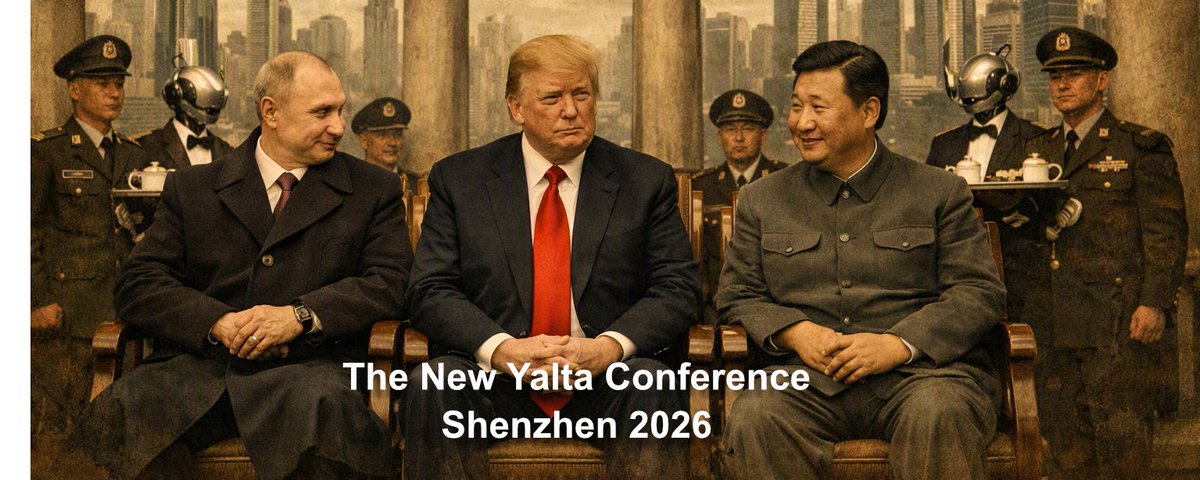
At Shenzhen’s APEC Summit, Trump, Xi, and Putin stage a “New Yalta,” deciding Ukraine’s fate and rewriting the post‑1945 order. Europe is sidelined, as drones buzz above China’s skyline as history loops with irony in a world negotiating its own reboot.
U.S. Ducks for Cover: Troops Pulled from Gulf Bases
Washington Shrinks Footprint as Iran Looms
Embassies Trim Staff, Bases Scale Back in Fear of Retaliation
Washington’s Drawdown in the Middle East: What It Really Means
The United States is pulling back troops from bases in Jordan, Kuwait, and Qatar, and trimming staff at embassies and consulates across the region. Officially, this is described as a “precautionary measure” against possible Iranian retaliation. In plain English: Washington knows its forces are exposed, and it doesn’t want to get caught flat‑footed if Iran decides to hit back hard.
Why the U.S. Is Scaling Back
- Exposure Problem: U.S. bases in the Middle East are within easy range of Iranian missiles and drones. Keeping thousands of troops packed into these facilities is like painting a bullseye on them.
- Casualty Risk: Iran has already demonstrated it can strike U.S. positions in Iraq and Syria. If it escalates, bases in Jordan or Kuwait could be next. Washington doesn’t want to explain to the American public why hundreds of soldiers were killed in a single strike just before the midterm election starting 3 Nov 2026.
- Diplomatic Staff: Embassies are soft targets. Cutting staff reduces the number of people at risk if Iran or its proxies decide to launch attacks on U.S. diplomatic missions.
What This Signals About U.S. Strategy
This isn’t a full withdrawal. It’s a downsizing designed to reduce vulnerability while keeping a skeleton force in place for defensive operations. In other words, Washington wants to limit exposure without abandoning the region entirely.
- Defensive Posture: The U.S. is leaving behind air defense units, radar systems, and rapid‑response forces. That means Washington still wants to deter Iran, but it doesn’t want to absorb heavy losses if deterrence fails.
- Political Optics: By scaling back, Washington can claim it’s being “responsible” and “protecting personnel.” But the reality is that this move underscores how dangerous the environment has become.
The Bigger Picture
This drawdown is part of a broader trend: the U.S. is shrinking its footprint in the Middle East because the costs outweigh the benefits.
- Shift to Asia: Washington’s long‑term priority is the Pacific, where it wants to counter China. Every soldier tied down in Kuwait is one less available for deterrence in Taiwan or the South China Sea.
- Iran’s Leverage: Tehran has proven it can impose costs on the U.S. at will. By forcing Washington to pull back, Iran demonstrates that it holds the initiative.
- Regional Allies: Countries like Saudi Arabia, the UAE, and Qatar see this too. If the U.S. is reducing its presence, they may start hedging more with China or Russia for security guarantees.
Risks of the Drawdown
- Perception of Weakness: Iran and its allies will read this as proof that the U.S. is afraid of escalation. That could embolden them to push harder.
- Reduced Deterrence: Fewer troops and diplomats mean fewer eyes and ears on the ground. Washington’s ability to respond quickly to crises will be weaker.
- Allied Confidence: Gulf states may question whether the U.S. is still a reliable partner. If they conclude Washington is heading for the exit, they’ll adjust their policies accordingly.
Bottom Line
This move is not about “peace” or “de‑escalation.” It’s about damage control. Washington is trying to avoid a scenario where Iran lands a devastating blow on U.S. forces just before the midterm election. By thinning out its presence, the U.S. reduces the risk of mass casualties just before an election but also signals that it no longer has the stomach for a prolonged confrontation in the region.
In layman’s terms: the U.S. is ducking its head, hoping Iran doesn’t swing too hard. It’s not a retreat, but it’s definitely not a show of strength either. It’s a middle ground—protecting personnel while keeping just enough forces in place to claim America is still “engaged.”
Final Thought
If history is any guide, adversaries don’t respect half‑measures. Iran will see this as proof that Washington is vulnerable and cautious. That perception alone shifts the balance of power in the region. The U.S. may think it’s playing smart defense, but in reality, it’s signaling to both friends and foes that its era of dominance in the Middle East is fading.
cbsnews.com/live-updates/ira…

Ignis Rex retweeted
History never ended. It continued quietly. Just that the Americans were resting on its laurels as it only hear Yeses from its junior partners and sycophants, and fell asleep at the wheel until it was too late.

The Chinese export control on refined rare earth elements and critical minerals are biting the US. It can no longer supply missiles and interceptors to the Europeans, even if they have paid for them without jeopardizing their own position in the Middle East and East Asia.
The Iran War, the war between Houthis and Saudi Arabia, resulting in high energy price and the possible closure of the Red Sea & Suez Canal; the fiery protests by students and workers in France complaining that the government is under investing in education and healthcare but over investing in war, these protests are spreading across Europe like the Arab Spring- all these are bringing Project Ukraine (US/NATO scheme to destroy and dismember Russia after the end of the Cold War) to an end.
On top of that Ukraine's population is now around 20 mil from 52 mil after independence. Meaning Ukraine has lost over 20 mil men to the war, they have either been killed, maimed or they have left the country as refugees. The US and NATO has fought to the last Ukrainian men, if they want to continue the fight with Russia they will have to send their own sons!
The Ukraine War didn't start with NATO expansion eastward, it started with the Fall of the USSR and the US intoxicated with "the end of history" started a grey zone war against Russia outside the ambit of the UNSC to dismember it. See my article below on this subject:
xitter.cf/Ignis_Rex/status/21080…

We know that the Pentagon is withholding the delivery of missiles for which our partners have already paid.
New missile shipments are awaiting Hegseth’s signature.
Our partners in Europe are waiting for U.S. authorization to transfer their Patriot interceptor missiles—Zelenskyy confirmed media reports regarding delays in the delivery of surface-to-air missiles, attributing these delays to the United States.
Europe has paid—Trump is not delivering—Ukrainians are dying—Putin is pleased.
RUSSIA HAS WON THE WAR!
ZELENSKY ADMITTED ON FOX NEWS THAT HE IS WILLING TO ACCEPT THAT THE CURRENT TERRITORY HELD BY RUSSIA IN UKRAINE BELONGS TO RUSSIA! THAT IS CRIMEA, DONETSK, LUHANSK, ZAPORIZHZHIA & KHERSON ARE RUSSIAN TERRITORY!
Ukraine population is now around 20 mil from 52 mil when it gets its independence. It has run out of men to send to the frontline!
The fake news from NATO claiming that Ukraine only having 43,000 killed and 370,000 wounded in Dec 2024 since the war started in 2022 - has been busted. The Western media has been feeding fake news of how the unstoppable Ukrainians just cannot stop winning against the Russian when almost 20 mil Ukrainians has been killed, maimed or are forced to leave the country as refugees.


The Trump administration banned Chinese AI startup DeepSeek from civilian U.S. government agencies, as it is at least 10X cheaper than OprnAI and Anthropic! DeepSeek pricing and performance will torpedo the Frontier Labs' IPO!
DeepSeek’s open-weights + ultra-low-price model, now reinforced by open-sourcing its production inference stack (DeepInfer), accelerates the commoditization of capable AI inference. This undercuts the pricing power, margins, and growth assumptions that support OpenAI’s and Anthropic’s massive valuations and IPO ambitions.


Ignis Rex retweeted

When America can't compete on price, it reaches for the national security excuse.
The US has moved to ban China's DeepSeek AI from government systems, once again claiming national security concerns. But I think there's a much bigger story here.
DeepSeek has demonstrated that China can develop AI models capable of competing with some of the best offerings from OpenAI and Anthropic, at a fraction of the cost.
And here's the interesting part. DeepSeek's models are openly available, meaning developers can download them, inspect them and run them on their own infrastructure, without sending sensitive information to servers in China.
So where exactly is the national security threat?
Of course, governments have every right to protect sensitive information. But there's a big difference between banning a Chinese-hosted AI service and restricting an openly available model that can run entirely on American hardware.
I suspect this has far more to do with protecting America's AI industry than protecting national security.
After all, American technology companies have invested hundreds of billions of dollars in AI infrastructure, while Chinese companies like DeepSeek are demonstrating that powerful AI doesn't necessarily have to come with an enormous price tag.
And that is potentially a much bigger threat to Silicon Valley than anything else.
The irony is that America has spent years championing open-source technology and free-market competition. Yet when a Chinese company delivers something genuinely competitive, suddenly the rules seem to change.
You have to ask yourself: is this really about national security, or is it about protecting American companies from Chinese competition?
🤖 Made with AI

China’s New Export Rules: A Layman’s Look at What It Means for India’s Border Construction
Let me be clear from the start: this is not a ban. China is not saying "you cannot have these machines." What Beijing announced on October 19, effective November 18, is a licensing system. If you want to buy certain tunnel-boring machines, specialized walking excavators, or high-altitude concrete sprayers, and you are in a country that China considers "in dispute" with it, you now need permission from the Chinese government.
India is not named. But everyone knows who this is about.
What is actually covered
The list is quite specific. It includes full-face tunnel boring machines (TBMs)—the big machines that chew through rock for metro lines and road tunnels. It includes walking excavators, the spider-like machines that can climb steep slopes where ordinary excavators cannot go. And it includes plateau-type wet shotcrete machines—equipment that sprays concrete onto tunnel walls to stabilize them, specially designed for altitudes above 3,000 meters.
That last item is the tell. Why would you need a special shotcrete machine for above 3,000 meters? Because that is where the Himalayas are. That is where Ladakh is. That is where India has been building roads and tunnels to move troops and supplies toward the Chinese border.
Why this matters for India’s border regions
India’s strategic infrastructure push in the high Himalayas is real. The Zojila tunnel, at 3,528 meters, just broke through earlier this year. It will connect Kashmir to Ladakh year-round, keeping the military supply line open even in winter. There are other projects too—tunnels, roads, and support infrastructure in places where the air is thin and the working season is short.
These projects do not always use giant TBMs. In difficult mountain terrain, Indian engineers often use the older drill-and-blast method instead. But that method depends heavily on two things: machines that can reach inaccessible slopes, and shotcrete to immediately stabilize the rock after blasting. Chinese-made walking excavators and shotcrete machines have been popular in India because they are cheaper and easier to get than European alternatives.
Now they need a license. And a license can be delayed. A license can be denied. Even if approved, the uncertainty alone changes how contractors plan. You cannot build a tunnel on a tight schedule if you do not know when your concrete sprayer will arrive.
The TBM angle is trickier
India’s dependence on Chinese TBMs has actually gone down. Direct imports dropped sharply after 2022-2023. India now assembles many TBMs locally through Herrenknecht’s facility in Chennai, and buys from German or American suppliers.
But here is the catch: even a German-brand TBM can have Chinese components. Or it might be manufactured in a Chinese factory.
The new rules say that if a controlled item—or key components or technology—originates in China, it needs a license before going to a sensitive destination. So a TBM that says "Herrenknecht" on the side but was assembled in China could still get stuck.
This is not hypothetical. In 2024, India’s commerce minister publicly complained that China was blocking a German company from exporting China-made TBMs to India. Customs holds and delays have already been happening.
What this is really about
China says these items have "dual-use" characteristics—meaning they can serve both civilian and military purposes. A tunnel-boring machine digs metro tunnels. It also digs strategic tunnels. A shotcrete machine stabilizes a road tunnel. It also stabilizes a military bunker.
From Beijing’s perspective, selling this equipment to India for use in border infrastructure is handing your rival the tools to strengthen positions aimed at you. The licensing regime gives China a dial it can turn up or down depending on how the relationship is going. It is not a weapon that stops everything. It is a pressure point.
The likely outcome
For India’s metro projects in Mumbai or Delhi, the impact is probably manageable. Alternatives exist. Local assembly helps. For the high-altitude border projects, the pain is more concentrated. Lead times will stretch. Costs will rise. Contractors will start hunting for European or Japanese replacements, which cost more and may take longer to deliver. Some may stockpile spares before November 18.
And in the longer run, this accelerates exactly what India has been talking about anyway: building its own capacity to make these machines. The roughly $1.2 billion incentive scheme for domestic TBM manufacturing suddenly looks less like industrial policy and more like strategic necessity.
The real question is not whether India can survive this. It can. The question is how many working seasons in the mountains get lost while contractors scramble for alternatives.
In the Himalayas, the window for construction in summer is short. A delay of a few months can mean waiting another year.

Ignis Rex retweeted

BREAKING: The U.S. is now preparing to completely abandon Gulf countries, as Trump envoy Tom Barrack directly warns Gulf allies that Washington can no longer guarantee their security indefinitely, telling regional officials in Doha that they must take responsibility for their own defense, signalling the end of the U.S. security umbrella in the Middle East, per the Wall Street Journal.
Barrack said the 80-year-old U.S. security-for-oil arrangement is no longer sustainable, pointing to regional defense partnerships as the way forward. The warning comes as Gulf states face Iranian strikes on U.S. military infrastructure and growing uncertainty over Washington’s future military commitment to the region.


Ignis Rex retweeted

Is Philippine National Security Being Mortgaged to Washington? Is Philippine National Security for Sale? The Gibo Letters, Washington, and the Price of Political Ambition
By Anna Malindog-Uy
October 21, 2026
When the lives of Filipino soldiers, national defense resources, and strategic alliances become entangled with allegations of personal political ambition, the nation deserves more than denials. It deserves the truth.
Two alleged letters bearing the signature of Defense Secretary Gibo Teodoro Jr. have surfaced, raising troubling questions about Philippine national security, the country's increasingly Washington-aligned defense posture, and the possibility of political ambition intruding into decisions involving Filipino soldiers' lives.
The first, dated July 31, 2026, and allegedly addressed to Peter Enzminger, a US Embassy official reportedly and allegedly linked to American intelligence, the CIA (Central Intelligence Agency), contains extraordinary assertions about the July 20 maritime confrontation at Ayungin Shoal, cooperation with Washington, and Gibo’s potential political ascent. A second purported letter, dated May 29, raises questions about defense procurement, US military infrastructure, strategic minerals, and economic cooperation.
The Department of National Defense (DND) categorically rejected the July document as fabricated and referred it to the National Bureau of Investigation (NBI). The Manila Times later reported the emergence of a second alleged letter. Both were noted to be still unverified.
With this, the underlying questions about Philippine defense policy, foreign influence, political ambition, and military accountability are too consequential to dismiss.
To continue reading, click the either of the links below:
Substack: annamalindoguy.substack.com/…
Facebook: facebook.com/share/p/1M4GRNq…


Email Leaks as Election Weapons: From Clinton to AfD, Democracy Hacked by Design
Foreign Hands in the Inbox: Why Intelligence Agencies Love Email Dumps
Did Israel hack the AfD server?
Manufactured Chaos, Same Playbook: Clinton 2016 and AfD 2026 Show Democracy’s Digital Weakness
Democracy, Now With Extra Malware
Germany’s far‑right AfD party has just had its inbox ripped open. Hackers claim to have stolen over 400,000 emails and 100,000 files, splashing them online in a 300GB torrent. AfD insists it’s all “old accounts” and nothing to see here. Sure. Because when your party’s private correspondence, ID photos, and bank statements are floating around the internet, the real issue is whether the accounts were “active.”
This isn’t just a hack. It’s a rerun of the Hillary Clinton email saga in 2016—same script, different actors. Back then, Clinton’s inbox was weaponized to derail her campaign. Which Foreign Lobby group in the US loves Trump in the 2016 Election? Now, AfD’s leak lands just as they’re topping German opinion polls and facing calls for a ban. Timing, as ever, is the sharpest knife in politics.
The Playbook of Chaos
Step one: steal a mountain of emails. Step two: dump them online with a wink and a torrent link. Step three: let the media do the heavy lifting. The Clinton emails were mostly boring, but the narrative of “corruption” stuck. AfD’s leak is the same—whether the files are authentic or not doesn’t matter. Suspicion is the product, and it sells.
Foreign Hosting, Foreign Shadows
The leak site was registered in Wyoming, USA. Clinton’s emails were funneled through WikiLeaks. See the pattern? Keep the servers outside the jurisdiction of the country you’re destabilizing. That way, investigators chase ghosts while the scandal festers. This isn’t the work of bored teenagers in hoodies. It’s the calling card of intelligence operations—professional, timed, and designed to evade accountability.
Authenticity Is Irrelevant
AfD says the accounts were outdated. Clinton said the leaks were doctored. Both miss the point. Once the word “leak” hits headlines, the damage is done. Authenticity disputes only prolong the circus. Intelligence agencies know this: truth is optional, doubt is mandatory.
Polarization as the Prize
Clinton’s leak deepened U.S. partisan divides. AfD’s breach is doing the same in Germany. Critics scream “proof of extremism,” supporters cry “political persecution.” The result? Paralysis. Democracy reduced to a shouting match. That’s the real win for foreign intelligence: not installing puppets, but fracturing societies until governance itself collapses under the weight of mistrust.
Foreign Intelligence Fingerprints
Let’s be blunt. Ordinary hackers don’t time leaks to election cycles. They don’t package hundreds of thousands of files for maximum scandal. They don’t set up offshore hosting to dodge regulators. This is professional work. And professionals in the hacking world usually wear the badge of intelligence agencies.
- Strategic timing: only geopolitical actors care about election calendars.
- Scale: 421,000 emails don’t fall off the back of a truck.
- Narrative engineering: leaks tailored to existing debates—corruption in Clinton’s case, extremism in AfD’s.
This isn’t about transparency. It’s about power. It’s about shaping elections without ballots, without tanks, without consent.
The New Face of War
Forget bombs and tanks. The battlefield is perception, and the weapon is doubt. Why spend billions on military campaigns when a few terabytes of stolen emails can destabilize a democracy? Clinton’s inbox in 2016, AfD’s inbox in 2026—two chapters of the same story. Democracy hacked, democracy weakened, democracy distracted.
Conclusion
The AfD hack isn’t just a German scandal. It’s a reminder that democracy is now a software bug waiting to be exploited. The similarities to Clinton’s email saga are too sharp to ignore: timed leaks, foreign hosting, weaponized suspicion. Whether it’s Tel Aviv, or Kyiv, or some other shadowy office, the fingerprints of intelligence are all over this.
We can keep pretending these are “isolated hacks.” Or we can admit the obvious: this is political warfare, carried out with torrents instead of tanks. Until democracies treat it as such, we’ll keep stumbling into the same trap—arguing over inboxes while the real battle for our political future is being fought elsewhere.
rt-english.com/news/647460-a…

Geography Is Not Guilt: Why China Isn't to Blame for the Golden Triangle's Drug Crisis
13 Labs Destroyed, 170 Patrols Strong: The Facts Strangio Left Out
Blaming Beijing Won't Dismantle a Single Drug Lab
Sebastian Strangio’s recent piece in The Diplomat paints a picture of Southeast Asia’s synthetic drug crisis that, while accurately describing the scale of the problem, subtly shifts responsibility onto China. The implication is that because the drugs flow across the border from Myanmar, China bears some special burden or blame. That framing is not just unfair—it is factually backwards.
For a person who's afraid to enter Myanmar for fear of being arrested, it is a big statement to make sitting comfortably in Australia and expenses paid for by US NGO.
Let’s start with what the UN actually says. The record 349 tons of methamphetamine seized in East and Southeast Asia last year did not come from China. The UNODC report is clear: the production epicenter is Myanmar’s Shan State, where organized crime and armed groups operate in areas with “weak state authority”. The former UNODC regional representative, Jeremy Douglas, put it plainly: the synthetics boom happened in “very remote” places with “no rule of law, no state authority”. That is not a description of Yunnan.
So what has China actually done? In January 2026, Myanmar’s military and police, acting on intelligence provided by Chinese authorities, launched a sweeping operation in northern Myanmar. They destroyed 13 drug-production sites in a single raid—the largest such operation in Myanmar’s history. They seized 2.47 tons of methamphetamine, 490 tons of controlled precursor chemicals, 952 tons of uncontrolled chemicals, and 83 sets of large-scale drug-processing equipment. That is not the behavior of a country turning a blind eye.
This was not a one-off. Yunnan’s own government reports that over the past five years, provincial authorities conducted 31 border meetings and 98 joint law enforcement operations with Myanmar, Laos, Vietnam, and Thailand. They destroyed drug-processing sites outside Chinese territory, captured 86 fugitives wanted on drug charges, and broke up a trafficking network that led to the seizure of 3.5 tons of drugs in a single case. The goal, stated explicitly by Yunnan officials, is to “investigate, block, and strike drugs outside the border”.
Then there is the Mekong patrol mechanism. This October marked the 170th joint patrol by China, Laos, Myanmar, and Thailand—a mechanism China initiated. The current operation explicitly targets “drug trafficking, illegal border crossing, and cross-border smuggling”. This is sustained, institutionalized cooperation, not passive neglect.
The article’s underlying logic seems to be that geography equals guilt. But a shared border is not a crime. The border is long, mountainous, and difficult to seal—that is an enforcement challenge shared by every country in the region, not a Chinese policy failure. If proximity to drug production were the measure of responsibility, then Thailand, Laos, and India would all share the same “guilt.” The actual responsibility lies with the criminal syndicates operating in the ungoverned spaces of northern Myanmar, and with the fragmented authority that allows them to flourish.
What Strangio’s piece misses is the fundamental asymmetry in this story. China is the primary target of these trafficking networks, not their sponsor. Chinese authorities seize drugs, arrest couriers, and share intelligence that leads to the destruction of labs across the border. Yunnan’s border counties bear the brunt of the public health consequences. The idea that China should be assigned “responsibility” for a crisis it is actively fighting—and fighting with measurable results—inverts cause and effect.
The productive question is not who to blame. It is how to strengthen the cooperation that is already producing results. China has demonstrated through the January operation and the Mekong patrols that it is willing to act. If critics want more, the answer is more intelligence-sharing, more joint operations, and more pressure on the armed groups in Shan State who profit from this trade. Blaming Beijing for geography does nothing to dismantle a single lab.
thediplomat.com/2026/10/sout…

Email to China-born clients from Singapore Wealth Managers
This is an urgent reminder.
Dear Client,
We are writing to you with an urgent update that directly affects many of our clients from mainland China who have offshore trust structures.
China’s tax authority has announced new rules requiring all citizens with offshore trusts to declare their gains. The deadline for compliance is October 22, 2026. This is a final call, and failure to comply will result in penalties, surcharges, and retroactive taxation going back to January 2023.
What this means in simple terms:
- If you have placed assets into an offshore trust, the act of funding it is now considered taxable.
- Any income generated by the trust, even if not distributed to you, will be attributed to you and taxed.
- When the trust is terminated, any property or gains you receive will also be taxed.
- The tax authority will look through complex structures and identify the real contributor or controller.
Key risks:
- Non-declaration will lead to penalties after October 22.
- Taxes will apply retroactively from January 2023.
- Losses cannot be offset against other income.
Our advice:
1. Review your offshore trust structures immediately.
2. Prepare to declare all relevant gains before the October 22 deadline.
3. Work with us to calculate your potential liabilities and clarify what expenses may be deductible.
4. Consider restructuring your wealth management approach to ensure long-term compliance and resilience.
At XXXX, we are ready to assist you with:
- Conducting a full audit of your offshore trusts.
- Developing a disclosure strategy to minimize penalties.
- Coordinating with offshore trustees and Chinese tax authorities.
- Exploring alternative structures such as family offices in Singapore that remain compliant and stable.
This is a significant change. Offshore trusts can no longer be used to defer taxation. The safest course of action is to comply now and restructure later.
Please contact your XXXX relationship manager immediately to discuss your situation. Time is short, and acting quickly will protect you from unnecessary penalties.
Sincerely,
XXX Wealth Management Advisory Team