Space exploration aficionado and occasional NASA image processor.

Rhode Island, USA
Joined January 2010
Earth beyond the Moon, captured by a Soviet spacecraft 56 years ago today
A photo of Earth "setting" beyond the Moon's horizon captured on large-format film by the Soviet Zond-8 spacecraft during a lunar fly-around on October 24, 1970
1
29
148
2,945
On its way to Jupiter, the European JUICE mission recently flew by the Earth & Moon, viewing them as we would explore another planetary system. It's fun to step back and think how strange we'd seem if studied up close for the first time. dlr.de/en/latest/news/2026/s…
2
23
100
2,775
Jason Major retweeted
A view of the 890ºF surface of Venus. This is a view made from monochrome image data captured by the Soviet Venera 9 lander on October 22, 1975, reprojected to a flat horizon format by @tsplanets with color added using data from later Venera images processed by @DonaldM38768041
2
16
63
2,015
Jason Major retweeted
The surface of Venus imaged by the Soviet Venera-14 lander on March 5, 1982. This is my edit of remapped image data by @DonaldM38768041 with color added. Atmospheric temperature at the site: 465 °C (869 °F). See more of Don's Venus image work at mentallandscape.com/C_Catalo…
7
52
5
188
8,194
Jason Major retweeted
Artemis III progress! 🚀 The rocket boosters have been stacked. Teams are inspecting the solar arrays and testing the spacecraft. The crew is continuing training for their upcoming mission to test lunar landers in low Earth orbit. All this and more has Artemis III on track for launch in 2027: go.nasa.gov/3W7jHeV
62
396
21
2,742
260,960
Jason Major retweeted
SpaceX CRS-35 this morning. Falcon 9 out of Cape Canaveral, 6:33am. Shot from Tampa, 140 miles from the pad, in twilight. The elusive space jellyfish. When the rocket is already up in sunlight while the ground is still dark. In this case a Falcon 9 First stage boosts back toward LZ-40 and the Second stage keeps climbing toward the ISS. Both burns dump vapor and exhaust into really thin air, it freezes and spreads, and the rising sun lights that cloud from below. You’re standing in shadow looking at something that’s already in sunrise. Scientific Magic. That’s why you get the blue bell and the gold and red tentacles, rising into sunrise. Same idea as noctilucent clouds too… ice crystals form high enough to catch the sun at night except these aren’t the polar night-shining clouds though. This is rocket exhaust in the upper atmosphere. What is amazing is that it can hang there for a while and look completely wrong, like something that doesn’t belong. People who don’t know think it’s an alien invasion but it’s just a Falcon 9 launching and landing. Besides the rocket nebula shots, these orbital sunrise frames are the ones I chase the most. If you’re going to shoot a dawn launch from Florida, get somewhere with a clean eastern sky and expose for the plume, not the rocket. The sky around you is still night. The show is sunrise in space. Photo Credit: me
3
40
4
274
8,092
Many of you are talking about the “space jellyfish” following this morning’s launch from Space Launch Complex 40 at Cape Canaveral Space Force Station in Florida. More than 6,300 scientific investigations and cargo are on their way to the @Space_Station, as part of SpaceX's 35th commercial resupply services mission for NASA. A jellyfish happens near sunrise or sunset when the exhaust plume from the rocket becomes brightly illuminated, creating a glowing shape resembling a jellyfish. Show us where you captured the jellyfish?
420
1,800
210
9,894
449,870
Jason Major retweeted
An extended-color view of Saturn's moon Enceladus made from narrow-angle camera images (w/ IR, green, and UV spectral filters) captured with Cassini on October 10, 2008 #OTD from a distance of about 314,000 kilometers.
3
18
2
141
Jason Major retweeted
For those who can’t believe we “had the technology” in 1969 to land on the Moon… We had the first fully automated commercial mainframe computer (UNIVAC) in 1951 The first nuclear sub (Nautilus) in 1954 The SR-71 Blackbird in 1966 So why NOT the Apollo 11 LM Eagle in 1969?
20
37
3
266
11,363
The Moon occults Jupiter very late tonight for observers in eastern and central North America and parts of the mountain region, and for much of Africa. The occultation will start as the Moon's bright limb slowly covers the planet. buff.ly/w2ooTfQ #stargazing
3
21
5
141
4,391
#PPOD: An Ultraviolet View of Earth's Aurora 🌌 @esa_smile has captured its first ultraviolet image of Earth’s northern aurora, revealing the glowing oval during an auroral substorm. Smile’s Ultraviolet Imager captured the image, observing ultraviolet light produced when energetic particles from Earth’s magnetosphere collide with gases in the upper atmosphere. Smile—short for Solar wind Magnetosphere Ionosphere Link Explorer—will study how Earth’s magnetic environment responds to the solar wind. From its highly elliptical orbit, the spacecraft will observe the entire auroral oval for extended periods, helping scientists connect changes in the aurora with activity throughout Earth’s magnetosphere and better understand the processes that drive space weather. Credit: @ESA @CAS__Science #planetaryscience
6
30
3
150
8,398
Jason Major retweeted
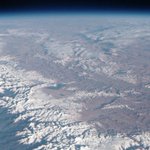
This is one of the first ever color pictures of Earth's horizon from space, taken as part of a 16mm movie film from 100 miles altitude on October 5, 1954. It shows an area of the Pacific just off the western coast of central Baja California. (Source: apollospace.com/first-color-…)
3
35
2
175
11,921
This is a view of the surface of asteroid Ryugu captured by the MASCOT probe during its descent on October 3, 2018 after separation from Japan's Hayabusa-2 spacecraft. The area in the foreground spans about 29 cm/11.4 inches across.
2
40
5
331
7,749
Earth from orbit 64 years ago today 📸🌎
A photo of Earth captured from 285 km altitude by NASA astronaut Wally Schirra during the Mercury-Atlas 8 mission on October 3, 1962. 70mm Hasselblad film photo # S62-06610 digitally scanned at ASU (with some additional level adjustments and dust cleanup.)
3
9
1
47
2,628
Jason Major retweeted
This October, you can look forward to these sights in the night sky: - A good look at Saturn - The Orionid meteor shower peaks mid-month - The Moon passes by the Seven Sisters Learn the tricks to spotting these celestial treats: go.nasa.gov/4hBG439
149
567
50
3,195
885,611
Jason Major retweeted
This is an interesting image. Captured with @NASA's Cassini spacecraft on September 24, 2016, it shows the night side of Saturn (across the bottom) refracting the light from the rings (F and outer edge of A) through the upper layers of its atmosphere. Greyscale, cropped to ~16:9.
6
38
1
263
Jason Major retweeted
Here's a view of the 40-km-wide moon Atlas seen in front of Saturn from the unilluminated side of the rings made from image data acquired by Cassini on September 24, 2016 #OTD. Atlas orbits along the outer edge of the A ring and was about 344,000 km away from Cassini at the time.
15
54
2
412
Jason Major retweeted
The first color images of the full sphere of Earth from space were captured with a camera aboard the @JHUAPL-built DODGE (Department of Defense Gravity Experiment) satellite on September 20, 1967
This is the first color photo of Earth from space. 📸🌍 55 years ago, #JHUAPL built DODGE, the @DeptofDefense Gravity Experiment spacecraft. DODGE carried a camera on board, which produced the first color picture of the whole planet #OTD in 1967.
4
16
2
107
6,387
It’s a lunar love fest — no eclipse of the heart here. 🌕 Happy International Observe the Moon Night. From Apollo to Artemis II’s 10‑day lunar flyby, exploration keeps lighting the path to the next giant leap. NASA’s Lunar Reconnaissance Orbiter has spent more than 16 years mapping the Moon, helping guide the Artemis era and beyond.📍Where are you observing from tonight? Tag us with your view.
44
279
15
1,841
58,623
Jason Major retweeted
The Moon is Earth’s attic where the family history is stored. One of the many reasons we need to get back to the Moon!
The Moon may keep an 80–100 million-year notebook of exploding stars. A new Physical Review Letters model of impact gardening shows how supernova debris gets buried and mixed in lunar regolith, and where Artemis deep cores should look. scitechdaily.com/the-moon-ma…
3
18
2
144
5,526