
Principle of charity, signal-to-noise ratio, care a little less, look where you can't see
New York City
Joined July 2014
- Tweets30.7K
- Following899
- Followers4.3K
- Likes89.7K



Jacob Eliosoff retweeted

has ai progress stalled?
i'm personally not aware of any major breakthroughs since riemann a few hours ago

A good goal for many activist communities (including ones I'm part of) is to not be this easy to accurately mock

TX: you want to build some "clean energy," son? sounds like gay communism. anway, here's your permit
CA: oh my Gooood yaaass kween clean energy!! but your 3,000 page report on harms to nonbinary snail communities wasn't sufficient for the HOA so see you in court for 30 years
1
153
😂 @JeffMightBWrong's still got it


"The trick at the core of this play is to take a poll that asks “Do you like stuff?” and use it to argue that Congress must immediately pass the Give Your House To A Death Row Inmate Act." imightbewrong.org/p/why-cant…

1
103
And I completely agree that there's nothing wrong with advocating currently-unpopular views! In the case of the DSA I tend to also disagree with those views, but the main thing is sheesh can we just be real about what is vs isn't popular. teapaw.org/JaEsf/status/212078361…

Instead we get this endless, snarky, doomed attempt to deny that progressive policies cost votes at all.
Please. Just say "It's true that Bernie policies pay an electoral price, federally, but the price is worth paying." There have always been unpopular policies worth backing!
38
Jacob Eliosoff retweeted

Me on @MTSlive: We can't keep doing "the sort of fake evaluations that Anthropic and OpenAI are currently doing where they bring in an evaluator but then they get to tell the evaluator, 'Oh, don't look in there, look in here.' And, 'Oh, thanks for the report, we're now gonna redact all of it and keep it to ourselves.' And also they can just ignore all your suggestions."
Instead we need "actual evaluators similar to what we have in banking and the financial services where they actually do get to be looking and scrutinizing the companies and making sure that they're safe and secure."

.@peterwildeford calls OpenAI and Anthropic's current safety evaluations "fake," arguing that the labs can control what evaluators inspect, redact their findings, and ignore their recommendations:
"Representatives Jacobs, Beyer and Maloy just put out a framework today. It involves having a part of government that could set binding safety and security standards, having examiners and evaluators, potentially even embedded in these companies."
"Not the sort of fake evaluations that Anthropic and OpenAI are currently doing where they bring in an evaluator but then they get to tell the evaluator, 'Oh, don't look in there, look in here.' And, 'Oh, thanks for the report, we're now gonna redact all of it and keep it to ourselves.' And also they can just ignore all your suggestions."
"There's gonna be actual evaluators similar to what we have in banking and the financial services where they actually do get to be looking and scrutinizing the companies and making sure that they're safe and secure."
"You can't just have the same people in charge of maximizing profit be the people who are also making all the safety and security decisions."
@AIpolicynetwork
Jacob Eliosoff retweeted

My wife is disemboweling goblins and banging vampires in BG3 and I’m over here painting a wall for ten minutes in a 1:1 scale reproduction of my least favorite state.
What's the worst case for crypto? Let's be real: it's not hacked exchanges or even smart contracts.
The worst case has always been a script where you enter a public key and get out the private key.
Is this doable? Probably not. The problem is in the age of AI we no longer know.
Fascinating thread. The unfortunate fact is that whereas lots of math is based on *proving* results, most used-in-the-real-world cryptographic protocols are based on "People have tried to solve this for decades and couldn't."
So now that AI is trying... Maybe they hold maybe not
2
1
204
The reason this would be so bad is unlike most other bugs, even if the white hats caught it first, no one knows what they should do about it:
Hard not to predict worse ahead. A lot of crypto bugs are borderline impossible to mitigate (with insecure seed generation, as in Coldcard, one of the very worst...)
1
72
Every Q&A should start with these three rules:
1. No comments. Questions.
2. ONE question. Not multiple. Then you can put your hand up again.
3. FOR THE LOVE OF GOD keep it brief. (Try to ask the abbreviated version the moderator repeats for you when people couldn't hear you.)
2
7
512
See also: teapaw.org/JaEsf/status/137448985…
There are few qualities that make me love someone in a meeting more than the ability to make your point and stop talking in under 15 seconds
50
LOL. This is the perfect "I'm a centrist" comparison (I would totally make this comparison)


Anyway, as you can probably tell, I had fun writing today's newsletter. natesilver.net/p/the-white-h…

1
110
There are reasonable differences people can have on BAAJA but this much is in the realm of concrete empirical predictions: no, if it doesn't pass Dems are not going to somehow push through a better version next year, c'mon, that's a child's fantasy. If you disagree let's bet.

Should Democrats pass the bipartisan permitting reform bill now, or wait for the next Congress to try to negotiate a better deal?
It’s a totally reasonable question given the midterm results.
The short answer: They should pass BAAJA now.
Rep. Huffman and Sen. Merkley are set to chair two of the most important committees for permitting reform in the next Congress and they’ve opposed every major permitting deal over the last 5 years.
A bill negotiated by them won’t even garner the support of every Senate Democrat, let alone enough Senate Republicans and President Trump.
The (much) longer answer requires digging into the legislative history of the three permitting reform fights prior to BAAJA:
1. Four years ago, the Senate voted on including the Building American Energy Security (BAES) Act of 2022 in the annual defense bill (NDAA).
2. This bill was negotiated by Democrats (principally the Biden Admin, Senate Leader Schumer, and the most moderate Democrat, Sen. Manchin) under a Democratic trifecta government.
3. BAES was backed by Biden, Pelosi, and 40 out of 50 Democrats in the Senate.
4. But despite overwhelming Democratic support, the vote didn't even come close to passing, deadlocking 47-47, well short of the Senate's 60-vote cloture threshold.
5. That alone is strong evidence that negotiating a permitting deal with only Democrats is not a recipe for success. Even if all 10 Senate Dems who opposed it had backed it, BAES 𝘀𝘁𝗶𝗹𝗹 would have failed.
6. Of the opposing Dems from the 117th Congress, 8 will be in the 120th Congress (vs just 2 for the supporting Rs). Only 1 of the 8 (Warnock) voted to advance on BAAJA.
7. Most notable among the opponents is Sen. Merkley of Oregon, the presumptive incoming Chair of the Environment and Public Works Committee (and if he is not, it would likely be Sen. Markey of Massachusetts, also a "no" on BAES).
8. And even though the bill never made it to the House for a vote, Rep. Jared Huffman, who is likely to become the next chair of the House Natural Resources Committee, was also a strong "no" on BAES.
9. Huffman opposed the bill vocally, saying it was “a shit sandwich” and "you don't get [Republican votes] by tackling the climate crisis."
10. But any bill that passes in the next Congress will need the votes of at least 4 Senate Republicans and the signature of President Trump.
11. Huffman was one of the lead signatories on a letter opposing the bill, which included 77 House Democrats (~37 of whom will be in the next Congress).
12. From Merkley and Huffman's records, we are left to infer that a bill would have to move leftward from where BAES was to earn their support.
13. But we already know that the bill's main challenge was not on the Democratic side — it was Republicans.
14. Only 2 Republicans who are going to be in the next Congress supported it, one of whom (Sen. Capito) only on the grounds that it helped the Mountain Valley Pipeline (MVP) being built in her state. MVP is now permitted and no longer available as a bargaining chip.
15. Republicans both disliked the bill's transmission provisions and felt that BAES did almost nothing for fossil fuels.
16. BAES also had some NEPA process reforms that Republicans viewed as weak (because they were), and an earlier draft had Clean Water Act (CWA) language so tepid that Republicans specifically requested its removal — before still voting "no" — because they believed it made the status quo worse.
17. But the prospect of this one pipeline being permitted by Congress was a big enough issue to drive staunch opposition among virtually all of the major green groups in DC.
18. NRDC called the bill "radical" and its language "draconian," saying it would "throw out half a century of law that gave environmental justice communities a seat at the table."
19. LCV scored the vote, giving positive marks to Sen. McConnell and the Senate Republicans who opposed it, and negative marks to climate hawks who supported it based in large part on its transmission provisions (albeit far less comprehensive ones than those negotiated by Sen. Whitehouse and Sen. Heinrich in BAAJA).
20. So, how could a bill that couldn't pass under a Democratic trifecta move left in order to satisfy incoming committee Chairs like Sen. Merkley and Rep. Huffman, and simultaneously move right enough to get signed by President Trump?
21. The logical conclusion to draw is it couldn't, and wouldn't.
22. The notion that President Trump would support anything like BAES is preposterous. It's not even close to the zone of interest.
23. The successor to BAES was the Energy Permitting Reform Act (EPRA) of 2024, and it went much further for renewables and fossil than just permitting one pipeline, included significant provisions on judicial review, on hardrock mining, on liquefied natural gas, and on on- and offshore leasing.
24. EPRA fared much better than BAES among Senate Republicans, passing out of the Energy and Natural Resources Committee with all but one (Hawley) of the nine Republicans there supporting.
25. But, by virtue of being the product of just one committee, EPRA did not include any reforms to the CWA, NEPA, or ESA, which were larger and longer-standing priorities for Republicans than the targeted Department of Interior, Department of Energy, or FERC reforms.
26. And so House Republicans, led by Speaker Johnson, balked.
27. Trump, of course, could have swooped in and urged Republicans to pass the bill, especially after his electoral victory, but chose not to.
28. As with BAES, Republicans in the highest positions of power, including Trump, were perfectly content to take a pass on a permitting reform bill that they felt did not address their core issues.
29. On EPRA, despite neither ever having to vote on it, Sen. Merkley and Rep. Huffman were again firm in voicing their opposition.
30. As with BAES, which got 40 (out of 50) Senate Dems when put to a vote, EPRA had strong margins among Dems who actually had to weigh in on it: 7 out of 10 Dems on the Energy and Natural Resources Committee voted for it.
31. So here we have a second, very different, permitting reform bill that ran up strong margins with Dems in the main, yet would have had to move left to earn the support of today's incoming Dem committee chairs, yet would also have had to move right to earn the support of President Trump.
32. These are not the only examples in recent history: Between BAES (2022) and EPRA (2024) was the Fiscal Responsibility Act (2023).
33. The FRA debate featured a serious push to include Sen. Hickenlooper’s and Rep. Peters' BIG WIRES Act to enable the buildout of transmission.
34. But Republicans insisted on changes to NEPA's judicial review process in exchange for transmission provisions.
35. Rep. Huffman was again one of the lead signatories on an 83-member letter (~54 returning for the next Congress) opposing the inclusion of any NEPA reforms in a deal.
36. Along with Republican opponents of the transmission reforms, this created a dynamic where the more significant reforms being asked for by Republicans could not be paired with the transmission reforms the Biden admin was seeking.
37. Ultimately, the FRA passed (including with 165 Democrats "yea" votes and 46 "nays" in the House and 44-4 among Dems in the Senate) with the Mountain Valley Pipeline authorization from BAES and very modest NEPA reforms (together sufficient to draw "no" votes on the entire debt-ceiling deal from Merkley and Huffman), as well as just a study on transmission (womp).
38. So there we have it: three permitting bills, all very different, in just the past 4 years, all drawing super-majority margins of Democrats when actually put up for votes, none viable with the key Democrats who would be in charge of negotiating a bill next year, or with Republicans (except in the special case of the FRA where they were giving up nothing on permitting other than a study).
39. All three, even the one negotiated under a Democratic trifecta, would have had to move left in order to earn the support of incoming Democratic Chairs, as well as a vocal minority of other Dems who will still be in office this coming Congress, and simultaneously move right in order to get Trump and the Republicans to agree to reforms Democrats have pushed for.
40. A deal cannot simultaneously satisfy Huffman, Merkley/Markey, and Trump and Republicans, and that is why waiting for the next Congress is not a viable strategy for enacting a better bill.
41. None of this is a hypothetical: We know it based on recorded votes and actions.
42. And none of that is to even mention that the next Congress is likely to be a more challenging environment for bipartisan legislating.
43. Democrats have made clear their intent to pursue a strong oversight agenda, likely to feature investigations, subpoenas, and potentially impeachments, none of which are likely to put the heads of either party — least of all President Trump — in a favorable mood to make a deal on permitting.
44. Oh, and there will be a presidential election going on.
45. Meanwhile, permitting problems continue to fester, with infrastructure projects taking years to get through federal permitting and interregional transmission (essential to viable clean energy) remaining barely possible.
46. Members should vote up or down on BAAJA based on whether they think it is good policy.
47. There are many legitimate reasons to support or oppose this bill, but "a better bill will be possible next Congress" does not belong on the list.

2
185


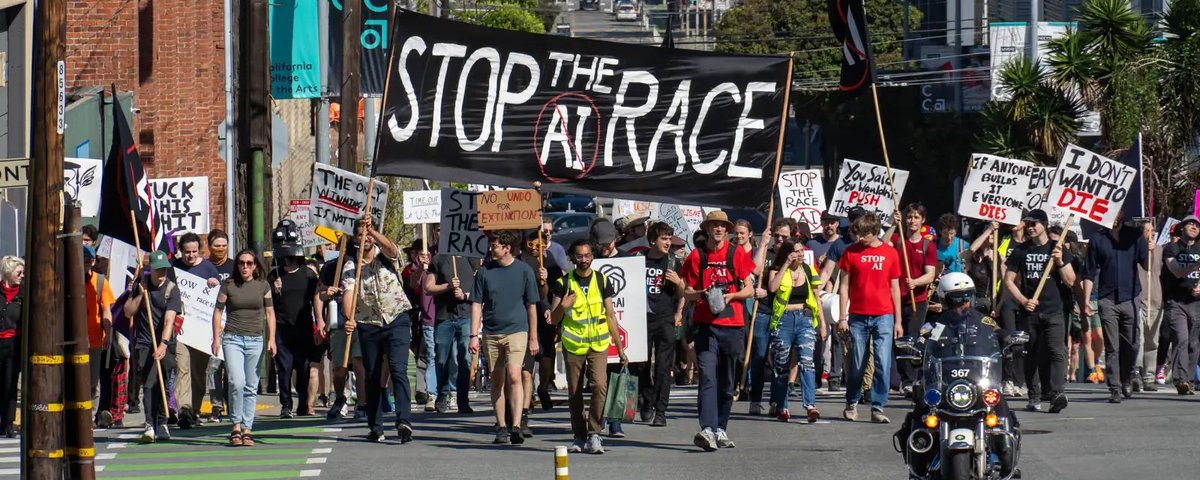


Chait is absolutely right here.
The frustrating thing about this is that so much energy is wasted on the wrong debate. It's *fine* to think progressive policies are better for the country than moderate ones, and that a few swing votes aren't worth selling out your principles.


"Dunlap lost, turning what had been the reddest district held by a Democrat into the bluest district held by a Republican."
theatlantic.com/ideas/2026/1…

1
1
202
Yes exactly. People are (trying to) debate the (heavily redacted) substance of the report, but even more important is the process and how broken it is. Decisions like whether to RSI shouldn't be up to voluntary nonprofits like METR, Twitter warriors, *or* the companies themselves


7
254
One strong case for Yglesias is how often his snarky critics just cannot get their heads around the factual record. Just a radioactive aversion to certain facts.
On the contrary, what I wrote in August was that El-Sayed would probably win while running somewhat weaker than a generic Democrat which is exactly what happened.
A question to ask is why progressives are dedicated to lying about this?

1
1
144
Please fact-check folks it's sooo easy now teapaw.org/JaEsf/status/208945484…
I honestly think a large % of social media deserves no further reply than "Here's an LLM patiently explaining why your argument is trash."
I posted about this before but I can't find it because Twitter search is also trash.
59