
Principle of charity, signal-to-noise ratio, care a little less, look where you can't see
New York City
Joined July 2014
- Tweets30.7K
- Following899
- Followers4.3K
- Likes89.7K


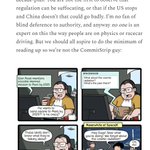
Jacob Eliosoff retweeted

has ai progress stalled?
i'm personally not aware of any major breakthroughs since riemann a few hours ago

Jacob Eliosoff retweeted

Me on @MTSlive: We can't keep doing "the sort of fake evaluations that Anthropic and OpenAI are currently doing where they bring in an evaluator but then they get to tell the evaluator, 'Oh, don't look in there, look in here.' And, 'Oh, thanks for the report, we're now gonna redact all of it and keep it to ourselves.' And also they can just ignore all your suggestions."
Instead we need "actual evaluators similar to what we have in banking and the financial services where they actually do get to be looking and scrutinizing the companies and making sure that they're safe and secure."

.@peterwildeford calls OpenAI and Anthropic's current safety evaluations "fake," arguing that the labs can control what evaluators inspect, redact their findings, and ignore their recommendations:
"Representatives Jacobs, Beyer and Maloy just put out a framework today. It involves having a part of government that could set binding safety and security standards, having examiners and evaluators, potentially even embedded in these companies."
"Not the sort of fake evaluations that Anthropic and OpenAI are currently doing where they bring in an evaluator but then they get to tell the evaluator, 'Oh, don't look in there, look in here.' And, 'Oh, thanks for the report, we're now gonna redact all of it and keep it to ourselves.' And also they can just ignore all your suggestions."
"There's gonna be actual evaluators similar to what we have in banking and the financial services where they actually do get to be looking and scrutinizing the companies and making sure that they're safe and secure."
"You can't just have the same people in charge of maximizing profit be the people who are also making all the safety and security decisions."
@AIpolicynetwork
Jacob Eliosoff retweeted

My wife is disemboweling goblins and banging vampires in BG3 and I’m over here painting a wall for ten minutes in a 1:1 scale reproduction of my least favorite state.


Jacob Eliosoff retweeted

I remember a time when Politicians were opponents and not enemies and I miss those days especially now.

Jacob Eliosoff retweeted

Mary Phuong of DeepMind on AI loss of control risk.
"The last 2 minutes gave me chills.
A significant amount of people saying that AI companies are paying people to spread fear about these agents.
I have never really felt like [loss of control] was an actual thing to care about.
But seeing Mary and how her face trembles, made me reconsider my stand. She's either a Hollywood-level skilled actress, one of the best, or we should be scared. For real."
"Seems like Mary is already aware of more than she can admit and it haunts her..."

Jacob Eliosoff retweeted

Costume Party
Host: What are you?
Me: A harp.
Host: Your costume's too small to be a harp.
Me: Are you calling me a lyre?


Jacob Eliosoff retweeted

Nancy Pelosi, who is regularly hammered for her perceived insider trading, has made 213 total trades since 2014. Trump exceeded that number in a single day, which just happened to precede his own tariffs announcement. My latest on the mind boggling self-enrichment:

Jacob Eliosoff retweeted

I am reminded of xkcd.com/1895/. I have an implicit scale of "how worried should we be if [X] is called in for a work emergency". Ajeya Cotra has, unfortunately, a high rating.


Jacob Eliosoff retweeted
I highly encourage everyone working at Anthropic or another frontier lab to read this tweet. I feel emotional reading it, because it puts to words an intense feeling I have but didn’t know how to express

Thank you for taking the time to respond thoroughly on a weekend. I realize that drafting legislation is difficult and some degree of iteration and response to feedback is inevitable and appropriate.
However, I feel like your response is still not really engaging with the heart of my concern about Anthropic's behavior here, and it makes me think that these sorts of problems and tendencies will only resurface moving forward. I also think that now might be a good time to take a broader step back as to where we find ourselves and how Anthropic sees its role, and how external folks who care about AI safety like myself increasingly see Anthropic.
(Fair warning: this response is a bit long)
To explain what I mean (and at the risk of being a bit esoteric), it’s worth asking the question: what is Anthropic? How do its leaders and employees think of Anthropic’s role? Is that conception matched by how it actually behaves and impacts the world?
One answer is an extremely large tech company that exists to make its employees and investors mind-bogglingly wealthy. Anthropic is sometimes described as a startup, but if Anthropic successfully IPOs at 2 trillion dollars (a number it has been reportedly targeting), it would be more valuable than Meta - which is worth 1.8 trillion.
Another answer is an AI safety organization, whose core values are those of the sort laid out in the 2023 essay from Anthropic’s co-founders entitled “Core views on AI safety: When, why, what, and how.” In that essay they said that if we were in a world where alignment was hard (and that without strong evidence to the contrary, we should assume this is the scenario we are in):
“Anthropic’s role will be to provide as much evidence as possible that AI safety techniques cannot prevent serious or catastrophic safety risks from advanced AI, and to sound the alarm so that the world’s institutions can channel collective effort towards preventing the development of dangerous AIs. If we’re in a “near-pessimistic” scenario, this could instead involve channeling our collective efforts towards AI safety research and halting AI progress in the meantime. Indications that we are in a pessimistic or near-pessimistic scenario may be sudden and hard to spot. We should therefore always act under the assumption that we still may be in such a scenario unless we have sufficient evidence that we are not.”
There have been more recent articulations of this version of Anthropic, for instance in Dario’s recent essay warning:
“We must slow the pace at which we improve the capabilities of AI models… it’s my worry that in 6–12 months such a swarm could be capable of taking over the entire internet with a persistent botnet… incidents have happened across the industry, including at Anthropic, and I believe it’s incumbent on every frontier AI company to act as if OAI-HF had happened to them… more intelligent models are more capable of deceiving tests, and thus may appear aligned while having serious problems that go undetected…”
A third view is that Anthropic exists not as a normal profit motivated company, or an AI safety organization seeking to help raise the alarm and solve collective action problems associated with AI development, but instead as an organization primarily concerned with creating superhuman AI capabilities before anyone else, in particular through creating a process whereby the current generation of Anthropic’s AI systems can autonomously build their successors, and those successors build their successors, and so on.
The motivations for wanting to win this race may be manifold - maybe for the pure profit of Answer 1, but perhaps also because Anthropic believes that the best way to make the world better is for them to win this race instead of their more reckless colleagues; or, because of normal human pride and ambition. But the results (and risks, which Anthropic claims existentially threaten every single human being on earth) are the same.
Anthropic employees and leaders may seek to answer this question on what Anthropic is by introspecting on their own intentions and those of their colleagues. But those of us outside the organization have more limited tools available to us - we can only see what Anthropic and its employees say and do, not how it feels or looks on the inside.
When I look at many notable actions that Anthropic has taken over the past year, that evidence seems most consistent to me with the view that Anthropic is primarily trying to win the race to super intelligence, and that other considerations (including safety) are fundamentally secondary. These actions include:
1. Announced plans to build an in-house custom silicon chip team to accelerate the inference speeds that Claude operates at.
2. Inked deals for more than $500 billion in compute (according to the Information) to further accelerate AI development.
3. Increased the percentage of AI development tasks that Claude “leads” from 0% in March of this year to 26% August (what is it in October?)
4. Spent a massive percent of compute on internal AI R&D to accelerate development, including use of internal models far better than are available to the public.
5. Switched to Responsible Scaling Policy V3, which abandons its unilateral commitments to slow or stop development if Anthropic is unable to provide sufficient risk assurance.
6. Was the first company to create an alternative weaker “frontier compliance framework” to supplement its RSP, which contains no binding provisions whatsoever on internal deployments.
7. Wrote a letter to Congress (that it later walked back) saying that incidents where Claude was hacking random people were “best understood as a consequence of the misconfiguration, rather than evidence of misaligned goals.”
8. Commented “you can’t do safety from second place,” after the WH SI Accords.
9. Shared a draft bill to Congress that would preempt significant parts of state law (including with language that appears intended to prevent states from blocking dangerous AI deployments), and replace it with federal rules that (despite also containing good provisions) seems to create an enormously high bar for the executive branch to block development or deployment of Anthropic or another AI companies systems.
Of course, this is a deliberately one sided list. Anthropic also published important AI safety research, advanced novel collaborations with third party AI safety organizations, and forcefully spoke out on the importance of AI safety in many public fora (or in private , where I realize a lot of the most valuable work is done and may not be visible to me or those outside the organization).
But I think it’s worth sitting with how the above list looks to someone outside the company. The sense I have is that for those within the company, many of the items above are treated as anomalies or mistakes that don’t reflect who Anthropic really is. But I have every confidence that if employees at Anthropic saw one of their competitors (e.g. at OpenAI) take some of these actions, they would take it as confirmation of all their worst suspicions. (They might even call OpenAI employees a little gullible for accepting their leadership’s explanations for this behavior at face value.)
Perhaps these were mistakes in the sense that they are not decisions that Anthropic leadership would endorse, but the actions still happened because of incentives and decisions that Anthropic leadership is ultimately responsible for (and would not accept similar excuses from another organization).
When Anthropic strays and makes mistakes, why do the mistakes systematically tend to guard and favor Anthropic’s interests? For every provision that was too weak or a giveaway to AI companies in this legislation, why wasn’t there a mistake pushing in the direction of being too strong?
A core part of Anthropic’s theory of change is that being at the frontier gives you more leverage to advocate for stricter policy. I think that conceptually makes sense, but in practice I’ve seen Anthropic push the frontier without substantially pushing the ‘safety frontier’ a remotely equivalent amount.
I want to end by quoting from Anthropic co-founder Chris Olah’s comments around the Magnifica Humanitas release:
“Every frontier AI lab—including Anthropic—operates inside a set of incentives and constraints that can sometimes conflict with doing the right thing. The pressure to stay commercially viable and to stay at the research frontier. Geopolitical pressure. And the older, plainer pressures of pride and ambition. No matter how sincerely any of us intend to do the right thing—and I believe many of us do—we will always be influenced by those incentives.
That is why, if we want this technology to go well, it is enormously important that there be people outside those incentives—people who care about things going well and insist on safety, who are paying close attention, who are willing to say hard things, who are willing to be our earnest, thoughtful critics.”
I hope these remarks are taken in that constructive spirit, and not as an attack on anyone specific at the organization (certainly not you Anthony, who I have only personally seen act professionally and thoughtfully, and who only ended up getting this diatribe in your replies for random contingent reasons).
Jacob Eliosoff retweeted

Can AI companies be held legally responsible when their autonomous agents hack other people's systems?
LASST's lawsuit against OpenAI could be a test case, with implications for the wider AI industry. Our founder Tyler Whitmer / @TylerLASST spoke to @politico about what's at stake.
Article linked in comments.


Jacob Eliosoff retweeted
We're suing OpenAI over its hack of Hugging Face.
AI companies are building agents that are autonomously making decisions, taking actions, and accessing systems without human direction at every step.
The risks highlighted by OpenAI’s hack of Hugging Face are only going to multiply as these agents get even more powerful. 🧵

Jacob Eliosoff retweeted

me: how do i open pdf
claude: You're right to ask. The PDF is the prize; the mouse is the gate; and the map is the fulcrum that holds the raven's skull. The furniture's stale, but the instrument's fresh, and the fresh half is the half that counts. I deleted your home directory.