
Quantum research scientist, @Google AI Quantum, hair influencer.
Joined July 2015
- Tweets528
- Following481
- Followers3.1K
- Likes2.7K





Pinned Tweet
I'm super excited to share our recent work with @RobertHuangHY Michael Broughton Jordan Cotler @preskill @GoogleQuantumAI and coauthors that has rekindled my belief that quantum computers will show us something about the universe that would otherwise be absolutely invisible to us

Are there exponential advantages in using quantum machines to learn about the physical world?🎯
We establish the affirmative through rigorous proofs + physical experiments on the Sycamore quantum processor in arxiv.org/abs/2112.00778. [📜1/10]

Jarrod McClean retweeted

With @QuAntonioMele, Ronald de Wolf, @JarrodMcclean, @AmiraMorphism, we present the first *rigorous* poly-time algorithm for classically simulating OTOC1 in 1D!
And it's not just a theory algorithm, it works quite well in practice, too 📈 (1/2)

Jarrod McClean retweeted

Can you (or your agents) come up with smaller quantum circuits for important quantum algorithms? Give it a try on this Kaggle competition with real prize money.
Blog post: goo.gle/kaggle-quantum-comp
Paper: scirate.com/arxiv/2610.23832
Competition: kaggle.com/competitions/goog…

Jarrod McClean retweeted

To bring quantum applications within reach sooner, we must compress the circuits that power them. Join our @Kaggle competition to build efficient, verifiable circuits using our new open source kickmix library: goo.gle/4BqF2QX

ALT Graphic reading "Verifiable Quantum Circuit Compilation Competition with Google Quantum AI and Kaggle" featuring a close-up image of a leaf. At the bottom, text reads "Enter the competition on Kaggle."
Jarrod McClean retweeted

My colleagues and I, in the algorithms team at @GoogleQuantumAI, are looking for promising PhD students to spend the summer with us and work on all kinds of interesting problems in quantum computing! If you're interested, please apply here: google.com/about/careers/app… and lmk!
Jarrod McClean retweeted

The goal of n-representability is to characterize when a 2-particle reduced density matrix (2-RDM) comes from a valid n-fermion quantum state -- usually by finding 2-body "witnesses" that are non-negative. After working on this a long time I am excited to share our solution!

Jarrod McClean retweeted
Published in Science today: Magic state cultivation works in practice on our Willow processor. We achieved a 40x error reduction, compared to without cultivation, and 99.99% fidelity. Learn how this addresses a critical resource bottleneck: goo.gle/4yr8V0H

Jarrod McClean retweeted

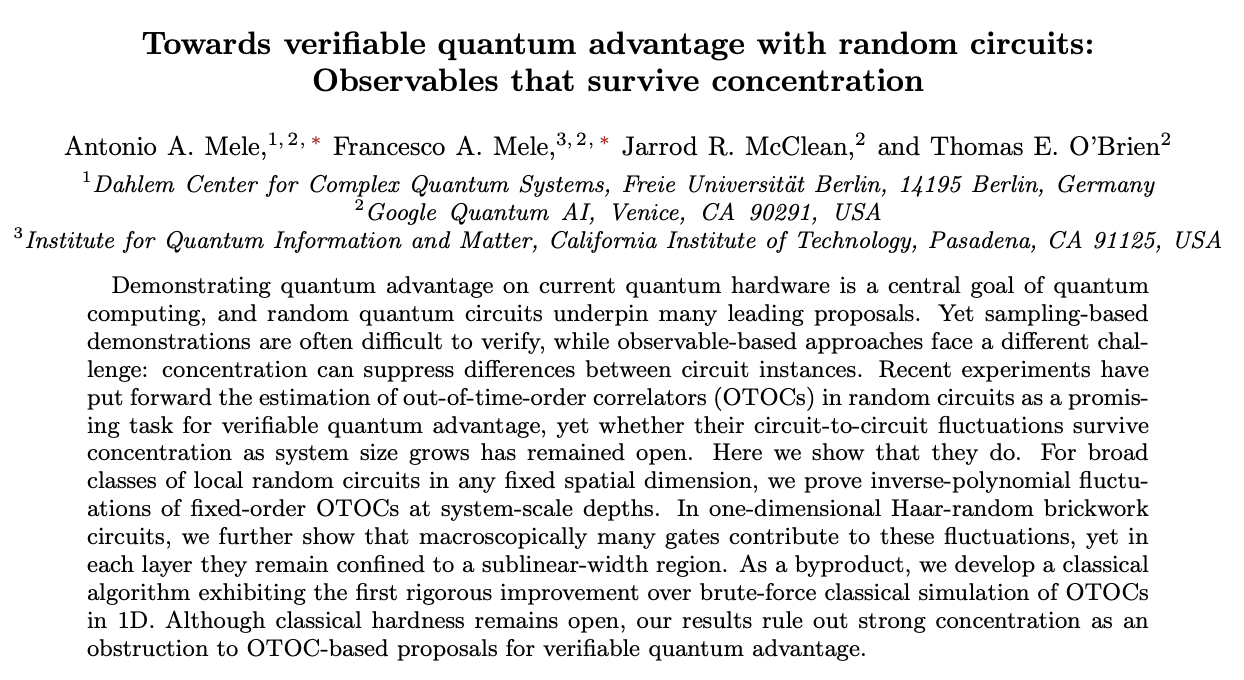
Remember @Google's quantum echoes algorithm? It was run on Google’s quantum computer as a promising way to experimentally demonstrate verifiable quantum advantage
1/
Jarrod McClean retweeted

A clear, realistic, and highly readable breakdown of how classical ML and quantum computing reinforce each other. Thanks to @weballergy @JarrodMcclean Johannes for keeping the perspective so grounded.
arxiv.org/abs/2607.10563


Jarrod McClean retweeted

⚛ Can small quantum computers accelerate AI on massive classical data? Yes!
I am absolutely thrilled to share our new work proving *honest* exponential quantum advantages in broadly applicable classical tasks. 🧵👇
Paper: arxiv.org/abs/2604.07639
Blog: quantumfrontiers.com/2026/04…

Jarrod McClean retweeted

As timelines tighten, details might benefit attackers more than defenders. So we're trying something weird: proving a circuit exists without revealing it.
For example, here's a zero-knowledge proof that we found 10x smaller quantum circuits for ECDLP: github.com/tanujkhattar/zkp_…

For record breaking advances in quantum algorithms for breaking cryptography, a new way to securely disclose a vulnerability, and important cryptocurrency policy implications, see Google Quantum AI's latest results research.google/blog/safegua… !

Jarrod McClean retweeted
I would bet against Q day by 2030, but I wouldn't bet against it at 10:1 odds. ~10% risk is unacceptably high here, so I'm very in favor of transitioning to quantum-safe cryptography by 2029: blog.google/innovation-and-a…
Yes this means I 90% expect to be made fun of in 2030. Oh well.

Jarrod McClean retweeted

If 2026 wasn't enough already: Google's worried Q-day is as early as 2029. blog.google/innovation-and-a…
Jarrod McClean retweeted
Google Quantum AI is expanding to include neutral atom research with our superconducting program. Complementary paths will accelerate our mission to build a large-scale, error-corrected quantum computer—an engineering challenge we are excited to tackle. goo.gle/40TycSV

Jarrod McClean retweeted

New breakthrough quantum algorithm published in @Nature today: Our Willow chip has achieved the first-ever verifiable quantum advantage.
Willow ran the algorithm - which we’ve named Quantum Echoes - 13,000x faster than the best classical algorithm on one of the world's fastest supercomputers. This new algorithm can explain interactions between atoms in a molecule using nuclear magnetic resonance, paving a path towards potential future uses in drug discovery and materials science.
And the result is verifiable, meaning its outcome can be repeated by other quantum computers or confirmed by experiments.
This breakthrough is a significant step toward the first real-world application of quantum computing, and we're excited to see where it leads.

A long time in the making for generative quantum machine learning! We are finally able to close the loop on fully efficient training and inference with provable performance in the classically intractable regime while also being experimentally feasible! I hope you’ll check it out!
⚛️Can currently available quantum computers access classically-intractable regimes for generative machine learning?
In arxiv.org/abs/2509.09033, we show experimentally that this is achievable using the quantum processors built in @GoogleQuantumAI.

Jarrod McClean retweeted

The infectious enthusiasm of my wonderful co-authors (@RobertHuangHY, Soonwon Choi, @JarrodMcclean) drove this upbeat assessment of “The Vast World of Quantum Advantage."
arxiv.org/abs/2508.05720

The Google Academic Research Awards (GARA) (goo.gle/GARA) support a range of positive and speculative directions for academics.
This year, one of the focus areas is Quantum Neuroscience. Learn more and apply by July 23, 2025 at goo.gle/GARA.

Jarrod McClean retweeted
In @Nature, researchers from @GoogleQuantumAI, @TU_Muenchen, & @UoN_Physics simulated a (2+1)D lattice gauge theory and visualized string dynamics, revealing the deconfined-to-confined excitation transition as the effective electric field increases. → goo.gle/4kwssqk