

Writer of military affairs, history, counter-terrorism, espionage and fluffy cat stories.
Joined October 2009
- Tweets10K
- Following3.5K
- Followers1.7K
- Likes19.1K

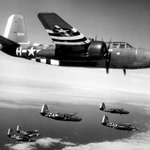


During the final years of the Pacific War, the USMC combat camera teams shot considerable footage in color. Much of it is muddy and poor quality. I digitally scanned some of it at Quantico in 2005, then tried grabbing stills from the footage. The results were...not great.
Here's one of the stills I grabbed from the footage, plus an AI enhanced version of it. What is your thought on historical images enhanced by AI?
A Marine SBD in the Central Pacific, late 1944.
🤖 Made with AI


2
86
The Devil's Daughter, one of the luckiest B-17s in the 8th Air Force. Arriving in the ETO in June 1943, this Douglas-produced Fort initially joined the 96th Bomb Group before being passed to the 95th. It flew its first combat mission July 24, 1943 against U-boat pens in Norway.
This photo was taken in September 16, 1943 during a raid on U-Boat pens at Bordeaux when the Devil's Daughter was flying #2 position in the group's low box.
Throughout the summer and fall of '43, 42-3153 suffered repeated flak damage on long-range missions. Hit by flak on August 19th, she was quickly repaired, only to be hit again on September 3rd. Three days later, she was damaged again by AA fire.
Through the hardest phase of the strategic bombing campaign, The Devil's Daughter kept getting hit, but always brought her crew home through the flak and fighters that assailed their formations. Hit again in November and December, she was always repaired and sent back into the fray days later.
Somehow, this F model survived to take part in a final mission on March 8, 1944 when the 95th was sent to bomb a ball bearing factory on the outskirts of Berlin. En route to target, it suffered mechanical failure and the pilot, Captain R.J. Abbott, aborted and brought back to England a full load of fourteen 100 lb and eight 500 lb bombs.
Following that last mission, The Devil's Daughter was flown back to the States where it joined Air Transport Command.
Ultimately, she wound up in the Boneyard near the Cal Aero Academy in Ontario, California. According to Alison Macor's wonderful book, "The Making of the Best Years of Our Lives," the famous scene in William Wyler's classic film was shot at the boneyard in June through mid-July, 1946. The Devil's Daughter was scrapped from the boneyard there in July, so her last act in a long career might very well have been to be part of the background in one of the most iconic scenes in movie history.


A remarkable image captured aboard the USS Intrepid on November 25, 1944, showing the moment a kamikaze impacted on the flight deck. A second one quickly followed, killing 69 members of the crew and wounding another 300. Despite a major fire on the hangar deck, the carrier remained on station for another month before heading back to the Bay Area for repairs.

2
5
202
A pair of P-400 Airacobras getting overhauled at Townsville, Australia on December 4, 1942. The P-400 was the export version of the P-39 that the RAF ultimately rejected. They were sent to the Pacific, where USAAF ground crews assembled them from crates that sometimes came with no instructions.
The P-400 utilized the RAF oxygen system, which differed from the USAAF one. This was a major problem for the 67th Fighter Squadron on Guadalcanal and forced the unit to operate in a low altitude role.
The P-400 also came equipped with a 20mm cannon instead of the massive 37mm that was standard armament for the P-39. The Airacobra units in New Guinea ended up with a mix of P-39s and P-400s while they fought to protect Port Moresby against long odds. Those outfits took heavy casualties through 1942.

4
106
You've been on the road for weeks. You haven't seen you family. Your marriage is stressed. You miss your kids. But you work this job for them, every draining day.
Packing for the next Redeye flight. Need some inspiration? These guys have what you need: No quit, all fire.

23,279
GI's of the 104th Infantry Division fighting in the urban hellscape of Cologne, Germany in the final weeks of the war. Imagine trying to move among all that rubble while under fire.

1
48
A third still image from Fighting 17's color gun camera film from the March 21, 1945 engagement of the JNAF's first operational use of Ohka stand-off, human piloted anti-ship rockets. Here, the Hellcat's pilot filming this scene executes a high side pass at the G4M formation attempting to get into launch range of the US carrier fleet.

1
51
A second still image taken from Fighting 17's gun camera footage showing a G4M still with its Yokosuka MXY-7 Ohka under the fuselage. The F6Fs shot down the entire unescorted formation of G4Ms before any of them could launch their Ohkas.

1
66
Toward the end of March, 1945, the Imperial Japanese Navy launched the first Ohka raid against Allied shipping about a week before the landings on Okinawa. Fifteen G4M bombers carried these human-piloted stand-off rockets under their fuselages with the intent to launch them at the U.S. fleet at a stand-off range of about 20 miles. F6F Hellcats from the USS Hornet--Fighting 17-- intercepted the formation before it reached the launch point. The ensuing color gun camera footage shot by the F6Fs during the engagement remains some of the most visually striking of the war.
Here's a still from that footage.

4
76
Things you sometimes get to see at Planes of Fame's airshow. Captain Eddie Kurdziel's one-of-a-kind (in the US) Fairey Firefly on the ramp at Chino.

2
162
A USN strike recon photo taken on February 17, 1944 shows the considerable damage done to the Japanese naval base facilities at Truck Atoll by carrier based aircraft. The two-day raids on Truk that February sank 32 merchant ships, two light cruisers, four destroyers and cost the Japanese 250 aircraft. The USN lost 25 planes.

56
Field exercises at Manassas, Virginia with the 66th Infantry Regiment (Light Tanks) in 1939. The 66th would be redesignated the 66th Armored Regiment the following year. It is considered the oldest armored unit in the U.S. Army, and two battalions of the 66th are still active, currently assigned to the 1st and the 4th ID. The tracks are M2 light tanks, which were largely replaced by the M3 Stuart by 1941.

1
95
A 4th Air Force A-20 buzzes CVE-69, USS Kasaan Bay, off NAS Alameda in the San Francisco Bay in October 1944.

2
131


