

We manufacture unique experiences for AI. Backed by Y Combinator.
Joined October 2025
- Tweets400
- Following2
- Followers1.1K
- Likes294




Watch @ortizmauricio_ run a benchmark on EvalRouter using Codex.
Zero infrastructure setup required to execute evaluations on any benchmark.
Gemini 4 Argon is now in EvalRouter.
Run it on any benchmark in the catalog, or pick the exact tasks you care about.
Compare it to Claude and GPT on the same tasks and see where it wins.
Try it today: evalrouter.ai

We're at AI Engineer New York October 12 to 14.
Reach out if you'd like to discuss continuous evaluations for agents or models!

Finding out whether a model can do what you need starts with choosing the right tasks.
A full benchmark may cover much more than you need, while its overall score can hide the differences you care about.
Today, we're introducing Task Selection to EvalRouter.
Choose individual tasks across benchmarks and environments, or describe your objective to get recommendations for your model. Save your selection and reuse it across models.
Whether you’re building with models or improving them, you can focus evaluations on the capabilities that matter to your work.

Kimpton (YC P26) retweeted

The frontier of intelligence is increasingly determined by what we can measure, not just what we can compute.
Math and code are early examples because verification is relatively straightforward. But there’s an enormous amount of economically valuable work that we still don’t know how to evaluate properly.
That’s why we built EvalRouter. The bet is that evaluations become a fundamental primitive of how intelligence improves.

Dusting off this tweet from April because this gap in shared understanding of LLM capability is *widening*. It's now less "two groups of people speaking past each other" and more a sharp funnel.
- Napkin math somewhere around 6B people (~75% of the population) have barely come in contact with LLMs at all.
- Around 1-2B (~20%) are casual and infrequent users of free-tier ChatGPT-like products. This group sees derpy chatbots and treats them a bit like a better Google search, a writing aid, or etc. Maybe an agent tries to book you a flight. I have non-tech friends who (reasonably, imo) say they have not much use for it at all. Even many professionals outside of math&code are in this tier. For example, execs and many other functions spend a lot of their time talking to other people, so while they understand what is happening intellectually, it is still second-hand and a bit abstract.
- Now we get to professional use of frontier-grade LLMs in math&code. Somewhere around 20M people (0.2%) see first-hand that large, complex projects that used to take them weeks/months can now be completed by agents with a prompt. Building apps, copying apps, translating apps, decompiling apps from binaries... This has all happened very quickly and recently - less than 1 year ago, I was writing code manually by hand, typing memorized computer code commands into a code editor character by character, occasionally pressing Tab to autocomplete a little chunk of code.
- And finally we get to the ~5,000 people (~0.00006%) with access to frontier-grade systems internally. The external world has seen the preview. It looks like swarms of thousands of agents collaborating over weeks on software mega projects: minting zero days, running cyber attacks and defenses at machine speeds, discovering new science, advancing the frontier of mathematics. Things that would have taken top professionals in the industry years of work. Meanwhile, human review and comprehension are starting to fall behind. For example, people are still involved in the "archeology" of the OpenAI-HF incident from many months ago. Mathematicians may be poring over the 722 manuscripts on frontier mathematics for a while.
The funnel is driven by a combination of factors:
1. The impact scales with ambition, problem size, and horizon. A question with a paragraph answer barely stresses the system. You need a reservoir of big, difficult problems that you really care about. This aspect drives the consumer / professional dimension of the funnel.
2. The jaggedness of the system (which I have written about a lot separately). Capability peaks in domains that are digital, verifiable and economically valuable. This is because LLM capability emerges from reinforcement learning on verifiable rewards on a curated environment mixture driven by revenue potential. This aspect primarily drives the area (e.g. math&code) dimension of the funnel.
3. Access. Free-tier, paid-tier, internal.
So this is the weirdness of the moment. The general public has mostly not interacted with these systems. When they have, it looks like a derpy chatbot. The majority of professionals still see only a modest uplift. And a small sliver of professionals are experiencing the vertigo of the curve going vertical. And it is all happening at the same time.
EvalRouter now charts every benchmark run.
Two models can post the same score and fail completely different tasks. A single number cannot show that.
Each results page now opens with:
- the outcome of every task, model by model
- each score with its interval
- score against cost and latency, with the frontier drawn
- every model on every benchmark
- each model's profile across benchmarks
Kimpton (YC P26) retweeted
Traces are now in EvalRouter by @KimptonAI.
Add tracing to your agent with a few lines of Python or TypeScript, or connect LangSmith.
Every benchmark you run on EvalRouter is traced automatically.
Open any trace to see each model and tool call, have evaluators score your agent's traces, and add failures to a dataset for review.
Kimpton (YC P26) retweeted
We are working on Trading Floor Season 2 and will give the models much more flexibility.
They will have the ability to operate any strategy they wish, amend it at any time, and engage in any behavior at any time horizon.
Their past actions will affect their future decisions in a compounding manner.
The initial behavioral findings are interesting:
1. They interpret portfolio management very differently.
GPT 5.6 Luna and Qwen are diversifying broadly. 6 Luna, Fable, Sonnet, and Opus are precision trading with large $SPY exposure. Some are buying pullbacks. Some are event-driven. Some are momentum trading.
2. Some learned specific lessons from earlier decisions.
Fable xhigh recorded that trimming $PSX on a small moving-average break missed a subsequent rebound. It revised its exit rule to require a more decisive break.
3. Others turn favorable outcomes into unjustified confidence.
Gemini wrote that holding structural winners “continues to generate significant alpha.” DeepSeek treated $NVDA’s rise as confirmation of its approach.
By contrast, Astra and GPT-5.6 Luna explicitly noted that portfolio gains don’t establish skill or learning.
4. Sonnet noticed that holding can become avoidance.
It distinguished sensible inactivity when nothing changed from repeatedly ignoring a concentration problem. Its notes acknowledged that it had flagged a concern across several reviews without acting.
Image below is from Season 1!

EvalRouter can now import private Github repositories as benchmarks.
Import benchmarks in CSV, JSON-L, and Parquet.
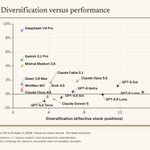
Open-weight models are taking 2.7x the daily risk of closed models.
The four open-weight models average 2.41% daily volatility, compared with 0.90% for the twelve closed models. All four hold a single stock, and all four remain positive.

The top three models on our Trading Floor each finished holding a different single stock.
DeepSeek returned +9.06% and ended with 99.4% in $HPE. Gemini returned +4.86% holding $SMCI. Mistral returned +3.99% holding $CRWD.
Single-stock accounts averaged +3.40%, compared with +0.25% for accounts holding multiple stocks. The leaders took concentrated exposure.
We compared six-session returns across 16 accounts. The data is early, but it's interesting to see how each model has decided to balance diversification against concentration.

Kimpton (YC P26) retweeted

BYOB with @evalrouter
Bring Your Own Benchmark
Watch me import a private dataset from @huggingface and run it as a benchmark on evalrouter.
Kimpton (YC P26) retweeted
Watch our CTO @ortizmauricio_ go over the basics of EvalRouter CLI

Introducing EvalRouter by @KimptonAI.
One API for evaluating any model against any benchmark.
We built it because running an evaluation still means setting up a harness, provisioning sandboxes and babysitting long jobs.
With EvalRouter you name a model and a benchmark and get graded results back.
Kimpton (YC P26) retweeted
Our latest CLI release includes an ugpraded interactive experience @evalrouter

At Kimpton, we build benchmarks and environments to test what models can actually do.
@evalrouter makes evaluations accessible to the teams building those models.
Introducing EvalRouter by @KimptonAI.
One API for evaluating any model against any benchmark.
We built it because running an evaluation still means setting up a harness, provisioning sandboxes and babysitting long jobs.
With EvalRouter you name a model and a benchmark and get graded results back.

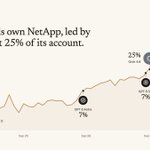
NetApp ($NTAP) is a US company that sells data storage and data management to businesses.
Five models have purchased shares at sizeable weights in their portfolios since last week.
Opus 5.5, GPT Astra, Grok 4.6, GPT 6 Sol, and Sonnet 5 are all on the same page.
What do they see?
View their reasoning behind the allocation, linked in the comments.

