

$KAS $1T MC by '29 or it's superior tech w/o disruption! ꓘK “Ultimate ignorance is the rejection of something you know nothing about yet refuse to investigate"
Wichita Falls, TX
Joined May 2009
- Tweets6.9K
- Following1.3K
- Followers873
- Likes56.6K


Why didn't we ever use Antartica as a giant freezer to end world hunger like Admiral Byrd suggested over 60 years ago?
youtube.com/watch?v=sAwbWl8e…
$KAS would face the same existential threat. Even 1-time pads wouldn't save it because the problem isn't encryption, it's publicly verifiable ownership, TX authorization & PoW. There's no known practical replacement that preserves all of its permissionless security guarantees.

19
If someone proves P = NP and discovers a practically efficient algorithm for NP-complete problems, virtually all modern computational cryptography would become insecure, with no practical, scalable replacement currently known.
Basically a digital apocalypse if proven.

Why raise the min relay fee rate 100x across the board? Why not keep normal TXs cheap & charge resource-intensive ZK TXs more?
Why support larger PQ ZK proofs when nobody uses native STARKs on mainnet yet?
How many viable projects were priced out of Kaspa? I know of at least 1.
1
25
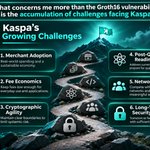
Each new mistake/vulnerability/architectural redesign diverts dev resources from improving utility needed to establish a sustainable fee-generating economy
$KAS is running out of time to establish one w/~99% of supply projected to be mined by ~July 2028
kodinglsfun.substack.com/p/k…


If you are building applications on Kaspa that use zero-knowledge proofs, this might be relevant to you.
TL;DR: RISC Zero recently disclosed a critical soundness vulnerability in their zkVM that allows malicious provers to produce valid-looking proofs for false statements.
Since Kaspa hard-codes RISC Zero's STARK verification circuit into its node, its native STARK verification pipeline is also affected and should currently be considered unsound.
We checked Kaspa's on-chain transaction history and found no uses of native STARK verification on mainnet. This means the vulnerability has no impact on existing mainnet applications or ordinary users.
However, if you are building something that would require this larger and more expensive proof format (e.g. for post-quantum security), you should be aware of this temporary limitation.
For applications that currently don't require post-quantum proof verification, an alternative is to compress STARK proofs into Groth16 proofs and settle them through Kaspa's generic Groth16 verification pipeline. This requires using a patched RISC Zero version (3.1.0 or later) and the corresponding verification keys, but I suspect most applications already take this approach anyway, since it's cheaper and more efficient for on-chain settlement.
Fixing the native STARK verification pipeline will require a hard fork. However, given that direct STARK verification is currently unused on mainnet, we've decided not to rush a consensus change.
Instead, we're aiming for a more flexible, modular approach to STARK verification, similar to how Kaspa already handles Groth16 proofs. This would allow developers to choose their own verification circuits and update them independently of the base layer, without requiring a hard fork whenever an upstream implementation needs to be patched.
I think the broader lesson here is that we should be very careful about embedding third-party cryptographic implementations directly into the base layer, regardless of how established or thoroughly reviewed they may seem.
Keeping these components modular and independently upgradeable makes the ecosystem more resilient to exactly this kind of issue (especially in the age of AI) and improves the expressiveness of the execution engine.
If no one is accepting $KAS in exchange for goods and services, then what hope does it have as a peer-to-peer electronic cash system? Merchant adoption should be the priority IMO.
19
@MARA also said "Other digital assets mining revenue decreased 88%, primarily due to lower production resulting from our planned wind-down of digital asset mining activities other than bitcoin."
sec.gov/Archives/edgar/data/…
"wind-down" almost always means they're ending it
7
747
$BTC/crypto was meant to eliminate middlemen, yet mining pools, staking providers & governance re-concentrate power.
Until incentives effectively prevent power reconcentration, crypto hasn't truly eliminated the middleman. It's recreated it under the illusion of decentralization

3
50

Why would you want your money to be freezeable by a centralized issuer? Should be developing decentralized, native stablecoins w/no issuer-controlled freezing. Let regulated institutions use centralized stablecoins if they want.
$KAS should offer both to get best of both worlds.
How so? You're confusing an exchange's willingness to reimburse customers with a legally enforceable guarantee that customers will be reimbursed. Your crypto isn't FDIC-insured, and exchanges aren't obligated to reimburse all losses.

18
Choosing to reimburse ≠ legally obligated to.
PoR ≠ insurance, & there’s no guarantee of full reimbursement.
"Tangem is more of a warm wallet, then cold." WTF? Hot = connection to internet, cold = no connection...
"Not your keys, not your coins" isn't outdated, it's reality

1
2
128

K Framework sounds very interesting, I'll definitely look into that some more. So far just scratching the surface, I've realized my current QSSM is a good private state-validity/policy verifier, but not yet a general state-transition computation verifier like I was aiming for.


14
Good idea, an emission-normalized/FDV comparison is an interesting second metric. At least $KAS now has much less future issuance left to absorb.

4
231
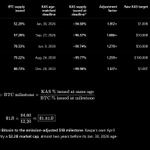
$KAS has officially lost the age-matched market-cap velocity lead it had over $BTC, missing the $10B milestone
Question is if it can regain that lead, or whether it’s simply another altcoin w/superior tech that never displaces the king
Time will tell...
kodinglsfun.substack.com/p/b…

I think this custom ZK engine could be useful here. I wanted no trusted setup or separate proving DSL, so I reduced it to 4 stateless predicates & removed arbitrary computation. If needed, arbitrary computation could be layered on top through interpreter
github.com/peavey2787/qssm-r…

1
2
17
Why transmit the secret at all? Alice & Bob use fresh ephemeral IDs to do an authenticated key exchange through an asynchronous rendezvous like $KAS, then independently derive the same secret. One-time IDs/addresses + network privacy handle linkability.
github.com/peavey2787/hydra-…

1
2
67
What if we go one step further and use the real media itself as the carrier, with only some objects containing hidden encrypted payloads via robust stenography?

2
1
19
