

Academic Clinical Fellow @KingsIoPPN | Resident Doctor @MaudsleyNHS | Brain, emotion, mood disorders | Views my own
London, England
Joined April 2012
- Tweets3.2K
- Following1.6K
- Followers4.5K
- Likes12.7K




Laith Alexander 🏳️🌈 retweeted

'Academic Psychiatry meets Clinical Psychiatry'
31/10/25 @rcpsych
✅Juggling clinical work&&research @lynne_drummond
✅Short&longterm directions in psych&neuro research
✅Clinical work&Academia: What is left to do to bridge the gap?@Derektracy1
Book now
lnkd.in/ecmkZzeT


Amazing work and goes a long way in understanding lateral/medial prefrontal interactions underlying symptoms of depression + anxiety

“Dysfunction in primate dorsolateral prefrontal area 46 affects motivation and anxiety” by Christian M. Wood et al. Science
dx.doi.org/10.1126/science.a…

1
3
1,469
Laith Alexander 🏳️🌈 retweeted

1/ Just out in @NatureMedicine : we show the opioid system modulates ketamine’s effects in major depressive disorder, with naltrexone pre‑treatment reducing acute glutamatergic activity and acute antidepressant effects. nature.com/articles/s41591-0…
Laith Alexander 🏳️🌈 retweeted

Most studies on esketamine (and the UK licence) have been as add-on to antidepressants. This study suggests monotherapy may also be effective - although only short term data. As ever the challenge with (es)ketamine comes in the longer term.

Esketamine nasal spray as a monotherapy improved depressive symptoms in treatment-resistant depression (TRD) compared to placebo. ja.ma/3ZYkZIv

Hot off the press!!! Prof Michael Browning from @UniofOxford presenting data from the PAX-D trial, looking a dopaminergic medication to augment the treatment of depression. #BAP2025

4
787
Prof Robinson describing the affective bias test, a translationally relevant assay to explore the effects of affective state on memory bias #BAP2025

1
730
Next up - Prof Emma Robinson, speaking about her exciting research developing preclinical models of psychiatric symptoms #BAP2025

1
626

It is #BAP2025 and we are at the first symposium of the day! Starting with Dr Thomas Blackmore and preclinical models of psychedelic efficacy. Exciting.

4
784
Laith Alexander 🏳️🌈 retweeted

Our new @NIHRMaudsleyBRC CRIS study shows that bipolar disorder is associated with a lower risk of dementia than depression | The British Journal of Psychiatry | Cambridge Core - bit.ly/3XH48sy


Paper out in @TheBJPsych exploring link between late-life depression vs. anxiety vs. bipolar disorder and dementia.
Compared to depression, anx had same risk but bipolar was lower. We found several demographic & clinical factors influencing risk too.
bit.ly/3XH48sy
Absolutely delighted that I’ve finally passed CASC. So happy that ordeal is over, particularly after the run in with Guillain Barre.

14
135
9,415

Laith Alexander 🏳️🌈 retweeted

Anatomy of Moncrieff's Anti-Medication Playbook
@joannamoncrieff has a carefully honed 3-step strategy of attacking psychiatry, which she has used with remarkable power against the medical establishment.
Step 1: Identify a narrow, technical assertion pertaining to the neurobiology or medical treatment of mental health problems, and show that the evidence supporting that assertion is not as strong or high quality as commonly believed.
Step 2: Use the uncertainty of evidence to make the claim, or imply, or pretend that the assertion has been shown to be false. [This step is a logically invalid inference since weak evidence in favor of thesis A does not equal strong evidence in favor of inverse A.]
Step 3: Use the claim as a stepping stone to bash medical psychiatry by making claims that extend far beyond the scope of the narrow, technical assertion in step 1. Rely on rhetoric, ignorance of the audience, and prevalent prejudices to pull this off, and make strategic motte-and-bailey retreats when needed.
This 3-step attack is bolstered by 2 ancillary moves:
a) Make isolated demands for rigor, and set the required bar of evidence to a level that favors one’s own position, while simultaneously lowering the bar or shifting the burden of proof when it suits your favored positions.
b) Pretend your personal opinion carries the same epistemic weight as the clinical consensus of the medical community.
See details of how this play out in my post: psychiatrymargins.com/p/anat…

Laith Alexander 🏳️🌈 retweeted

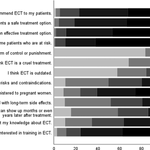
What are early career psychiatrists' perceptions of and training experience in electroconvulsive therapy? Read this new study in @Euro_Psychiatry co-authored with IoPPN + @MaudsleyNHS researchers (@Laithalexander, Gautam Bhatia, Mariana Pinto da Costa)
cambridge.org/core/journals/…

Laith Alexander 🏳️🌈 retweeted

Please see Division vacancies for this week. If you are interested in any of the positions listed below, please get in touch. Feel free to share this information with anyone who might be interested.

Laith Alexander 🏳️🌈 retweeted

❔ What are the early career psychiatrists' perceptions of and training experience in electroconvulsive therapy?
📋 A cross-sectional survey across Europe has been published in European Psychiatry!
🔗 Open access: doi.org/10.1192/j.eurpsy.202…

Our survey exploring early career psychiatrists’ perceptions of ECT is out @Euro_Psychiatry bit.ly/3DRPjfv
- Across Europe, perception favourable
- Willingness for more training
Wonderfully led by @CTapoi & Dr Pinto da Costa @KingsIoPPN

Laith Alexander 🏳️🌈 retweeted
Would you like to make a difference and be part of what happens in your region? The London Division have some fantastic opportunities to get involved. Apply today to become part of the Executive Committee. rcpsych.ac.uk/members/englan…
