

Researcher and Visual Educator : DeFi • Tokenization • NeoFinance • AI | Top Research in Highlights
Blockchain
Joined December 2014
- Tweets27K
- Following3.6K
- Followers28K
- Likes41.2K







Marspective retweeted

Intel gives you a quant-level data for HL (currently in closed access). Insane amount of real-time data on who's doing what in the market.
I've got 10 codes for it. DM if you're on HL and want it.
(Or reply under the tweet).



Web3 is evolving on multiple fronts, from smarter security and better market infrastructure to new ways of building, earning, and creating value.
This week’s article roundup covers a range of ideas across Web3, including pre-IPO perps, vault security, tokenized equities, airdrop opportunities, and AI-driven businesses.
Several articles also explore how creators, founders, and professionals can adapt to changing market conditions.
Here’s a roundup of the interesting reads from the week.
—
@Baheet_ examines how pre-IPO perps can accurately forecast valuations while still being exposed to serious oracle risks.
Markets like SpaceX and Cerebras showed strong price discovery, but many perps rely partly on their own trading activity for reference prices, creating a self-referencing loop.
A bad external feed, corporate actions, or thin short-side liquidity can distort the oracle and trigger liquidations, which is why pre-IPO perps need an independent, liquid price source.
x.com/baheet_/status/2117178…
—
@Cryptfancier stresses that clear quality standards are vital for making decentralized labor marketplaces trustworthy for both contributors and projects.
Defined requirements, consistent evaluation, validation records, and real feedback separate genuine work from noise. @TheDAOLabs is pushing this further by automating more of the process.
The real gap sits between basic compliance, contribution quality, and campaign results. Stronger reporting and validation are still needed to turn activity rewards into a marketplace that reliably delivers useful work.
x.com/cryptfancier/status/21…
—
@zaimiri shares a practical framework for growing on X, centered on a clear profile, focused topics, strong hooks, valuable replies, and consistent posting.
The strategy is to make your page easy to understand, reply to relevant accounts, show the person behind the content, and study your best-performing posts to repeat what works.
For monetization, he recommends building credibility first, diversifying income across payouts, affiliates, brand deals, services and products, and maintaining a posting routine you can sustain.
x.com/zaimiri/status/2118661…
—
@definikos compares the permission and security models of @veda_labs, @ConcreteXYZ, @centrifuge and @upshift_fi.
Across the 4, the biggest risk sits with admin keys that can expand whitelists or change strategies, while timelocks often exclude the frequent changes that can expand a vault’s blast radius.
The takeaway is that secure vaults should pin recipients, delay mandate-widening changes past the exit window, separate pricing and execution keys, and give independent guardians the power to pause or veto risky changes.
x.com/definikos/status/21184…
—
@wizofecom shares a 90-day framework for building a founder’s personal brand on X.
The strategy combines articles, Google Doc screenshots, infographics, industry opinions, founder stories, and client results, with each content format serving a specific purpose across awareness, authority, and conversion.
Build content around your ideal customer profile, repurpose strong ideas across formats, and measure success by qualified leads and revenue, not just impressions and followers.
x.com/wizofecom/status/21187…
—
@steinRWA breaks down 6 ways to hold shares and shows how each structure decides whether you are a registered shareholder or just hold a claim through an intermediary.
It compares traditional certificates, broker-held shares, DRS, DSPPs, tokenized wrappers, and issuer-sponsored tokens, covering differences in ownership rights, dividends, voting, lending, and DeFi utility.
Not every tokenized stock equals real share ownership. Check whose name sits on the official register and what legal rights the tokens actually give you.
x.com/steinrwa/status/211656…
—
@FabianoSolana lists 20+ Solana airdrop opportunities, ranking projects across RWA, DeFi, trading, payments, mobile, and DePIN by farming potential.
He covers practical ways to earn points through trading, lending, liquidity, vaults, card use, and ecosystem activity, while flagging live campaigns and upcoming airdrops.
He advises to weigh timing, capital needs, competition, product quality, and risk before farming. A big funding round or points campaign alone doesn’t guarantee a worthwhile airdrop.
x.com/fabianosolana/status/2…
—
@jackhcable reviews recent major security incidents, including the $6.34B Binance theft, a compromised dev extension, and critical flaws in popular software.
AI is making attacks faster and cheaper, yet most breaches still exploit the same old weaknesses such as unpatched systems, stolen credentials, exposed secrets, and compromised developer devices.
Use phishing-resistant MFA, tighten device and extension controls, keep production secrets off dev machines, and ensure dependency audits, code scanning, and stronger monitoring.
x.com/jackhcable/status/2117…
—
@VibeMarketer_ outlines 5 one-person business models that lean on AI, including founder-led content, product-demo videos, niche research, small-business software, and AI automation services.
For each, he covers what to sell, how AI supports delivery, how to create a sample, and how to land the first customer.
Start with a problem you know well, validate a small paid offer, then use AI to make delivery repeatable while keeping human oversight on quality and client relationships.
x.com/vibemarketer_/status/2…
—
@ByRubiks argues that staying valuable in the AI era means adapting without constantly discarding the expertise you’ve built.
AI can automate tasks and make less experienced workers look more capable, but deep knowledge still matters for spotting errors, exercising judgment, and handling unfamiliar problems. Higher productivity also doesn’t automatically mean higher value or better pay.
The edge comes from building real expertise, knowing what’s being automated, and finding where that knowledge still solves valuable problems.
x.com/byrubiks/status/211870…
—
That’s a wrap for the week. Stick around for more insights weekly.


Finding sustainable yield opportunities in DeFi increasingly comes down to having access to structured strategies that can navigate different market conditions.
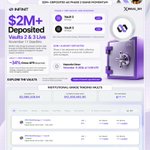
@Infinit_Labs is bringing that approach to onchain yield through its APEX Multi-Strategy Vaults, with Phase 2 already attracting over $2M in deposits.
Following Vault 1's reported ~34% gross APR, Vaults 2 and 3 are now live, offering access to the same CTA momentum strategy designed to capture market trends while managing volatility.
Here's what's available:
• Vault 2: 90-day trading period
• Vault 3: 30-day trading period
Both vaults follow the same underlying strategy, giving depositors flexibility to choose their preferred trading duration.
With over $2M already deposited into Phase 2, interest is building, and there's still an opportunity to participate.
Deposits remain open for just one more week, closing on November 11 at 12:00 UTC.
If you've been exploring opportunities to put your stablecoins to work through systematic trading strategies, APEX Multi-Strategy is worth a closer look.
Explore the vaults and deposit: app.infinit.tech
Disclaimer: Past performance is not a guarantee of future returns, and vault strategies carry risk.
🤝 Paid partnership

Binance's reported $6.3B security breach in October 2026 and Bybit's $1.4B hack in February 2025 have renewed concerns about centralized exchange security.
Both incidents exposed the risks of concentrating billions in user assets within exchange-controlled infrastructure.
But does moving trading onchain actually make Perp DEXs safer?
Let's compare where the risks sit.
—
● The Three Layers of Exchange Security
Comparing CEXs like @binance and @Bybit_Official with Perp DEXs like @HyperliquidX, @Lighter_xyz, @Aster_DEX and @variational_io requires looking beyond who holds user funds.
Three dimensions determine how secure an exchange really is:
• Custody: Who controls user funds and withdrawals?
• Protocol security: Can infrastructure or smart-contract vulnerabilities compromise execution?
• Market integrity: Can oracle manipulation or liquidation failures create losses?
CEXs concentrate operational control within exchange operators, while DEXs distribute dependencies across smart contracts, validators and supporting infrastructure.
The distinction becomes clearer when examining how recent exchange breaches occurred.
—
● Binance's $6.3B Breach: Internal Infrastructure Compromised
On October 29, 2026, Binance suffered a security breach involving unauthorized hot-wallet withdrawals. Rather than exploiting a smart-contract vulnerability, attackers compromised developer devices and internal wallet infrastructure to gain access to signing operations.
The attack developed over several months:
• June–September: Developers were targeted through malicious software and a fake job interview.
• October 20: Attackers gained access to developers' systems.
• October 29: Unauthorized withdrawals were executed.
• October 31: The FBI attributed the attack to North Korea's TraderTraitor group.
Binance committed to absorbing the losses through SAFU and corporate funds.
The incident highlights how compromised internal infrastructure can bypass security controls even without directly stealing wallet private keys.
—
● The Attack That Bypassed Bybit's Multisig
Bybit's February 21, 2025 hack exposed a different weakness within centralized custody.
Attackers stole approximately $1.4B in $ETH by compromising the exchange's Safe wallet signing interface.
Three authorized signers approved what appeared to be a legitimate transaction, but malicious JavaScript had altered its underlying instructions, allowing attackers to take control of the cold wallet.
The contrast:
• Binance: Developer infrastructure compromise enabled unauthorized hot-wallet transfers.
• Bybit: Signing interface compromise enabled a cold-wallet takeover.
Despite different attack methods, both incidents demonstrate that cold storage and multisig cannot eliminate operational security risks.
Understanding why requires examining how CEX custody works.
—
● How CEX Custody Works
Centralized exchanges manage user balances and perpetual positions through internal ledgers, while deposits and withdrawals settle onchain.
User deposit -> Internal ledger -> Hot / cold wallets -> Blockchain withdrawal
Three components support this architecture:
• Hot wallets: Online wallets handling operational transfers and withdrawals.
• Cold wallets: Offline storage designed to protect larger reserves.
• MPC / multisig: Systems that distribute transaction-signing authority.
However, this structure introduces two important dependencies.
• The Internal Ledger Risk:
Perpetual positions, collateral balances and PnL are recorded internally rather than through individual onchain transactions.
Users therefore depend on the exchange's accounting accuracy, operational security and withdrawal infrastructure.
• Proof of Reserves ≠ Proof of Solvency:
Merkle-based PoR can help users verify balances included in a reported liability snapshot.
However, it does not independently establish that all liabilities are disclosed or that reserves are free from encumbrances.
Perp DEXs attempt to reduce these dependencies, but their architecture introduces different risks.
—
● Perp DEX Architecture: Where Trust Moves
Unlike CEXs, Perp DEXs can hold collateral in smart contracts, reducing reliance on exchange-controlled wallets.
However, trading execution may still depend on centralized infrastructure.
User wallet -> Collateral -> Trading engine -> Oracle -> Liquidation -> Settlement
Three risks remain:
• Sequencer: Transaction censorship, delays or reordering.
• Oracle: Manipulated or stale prices affecting positions and liquidations.
• Smart contracts: Exploits, vulnerabilities or unauthorized upgrades.
The important distinction is that non-custodial does not automatically mean decentralized.
Users may retain control over collateral while operators still influence execution, protocol upgrades and emergency interventions.
How these responsibilities are distributed varies considerably across Perp DEXs.
—
● Protocol-by-Protocol Security Analysis
• @HyperliquidX
Hyperliquid operates a custom L1 using HyperBFT consensus, validator-operated infrastructure and an onchain order book.
• Validators aggregate external exchange prices to determine oracle feeds.
• The March 2025 JELLY incident left HLP with approximately $12M in unrealized losses.
• Validators intervened to delist the market, highlighting the trade-off between protecting the system and retaining discretionary control.
• @Lighter_xyz
Lighter uses an Ethereum-based zk-rollup architecture, applying cryptographic proofs to exchange execution.
• ZK proofs verify matching and liquidation state transitions.
• Its fallback mechanism is designed to support withdrawals if the sequencer fails.
• However, execution proofs cannot guarantee oracle accuracy or eliminate sequencer censorship.
• @Aster_DEX
Aster combines order-book trading with private order execution.
• Encrypted orders reduce public visibility into trading activity and large positions.
• The trade-off is less public transparency into execution.
• Security therefore depends partly on encryption assumptions and the scope of administrative permissions.
• @variational_io
Variational uses peer-to-peer derivatives with isolated settlement pools between users and the OLP.
• Isolated pools help limit direct contagion between users.
• However, OLP counterparty exposure and oracle risks remain.
• The protocol lists security audits by @zellic_io and @spearbit.
These differences show that Perp DEX security cannot be evaluated through custody alone.
Oracle reliability and liquidation mechanisms are equally important.
—
● Oracle Design and Liquidation Risk
Even when user collateral is protected by smart contracts, manipulated price feeds can trigger liquidations without corresponding movements in external markets.
For example:
$BTC market price: $100K -> Oracle reports $90K -> Leveraged long liquidated.
Three factors influence oracle resilience:
• Independence of price sources.
• Aggregation methodology and update frequency.
• Stale-feed protection and deviation limits.
Using multiple price sources is not sufficient on its own. Their independence, underlying liquidity and assigned weighting determine how resistant the oracle is to manipulation.
But accurate pricing is only one part of managing leveraged positions.
—
● Liquidation and Bad-Debt Risk
When market volatility pushes leveraged positions into insolvency, liquidation design determines how losses are contained and who ultimately absorbs them.
Different architectures use different mechanisms:
• CEXs: Internal liquidation engines, insurance funds and auto-deleveraging (ADL).
• Perp DEXs: Liquidators, backstop vaults, insurance funds or socialized-loss mechanisms.
• Both: Open-interest caps and position limits can help contain concentrated exposure.
This creates another important distinction between technical security and financial resilience.
A protocol can execute its smart contracts exactly as designed and still experience substantial losses because its liquidation economics fail under stress.
—
The Binance and Bybit breaches demonstrate the risks of concentrating custody and operational control within centralized exchanges.
Perp DEXs reduce certain custody dependencies, but shift security risks toward smart contracts, validators, oracles, execution infrastructure and liquidity backstops.
Neither architecture eliminates trust or the possibility of failure.
Ultimately, the question isn't simply whether CEXs or Perp DEXs are safer. It's where control sits, whether users can exit when something breaks, and who ultimately absorbs the losses when security mechanisms fail.

Marspective retweeted

5 days before mainnet, elysium already has more daily users than robinhood had on its launch day.
i compared the 3 big new chains of 2026 at the exact same moment: 5 days before their public mainnet.
active wallets per day:
> robinhood chain (jun 26): 315
> arc (sep 11): 3,668
> elysium (today): 11,935
> robinhood on its launch day: 11,153
dex volume per day:
> arc: $1.75m
> elysium: $4.21m
> robinhood: untracked (its pre-mainnet trades mostly ran on noxa)
transactions per day:
> robinhood: 74k
> arc: 121k
> elysium: 121k

Although these platforms share similar token-launch infrastructure, their competitive advantages fall into several categories.
Here is how they compare and read to the end to know my favorite pick.
—
● Trading Volume and Market Access
@TheKleos_ , @Boxa_Elysium and @ElysiumPump have established some of the strongest early activity.
@TheKleos_ combines trading infrastructure with clans, leaderboards and multi-asset holder rewards, while @Boxa_Elysium differentiates through aggregation, allowing users to discover and trade assets across multiple launchpads.
@ElysiumPump benefits from its early entry, with established tokens contributing to trading activity.
Their advantage is distribution: greater trading visibility can attract more creators, which in turn brings additional tokens and potential liquidity.
However, early activity does not necessarily translate into lasting market dominance.
—
● Specialized Launch Infrastructure
@Stockium , @SignalFam and @eleosfun compete by offering features beyond ordinary $HYPE-paired token launches.
@Stockium introduces tokenized-stock pairs, connecting speculative assets with equity-linked markets.
@SignalFam allows creators to route fees toward holder rewards, buybacks or perpetual-market exposure, bringing trading strategies into token economics.
@eleosfun emphasizes customizable launch modes and transparent rules, including restrictions preventing creators from increasing taxes after launch.
These features give each platform a distinct audience, although additional complexity can also introduce new risks.
—
● Simplicity and Community Participation
@Bunnypadfun approaches the market through direct fair launches, permanently locked liquidity and participation incentives.
Its Bunny Pass model links a portion of platform revenue to NFT stakers, while points and community initiatives encourage continued engagement.
This creates a distribution channel beyond ordinary trading activity.
However, the durability of these incentives will depend on how much genuine activity remains once promotional rewards decline.
—
● Where Elysianpad Differentiates
While established competitors emphasize volume, aggregation, specialized trading features or community incentives, @Elysianpad focuses on a more direct proposition which is giving creators control over how trading fees are distributed.
Its reported design combines three elements.
• One-transaction token creation: Reducing the complexity involved in launching a token.
• A 1% trading-fee structure: Giving creators a defined framework for directing fees rather than relying entirely on higher, variable tax models.
• Fee-funded buybacks and burns: Connecting platform activity with a mechanism intended to support its native token economics.
This distinction matters because launchpads compete for more than traders.
They also compete for creators who need accessible infrastructure, predictable costs and an economic model that can remain relevant after launch.
Rather than relying primarily on leaderboards or additional trading features, Elysianpad brings the allocation of trading fees closer to the center of its product.
The reported commitment to directing a substantial share of fees toward buybacks and burns strengthens that positioning, provided the allocations are implemented transparently and consistently.
—
● What Will Determine the Winners?
Elysium's launchpad competition is still developing, and each platform currently has a different advantage.
@TheKleos_ stands out for early trading activity and its reward ecosystem.
@Boxa_Elysium offers strong aggregation and market accessibility, while @ElysiumPump benefits from its first-mover position.
@Stockium and @SignalFam introduce specialized trading mechanics, eleos focuses on flexible and transparent rules, and BunnyPad emphasizes fair-launch simplicity and community participation.
@Elysianpad's strongest proposition lies in the relationship between creators, fee allocation and platform-token economics.
But the real comparison begins after mainnet.
Sustained trading volume, active creators, liquidity retention, verified fee distribution and actual buyback execution will determine whether these designs translate into durable ecosystems.
—
@Elysianpad still needs to demonstrate that its model can attract sustained usage and deliver the reported benefits onchain.
However, among the newer entrants, its emphasis on creator control and straightforward token economics gives it a strong strategic position.
If Elysium's next phase is defined by sustainable token-launch economics rather than short-lived volume, Elysianpad has a credible opportunity to emerge as one of its strongest launchpads.


With @Enter_Elysium targeting November 9 for its public mainnet launch, competition among token launchpads is already taking shape.
@TheKleos_ , @Boxa_Elysium , @ElysiumPump , @Stockium , @eleosfun , @Bunnypadfun , @SignalFam and @Elysianpad are approaching token creation through different combinations of liquidity, trading fees, creator incentives, and holder rewards.
While some have established early trading activity, others are introducing models designed to attract creators and retain value within their ecosystems.
The question is no longer simply which platform launches the most tokens, but which model can sustain activity beyond the initial speculation.
Here's an infographic on how they compare.

Marspective retweeted
We're excited to announce our partnership with @KyberNetwork , a leading DeFi liquidity aggregation and trading infrastructure provider.
By combining Kyber Network's expertise in liquidity aggregation with Elysianpad's community-focused token launch model, we aim to support deeper liquidity, more efficient trading, and sustainable growth across the @Enter_Elysium ecosystem.
Together, we're building toward a more connected and accessible DeFi experience.
Stronger liquidity, better opportunities and one growing ecosystem.
Get started on Elysian today:
elysianpad.fun

With @Enter_Elysium targeting November 9 for its public mainnet launch, competition among token launchpads is already taking shape.
@TheKleos_ , @Boxa_Elysium , @ElysiumPump , @Stockium , @eleosfun , @Bunnypadfun , @SignalFam and @Elysianpad are approaching token creation through different combinations of liquidity, trading fees, creator incentives, and holder rewards.
While some have established early trading activity, others are introducing models designed to attract creators and retain value within their ecosystems.
The question is no longer simply which platform launches the most tokens, but which model can sustain activity beyond the initial speculation.
Here's an infographic on how they compare.
Stablecoins are moving from being an alternative way to hold dollars to becoming the infrastructure through which money moves, gets spent and earns yield.
Polygon expanded its Open Money Stack, while Mastercard, Visa, Coinbase and other major players pushed stablecoins further into cards, enterprise payments and cross-border transfers.
Here’s a quick round up of the updates in the sector in the last month.
—
● @0xPolygon
• Expanded Open Money Stack support to @trondao and @solana
• Introduced automated stablecoin payout runs, allowing businesses to configure recurring payment schedules for global payouts
• Introduced agent spend controls, enabling businesses to assign AI agents specific payment permissions, USDC spending limits, approved contracts, and expiration
● @zerohashx
• Joined @tempo as a network validator and integrated its stablecoin payment infrastructure with the network
● @morphllm
• Partnered with @coinbase to bring USDC and USDT payments to its platform
● @okx
• OKX Card went live, a crypto and stablecoin-backed virtual payment card linked directly to OKX Pay wallet
● @StraitsX
• Partnered with @Visa to expand card issuing capabilities to over 100 markets
● @atomHQ
• Partnered with @CoinbaseBiz to integrate stablecoin payments into domain trading and pioneer the use of AI agents for RWA purchases
● @Underdog
• Partnered with @zerohashx to introduce crypto and stablecoin account funding for prediction markets
● @Crossmint
• Launched Agent Commerce Toolkit, a product that allows AI agents to make online purchases using saved payment cards through a single integration
● @raincards
• Introduced Rain Wallets, embedded stablecoin wallets that partners can integrate directly into their apps
● @FinTax_Official
• Partnered with @InterlaceMoney to explore new possibilities for stablecoin payment services
● @InterlaceMoney
• Partnered with @EchobitExchange to bring stablecoin cards and the customized Ceramic Cards to its platform through Interlace’s card-issuing API
● @airtminc
• Partnered with @BVNKFinance to bring wallet-native payments to emerging markets through Airtm Connect
● @Mastercard
• Launched Mastercard Global Money Platform, a B2B infrastructure layer that unites fiat with digital assets and stablecoins through a single API
● @crossriverbank
• Partnered with @Ripple to integrate RLUSD into its core banking infrastructure
● Movantis
• Integrated Stellar into its cross-border payments infrastructure.
● @HSBC
• Introduced its first stablecoin, RedCoin (RCHKD), a Hong Kong dollar-denominated stablecoin
● @SoFi
• Introduced SoFi Earn, an interest-bearing tokenized deposit product offering 4.4% APY
● @evervault
• Launched Browser Tokens, letting AI agents and browser automation tools make payments and log into accounts without exposing sensitive data
● @Visa
• Partnered with BILL and Billtrust to allow authorized AI agents to initiate and complete approved invoice payments through supplier portals.
● Safirum
• Launched CHF-S, a Swiss franc-backed stablecoin, on Solana
● @trylimitless
• Partnered with @crossmint to bring card deposits to Limitless
● @base
• Introduced Earn & Borrow, an end-to-end infrastructure stack that lets apps, fintechs, and enterprises embed stablecoin yields and crypto-backed loans into their apps
● @circle
• Partnered with Tereina, an SAP-backed financial services company, to integrate USDC and EURC into enterprise financial workflows through SAP Pay
● Majority
• Launched cross-border stablecoin payments to Latin America, powered by @zerohashx
● @Infinit_Labs
• Launched APEX Multi-Strategy Vaults 2 and 3, with 90 and 30-day trading periods, respectively
—
They’re no longer limited to transfers and trading. They’re becoming part of the infrastructure for spending, lending, business payments, cross-border settlement and autonomous commerce.
That’s all for the month. Stick around for more updates monthly

Marspective retweeted
IT'S HERE.
Elysian is now LIVE on @Enter_Elysium , and our official token, $ELYSIAN, is live too!
Elysian is a launchpad built to give creators more control over their launches and communities more ways to participate.
CA: 0x298622170fab26db27bd8e29d13c429bfd819eb4
elysianpad.fun/
Marspective retweeted
i don't recommend trading memecoins. you'd have better odds at a casino.
but if you really want to do it, here's how:
> trade 12h a day, 6 days a week.
> you need to have seen every coin that ran yesterday. most new coins are reruns.
> one narrative = 50 coins. only one wins: good image, right name, right ticker, right fees distribution etc ... the rest get vamped
> if you're new, don't trade for 2-4 weeks. just study what bonded and why
> timing beats narrative. the same coin deployed 5 min later can run because nobody saw the first one
> the coin has to explain itself in one second. clean image, simple ticker, tweet framed bullish
> no links or a random tweet = skip
> fresh tweet (10-30 sec old) = more bullish. new narratives often hit $12-15k on attention alone
> under $8k and interesting: quick buy
> above $10-12k: open the chart first. check dev % and sniper %
> very low "fees paid" = probably bundled. dig before you buy
> buying at $4k is your insurance: it buys you time to decide hold or sell
rule #1 is "make it your full-time job".

US midterm elections could reshape crypto regulation, but the industry's long-term growth is becoming increasingly difficult to define through US politics alone.
@Grayscale estimates that the US accounts for just 15–20% of global crypto activity, with most adoption taking place overseas.
Here's why crypto's trajectory increasingly extends beyond Washington.
—
● US Midterms Put Crypto Regulation in Focus
Prediction markets suggest Democrats could gain control of both chambers of Congress, introducing uncertainty around the industry's regulatory outlook.
A shift in political control could influence stablecoin legislation, market structure reforms and regulatory oversight.
However, while election outcomes may affect the pace of regulatory progress, crypto's political support is no longer confined to one party.
—
● Crypto Has Bipartisan Political Support
Crypto ownership cuts across political lines, with 19% of US adults having used crypto, including 22% of Republicans and 17% of Democrats.
This support is increasingly reflected in legislative developments:
• GENIUS Act: Passed with 68–30 Senate and 308–122 House votes.
• CLARITY Act: Passed the House 294–134 but stalled in the Senate at 49–50.
Meanwhile, @coinbase, @Ripple and @a16z back Fairshake and its affiliates, which spent $150–176M supporting pro-crypto candidates across both parties.
This bipartisan foundation provides some political resilience, even as legislative progress remains uncertain.
—
● Crypto Regulation Is Moving Beyond Legislation
The CLARITY Act's Senate setback has also highlighted the importance of regulatory developments outside Congress.
With comprehensive legislation facing obstacles, the SEC and CFTC continue advancing regulatory clarity through two parallel routes:
• Legislative: Congress establishes comprehensive statutory frameworks for digital assets.
• Agency-led: SEC and CFTC develop joint guidance, proposed rules and innovation exemptions while legislation remains stalled.
Both approaches could influence the industry's regulatory environment, but neither determines the full extent of global crypto adoption.
—
● Crypto's Activity Extends Far Beyond the US
While US policy remains influential, the geographic distribution of crypto activity reveals a much broader market.
@Grayscale's breakdown highlights the difference between infrastructure concentration and user adoption:
• Infrastructure: 36% of $BTC hashrate and 31% of $ETH full nodes.
• Payments: 24% of stablecoin payment value and 22% of merchant payments.
• Adoption: 13% of crypto holders and 12% of mobile wallet users.
Across approximately 14 indicators, the US accounts for a median share of 16% and a mean of 19%.
This global distribution reduces the industry's dependence on any single political or regulatory environment.
—
● Traditional Finance Is Integrating Blockchain Infrastructure
Beyond geographic expansion, institutional adoption is embedding blockchain into existing financial systems.
Three areas stand out:
• Payments: @Visa, @Mastercard, @Fiserv and @stripe are developing stablecoin payment infrastructure.
• Tokenization: @BlackRock, @FranklnTempletn and @jpmorgan are tokenizing financial products and integrating digital assets.
• ETPs: Crypto exchange-traded products are gaining exposure within institutional portfolios.
These developments extend adoption beyond crypto-native markets, creating financial infrastructure with applications that persist regardless of election cycles.
—
● DeFi's Growth Will Be Driven by Structural Adoption
As blockchain becomes more integrated into traditional finance, new pathways are emerging for capital and users to enter decentralized markets.
Three developments are particularly important:
• Stablecoins: Expanding on-chain liquidity, payments and settlement infrastructure.
• Tokenization: Bringing traditional assets onchain, with potential applications in DeFi trading and lending collateral.
• Global adoption: Supporting on-chain activity beyond US political and regulatory developments.
Together, these trends are gradually shifting DeFi's growth drivers from speculation towards financial utility and broader market participation.
—
Crypto is evolving beyond a market driven primarily by speculation and regulatory expectations into one increasingly supported by global adoption, financial infrastructure and institutional participation.
Stablecoin payment rails, tokenized assets and expanding on-chain activity are strengthening the foundations of this transition.
US elections will continue to influence regulatory conditions and the pace of adoption.
But the industry's long-term trajectory is increasingly shaped by structural forces that extend far beyond Washington.

Following the reported $6.3B exploit, @binance has committed more than $6.34B to cover affected assets, ensuring customers do not bear the financial loss.
It is a significant demonstration of financial resilience, particularly given the scale of the attack.
But what makes Binance's response stand out is how it compares with a decade of exchange hacks.
Here's why its commitment to protecting users matters more than its size.
—
● Binance's Commitment to Protecting Users
When Binance suffered its first major security breach in 2019, hackers stole 7,000 BTC, worth approximately $40M.
Rather than pass those losses to customers, the exchange absorbed them through its Secure Asset Fund for Users (SAFU).
Seven years later, Binance faces a substantially larger challenge.
Following the October 29, 2026 breach, which resulted in approximately $6.3B in stolen assets, Binance mobilized resources to protect affected customer balances.
Its response includes:
• Setting aside more than $6.34B in company funds to cover the losses.
• Deploying resources from SAFU, corporate treasury and part of its Futures Insurance Fund.
• Coordinating with industry partners to freeze approximately $3B in affected assets.
• Replenishing stolen tokens through market and OTC purchases.
According to Binance, affected-asset replenishment increased from approximately 80% on October 30 to 90% on October 31 and 95% by November 1.
The exchange also began restoring withdrawal services in phases.
This reflects an important distinction: Binance is using its financial resources to absorb the impact rather than transferring the burden directly to customers.
—
● Turning Financial Commitments Into Measurable Recovery
Beyond replacing stolen assets, Binance is also working to demonstrate that customer holdings remain adequately backed.
On October 31, it published an updated Proof of Reserves snapshot covering major assets, including BTC, ETH, USDT and BNB.
Binance reported full backing for ten major affected tokens, with complete zero-knowledge verification expected by November 3.
However, approximately 5% of affected assets remained to be replenished as of November 1.
Replenishing assets is not the same as recovering stolen funds, just as a reserve snapshot is not a comprehensive solvency audit.
Completing the remaining purchases, restoring withdrawal access across affected assets and delivering verifiable reserve evidence will therefore be important milestones.
Still, Binance's willingness to commit substantial capital, publish recovery progress and prioritize customer protection represents a meaningful response to an exceptionally large security crisis.
—
● Why Binance's Response Matters
An exchange's strength is not defined solely by the assets it holds or the volume it processes.
It also depends on its ability to protect customers when unexpected losses threaten normal operations.
Binance's response demonstrates how dedicated protection reserves, corporate liquidity and coordinated industry support can help an exchange manage a crisis without immediately imposing losses on users.
If the remaining replenishment and verification milestones are completed, its recovery could establish an important benchmark for centralized exchange resilience.
And the significance becomes clearer when compared with how previous exchanges handled similar crises.
—
● A Decade of Exchange Hacks: How Binance Compares
Crypto's history is filled with major exchange breaches, but their consequences have varied considerably.
Some exchanges collapsed, others transferred losses to customers, while a few absorbed the damage and restored operations.
In 2014, Mt. Gox lost approximately $450M, entered bankruptcy and left creditors facing years of recovery proceedings.
Cryptopia followed a similar path in 2019, entering liquidation after a $16M exploit.
Other exchanges survived, but their approaches to compensation differed.
• Bitfinex (2016): A ~$72M breach led to a 36% haircut, followed by BFX tokens eventually redeemed at dollar face value or exchanged for equity.
• Coincheck (2018): Reimbursed affected users in yen following a ~$530M NEM exploit.
• WazirX (2024): Restructured after a ~$235M hack, distributing approximately 85% of approved claims at scheme reference prices.
Over time, stronger recovery mechanisms also emerged.
• KuCoin (2020): Approximately $239.45M of its $285M breach was recovered or secured, with company funds and insurance covering the remainder.
• Crypto.com (2022): Reimbursed affected customers following a $34M exploit.
• Bybit (2025): Following a $1.46B theft, maintained withdrawals and replenished reserves through financing, deposits and institutional support. A subsequent Hacken-reviewed report confirmed 1:1 backing within 72 hours.
—
These incidents highlight an important distinction: surviving a hack does not necessarily mean customers are restored to their original economic positions.
Binance's reported response stands out because of the scale of capital committed, the progress in replenishing affected assets and its stated decision to shield customers from the losses.
The final assessment still depends on completing that recovery.
But the broader lesson from exchange history is that the real measure of an exchange isn't how much capital it controls. It's how effectively that capital protects customers when something goes wrong.

The reported $6.36B @Binance hack has exposed a how a single security breach can disrupt liquidity, trading, and capital flows across multiple markets.
With funds stolen across 10 blockchains in roughly 20 minutes, the attack triggered an arbitrage frenzy on Ethereum and significant activity across DeFi.
Investigators have linked the incident to North Korean hackers, but the consequences extend far beyond the stolen assets.
Here's how it unfolded.
—
● The North Korean Connection
Blockchain investigators have attributed the Binance attack to TraderTraitor, a North Korean hacking group also linked to the $1.5B @Bybit_Official hack.
However, identifying the attackers does not guarantee accountability.
Even if investigators establish their identities and trace the stolen funds, the FBI cannot simply enter North Korea to arrest them.
This creates a persistent challenge that tracing illicit capital is increasingly possible onchain, but recovering assets and prosecuting state-backed attackers remains far more complicated.
—
● How the Binance Hack Triggered an Ethereum Arbitrage Frenzy
Of the stolen assets, approximately $3.79B was on ethereum.
To avoid potential freezing by @Tether, the attacker rushed to convert stolen $USDT into $ETH, creating significant buying pressure across decentralized exchanges.
The resulting trades reveal the scale of the disruption:
• $325M in $USDT was routed through UniswapX and 1inch orders.
• $ETH was purchased at $2,657 against a market price of $2,284.
• Direct pool purchases pushed Uniswap's WETH/USDT price 38% above market.
These price dislocations created substantial arbitrage opportunities, attracting traders and automated bots looking to capture the difference.
—
● How MEV Bots Captured Millions From the Chaos
As $ETH prices diverged across trading venues, arbitrage bots competed aggressively for transaction priority, driving up payments to Ethereum block builders.
Between 20:30 and 01:00 UTC:
• Bots paid 10,251 $ETH in builder tips, compared with just 4.6 ETH during the same period the previous night.
• Traders and bots reportedly captured approximately $60M.
• Ethereum builders and validators received around $29.5M.
• The attacker lost approximately $119M through unfavorable execution prices.
The disruption also reached lending markets.
By October 30, @aave's $USDT pool reportedly held just $4,707, as liquidity providers withdrew funds amid the uncertainty.
What began as an exchange security failure had become a broader liquidity event across Ethereum.
—
● Binance Withdrawals Reveal the Capital Response
While DeFi markets absorbed the immediate trading disruption, Binance faced another challenge of restoring withdrawals and maintaining user confidence.
Following the reopening of withdrawals on November 1, the exchange recorded the following activity within 9.5 hours:
• Withdrawals: $4.649B
• Deposits: $1.01B
This translated into approximately $3.64B in negative net outflows, representing 2.1% of Binance's reported $171B AUM.
The figures highlight the scale of capital movement following the breach, although they do not establish how much was directly driven by declining user confidence.
The next question is whether Binance can demonstrate sufficient reserves to reassure users.
—
● Proof of Reserves: Binance's Next Confidence Check
With withdrawals restored, attention has shifted toward Binance's updated Proof of Reserves (PoR).
The timeline:
• October 28: Previous available PoR data.
• October 31: New reserve snapshot taken.
• November 1: Zero-knowledge proof computation was still underway.
The updated report provides another checkpoint for users to assess whether Binance's reserves adequately back customer balances.
However, PoR alone cannot establish complete solvency or account for every liability.
This makes reserve transparency important, but only one part of the broader process of restoring confidence.
—
● How Binance's Security Breach Spilled Into DeFi
The broader impact highlights how interconnected centralized exchanges and decentralized financial markets have become.
A single breach produced several overlapping market reactions:
• DEXs experienced substantial price dislocations as stolen assets were exchanged.
• MEV bots and block builders captured millions from arbitrage activity.
• Aave experienced a sharp decline in available USDT liquidity.
• @HyperliquidX recorded $17.44B in perpetuals volume and approximately $252M in liquidations, alongside a separate institutional catalyst involving @tradexyz.
- Binance recorded approximately $3.64B in net outflows following the restoration of withdrawals.
Not every market movement can be attributed entirely to the attack, particularly on Hyperliquid, where independent developments also influenced activity.
Still, the incident demonstrates how a centralized security failure can transmit risk across trading venues, lending markets, liquidity providers, and derivatives platforms.
—
The Binance hack highlights two persistent challenges for crypto:
• the difficulty of holding state-backed attackers accountable
• the systemic consequences of concentrated security failures.
Beyond the $6.36B theft, the incident exposed how quickly liquidity disruptions, arbitrage activity, and capital movements can spread across interconnected markets.
As state-backed cyber threats continue to evolve, stronger exchange security, liquidity safeguards, and coordinated risk management will be essential to limiting the damage from future attacks.
Another busy week across crypto, with new DeFi products, tokenization initiatives, infrastructure upgrades, and key token events taking shape.
Here’s your weekly roundup of major updates, upcoming catalysts, protocol milestones, and yield opportunities.
—
● Major Updates
• @RKST_xyz introduced Space Capital Markets Launchpad, a platform to tokenize high-value, private aerospace companies, powered by @starcap_xyz
• @EthenaPay introduced Earn+, a higher-yield vault feature that targets up to 12% APY on dollar balances
• @GeniusTerminal introduced Genius App, integrating trading, social features, and token creation into a single unified app
• @bopzopapp launched Bopzop, a social trading terminal and token launch platform
• @Americanfort_io introduced FortressID™, a decentralized, reusable digital identity credential built for crypto transactions in partnership with @sumsub
• @ManicTrade introduced PaperManiac, an incentive layer and mobile app layer
• @spectra_finance introduced Spectra OTC, an over-the-counter trading feature designed for large-scale or counterparty-specific trades of PT and YT
• @saturn_credit introduced Prometheus, a digital capital consolidation program
• @0xMiden launched its Partner Mainnet, opening its privacy-focused blockchain infrastructure to ecosystem partners and developers
• @chainlink introduced Chainlink CustodySync, connecting traditional qualified custodians with DeFi lending markets
• @pharos_network’s $PROS liquid staking went live with @Farooxyz
• @initia resumes its L1 and rollup services on the 2nd, following a MoveVM patch
• @Lisk chain shuts down on the 2nd
• @KorProtocol’s $KOR airdrop registration closes on the 2nd
• @TradeOnStrat resumes operations on the 2nd
• @FlopNetwork’s public testnet launches on the 3rd
• @horizenglobal has scheduled the shutdown of its L3 network and migration to Base for 4th
• @Zcash’s NU7 network upgrade is scheduled for 5th
• @base’s Denim upgrade goes live on mainnet on the 5th
—
● Upcoming TGEs
• @1winToken ($1WIN listing) - 3rd
• @WireNetwork ($WIRE TGE) - Nov (TBD)
• @extendedapp ($XTEN TGE) - Nov (TBD)
—
● Upcoming Token Unlocks
• @MYX_Finance (15.63M $MYX) - 6th
• @zen_chain (360.61M $ZTC) - 7th
—
● Recent Milestones Across Protocols
• @jusd_finance’s JUSD surpassed $25M in TVL
• @MidnightNtwrk crossed 1M cumulative mainnet transactions
• @wafer_ai became number 3 on @OpenRouter in daily token volume
—
● Yield Opportunities To Explore This Week
• Protocol - @csigmafinance
• Network - @ethereum
• Steps
➊ Visit edge.csigma.finance/?view=cs…
➋ Deposit USDC to mint csUSD
• Current yield - 14.85% APY
• Protocol - @jusd_finance
• Network - @AleoHQ
• Steps
➊ Visit jusd.fi
➋ Deposit USDCx to mint JUSD
• Current yield - 12.5% APY
• Protocol - @SparkDexAI
• Network - @FlareNetworks
• Steps
➊ Visit sparkdex.ai/stflr
➋ Stake $FLR for stFLR
• Current yield - 12.38% APY
—
That's a wrap for this week's updates.
With network upgrades, token launches, and new financial infrastructure rolling out, there's plenty to monitor across the ecosystem.
For the yield opportunities highlighted, remember that APYs fluctuate, and higher returns often come with additional risks. Always assess the underlying protocols before committing capital.
Stay informed, manage your risks, and keep an eye on the developments shaping the week ahead.



Marspective retweeted
NETRO SIGNAL CREATOR CONTEST 🏆
$300 for the top 5 creators.
Make a video or article showing how you really use Netro Signal, pick at least 2 features that matter to you, and post it on X.
To enter:
- Like and retweet this post
- Follow @NetroSignal and our sponsors
@Mars_DeFi @belizardd @Iamdotify @sageofsomething
- Drop your entry link in the comments
Starts Nov 1, ends Nov 15.
Bot: t.me/netrosignal_bot
