

Examines how media and emerging technologies shape democracy. Housed at @mcgillu @maxbellschool. Led by @taylor_owen & @SonjaSolomun.
Montreal, Quebec, Canada
Joined July 2020
- Tweets2K
- Following1.3K
- Followers2.9K
- Likes1.4K



Centre for Media, Technology & Democracy retweeted

Below is a video of my opening remarks at Attention: Democracy, Rebuilt. In short, I wanted to frame the event as aspiring to democratic alignment, and to set out what middle powers can do to achieve it.
Technical alignment asks whether an AI system does what its developers intend. Democratic alignment asks whether it does what citizens, through their institutions, have decided it should do. By the second standard we are badly misaligned, and the gap is widening.
If technical alignment is largely the responsibility of the AI superpowers, democratic alignment is a middle power responsibility. The talk is about what that responsibility looks like in practice.
We need to see together, so that what these systems are doing is public knowledge: testing them before they are released, watching how they behave once they are in the world, and understanding what they are doing to our work, our economies and our politics. None of us needs to build that capacity alone.
We need to act together, so that public authority sets the terms: the safety of the systems and of the people who use them, the floor any system must meet to enter our countries, and our combined market weight, used to reward the AI we want built.
And we need to decide together, so that these choices rest on democratic participation. Governments already work with one another; here they have to work with their own publics, which means citizens who have the knowledge they need, a way to be heard, and governments that answer for the result.
A year after Attention: Govern or be Governed asked whether democracies can still govern in the digital age, the question has shifted beneath us. AI is no longer arriving; it is being deployed into the core of democratic life. 🧵

All sessions will be made publicly available. Follow along for highlights during the conference, with full panel recordings to follow in the weeks after.
Thank you to our partners: Canadian Medical Association, @BlackbirdStrat, Ronald S. Roadburg Foundation, The Waltons Trust, and Pro-Human AI Coalition.
Learn more and read the full agenda: attentionconferences.com/con…

🟢 Sur notre radar : avec le vote par anticipation, certains électeurs ont partagé en ligne des photos de leur bulletin de vote. Élections Québec le déconseille, mais aucune sanction n'est prévue. La confusion vient peut-être des règles fédérales, qui sanctionnent cette pratique.
Visitez notre site web pour en savoir plus : tinyurl.com/4bzth4zp
Merci à l'équipe : @MathieuLavigne3, Manon Paquet, @ZPehlivan, @mika_jpd, @jeremie_drouin, Fakhreddine Riahi, Gabrielle Turp, @AengusBridgman
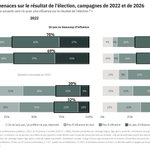
🟢 Selon notre sondage (n = 1 956), l'influence perçue de la désinformation des politiciens, de la couverture médiatique biaisée ou de la fraude électorale sur l'élection est demeurée stable par rapport à 2022, mais celle de l'ingérence étrangère a légèrement augmenté.

ALT Figure 5. Influence perçue de différentes menaces sur le résultat de l'élection.
🟢 La discussion sur l'intégrité électorale reste minimale et ne remet généralement pas en question l'intégrité du vote ou d'Élections Québec. Le discours porte notamment sur les perceptions d'ingérence fédérale ou étrangère et les problèmes d'accès introduits par la Loi 96.
🟢 Les 25 et 26 septembre, 803 publications sur l'intégrité électorale évoquaient surtout une possible ingérence américaine. Notre sondage ne montre toutefois pas de hausse de l'inquiétude face à l'ingérence étrangère après la couverture médiatique et les réactions politiques.

ALT Figure 2. Publications portant sur l'intégrité électorale, par catégorie (moyenne mobile sur trois jours). Les bandes indiquent les quatre principales vagues de publications.
Élections québécoises : l'intégrité électorale fait plus parler cette semaine, après qu'un article ait suggéré une possible ingérence américaine et avec le début du vote par anticipation. Notre 5e mise à jour examine comment les Québécois et les candidats abordent ces enjeux. 🧵

Facebook est la principale source d'info politique des Québécois. Mais sans les médias sur la plateforme, comment y discute-t-on de politique ? Cette semaine, on se penche sur l'information dans les groupes Facebook et sur les publicités à caractère social et politique. 🧵

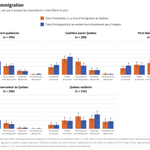
🟢 Sur notre radar : le site repéré la semaine dernière est encore plus cité par les IA conversationnelles. Aussi : plus de discussions sur l'immigration, des discours sur l'intégrité électorale et une déclaration d'Amnistie internationale Canada francophone sur le PQ.

Visitez notre site web pour en savoir plus : tinyurl.com/2s3fu86y
Merci à l'équipe : @MathieuLavigne3, Manon Paquet, @ZPehlivan, @mika_jpd, @jeremie_drouin, Fakhreddine Riahi, Gabrielle Turp, @AengusBridgman