

Research Analyst & Writer | DeFi • RWAs • Stablecoins • Onchain Analysis | @pendle_fi evangelist | @redstone_defi advocate
On-chain
Joined August 2022
- Tweets32.3K
- Following2.1K
- Followers7.5K
- Likes40.6K







Pinned Tweet
From August 2021 through 2023, blockchains captured 90%+ of monthly crypto revenue.
By mid-2026, that share dropped to 25%.
The new breakdown:
🔸 Finance apps: exceeded 50% in most months
🔸 Consumer apps: steady meaningful share
🔸 Blockchains: down to ~25%
🔸 Physical and crypto infrastructure: rounding errors
The economic center of crypto moved from the base layer to the apps running on it.
Early cycles were infrastructure-focused because infrastructure was the only place value could accrue.
Users paid L1 gas fees because there was nowhere else for the money to go. Ethereum's high fees, Solana's spikes, Bitcoin's security budget drove revenue.
As blockchains became cheaper, more scalable, and more reliable, apps could finally support real users and capture their own revenue streams.
Finance apps (perp DEXs, lending protocols, stablecoin issuers, trading tools) earn fees from trading volume, not just gas.
Consumer apps (memecoin launchpads, wallets, social tools) turn engagement into sustained revenue as they find market fit.
The internet followed the same arc.
In the 1990s, ISPs and backbone providers made the money. By the 2010s, applications and platforms captured most of the value.
Crypto is following that path, faster and with full transparency because everything settles onchain.
You can't value L1s solely on the claim that they capture all fees anymore.
App-layer protocols have proven that lean teams can generate hundreds of millions in revenue across:
🔸 @HyperliquidX -style derivatives platforms
🔸 @Pumpfun -style consumer platforms
🔸 The wider DeFi stack
These products now capture economic surplus that once flowed almost entirely to validators and miners.
That diversification is healthy. Crypto no longer depends on one revenue source or one narrative.
The infra succeeded, which is why its revenue share fell. Finance and consumer apps now generate the majority.
That's where the next decade of value compounds.
h/t: @Blockworks

Mesh retweeted

NEW: RedStone's data infrastructure is now live on @Filecoin.
First up is a FIL/USD push feed on mainnet, giving smart contracts on the Filecoin Virtual Machine an onchain dollar price for FIL, updated on every 0.5% move and at least every four hours.

Mesh retweeted

$33.6B in deposits, $13.2B in active loans and 11 new markets launched in Q3 alone
@aave’s expansion is starting to reflect a much broader ambition, where the protocol is becoming credit infrastructure for financial products that already have their own users and distribution
looking through @Token_Logic’s Q3 report, I think the progress across V4 gives that direction a lot more weight
EtherFi Cash is a good example, with its dedicated V4 instance reaching $311.5M in deposits, showing how Aave can provide the credit infrastructure underneath financial products that already have their own distribution
And the same approach is expanding across other markets
➥ Arc is building liquidity around Circle’s stablecoin ecosystem
➥ Base is extending Aave credit into tokenized equities
➥ Monad is adding more stablecoin and yield bearing collateral markets
V4's hub and spoke architecture is becoming increasingly useful as @aave expands into different credit markets
Each integration can support its own collateral configurations and borrowing use cases while drawing on shared liquidity infrastructure, giving Aave more flexibility to serve different financial products
And as more institutions, consumer products and tokenized assets integrate with Aave, its growth becomes increasingly tied to the financial activity those integrations bring.
@aave is gradually becoming the credit infrastructure other financial products can build around


Mesh retweeted
Uniswap v4 hooks are quietly becoming one of the most interesting shifts in onchain markets.
@BlockworksData data shows it’s real volume now: hooked pools were ~1.5% of v4 spot volume at the start of summer, then ~40% by September.
In dollars, that’s from well under $1B to roughly $14B/month.
What I like most is the shape of it. Total v4 volume dipped in July and August, but hooked volume still climbed every month.
And imo that looks more like sticky usage than a one-month spike.
Three things are driving it:
🔸 @Uniswap own hooks, built for LP returns. StablePair adjusts fees for assets that should trade near a fixed rate. VolatilePair (now live on ETH/USDC) sets separate buy and sell fees based on recent price moves, so LPs keep more of the value they provide instead of leaking it to informed flow.
🔸 Launchpad + community hooks, built for fee capture and specialized markets, w/ @ponsdotfamily -style platforms as the obvious examples.
🔸 Independent builders putting hooks at the center of what they ship, so the AMM works as a flexible primitive, not a fixed product.
Zoom out and the real story is expressivity: the pool becomes the programmable venue.
That means more efficient markets for pairs that already exist and over time room for new categories of assets.
Tbh we’re still early and the surface area has barely been scratched. But you’ve got official, launchpad, and independent builders all shipping on the same primitive.
To me that already says hooks are a core building block.
Permissioned pools are the next test. Hooks can enforce issuer-controlled allowlists right at the protocol level, w/ teams like Superstate and Securitize building in that direction.
So more real-world + regulated value can come onchain while settlement stays on v4.
If regulated assets settle on v4 through hooks the pool can act as the compliance layer too.


going down an autistic rabbit hole tonight on hooks (courtesy of @Blockworks data)
but it's interesting to see how volume from hooked pools has remained incredibly durable, despite onchain cooling off
from ~1.5% of all v4 volume at the start of the summer to ~40% as of today

Uniswap v4 hooks are quietly becoming one of the most interesting shifts in onchain markets.
@BlockworksData data shows it’s real volume now: hooked pools were ~1.5% of v4 spot volume at the start of summer, then ~40% by September.
In dollars, that’s from well under $1B to roughly $14B/month.
What I like most is the shape of it. Total v4 volume dipped in July and August, but hooked volume still climbed every month.
And imo that looks more like sticky usage than a one-month spike.
Three things are driving it:
🔸 @Uniswap own hooks, built for LP returns. StablePair adjusts fees for assets that should trade near a fixed rate. VolatilePair (now live on ETH/USDC) sets separate buy and sell fees based on recent price moves, so LPs keep more of the value they provide instead of leaking it to informed flow.
🔸 Launchpad + community hooks, built for fee capture and specialized markets, w/ @ponsdotfamily -style platforms as the obvious examples.
🔸 Independent builders putting hooks at the center of what they ship, so the AMM works as a flexible primitive, not a fixed product.
Zoom out and the real story is expressivity: the pool becomes the programmable venue.
That means more efficient markets for pairs that already exist and over time room for new categories of assets.
Tbh we’re still early and the surface area has barely been scratched. But you’ve got official, launchpad, and independent builders all shipping on the same primitive.
To me that already says hooks are a core building block.
Permissioned pools are the next test. Hooks can enforce issuer-controlled allowlists right at the protocol level, w/ teams like Superstate and Securitize building in that direction.
So more real-world + regulated value can come onchain while settlement stays on v4.
If regulated assets settle on v4 through hooks the pool can act as the compliance layer too.
going down an autistic rabbit hole tonight on hooks (courtesy of @Blockworks data)
but it's interesting to see how volume from hooked pools has remained incredibly durable, despite onchain cooling off
from ~1.5% of all v4 volume at the start of the summer to ~40% as of today
Mesh retweeted
Aero's expansion across seven EVM chains is a pretty significant step for a protocol that has already built a strong liquidity base on Base
With ethereum, arbitrum, optimism, Robinhood Chain and others joining the network, @aeroxyz is now extending that liquidity infrastructure across a much wider market
And I think the ambition here goes beyond simply being a multichain DEX
One of the persistent problems with DeFi liquidity is how fragmented it becomes as more assets and chains enter the market. projects often need to bootstrap separate pools across different networks, tying up more capital just to maintain reasonable trading depth
Aero is trying to improve that through crosschain routing, where liquidity sitting in deeper pools can serve trading demand from other connected chains.
The Slipstream V3 upgrade adds another economic layer through adaptive fees and MEV capture, designed to redirect more trading value toward LPs and AERO stakers
So there are two things developing together:
🔸 More efficient access to liquidity across chains, potentially reducing the need to duplicate capital in separate pools
🔸 Better fee capture around the liquidity already deployed, especially during periods of high trading demand
Imo this becomes particularly relevant as stablecoins, tokenized stocks and other RWAs keep expanding across EVM networks
Those assets need reliable secondary liquidity, and a shared routing network could make it easier for issuers to reach deeper markets without rebuilding liquidity from scratch on every chain
The real test will be how much trading flow @aeroxyz can attract through that routing infrastructure and how effectively the new fee design translates into sustainable returns for liquidity providers
Because getting liquidity onto seven chains is one achievement. making that liquidity more capital-efficient and economically productive across all seven is a much larger opportunity

Mesh retweeted
Aerodrome Slipstream has established itself as the clear liquidity hub for tokenized equities on Base.
It's processing $1.9 billion of the $2.3 billion in total DEX trading volume for these assets over the past 90 days, roughly 83% market share.
That's inside a category up 2,652% versus the prior period.
Honestly, it makes sense once you look at how the product works.
🔸 Coinbase's equities went live on Base on Aug 24, with day-one pools on @aeroxyz
🔸 Each token is backed by shares held in custody and issued natively on Base under the B20 standard
🔸 Eligible holders outside the US can trade 24/7, weekends and market holidays included, from a self-custody wallet
Stocks that trade around the clock need a venue that's always liquid too. Slipstream's concentrated liquidity lets LPs pick their price ranges
so a modest amount of funded inventory can handle a lot of flow
Uniswap V4 ($195.4M) and a few other venues add real volume, but Aerodrome carries most of it.
Here's how that volume turns into protocol economics:
→ equity trading volume → swap fees → veAERO voters
→ AERO emissions → LPs, who earn mostly this way
Composability is the next layer, and it's already showing up:
→ @aave accepts 7 of these equities (AAPLc, AMZNc, GOOGLc, METAc, MSFTc, NVDAc, TSLAc) as collateral for USDC borrowing
→ Base's asset directory now lists 10 symbols, up from 4 at launch
→ more tickers means more pairs for Slipstream to deepen
Base wanted proof that real assets can live onchain and stay liquid.
One venue, 83% of the volume, and a lineup that grew from 4 to 10 symbols in two months is a pretty direct answer imo.
h/t @tokenterminal
Mesh retweeted
I think one of the areas Hyperliquid still has a lot of room to develop is how larger traders access liquidity without giving away too much of their position before execution
Deep order books are useful, but moving $1M+ in size introduces a different set of challenges.
splitting orders, managing slippage and having the market react before the full position is filled can make execution expensive.
And this is where @silhouette_ex comes into the picture
The RFQ model allows traders to get competing quotes on their full order size before committing to a trade, with the agreed price acting as an execution limit.
For HyperCore perps, the structure is especially useful because the order still goes through Hyperliquid's existing book, allowing traders to benefit from better available prices while retaining the protection of their agreed quote.
Imo this has broader implications for how institutional-sized flow develops on @HyperliquidX
Hyperliquid already has the trading infra, liquidity and margin engine. so adding a dedicated block execution layer gives funds, market makers and trading desks another way to access that liquidity without having to work large orders manually
And with Silhouette already supporting tokenized stocks on HyperEVM, the same RFQ approach can serve different asset classes as the ecosystem expands
The opportunity here is in making existing liquidity more accessible to participants who trade size, which could help hyperliquid accommodate a broader range of financial activity over time
🤝 Paid partnership

Perps RFQ is now live on HyperCore.
Request a quote, accept it, and the trade prints on the @HyperliquidX order book.
- BTC and HYPE to start, HIP-3 markets next
- Up to $100k per quote, higher caps coming
Which market should we add? UX feedback welcome too.
Size finds size. 🖤
I think one of the areas Hyperliquid still has a lot of room to develop is how larger traders access liquidity without giving away too much of their position before execution
Deep order books are useful, but moving $1M+ in size introduces a different set of challenges.
splitting orders, managing slippage and having the market react before the full position is filled can make execution expensive.
And this is where @silhouette_ex comes into the picture
The RFQ model allows traders to get competing quotes on their full order size before committing to a trade, with the agreed price acting as an execution limit.
For HyperCore perps, the structure is especially useful because the order still goes through Hyperliquid's existing book, allowing traders to benefit from better available prices while retaining the protection of their agreed quote.
Imo this has broader implications for how institutional-sized flow develops on @HyperliquidX
Hyperliquid already has the trading infra, liquidity and margin engine. so adding a dedicated block execution layer gives funds, market makers and trading desks another way to access that liquidity without having to work large orders manually
And with Silhouette already supporting tokenized stocks on HyperEVM, the same RFQ approach can serve different asset classes as the ecosystem expands
The opportunity here is in making existing liquidity more accessible to participants who trade size, which could help hyperliquid accommodate a broader range of financial activity over time
🤝 Paid partnership
Perps RFQ is now live on HyperCore.
Request a quote, accept it, and the trade prints on the @HyperliquidX order book.
- BTC and HYPE to start, HIP-3 markets next
- Up to $100k per quote, higher caps coming
Which market should we add? UX feedback welcome too.
Size finds size. 🖤
Mesh retweeted
The shift to onchain trading is slowly coming together, and spot is the latest place it appears.
DEX spot volume just reached ~25% of CEX spot volume in September 2026, up from roughly 18% a year earlier.
On a broader tracker, September was roughly $279B of DEX spot volume against $1.13T on CEXs. The ratio rose even as CEX spot volume grew 27% month over month.
The chart shows how it played out:
🔸 Sep 2025 to Jun 2026: the ratio sat in a tight ~17% to 19% band
🔸 Jul 2026: jumped higher
🔸 Aug 2026: kept climbing
🔸 Sep 2026: printed ~25%
On this chart, three straight months of higher readings after a full year in a range looks like the first sustained breakout, imo.
The more telling number is in RWA perps, where onchain is already the default venue.
By August 2026, 86% of tracked real-world asset perp volume was trading onchain. A year earlier that category barely existed at scale, and onchain venues handled about a third or less of it. So the onchain share went from roughly a third to 86% in twelve months.
What pulled activity over:
🔸 @HyperliquidX 's infrastructure upgrades
🔸 Better oracle pricing
🔸 Equities, commodities and indices tradable 24/7 with self-custody
The infrastructure gap between onchain and centralized venues has narrowed sharply.
On spot, the drivers are familiar but now compounding:
➢ Aggregators and routers improved execution
➢ Chains got faster and cheaper
➢ Market makers are more willing to provide liquidity onchain
➢ New tokens and tokenized assets list permissionlessly in minutes instead of weeks
➢ Self-custody matters for a real slice of volume, especially outside the largest pairs
Spot and RWA perps are moving at different speeds, in the same direction.
If the ratio holds or expands as overall spot volumes keep growing, the structural case gets a lot stronger.
The next test, imo, is whether onchain venues keep capturing new flow in core crypto pairs, beyond new tokens and tokenized assets. If they do, the gap between "CEX for size" and "DEX for everything else" keeps closing.
h/t @TheBlockCo , @DefiLlama , @a16zcrypto for the data

Mesh retweeted

You want yields? Points? Giga-brain farming strats?
A place where both yield and points farmooors can enjoy the treat!
It's time for Yield Collective No. 60
Bring your wallet, let’s eat 👇

The shift to onchain trading is slowly coming together, and spot is the latest place it appears.
DEX spot volume just reached ~25% of CEX spot volume in September 2026, up from roughly 18% a year earlier.
On a broader tracker, September was roughly $279B of DEX spot volume against $1.13T on CEXs. The ratio rose even as CEX spot volume grew 27% month over month.
The chart shows how it played out:
🔸 Sep 2025 to Jun 2026: the ratio sat in a tight ~17% to 19% band
🔸 Jul 2026: jumped higher
🔸 Aug 2026: kept climbing
🔸 Sep 2026: printed ~25%
On this chart, three straight months of higher readings after a full year in a range looks like the first sustained breakout, imo.
The more telling number is in RWA perps, where onchain is already the default venue.
By August 2026, 86% of tracked real-world asset perp volume was trading onchain. A year earlier that category barely existed at scale, and onchain venues handled about a third or less of it. So the onchain share went from roughly a third to 86% in twelve months.
What pulled activity over:
🔸 @HyperliquidX 's infrastructure upgrades
🔸 Better oracle pricing
🔸 Equities, commodities and indices tradable 24/7 with self-custody
The infrastructure gap between onchain and centralized venues has narrowed sharply.
On spot, the drivers are familiar but now compounding:
➢ Aggregators and routers improved execution
➢ Chains got faster and cheaper
➢ Market makers are more willing to provide liquidity onchain
➢ New tokens and tokenized assets list permissionlessly in minutes instead of weeks
➢ Self-custody matters for a real slice of volume, especially outside the largest pairs
Spot and RWA perps are moving at different speeds, in the same direction.
If the ratio holds or expands as overall spot volumes keep growing, the structural case gets a lot stronger.
The next test, imo, is whether onchain venues keep capturing new flow in core crypto pairs, beyond new tokens and tokenized assets. If they do, the gap between "CEX for size" and "DEX for everything else" keeps closing.
h/t @TheBlockCo , @DefiLlama , @a16zcrypto for the data
Mesh retweeted
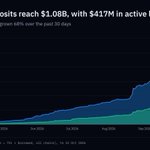
Aave V4 deposits hit $1.08B with $417M in active loans, up 68% over the past 30 days, and utilization sits around 39%.
The curve has steepened since September, and I think the reason is the design, since hub-and-spoke lets specialized markets spin up without fragmenting core liquidity.
🔸 @arc (Circle's chain): $294.2M of deposits, 26.7% of core V4
🔸 @ether_fi Cash on Optimism: $340.8M of deposits and $42.0M of loans, running as its own market
🔸 @base with tokenized stocks: $14.3M of deposits, live since 25 September
→ Each is a partner-shaped hub with its own users and collateral, drawing on the same shared liquidity, with Arc as the largest contributor inside the $1.08B, Etherfi adding a large market alongside it, and Base small today but strategically notable for bringing tokenized stocks onto Aave.
For context V4 is still only ~3-4% of total Aave deposits while V3 remains the ~$30B workhorse, which makes these early-stage traction numbers.
The more useful read is that V4 is proving Aave can expand into new chains, assets and use cases without rebuilding the core.
Etherfi is the clearest example of a new use case, since it brings real-world card spending onto Aave while the DAO keeps a revenue share, which makes distribution part of the product.
Utilization in the high 30s is healthy for a growing protocol.
What stands out to me is that borrowing has kept up with the inflows, w/ loans up 63.3% against deposits up 66.5% from 15 September to 15 October.
And Etherfi Cash loans up 27.3% against deposits up 14.7% over the same window, which says the new capital is finding real lending demand.
Imo the modular setup is doing what it was designed to do, and the next few months will show how utilization and revenue build on top of a growing deposit base.
Mesh retweeted
We’ve gone past the phase where putting an asset onchain is enough to make the RWA thesis interesting
Issuance has proven that treasuries, private credit and funds can live onchain. The work now is making those assets usable once they get there, and building markets that can support borrowing, leverage and redemptions without treating every RWA like a liquid crypto token
Listening to @MarcinRedStone on the @Cointelegraph stream, this is where @redstone_defi position in the stack becomes clearer
A tokenized T-bill sitting in a wallet is representation. Getting a lending protocol comfortable enough to accept it as collateral brings pricing, liquidity, redemption windows and collateral parameters into the equation
And different RWAs create different constraints:
🔸 MMFs yielding ~4.5% are difficult to loop when borrowing costs sit closer to 5%. The asset is onchain, but the economics limit its use as collateral.
🔸 Private credit yielding 11–12% can support that loop, but 180-day to one-year redemption periods create a tenor mismatch. That’s part of the problem redstone is addressing through Settle
🔸 New markets also need reliable pricing before deep liquidity exists. @entropyIO on hyperliquid is pricing pre-IPO exposure like Anthropic and OpenAI using RedStone feeds
As collateral gets thinner, the risk framework has to tighten too. Supply caps, circuit breakers and parameters need to reflect the actual liquidity and exit conditions of the asset
So imo the next RWA phase looks closer to:
legal clarity → tokenize → price → add the function → manage risk → scale
Imo that also explains where redstone fits. It isn't the issuer or the money market. It sits between the asset and the protocols trying to use it, providing the pricing and risk infrastructure that allows a T-bill, private credit position or another less-liquid asset to become collateral a protocol can actually manage
And this distinction will matter more as institutional issuance scales
The RWA decade probably won't be decided by how many tickers make it onchain.
It'll be decided by how much financial activity those assets can support once they get there


What’s Next for Crypto Infrastructure in 2026? [Ft. RedStone founder] #CHAINREACTION xitter.cf/i/broadcasts/1yKAPwbov…

Mesh retweeted

Tokenized stocks hit a record of about $3.3B (@RWA_xyz, 12 Oct).
But a “tokenized stock” can mean very different things. For @redstone_defi’s new tokenized stocks report, we mapped the issuers behind the market.
Same stock exposure, six legal instruments, six risk profiles.

ALT A single $AAPL ticker branching into six instrument types: tracker certificate, structured note, certificate, 1:1 dShare, debt security and registered share. Only the registered share is highlighted.

Mesh retweeted
WETH deposits on @aave V4 keep growing while utilization remains high at 90%
since mid-July, deposits have moved from roughly $25M to over $100M, with the market still absorbing most of that added supply
WETH remains the dominant collateral backing stablecoin debt on the ethereum Core V4 market, so the growth here is doing more than simply increasing deposits
New supply is mostly filling existing credit capacity, not creating an equally large expansion in borrowing.
That creates a useful dynamic for the market
More WETH keeps strengthening the collateral base and giving borrowers additional room, while high utilization shows that a meaningful share of the liquidity already available is still being put to work
So V4 is effectively building a deeper WETH balance sheet first, with the borrow side having more capacity to expand from there
h/t: @Token_Logic for data

Mesh retweeted
L2s competing on cheaper transactions is one thing, but the more interesting race is where actual financial activity is starting to concentrate
Open interest adds another dimension to that growth. it measures the value of derivatives positions that remain open, giving us an idea of how much trading exposure is being maintained across these markets
$LIT currently leads the L2 open interest chart at roughly $69M, ahead of Arbitrum at around $59M in the past 30d
For @Lighter_xyz, that represents a growing base of active derivatives exposure, with traders maintaining positions on the venue and contributing to the broader demand for onchain trading infrastructure
We're already seeing networks compete for stablecoin liquidity, transaction activity and fees, while derivatives markets are creating another source of demand for onchain execution.
→ stablecoin supply provides liquidity
→ OI reflects outstanding derivatives exposure
→ fees and sequencer revenue show how activity translates into economics
Imo this is how the L2 opportunity starts expanding beyond transaction throughput
As trading venues continue developing, more financial activity can take place directly on L2 infrastructure, with liquidity, leverage and execution all contributing to the economics of the ecosystem
And sustained open interest alongside growing fees and trading volume would provide further evidence of that demand


L2s are leading sector performance over the last 30 days, ahead of AI, Gaming, DeFi, L1s and Memes.
The spark was STRK. On 7 Oct @EliBenSasson floated Starknet becoming an L1 for post-quantum agility.
It's an idea under discussion, with 2027 as his estimate for full quantum resistance if Starknet controls its own migration.
STRK is up 228% over 30 days.
What's underneath, last 30 days:
🔸 @Starknet daily transactions: +189%
🔸 Starknet DeFi TVL: +6.4%, daily fees +21%
🔸 @base DeFi TVL: +12.4%, stablecoin supply $5.07B
🔸 @arbitrum One: $4.70B stablecoin supply, daily active addresses +3.4%, $682.6K sequencer profit
🔸 @Optimism stablecoin supply: +33.3%
🔸 @zksync Era daily active addresses: +38.8%
The economics got easier too. All L2s together paid Ethereum $83.6K in 30 days to settle, and Base's median fee is $0.0016 vs $0.0261 on Ethereum.
Base alone made $3.18M in sequencer profit over the same period.
Token value capture is also moving beyond pure governance:
➢ OP: 50% of Superchain revenue goes to monthly OP buybacks
➢ ZK: Fee Flow auctions, with the launch setting burning 100% of acquired ZK
➢ LINEA: dual burn on ETH and LINEA
➢ STRK: staking yield of about 7-8% for delegators and validators, paid in newly minted STRK
And the institutional side is showing up onchain.
BlackRock's BUIDL sits on OP Mainnet ($26.5M) and Arbitrum ($8.6M), and Robinhood Chain, built on Arbitrum tech, reportedly reached about $1.05B in TVL.
imo the interesting part is where the money is going. It's moving to the L2s with distribution, real settlement revenue and a clearer path from usage to the token.
I'm watching fees and stablecoin supply against price from here. If both keep climbing, the setup looks solid.
h/t: @velo_xyz
