
Stanford Neurobiology and Bioengineering Precision molecular design / synbiochem. Also @michaelzlin
Greenberg → Tsien →
Joined July 2022
- Tweets1.8K
- Following213
- Followers2.7K
- Likes987




Prof. Michael Lin retweeted
Public preview of BioEmu2! @MSFTResearch AI for Science’s new foundation model for biomolecular structure, dynamics and function. Open weights, MIT license.
github.com/microsoft/bioemu2
Movie: BioEmu2-simulated binding of intrinsically disordered peptide PUMA to MCL-1 receptor. 🧵⬇️
Prof. Michael Lin retweeted

I’m so sick of reviewers using ChatGPT to review papers. It’s atrocious having to respond to the same garbage from all 3 reviewers where each comment requests 5 new analyses. Just don’t agree to review papers if it’s too much work 🤷♂️
Even if you used AI to review my paper- at least ensure the asks are genuine and then choose the most pertinent/relevant comments to include in your review? Is that too much work?
I’m sure journal editors recognize that this is a real problem but can’t do much to rectify this issue.
Prof. Michael Lin retweeted

Interesting. If I understood this correctly, TIME once again turns out to be the critical measurement axis that unlocks this mystery.

1/ We discovered something totally unexpected about the neural structure of consciousness that overturns decades of thinking on its biological basis and brings us significantly closer to the recipe for generating conscious awareness.
New preprint: biorxiv.org/content/10.64898… (led by @HesseJanis, with @FrankLanfranchi, @_conor_mcgrory, @Yuelin_Shi, and @EngelTatiana)

Prof. Michael Lin retweeted

Want to get clean calcium signals from tons of deep-brain neurons in freely moving animals?
Check our paper science.org/doi/10.1126/scia… !
We show how correcting GRIN lens aberrations transforms MINI2P performance, revealing sparse HD coding in sensory thalamus!
@ScienceAdvances

Prof. Michael Lin retweeted

Autism cannot be reduced to a simple excitation/inhibition imbalance. Inhibition is not one dial: PV, SST and VIP interneurons regulate different compartments, timescales and network states. A circuit can appear globally “balanced” yet remain computationally disorganized.

Prof. Michael Lin retweeted

In 1952, Alan Hodgkin and Andrew Huxley developed a mathematical model describing how neurons generate electrical impulses.
Using the giant axon of a squid, they studied how sodium (Na⁺) and potassium (K⁺) currents influence the electrical activity of nerve cells.

Prof. Michael Lin retweeted

Institute Director Kang Shen shares congratulations to Karl Deisseroth for his recent Nobel Prize. Karl shares that he started out with an interest in developmental neuroscience and is excited to see the frontiers of the field today.

Prof. Michael Lin retweeted

Our new paper in @NatureNeuro!
Psilocybin remodels synapses differently in healthy and stressed brains, promoting new connections and limiting stress-induced loss.
We also identify distinct mechanisms for plasticity and hallucination-like behavior. #Zuolab
rdcu.be/LwdavdKQQJwa
Prof. Michael Lin retweeted

Our paper is out in Nature, congrats to Qiyu, An et al!
By stimulating ~20 motor cortex neurons carefully selected based on their activity, we could induce learned population activity and, sometimes, the movement itself, depending on the brain's state.
nature.com/articles/s41586-0…

Prof. Michael Lin retweeted

Here's a cool new drug that just dosed its first patient in China.
It targets the cancer antigen, B7-H3, and 'desialylates' - removes surface sialic acids that suppress immune responses. In experiments, this activates tumor killing, mainly by NK cells and macrophages.
The trial is in China, run by Shanghai Henlius - the tech itself originated from the US biotech, Palleon Pharma.
This desialylation mechanism is independent of PD1: in other words, a potentially new cancer immunotherapy.


By my count, China has cleared 160 novel drugs for first-in-human clinical trials this year — so far.
One of them is a potential treatment for sepsis, a condition associated with ~20% of all deaths globally.
The drug, made by Pyrotech Therapeutics, is the first to enter the clinic that blocks formation of the gasdermin D pore (that triggers pyroptosis - inflammatory cell death - in sepsis).
That’s just one of many — we looked at all of them here: breakingground.substack.com/…

Prof. Michael Lin retweeted

The pope recapitulating one of the tenents of modern neuroscience "Intelligence must draw on memory" 🤯

Intelligence must draw on memory. The mind must not simply compile data — as an algorithm now does more quickly than we can — but recall lived experiences, which contain depths of meaning that only the human soul can recognize, and connect more deeply with the goodness of these experiences. Everything that is good begins “with the Spirit” and thus possesses a breath, a dynamism and a sense of communion that, once experienced, are engraved upon the heart. vatican.va/content/leo-xiv/e…
Prof. Michael Lin retweeted

I am pleased to be recognized by Princeton University for the Woodrow Wilson Award. A big year for @Princeton science/engineering alumnae, with Mary Brunkow getting the corresponding graduate award. I wonder if they feel sorry for us...it's not been fun for basic science these days. @caltech @CaltechCCE

The University will present its top awards for @princetonalumni to @francesarnold '79, 2018 Nobel laureate and engineering professor at @Caltech, and Mary Brunkow *91, 2025 Nobel laureate and distinguished investigator at the @isbsci in Seattle.
Arnold, who graduated from Princeton with a bachelor’s degree in mechanical and aerospace engineering, will receive the Woodrow Wilson Award. Brunkow, who earned a Ph.D. in molecular biology, will receive the James Madison Medal. These awards will be presented on Feb. 20, 2027 at Alumni Day: bit.ly/4yO9rXx

ALT The words: "Nobel laureates Frances Arnold '79 and Mary Brunkow *91 to receive Princeton’s top alumni awards" with photos of Frances and Mary
Prof. Michael Lin retweeted
This has been a wonderful collaboration with @GoogleDeepMind to make new-to-nature #enzymes. Great work from the whole team.

Introducing AlphaProtein Novo, a pipeline for de novo enzyme design! In collaboration with @francesarnold's group, we developed AP Novo and used it to get SoTA "novel-scaffold" activity on 2 benchmark reactions and create enzymes to synthesize the pharmaceutical motif piperidine and degrade the environmental toxin DEHP.
Work led by @ZvxyWu @ZiqiLi0513 with teammates @alexechu_ @kelly_ruijie @schulluc @jacobjinkelly @rosaliags @davidla @solserpens @j_reisenbauer, @pengliu_group, Josh, Thomas, Amy, Tristan, Harshnira, and others. It was a joy and privilege to work with you all!
Preprints and code:
biorxiv.org/content/10.64898…
biorxiv.org/content/10.64898…
github.com/google-deepmind/a…
Prof. Michael Lin retweeted

Harvard’s FAS is launching 25 tenure-track faculty searches, FAS Dean Hopi Hoekstra announced, loosening a hiring freeze instituted last spring as the school draws an influx of philanthropic support.
@abbysgerstein and @amannmahajan report.
thecrimson.com/article/2026/…
Prof. Michael Lin retweeted

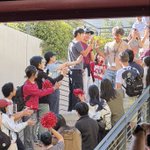
Thanks to everyone sharing in this moment!
I’m so grateful to my trainees & collaborators…
dlab.stanford.edu/group-memb…
(pic: optogenetics conference chairs, Tuscany)
Reading for all those asking:
for technical details: dlab.stanford.edu
for everyone: deisseroth.org/projections

Prof. Michael Lin retweeted

Many in this field had begun to wonder if the Nobel committee would ever call
go.nature.com/4eek4ui

Prof. Michael Lin retweeted

“There is a big picture that brings it all into relief and my hope is that we can increase empathy and understanding,” says 2026 medicine laureate Karl Deisseroth.
As a medical student, Deisseroth completed part of his training at a psychiatric clinic. He was struck by the patients’ suffering and their need for help. At the same time, he began to wonder how the brain could function so differently from one person to another.
Deisseroth was awarded this year's medicine prize, together with Peter Hegemann and Georg Nagel, for discoveries leading to optogenetics – a biological technique making it possible to switch the activity of individual nerve cells in a living brain on or off.
Optogenetics is now helping us understand more about how nerve cells shape memories, emotions and behaviour in the living brain.
Learn more about the 2026 medicine prize: bit.ly/4ru82ml

ALT Karl Deisseroth in a white shirt sits at a table, thoughtfully holding a model of a brain in one hand. Photo by Christopher Michel.
Prof. Michael Lin retweeted

Congratulations @KarlDeisseroth!!! I think all of us in systems neuro have been rooting for you to get this call for a long time coming (the one and only time my lab ever had a jclub on a Saturday was to catch up with all the jaw-dropping papers coming out of your lab).
You revolutionized our field, making it possible to probe this tangle of cells that is us in an entirely new way. I believe the most profound consequences of what you unlocked have yet to be written.

Congratulations to our first #NobelPrize laureate of 2026 🎉
Early this morning Karl Deisseroth found out he was awarded this year's Nobel Prize in Physiology or Medicine.
He seems very happy with the news!

ALT Karl Deisseroth on the phone looking happy
Prof. Michael Lin retweeted

Adding a watermark to protein or DNA is super easy. That's never been a serious problem.
The bigger issue: it's super easy to now remove a watermark with tools like proteinmpnn.
Prof. Michael Lin retweeted

Assistant Professor of Bioengineering and of Neurosurgery Paul Nuyujukian is advancing research on brain disorders and the potential of neurotechnology to improve lives. Read more about his work and what it could mean for the future of care.
Learn more: news.stanford.edu/stories/20…
