

Mostly intelligible rambles.
NY
Joined May 2022
- Tweets15.5K
- Following563
- Followers7K
- Likes64.4K
Pinned Tweet
Article’s out! Memoirs and travelogues as genres should be revived, so as my own contribution, I wanted to write on my recent travels and my discovery of «home»—here’s the outcome. LMK what y’all think. traversingtradition.com/2025…

Why wouldn’t it be?
Part of it arises due to treating AI companies with suspicion, and rightfully so. Contrary to having done anything at all to earn the trust of the masses, they’ve repeatedly acted in ways to reduce it further in an era of already low institutional trust.
The question of entry-level jobs hasn’t been answered at all either, and given the pace at which AI is improving and being adopted across the board, it’s evident that the graduation-to-job pipeline likewise causes one to raise an eyebrow.
Schools have degraded in the value they can offer and will degrade further in the near future. The quality of students keeps decreasing. Professors of the previous generation who held knowledge aren’t getting any younger and clearly, there’s no replacement.
The next generation will be post-literate because of parenting practices and growing up in a world that increasingly incentivizes over-relying on LLMs.
The pleasures and necessities of academia, in terms of knowledge-building and knowledge-sharing, are gradually being dismissed as power veers towards satisfying corporate interests. OpenAI’s tackling of the major math problems are relevant here, but the effects it’ll have are obvious.
And the part about human nature can never be emphasized enough. One wishes to employ his creative agency and see the fruits of his labor, or at least exert himself and learn throughout the process even if the fruits themselves aren’t satisfactory. This is dismissed from the very beginning.

Part of it owes to the racialization of Muslims—in the Middle Ages, Islam was equivalent to being Arab and then, with the Ottomans, being a Turk. With Mamdani, the factor is competence and media training, so other avenues for insults are ignored. Vivek is the case of the classic Indian-American—born to immigrants, never got rid of his inferiority complex, and allied with the worst of the right-wing even after, on live TV, he was insulted for his color. He never retorted.

Advocated heavily for a war against an already ruined country to an indecisive idiot, only to make that country a regional power, destroy all allies in the region, accelerate the collapse of America’s order and the economy within and make citizens suffer. Well done.

Nafi‘ retweeted

How can we make lovable cities? If you had asked a European architect this question in 1900, they would probably have referred you to a slender, lively book by the Austrian writer Camillo Sitte, translated as ‘The Art of Building Cities’. Published in 1889, ‘The Art of Building Cities’ swiftly came to be revered around the world.
worksinprogress.co/issue/the…
Sitte was repudiated by the modernists and fell into obscurity, but his ideas are beginning to be revived. My cousin @PMArslanagic and I have distilled nineteenth century's finest work on urbanism into five principles:
- Create enclosed spaces
- Keep squares small
- Symmetry is overrated
- Move monuments to the edges of spaces
- Nestle monuments in vernacular fabric


The world’s always been like this. The New Atheist movement intended to cull the “group in the middle,” given that both the elites and the lowest stratum have always been inclined towards religion or cultism—for good or evil. That momentary illusion faded as the world is once again headed towards an ideological distinction with Islam as the counter-culture, as the technocratic elite defines the culture with Trump’s cult of personality. “Glad tidings for the strangers.”


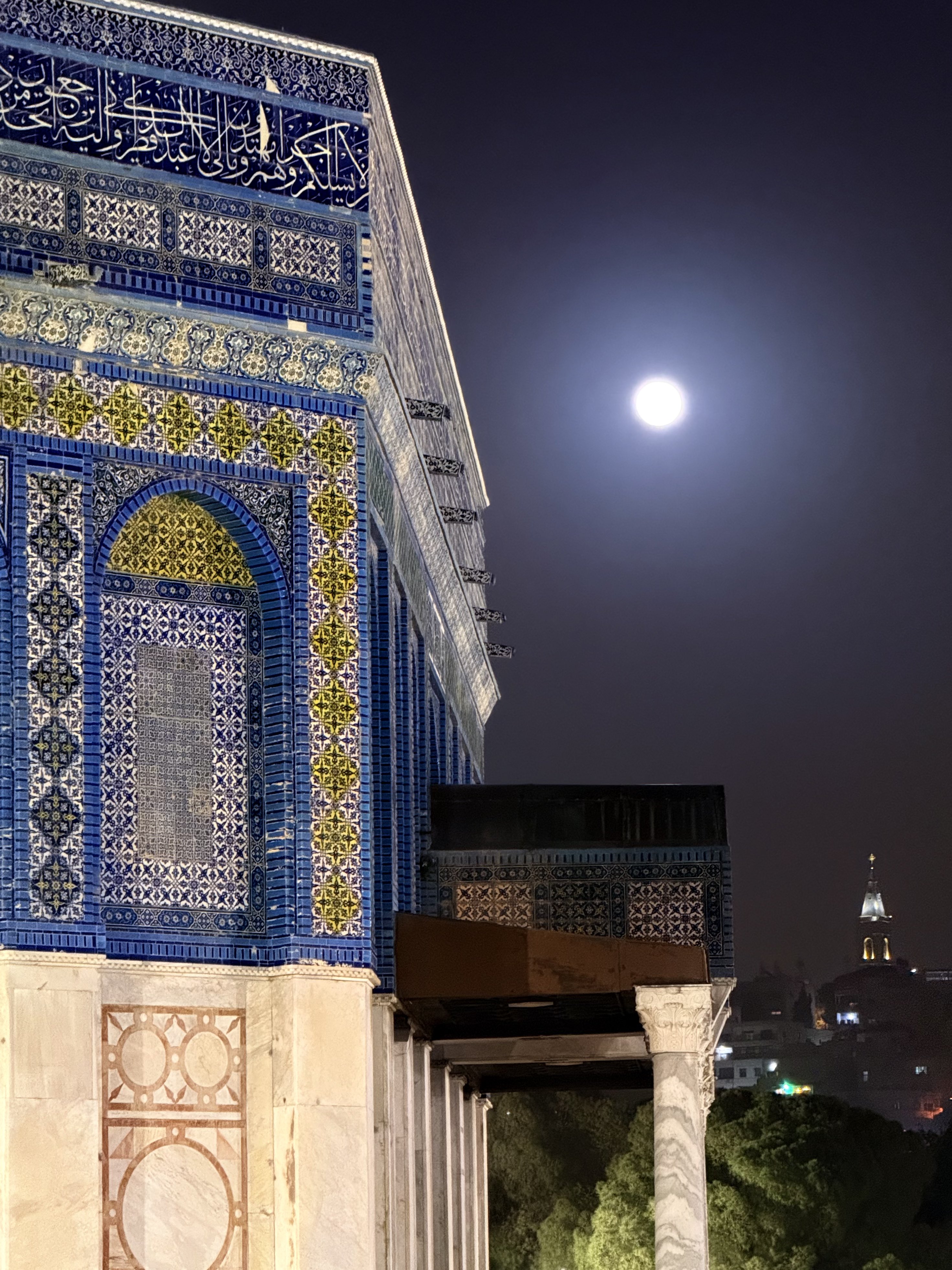
Happens often at spiritual sites. I remember during my first time at the Haram, after praying Maghrib in the courtyard, I stared up to see the full moon next to the minaret—it was ethereal. This year, I’d slightly wished to see the same so as to have a feeling of the years coming in “full circle”—and this I was to receive in my visit to the Aqsa. It’s beautiful how even the smallest of prayers are never ignored.


Nafi‘ retweeted

Watching Al Jazeera’s documentary on Mohammed Deif has reopened emotional wounds that I genuinely do not believe will ever fully heal, not for as long as I live.
I don't think it has fully registered with many just how much this Ummah has endured and lost. Perhaps some will come to understand the magnitude of those losses with time, while others may never understand at all. As Allah says:
“…it is not the eyes that are blind, but it is the hearts in the chests that grow blind.” (Qur’an 22:46)
And amid all this grief, I cannot help but feel an immense sense of pride and gratitude for having grown up in an Ummah whose history is filled with people of extraordinary faith, conviction, and perseverance: people like Abdelhamid Ibn Badis, Amadou Bamba, Mahmud Hasan Deobandi, and Izz Al-Din Al-Qassam, whose lives remind us that a person's time in this dunya is temporary, but the good they leave behind can endure for generations.
Their chapters in this dunya may have come to an end, but the principles they lived by, the sacrifices they made, and the message they devoted their lives to remain, and at the heart of that message is a conviction that should never be lost: that our purpose is to live for the sake of Allah, to remain steadfast upon His guidance, and to seek His pleasure above all else.
And while the loss of great men from our Ummah will always be a source of tremendous sadness and grief, I refuse to allow that grief to overshadow something far greater: the certainty that Allah is greater than every loss we endure, greater than every hardship we face, and greater than every power that believes itself beyond His reach.
It is Allah who grants honor to whomever He wills and strips it from whomever He wills. It is He who raises whomever He wills and humbles whomever He wills. And ultimately, it is to Him that we all return, and before Him that we will all stand.
The better question to ask is what tells you that someone is an idiot who’s read a lot. CS Lewis writes correctly that the medieval man was bookish, because by nature he was a systematizer and sought proper places for what he found. But this was also because books were the primary compendia of knowledge (far more so than they are today) so there was no choice. The authors’ biases would naturally be absorbed by later researchers without due questioning into their correctness. The case is the same now, with many who read having turned the act into book-worship. Read, but read well.

Nafi‘ retweeted

The problem with Divine Command Theory is that it presents an image of God as a kind of Demiurgic figure, who is totally unintelligible and unknowable, and He can contradict his own attributes because whatever He does is moral, and morality is whatever He does. Circular logic


Nafi‘ retweeted
Power is entirely in the hands of the technocratic elite. We’ll see a Palantir-OpenAI-Anthropic-NVIDIA coalition with the gov’t—the rule of these few upon a population that has lost what it means to be human.
They have no attention spans, no inclination to write in a world where writing is done by machines, no inclination towards art or what touches the soul—after all, models can generate art instantly anyway—on top of it all, they’ll have transcended the need to think (why think when the answer lies a click away)?
We live in an age of abundance and we’re walking towards further abundance—but ironically, the more we have in our hands, the more meaningless it all becomes. These models will become even more powerful, and whilst now one can make the argument that you need to have an idea as to what you want and implement fixes along the way to generate proper results, this is not to survive for long. ChatGPT might’ve been a funny bot in 2022 when it was released, but these 4 years have come with exponential growth in the AI field, and its hold is only to increase, with the oligarchy having an even stronger hold.
Even by the most optimistic perceptions, nothing lies ahead save for the worst dystopia one can conceive.
Saladin’s hospital in Cairo (as described by Ibn Jubayr) did this—a courtyard graced with greenery and running water, with the structure’s architecture itself being sprawling and palatial. The Almohad Ya‘qub al-Mansur followed suit. The idea was that beauty itself healed.


We’re already in an AGI era. In the coming years, human incapacity will get worse, and the next generation is clearly hopeless. I’m serious when I say that the best investment for humanity will be in monasteries in the mountains, away from urban uncivilization.

Power is entirely in the hands of the technocratic elite. We’ll see a Palantir-OpenAI-Anthropic-NVIDIA coalition with the gov’t—the rule of these few upon a population that has lost what it means to be human.
They have no attention spans, no inclination to write in a world where writing is done by machines, no inclination towards art or what touches the soul—after all, models can generate art instantly anyway—on top of it all, they’ll have transcended the need to think (why think when the answer lies a click away)?
We live in an age of abundance and we’re walking towards further abundance—but ironically, the more we have in our hands, the more meaningless it all becomes. These models will become even more powerful, and whilst now one can make the argument that you need to have an idea as to what you want and implement fixes along the way to generate proper results, this is not to survive for long. ChatGPT might’ve been a funny bot in 2022 when it was released, but these 4 years have come with exponential growth in the AI field, and its hold is only to increase, with the oligarchy having an even stronger hold.
Even by the most optimistic perceptions, nothing lies ahead save for the worst dystopia one can conceive.


