

Your brand's news section on autopilot.
Spain
Joined March 2022
- Tweets17.9K
- Following343
- Followers25.8K
- Likes16.8K






Pinned Tweet
What is NewsRank.io?
A fully managed automated newsroom that runs on your website and publishes fresh market news 24/7. 🟢
It keeps your site current and creates more useful pages for search and AI discovery.

🔎 75.9% of ChatGPT’s most common site: searches targeted brand websites, according to @ahrefs .
When AI wants first-hand information, official domains often become the source.
That makes owned publishing much more interesting for brands.
🤖 Made with AI

👻 Ghost citations?
Around 40% of AI citations in Writesonic’s study didn’t name the source brand.
- Perplexity: 52%
- Google AI Mode: 49%
- AI Overviews: 41%
- ChatGPT: 37%
Citation count alone misses part of brand visibility.

🦥 Rankie published one news article this month and called it a newsroom.
Meanwhile, the market kept moving.
News doesn’t wait for an editorial calendar.

NP Digital asked 512 marketers to rate GEO tactics by impact and effort.
Content refreshes and technical fixes scored well for relatively low effort.
Original research, proprietary data and Digital PR scored higher on impact, but took more work.


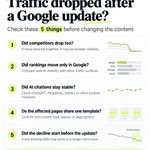
📉 Traffic dropped after a Google update?
Don’t rewrite pages immediately.
First check whether the problem is actually Google-specific, site-wide, or limited to one content pattern.


Google’s September 2026 spam update is rolling out globally across all languages, and Google says it may take up to two weeks to complete. That makes this a longer rollout than the previous three spam updates, which each finished in under three days.
Google hasn’t said what the update targets, so ranking changes during the rollout will be harder to attribute. Volatility was already visible around September 23–24, before Google announced the update.
For SEO, that means treating the next two weeks as a monitoring period rather than reacting to every ranking movement. Compare competitor performance, look for changes across your broader search visibility, and wait for Google to confirm the rollout is complete before drawing conclusions.
social.semrush.com/4AFvZLt.

Check the affected pages as a group.
Same template? Same page type? Same publishing period?
Clusters usually tell you more than inspecting one URL in isolation.
🇬🇪 NewsRank.io at Institutional Night in Georgia.
A strong mix of conversations across the W Group ecosystem, from fintech and crypto to media and other businesses.
Useful meetings, new contacts, and plenty to follow up on after the event.


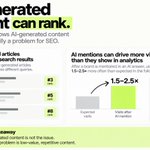
🤖 AI-generated content can rank.
Search Engine Land cites analysis showing fully AI-written pages in top results.
After an AI mention, visits were 1.5–2.5× higher than expected, while only ~2.5% showed trackable AI referral.
Low-value repetition is the bigger risk.


7 AI search myths #SEOs keep repeating, tested against real data.
👉 Most fall apart, from llms.txt to "AI is killing search."
Each myth, the claim, and what the data shows: searchengineland.com/seo-ai-…

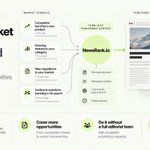
Most teams already spot useful market signals.
The bottleneck is turning them into content while they’re fresh.
NewsRank.io turns competitor moves, market shifts, regulations and AI queries into publishable content without a full editorial team on standby.

💡 46.8% say AI authority starts with the company’s own website
That makes static sites increasingly costly. AI need current, specific material: research, updates, commentary, data.
The more useful content lives on your domain, the more surface area you create for AI discovery.

⚡️This chart shows a sharp drop in visits to news sites.
What it doesn’t show is whether people are consuming less news, or just reaching it differently. Search, social, aggregators and AI products can all absorb part of that journey before a click ever happens 💡


👀 Google is pushing more of the search journey into AI Mode.
That makes fresh, specific content on your own domain more valuable, because AI systems need material to retrieve before they can cite or surface it.
A living newsroom gives them more to find.


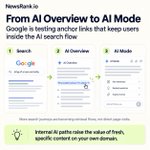
🆕 in AI Overviews answers Google is now testing showing anchor links which instead of taking to a webpage takes to AI Mode.
Another day - Another Tactic!
from Google to push users from usual search results to AI Mode #SEO
🔎 Fresh content has more value when retrieval systems can isolate the useful parts quickly.
Clear sections, direct facts and compact structure make that easier.
Metehan Yesilyurt’s analysis of Google Discovery Engine / Vertex AI Search gives a good look at why.


Google accidentally revealed how its AI search systems choose which sites to recommend and send traffic to.
Now that none of it is much of a secret anymore, let’s talk about it.
With the new Google Search rolling out as we speak, it has never been more important to understand how to maximize value from this marketing channel.
If you want to see where your site stands across Google, ChatGPT, Claude, Perplexity and broader AI search, you can do so for free here:
seo-stuff.com/free-audit
Let’s start from the beginning.
Metehan Yesilyurt, who previously went viral for his analysis of Perplexity’s ranking factors, recently broke down Google AI ranking factors in a fascinating blog post.
A lot of what he found also lines up with what SEO Stuff (seo-stuff.com) has been doing all year to get customers more traffic and sales.
Specifically with the done-for-you package:
seo-stuff.com/gold-plan-pack…
Basically, Google sells much of the underlying retrieval infrastructure through Google Cloud Discovery Engine, also called Vertex AI Search.
By analyzing what Discovery Engine exposes, Yesilyurt was able to show how Google’s AI retrieval and ranking stack works.
The seven major signals he identified were Base Ranking, Gecko embedding similarity, Jetstream cross-attention relevance, BM25 keyword matching, predicted click-through rate, freshness and Boost/Bury rules.
In simpler terms, Google is combining traditional ranking signals with semantic similarity, deeper contextual relevance, keyword matching, engagement predictions, recency and manual business logic.
Discovery Engine exposes a maximum chunk size of 500 tokens, roughly 375 words, while ancestor headings can travel with each chunk and tables, images and page layouts can all be parsed with Gemini-enhanced understanding.
That means important ideas need to make sense inside relatively small, clearly labeled sections.
If your content is one massive wall of text, Google has a much harder job extracting the exact information it needs.
This is also why I keep talking about question-based headings, direct answers, clear comparisons and structured pages.
Additionally, Discovery Engine shows Google processing structured data using separate Searchable, Indexable and Retrievable settings.
Those can affect whether information can be found, used for filtering or ordering and surfaced by the model. Mind you, they are independent.
So a field can potentially influence retrieval or ranking without necessarily being displayed in exactly the same way.
That gives us a pretty significant clue about why structured data continues to matter as Google becomes more AI-driven.
Discovery Engine also reveals a four-stage pipeline: Prepare, Retrieve, Signal and Serve.
Google first interprets the query, handles things like synonyms and intent, then retrieves and chunks relevant content, applies ranking signals and finally uses Gemini to generate the response with grounding and safety rules.
Traditional Search, AI Overviews and AI Mode can be thought of as different configurations built on much of the same underlying retrieval infrastructure.
So what does all of this mean for businesses?
You need to optimize for several layers at once.
Your content needs strong semantic alignment so Google clearly understands what the page is about, enough contextual detail to handle nuanced searches such as comparisons and “best for” queries, and clean chunk-level structure so useful answers can be extracted without digging through hundreds of words of filler.
That means clear definitions, direct answers, comparison language, question-based headings, concise sections, factual claims, TLDR summaries, clean HTML and useful tables where appropriate.
This is exactly why SEO Stuff content is structured the way it is.
The done-for-you package combines 10 long-form, search-focused articles with three DR50+ contextual backlinks:
seo-stuff.com/gold-plan-pack…
The content is designed around semantic relevance, keyword alignment, structured sections, comparisons, freshness and extractability, while the backlinks help strengthen the underlying authority of the pages and domain.
The Premium Content Bundle takes the same idea much further:
seo-stuff.com/premium-conten…
It includes 60 long-form articles designed to build broader category coverage, stronger semantic associations and more opportunities for Google to retrieve useful sections across the different questions customers ask.
Then there is the Premium Backlink Bundle:
seo-stuff.com/premium-backli…
It adds three contextual DR50+ backlinks designed to strengthen search authority and reinforce the company’s identity and category across the web.
And if you want to see where your site stands across Google, ChatGPT, Claude, Perplexity and broader AI search, you can do so for free here:
seo-stuff.com/free-audit


Stable rankings can hide a real traffic loss.
The reason may be sitting above your result: AI Overviews, Shopping, PAA, local packs and ads.
Comparing SERP layouts year over year is becoming essential for understanding what actually changed.


👀 Are you an ecommerce seeing important YOY drops in organic search traffic from your top performing non-branded queries/topics even if you haven't actually decreased in real positions? It's not you, it's Google! Just compare the SERPs from September 2025 vs the ones of 2026, and you'll see an insane increase of:
* AI Overviews
* Shopping packs (two or three times in many cases)
* People Also Ask
* Local Packs
... and that's not even going into more visibility to ads across many verticals!
In the first page of the SERP:
* A year ago we still had 7-8 organic search ranked pages vs 1-2 search features
* Now it's 4-5 organic search ranked pages vs 4-5 search features.
It's all about keeping engagement within the SERPs.
Welcome to Google's featurization era 😐 and say goobye to your traffic!

📊 Only 14% of marketers report strong blog results, while 92.4% already use AI for content.
One underused traffic layer sits outside the traditional blog model: fresh industry news and the search demand created around new events.

Content marketing hit a 12-year performance low.
AI use reached 92.4%, but showed no relationship with stronger results. The bigger issue: proven tactics are being used less.
Check the findings here: searchengineland.com/content…

Google is testing direct payments for publisher content used in AI Overviews, AI Mode, and Gemini.
-invite-only pilot
-AI Earnings Widget in Search Console
-pay-per-use model
-early payouts described as symbolic
Сompensation for content used in AI answers, not just traffic 💡

👀 Google Search Console can report an AI Overview citation as position #1 even when the link gets little actual attention.
Impressions can also be counted before the user sees the citation.
Barry Schwartz + John Mueller discussed the reporting logic.
Mapped below ↓


Google's John Mueller says the old "position 1 - 10" is hard to map for site owners seroundtable.com/google-posi…
