

Private investor, stockpicker, in search of the truth, asking questions (Currently $NOK robot trading in OMXH). Active on some financial forums under ruuki
Finland
Joined May 2021
- Tweets792
- Following278
- Followers154
- Likes868




ruuki retweeted

I’m actually referring to your 30,000 stock trades (more than all Members of Congress combined), your Qatari-gifted luxury jet, your crypto scams, your Truth Social pay to play scheme, your billionaire-funded ballroom, your insurrectionist slush fund, and your pardons for big donors—just to name a few.
Senate Democrats will ban stock trading for all Members of Congress and White House officials, and hold you and your administration accountable for all the ways your rampant corruption has made life more expensive for families.


Seen so many of these, how out of touch ppl are.. is it the algorithms, Fox news or just being thick?
#Democrats knocked out #Republicans

Have you checked in on your Democrat friends yet?
Now would be a good time.
No, don’t gloat in their faces.
Instead, show up with some beer and be willing to support them during this tough time in their lives.
Remember, we always listen and we never judge. At least not when they are in the room!
45
What.A.Plank🤣🤣🤣
😎

This is the easiest fucking money you could make. No, you morons. Texas is not flipping.
Readers added context they thought people might want to know
Texas flipped in the 2026 gubernatorial election: Democrat Gina Hinojosa defeated incumbent Republican Greg Abbott.
npr.org/2026/11/03/g-s…
usatoday.com/story/news/pol…
texastribune.org/2026/11/03/tex…
30
Example when you just watch FoxNews 🤦♂️🤣
Its basically RTR in Russia
This quoted post is unavailable.
28

Liking the 100-150b rerating figure, Innccoooooooomiiiiinnngg 🚀
$NOK

Considering the potential Marvell-Lumentum equity swap at a ~$115B valuation, $NOK’s intrinsic value comes into a completely new light.
Nokia’s 2024 announcement (completed 2025) to acquire Infinera for just $2.3B was an absolute steal — executed right before Wall Street realized the magnitude of the AI optical inflection. Today, acquiring that same vertical integration (including U.S.-based InP wafer fabs) would easily command $50B+. Paired with Nokia’s legacy Silicon Photonics and IP routing dominance, its data center optical stack is almost unmatchable. Nokia also has its Fixed Networks business, where it holds a dominant market-leading position (outside China).
Looking at current market multiples, Nokia’s fair enterprise value should realistically sit at $100B–$150B (a 2–3x re-rating from here) when comparing to others — and that is attributing more or less zero value to its Mobile Networks (MI) division.
Mobile Networks acts as a free call option on future distributed AI edge compute AI-RAN. Plus, Nokia’s patent portfolio alone prints >€1B in high-margin annual operating profit.
Maybe Wall Street will catch on once hyperscaler optical/IP contracts go public (IF) or as Nokia's earnings acceleration takes off post-2026 balance sheet cleanup. Hopefully patience will pay off.
#Investing #Optical #AIInfrastructure #Semiconductors $NOK $MRVL $LITE
16
1,761

I Will not watch #IIHF WCs due to warcriminals being allowed to participate and will boycott
#infrontsports
#Skoda
#NokianTyres
#Wurth
#AJProducts
#Aika
#Tissot
#TrueHockey
#SlavaUkraïni 🇺🇦
1
47
I Will not watch #IIHF WCs due to warcriminals being allowed to participate and will boycott
#infrontsports
#Skoda
#NokianTyres
#Wurth
#AJProducts
#Aika
#Tissot
#TrueHockey
#SlavaUkraïni 🇺🇦
KarjalaCup tai whatever johon kutsutaan Canada, pelatkoon venäjät ja United States of Russkija omat kisansa..

Venäjällä ei ole asiaa jääkiekon MM-kisoihin niin kauan kuin ukrainalaisten murhaaminen ja hyökkäyssota jatkuu.
– Jääkiekko on minulle rakas laji, mutta mikään MM-mitali ei ole tärkeämpi kuin ne arvot, joiden puolesta seisomme, sanoo @swheimo
sttinfo.fi/tiedote/72461278/…

28
Jealousy of what?! Being ruled by a moneygrabbing dictator with his pals whilst most are living in shit..

2
30


ruuki retweeted

Nokia and Nvidia’s Extreme Co-Design: From Two Separate Visions to One Drawing Board
To better understand how this alliance came about, I had to take a trip down memory lane. @PeterBr70324445 brought this to my attention. He told me that I needed to see the bigger picture and that this would be of immense value to anyone who has invested in Nokia or plans to.
To do so, I had to compare the strategic moves of both companies over the past 20 years.
While CEO @JensenHuang was building the compute side, successive CEOs at $NOK were forging the Interconnect and Edge. The result is that Nokia now finds itself at the heart of @nvidia GB300 ecosystem.
Part 1: The Simultaneous Timeline (2006–2026)
In this first part, I’ll discuss the parallel development of both companies, starting with @nokia and NVIDIA’s investments in a future that the stock markets didn’t yet understand at the time.
Phase 1 (2006–2013): Sowing Early to Be the First to Reap
NVIDIA: In 2006, Jensen Huang introduced CUDA—for those unfamiliar with it—a programming platform designed to harness the parallel computing power of a GPU for demanding general-purpose computing tasks.
He envisioned every graphics card becoming a supercomputer. The process cost billions, was slow, and analysts complained about margins for years. But the stubborn visionary Jensen Huang was already looking much further ahead as early as 2011! He spoke openly about expanding CUDA to mobile platforms and even the physical world.
NOKIA: At the same time, the mobile phone segment was taking a massive hit due to the rise of the smartphone. It was decided via Nokia Siemens Networks to focus on high-capacity mobile data infrastructure instead (4G/LTE).
The parallel: Both companies share the same long-term philosophy—building the fundamental architecture for a data-driven world…
Phase 2 (2014–2019): Suri’s Vision of the Programmable World
NOKIA: Rajeev Suri became Nokia’s new CEO in 2014. He decided to permanently shut down the phone division and presented his vision of a future where the physical world would be automated and connected through smart networks: The Programmable World. To make this a reality, Suri made his masterstroke in 2016: the acquisition of Alcatel-Lucent and, shortly thereafter, network analytics specialist Diepfield. With these moves, he secured the crown jewel: high-capacity IP routing (7750 SR), optical transport lines (1830 series), and Bell Labs.
NVIDIA: In 2016, Jensen Huang launched the first DGX AI supercomputer, followed by the acquisition of Mellanox in 2019. He realized that for thousands of GPUs to work together, the network is the bottleneck.
The Convergence: The visions of both CEOs begin to align. Huang focuses on internal connectivity, while Suri builds a network connecting data centers to the outside world.
Phase 3 (2020–2024): Building the Optical AI Stack
NVIDIA: The AI market explodes following the launch of the H100 and B200. Data centers are bursting at the seams and scaling from megawatts to gigawatts. The distances between GPUs become too great for copper cables, making optical data transmission and power consumption the new bottlenecks for AI scaling.
NOKIA: In 2020, Pekka Lundmark becomes the new CEO, and under his leadership, Nokia launches SR Linux (an open-source operating system for data center switches). He is also heavily investing in tactical 5G for defense. But it wasn’t until 2024 that he took the decisive step with the acquisition of Infinera. This gave Nokia ownership of ICE-D coherent optical technology and its own indium phosphide chip manufacturing capabilities.
The Convergence: To solve the problem of Nvidia’s gigawatt data centers, Nokia now has all the necessary building blocks:
- Alcatel routing
- SR Linux
- Deepfield
- Infinera optical
Phase 4 (2025–2026): Time to Reap the Rewards
NOKIA: In April 2025, after completing the Infinera acquisition, Justin Hotard took over from Lundmark. As the former head of Intel’s Data Center & AI Group and former HPC leader at HPE. It’s clear that Nokia brought him on to capitalize on the AI infrastructure built by Suri and Lundmark.
NVIDIA: Having already acquired a $1B equity stake in Nokia, Jensen introduces the term that sums up this twenty-year journey during the launch of the GB300 NVL72 and the 1GW Omniverse DSX AI Factory blueprint: “Extreme Co-Design.”
Part 2: Together at the Drawing Board—The 1 GW Blueprint
To find concrete evidence of the joint blueprint, we only need to look at the Zankore project—a joint venture between Nokia, NVIDIA, Ooredoo Group, and Indosat that was launched in August 2026. Zankore is building a 1GW NVIDIA DSX AI Factory in Southeast Asia.
The architecture: The facility runs on NVIDIA GB300 NVL72 systems combined with DSX MaxEPS/MaxLPS dynamic power management, which increases usable computing capacity per megawatt by up to 40%.
And now for Nokia’s role: The ONLY AI-native network partner within this reference design. Nokia provides THE ENTIRE PHYSICAL AND OPTICAL INTERCONNECT INFRASTRUCTURE, both in-house and with the external telecom network!
Led by Zankore CEO Ulf Ewaldsson (former CTO of rival Ericsson), this project serves as the standard blueprint for future 1GW AI Factories worldwide. This is the result of extreme co-design: Nokia and Nvidia design their hardware and network architecture together from the drawing board as a single system.
Part 3: The Technical Architecture Within the Data Center
Okay, this part is very technical, but necessary to understand Nokia’s value in this system.
1. Coherent Optical Efficiency (ICE-D + 1830 GX):
The challenge in transmitting data from a data center to the outside world is that short-distance signals (standard light) typically need to be converted into long-distance signals. This requires additional transponders that consume a lot of power and introduce latency.
The solution Nokia offers is to precisely tune the ICE-D optical components (Infinera) to the modulation formats and spectral profiles of its 1830GX Multi-rail line systems. The powerful laser (colored light) for long-distance transmission (ICE-D chip) has been miniaturized to the size of a USB flash drive and plugs directly into the switch or router. This enables IP-over-DWDM. DWDM (Dense Wavelength Division Multiplexing) is a technique in which dozens of different data streams are transmitted simultaneously over a single long-distance fiber-optic cable by assigning each its own color of light (wavelength). Data center switches now send data directly to the global fiber-optic network. This results in up to 50% less power consumption, more bandwidth at the network layer, and a faster connection.
2. Telemetry and Troubleshooting (SR Linux + Deepfield)
The problem here is that AI training models are susceptible to interruptions. During a checkpoint synchronization (interim saving of progress during training), a single faltering connection can shut down a cluster of 100,000 GPUs, which naturally leads to GPU idle time.
The solution: Nokia’s data center switches run on SR Linux. Combined with the Deepfield analytics engine, this provides real-time visibility from the individual GPU transceiver all the way to the long-haul fiber-optic cable (1830GX). If there’s a problem with a fiber-optic line kilometers away, internal switches immediately reroute traffic. This way, the GPU cluster doesn’t experience a timeout.
3. Zero-touch optical automation (1830GX + 7750 SR)
The problem: Manual configuration of large-scale networks is time-consuming when scaling up data centers.
The solution: The 7750 SR router platform and the 1830 GX optical system share a single central control plane. Once a router card is plugged in, the 1830 GX automatically detects it, sets the correct wavelengths, and optimizes power without human intervention. Deployment time drops from days to minutes.
Part 4: Closed Ecosystem & Mobile Integration
Total Stack Enclosure: Nvidia and Nokia jointly deliver pre-validated, software-defined computing pods that are ready for immediate deployment. No months-long integration processes for data center administrators.
Mobile Network as an Extension (Physical AI)
By integrating Nvidia’s CUDA architecture with Nokia’s mobile 5G and 6G radios (AI-RAN), the mobile network becomes a direct extension of the data center. External applications such as autonomous robots, vehicles, and defense systems are thus directly connected to the AI-Factory.
In this post, I’ve tried to objectively demonstrate that all the pieces of the puzzle have fallen into place, that this is no longer a distant dream, and that the seed for this was planted about 20 years ago….
K.C.
I closely track $NOK, 6G tech and the broader AI infra boom. Drop a follow to stay ahead of the curve!
This has potential for 2028+
$NOK

Nokia and @iceye_global announced today a partnership with the Ministry of Defence of Ukraine to develop sovereign satellite communications. Through this Letter of Intent we will explore how trusted, sovereign satellite communications can strengthen Ukraine's resilience and give it control over the connectivity it depends on.
Read more: nokia.ly/4BmEzim

1
9
656
ruuki retweeted
Hi guys,
After reviewing the figures from $NOK's Q3 earnings report and reading what the CEO @justinhotard said during the web call, I can draw two conclusions.
First, Nokia is indeed pivoting toward becoming an AI player.
I kept an eye on five key metrics:
- Direct AI & Cloud mix: 12.3%, so no longer in the 8% to 10% range
- Growth Engine: What used to be solely Optical (20%) has now become a duo thanks to the huge leap made by IP Networks (+43%)
- Network Infrastructure Margin: was 8%–10%; 13% was the minimum I wanted to see, but unfortunately, this wasn’t achieved: 10%. I’m not concerned about this, as the cause is actually positive—namely, ramp-up costs for new AI & Cloud products.
- Network Infrastructure Valuation Multiple: Although the 25%–30% growth in Optical/IP justifies an AI multiple, the markets had already priced in the AI story earlier this year. As a result, the market is already paying an EV/EBIT of 22.5x based on current (still depressed) profits, as mentioned in the point above.
- Implied NI Value: Network Infra is already being valued as an AI company, albeit based on the weak earnings of 2026. On the other hand, the market refuses to look further ahead to the increased earnings expected in 2027—yet that is where I believe the real increase in valuation lies.
But anyway, secondly, 2026 will have to be viewed as a restructuring year. I therefore assume that, due to the increase in restructuring costs, the timeframe in which this was anticipated will be shorter. It’s also beneficial to be able to claim the expenses in the 2026 tax year.
And oooooh yeah... I'm still bullish on $NOK :-)
K.C.
I closely track $NOK, 6G tech and the broader AI infra boom. Drop a follow to stay ahead of the curve!
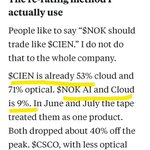
$NOK AI&Cloud is basically the size of $CIEN now, and growing fast(er?)
New SanJose InP fab (nr2) running 24/7 end of this month too, more growth incoming..
Nokia’s AI & Cloud segment delivered €631M in Q3 with +123% YoY growth!
With management forecasting 25–30% combined growth for IP & Optical in 2027 (even with traditional telco included), AI & Cloud is scaling at a triple-digit pace (in future as well).
Hyperscaler adoption is exploding - a huge growth engine for Nokia.


8
279
Very positive news $NOK
Add that to the extra 400m€ for working capital for inventory 💪😎

·Fab 2 in San Jose moving to 24/7 operations by end of October
·800G coherent pluggableshipments up 2.4x QoQ
·800GZR/ZR+ pluggable: designwins with 29 customers
·Major hyperscaler line system win
·Multi-rail: 3 design wins andachieved initial customerdeliveries
·Telco wins in edge/core routingaggregation and backhaul across US, Japan and Europe.


14
523
🚀

NOKIA $NOK Q3’26 EARNINGS HIGHLIGHTS
🔹 Net Sales: €5,154M (Est. €5.04B) 🟢; +10% YoY
🔹 Adj. EPS: €0.09 (Est. €0.06) 🟢; +50% YoY
🔹 Comparable Gross Margin: 44.6%; -20 bps YoY
🔹 Comparable Oper Profit: €605M (Est. €442M) 🟢
FY26 Guide:
🔹 Comparable Oper Profit: €2.1B-€2.6B
🔹 Network Infrastructure Growth: 12% to 14%
🔹 FCF Conversion: 35% to 55%
🔹 CapEx: €750M-€850M
Segment Net Sales:
🔹 Network Infrastructure: €2,158M; +17% YoY
🔹 Mobile Infrastructure: €2,902M; +5% YoY
🔹 Portfolio Businesses: €96M; -1% YoY
Other Q3 Metrics:
🔹 Comparable Oper Margin: 11.7%; +220 bps YoY
🔹 AI & Cloud Net Sales: +123% YoY; cc
🔹 Optical Networks: +18% YoY; cc
🔹 IP Networks: +43% YoY; cc
🔹 AI & Cloud Order Intake: €1.5B
🔹 Reported EPS: €0.03
🔹 Net Cash: €2,584M; -14% YoY
Key Updates:
🔹 Dividend per Share: €0.03
🔹 Infinera Integration: On track for completion by the end of 2026, one year ahead of plan
🔹 AI-RAN Call: Completed with T-Mobile and NVIDIA in a live operator network
Comments:
🔸 “In Q3, we grew net sales by 9% and improved comparable operating margin by 220 basis points.”

34