

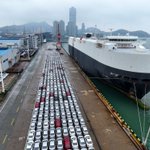





A total of 5,910 China-made vehicles were loaded onto a roll-on/roll-off vessel at Lianyungang Port in east China's Jiangsu Province on Sunday for shipment to Mexico.
Since opening on Sept. 30, 2021, the Lianyungang-Mexico ro-ro shipping route has expanded its cargo services, offering more shipping options for China's auto exports.


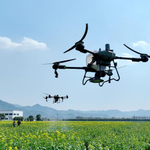
From the fields to the skies, technology is changing the way China farms.
China now has more than 300,000 agricultural drones — the largest fleet in the world — covering an annual operation area of over 460 million mu (about 30.7 million hectares).
Compared with manual farming methods, crop protection drones can boost operational efficiency by more than 20 times, cut water use by over 50%, and reduce pesticide application by 20% to 40%.
As China's low-altitude economy takes off, agricultural drones are becoming an increasingly common sight in the fields.


Need a hand? These robotic arms, developed in south China's Shenzhen, sort parcels along an assembly line swiftly and seamlessly.
Outdoor sports fuel a new consumption boom in China
More and more people are heading outdoors to enjoy sports among mountains, lakes and seas. The steady rise in outdoor activity is also giving the consumer market a fresh boost.
The 2026 China Outdoor Sports Industry Conference was recently held in Beijing. According to a report released at the event, more than 500 million Chinese people took part in outdoor sports by the end of 2025, and related industries were worth about 3.17 trillion yuan (about $475 billion) in total.
The report shows that by the end of 2025, China had 182,000 fitness trails stretching 430,300 kilometers, and 2,626 snow and ice sports venues. As of September 2025, the country had 970 commercial climbing gyms.
Read full: en.people.cn/n3/2026/1027/c9…


From China's only national nature reserve located in the heart of a city to green buildings, waste-to-energy plant and everyday products, Shenzhen in south China is stepping up efforts to protect nature and promote zero-carbon development.


Egyptian engineer builds 'Chinese-made' prefab homes in Saudi Arabia
On the outskirts of Riyadh, Saudi Arabia, rows of "made-in-China" modular buildings are rising from the desert, creating a striking new landscape.
The development is the Sedra Project, led by China Harbour Engineering Company. As one of Riyadh's flagship housing initiatives, it forms an important part of Saudi Vision 2030 plan to improve living standards.
Sedra is being built using fully prefabricated construction. To support the project, China Harbour established Saudi Arabia's largest and most comprehensive smart factory for prefabricated building components. The facility uses digital systems and coordinated workflows to produce components quickly and efficiently.
Egyptian engineer Ahmed Ghanem joined the project in 2023 as a senior structural engineer. He explained that prefabricated construction works differently from traditional building methods: structures are divided into components that are manufactured in a factory, then transported to the site and assembled.
Ahmed said using prefabricated components could significantly accelerate construction, reducing the project timeline from five years to three without compromising quality.
The approach turns building into something closer to assembling large-scale building blocks. Beyond speeding up construction, it also supports Saudi Arabia's push toward energy-efficient, greener buildings. The growing international presence of "China Construction" draws on China's enormous domestic market and complete industrial system, along with the country's recent advances in industrialized, digital, and intelligent construction methods.
While working on Sedra, Ahmed led improvements to several critical technical areas, including foundations and upper prefabricated structures. According to his colleague Xu Chengguang, the project's technical manager, Ahmed successfully improved the foundation design, offering structural reliability and boosted construction efficiency by roughly 43 percent, helping keep the project on track.
Ahmed said he regards the project as his home. His colleagues come from many different countries, which has given everyone the chance to learn about other cultures and exchange ideas.
Wu Yuansheng, general manager of China Harbour's Sedra Project, says the team is steadily building local capability through on-the-job experience, technical mentoring, and skills development. So far, the project has trained 117 foreign technical specialists and 46 project management professionals.
Reflecting on his impressions of China, Ahmed said he had previously viewed it as a vast country undergoing rapid development. His experience working with China Harbour has reinforced that impression, demonstrating to him that both China and "China Construction" are continuing to advance.
China's old-age dependency ratio surpassed its child dependency ratio for the first time in 2025, reaching 23.1%, compared with 22% for children, according to the China Statistical Yearbook 2026 compiled and published by the National Bureau of Statistics.
It marked a significant demographic turning point that poses new challenges for elderly care while creating opportunities for the silver economy.


Yangguang Island at Yangkou Port in Rudong, east China’s Jiangsu Province, is emerging as an offshore energy hub as its liquefied natural gas industry expands. The island has received nearly 75 million tonnes of imported LNG and supplied more than 100 billion cubic meters of natural gas to date. Its annual LNG receiving capacity is expected to exceed 20 million tonnes once projects under construction are completed.


In recent years, Lutai economic development zone in Tangshan City, north China's Hebei Province, has continuously promoted the upgrading of its bicycle industry. Local manufacturers are encouraged to expand their operation from mere production of components to development and production of ready-for-use bicycles. There are 55 of such manufacturers in this district, covering production of bicycles, bicycle parts, and motors for electric two-wheelers.


The future is here | An Italian unlocks futuristic daily life in Shenzhen
Driverless taxis, food delivered from the sky, and robots serving meals in restaurants. Scenes straight out of a sci-fi movie have become part of everyday life in Shenzhen, south China's Guangdong Province. These emerging smart experiences are not just showcases of technological progress; they are gradually weaving themselves into people's everyday lives.
Curious to see how technology is shaping the city, an Italian sets off to explore it. A string of vivid futuristic encounters keeps reshaping his understanding of Shenzhen. Here, sci-fi imagination is no longer confined to the screen.
China will extend anti-dumping and anti-subsidy duties on imports of n-Propanol (NPA) from the United States for a further five years starting Friday, the commerce ministry said Thursday.
NPA is an industrial chemical used mainly as a solvent and as an intermediate in chemical manufacturing.
Under the extended measures, anti-dumping duties range from 254.4 percent to 267.4 percent, while the anti-subsidy duties range from 34.2 percent to 37.7 percent, according to two ministry notices.
The decision follows two expiry reviews covering separate anti-dumping and anti-subsidy measures. The ministry found that dumping and subsidisation involving U.S. NPA imports could continue or recur if the duties were lifted, potentially causing damage to China's domestic industry to persist or recur.
China first imposed the duties in November 2020 for a five-year period. It launched expiry reviews in November 2025 at the request of domestic producers.

In recent years, Fengnan District in Tangshan, north China's Hebei Province, has prioritized the development of distinctive agricultural products as a key engine for local rural revitalization.
By promoting collaboration among agricultural cooperatives, planting bases and local households, Fengnan has vigorously optimized its specialty agriculture and implemented standardized management. These efforts have boosted agricultural efficiency here as well as increased farmers' incomes.


China is highly concerned about the European Union's (EU) new rule of imposing a 2-euro handling fee on low-value imports as of Nov. 1, following a 3-euro customs duty introduced in July this year, the Ministry of Commerce said on Thursday.
Ministry spokesperson Huang Ling noted at a regular press conference that cross-border e-commerce, as a new business form and model of international trade, provides diversified choices for global enterprises and consumers.
China hopes the EU will assess the impact of relevant policies in a prudent manner and create favorable conditions for China-EU cooperation in e-commerce and other fields, Huang said.

Are AI-generated short dramas a waste of computing power?
Recently, a set of figures on the share of token consumption by large artificial intelligence (AI) models has drawn considerable public attention in China. According to the figures, short dramas and video generation account for 55 percent of domestic token consumption, e-commerce and marketing 24 percent, and software development only 15 percent. Some have contrasted this with the claim that "58 percent of US tokens go to writing code and enterprise automation," giving rise to the catchy narrative that "China uses computing power to chase entertaining short dramas, while the US uses it to build the future."
Set against the current international discourse surrounding China-US competition in AI, the comparison is certainly attention-grabbing. Yet it does not withstand even the most basic fact-checking or scrutiny. The claim that "AI short dramas and video generation account for 55 percent" originated from an industry assessment, which circulates online and is contained in the investor-relations records of a listed company that is itself heavily invested in AI-generated short dramas. It is not a comprehensive calculation based on any authoritative statistical framework. Doubao has also recently clarified that the computing-power figures are "somewhat unreliable" and that, at ByteDance itself, only about 10 percent of the company's total compute is used for training and inference of video-generation models. As for the claim that "58 percent of the US token go to writing code," no authoritative source for the figure can be found at all.
Tokens are units used to measure and bill AI model usage, reflecting workload and computing consumption. They are neither a measure of productivity nor an equivalent of GDP, and therefore cannot be used directly to gauge the value of a country's AI industry. Meanwhile, video generation is a computationally intensive use case, while code generation is relatively low in token intensity but highly efficient. Comparing the two simply on the basis of token consumption is therefore methodologically unsound.
Read full: en.people.cn/n3/2026/1028/c9…


The future is here | Unlock smart book borrowing at Shenzhen Library in Guangdong, South China
When technology is applied to cultural environments, the ordinary act of borrowing books breaks free from traditional models and becomes far more efficient and convenient. The North Hall of Shenzhen Library in south China's Guangdong Province stands as a vivid example of China's digital practices in urban public cultural services.
Visitors can search the library's collections via on-site smart screens and submit book retrieval requests through a mini-program. The intelligent system fetches books from the underground automated stacks and transports them to the collection outlet via overhead rail trolleys to complete one-stop self-service borrowing.
Andrew Smith from the U.S. tried the entire borrowing process on site and got a close-up look at the convenience of smart book lending. Featuring full self-service, unattended operation and fast book retrieval, the once time-consuming and laborious process of searching for and borrowing books has been streamlined by technology into a smooth experience, transforming the daily reading experience for local residents.
From Abu Dhabi to Hainan: An Emirati's dream to see the 'sister port'
Arriving at Khalifa Port in Abu Dhabi, capital of the United Arab Emirates, a modern container terminal comes into view. Tens of thousands of containers are neatly stacked on the terminal, forming vast, colorful arrays.
Not far offshore, ocean-going cargo ships shuttle back and forth, sailing in an orderly manner to all corners of the world. This terminal is a flagship Belt and Road project jointly operated by COSCO SHIPPING Ports Limited and Abu Dhabi Port Authority.
Amidst this bustling yet orderly scene, Reem Mohammed Alhosani has been diligently working for nearly three years. During an interview with People's Daily Online, the Emirati local introduced that her job duties are accounting, payment processing, and supplier coordination, adding that she was initially attracted to join COSCO SHIPPING by its international work environment.
Prior to joining the Chinese company, Alhosani's original impression of China and the Chinese people mostly came from her university studies, where she learned that Chinese people are "disciplined and result-oriented." However, after working closely with her Chinese colleagues day in and day out, her perception underwent a profound shift.
According to Alhosani, her Chinese colleagues are not only serious and efficient at work but also consistently sincere and kind. "They gave me guidance and kindness, and they welcomed me with open arms, and made me feel as comfortable as I am, which showed me how valued I was."
What Alhosani cherishes even more is the multi-cultural atmosphere. "I enjoy working in multi-cultural environments, because every time I learn new perspectives, and it makes me become more adaptable," she said.
In April 2024, with the official launch of the direct shipping route between Yangpu Port in south China's Hainan Province and Khalifa Port, the two "sister ports" across the seas achieved an even closer connection. This has also sparked a yearning in Alhosani's heart.
"Many friends around me have described the beauty of China to me, but seeing is believing," Alhosani said with a smile, expressing her hope to visit Hainan one day and travel to more cities in China.
Xiong'an New Area advances high-quality development alongside effective governance
Above ground, expansive green spaces blend seamlessly with modern architecture. Beneath the surface, a network spanning more than 100 kilometers links underground utility corridors that deliver water, electricity, gas, heating, and communications.
In the cloud, a digital city is taking shape alongside the physical one, while the Xiong'an Urban Computing Center keeps watch over the entire city. A "city of the future" is steadily taking shape in the Xiong'an New Area, north China's Hebei province.
Rejecting sprawling, haphazard urban expansion, Xiong'an has adopted a different approach, with planning preceding construction, underground infrastructure built before above-ground development, and trees planted before the city takes shape. Modern governance has been integrated into every stage of urban development.
Read full: en.people.cn/n3/2026/1029/c9…


Together for greater progress in poverty reduction
Eradicating poverty has long been a shared aspiration of humanity and remains one of the most formidable challenges to global development. Learning from poverty reduction efforts, building international consensus, deepening practical multilateral cooperation, and advancing the global fight against poverty are shared missions and responsibilities of the international community.
As the world's largest developing country, China struggled with poverty for a long time. To tackle this global challenge, China rolled out the poverty alleviation campaign unmatched in human history in scale, intensity, and number of people benefiting, achieving a remarkable milestone in human development.
After eight years of sustained effort, China lifted nearly 100 million rural residents out of absolute poverty, achieving the poverty reduction target of the UN 2030 Agenda for Sustainable Development 10 years ahead of schedule.
Since the launch of reform and opening-up more than four decades ago, China has lifted over 800 million people out of poverty, accounting for more than 70 percent of the global total over the same period.
Read full: en.people.cn/n3/2026/1027/c9…


Meet my new badminton buddy...it's a robot!
Ever imagined playing badminton with a robot? At this year's The Light of Internet Expo at the World Internet Conference Wuzhen Summit, I met a brand-new robot badminton buddy! Come check out the coolest gadgets on display!
