

Husband. Father. Writer of words. Champion of Narrative Medicine and Medical Director of Palliative Care at UPMC Mercy. All posts and thoughts are my own.
Pittsburgh
Joined August 2014
- Tweets691
- Following363
- Followers392
- Likes681







Pinned Tweet
One of the hardest, and easiest, things I've ever written.

New Blog Post: Moments Matter #70 - Two Weeks
momentsmattermd.com
#MedEd #MedTwitter #Palliative #HPM #Communication

I've become a BIG fan of @NEJM Voices - it's a relatively new offering, but there are some brilliant opinion pieces from some great leaders in medicine.
Check it out if you haven't already 👇
voices.nejm.org/
#medicine #healthcare #MedicalStudents #healthsector #wellness #medicalhumanities
“I feel like I’m put together from a bunch of smaller pieces,” a patient once told me. And it made sense: medicine's great at breaking things down into smaller pieces, at analyzing the fragments of a whole. A cardiologist focuses on the heart, a nephrologist on the kidney, and so on. Someone could easily open their chart and view the pieces spread out across a dozen or more appointments and medications and lab tests and scans.
We do this well, the deconstruction of humanity. We’re also great at leaving people in pieces, at handing them a bag of all those fragments and saying “Ok, now make sense of this. Now put yourself back together.” As if the puzzle of modern life wasn’t hard enough to solve on its own.
Much of what I do in palliative care is try to make sense of the pieces, try to help put them back together into some semblance of a whole. The new picture is never the same as the old, but hopefully there’s enough there that makes sense and is recognizable and comforting in its own way and unique.
Practicing medicine reminds me a lot of Cubism. Jean Metzinger (1883 - 1956) was one of the leading artists in both the Cubism and Crystal-Cubism movements, and perhaps Cubism’s pre-eminent theoretical scholar. Having grown from deep Neo-Impressionistic roots, Metzinger expanded his early interest in Divisionism into the geometric construct of Cubism in the early 1900s. Together with Albert Gleizes, Metzinger published the first major treatise on this new art form titled 𝘋𝘶 "𝘊𝘶𝘣𝘪𝘴𝘮𝘦" in 1912, which was endorsed by perhaps the most famous Cubism painter of all time, Pablo Picasso.
Aside from the concept of fragments forming a whole that was so characteristic of Cubism, Metzinger and Gleizes challenged the sense of traditional perspective in painting by coining the concept of “mobile perspective.” This concept is perhaps best represented by Metzinger’s painting 𝘓𝘢 𝘍𝘦𝘮𝘮𝘦 à 𝘭'É𝘷𝘦𝘯𝘵𝘢𝘪𝘭 (Woman with a Fan) completed in 1913 and housed in the Art Institute of Chicago. It depicts a woman composed of slices from different spatial and temporal perspectives spanning her entire life. The painting transforms from a static representation of a woman with a fan into a composite of her entire lived experience.
Now, whenever I meet my patients for the first time, I think of Cubism and the concept of mobile perspective. I explore how they’re feeling, whether they feel whole or put together from a bunch of smaller pieces or somewhere in between. And I remind myself that perspective is often mobile in the face of illness - that my patients may feel like they’re transitioning between phases of life, versions of themselves in constant motion, the past mixing with the present mixing with the future.
Sometimes my role is to help find meaning or a better way of putting the pieces together. Other times, my role is to just sit there and bear witness to the awe and beauty and mystery that is a life in flux.

It’s impossible to know if there’s something more - something deeper - unless you ask. An experience from the past that changed everything. A conversation that altered all things to come. We all have such stories, and whether or not we choose to share is our choice alone. But to know that someone cares enough to ask - or, rather, recognizes the importance of our humanism and our narrative - can make a world of difference. It can turn a question into a conversation that alters all things to come.
Meindert Hobbema (1638 - 1709) was a Dutch painter of intricate woodland landscapes who achieved almost no recognition during his lifetime (or even the lifetime that followed his lifetime). Hobbema studied with renowned master painter Jacob van Ruisdael, and together they represented the last of the Golden Age Dutch landscape painters. He was, in fact, a very productive painter until life happened. He married Eeltje Vinck in 1668 at the age of 30, and they had 5 children in quick succession. Around the same time, he was hired as a tax assessor and collector for the local wine trade, which occupied much of his time. His painting productivity, and quality, dipped (with a few late exceptions). He died a pauper in Amsterdam in 1709.
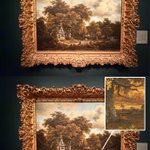
His most famous painting, 𝘛𝘩𝘦 𝘈𝘷𝘦𝘯𝘶𝘦 𝘢𝘵 𝘔𝘪𝘥𝘥𝘦𝘭𝘩𝘢𝘳𝘯𝘪𝘴, hangs in the National Gallery in London. It’s stunning and had a strong influence on later artists like van Gogh and Pissarro. But his painting 𝘙𝘰𝘢𝘥 𝘪𝘯 𝘵𝘩𝘦 𝘞𝘰𝘰𝘥𝘴 intrigued me more. Painted sometime in the 1670s, it hangs in the @nelson_atkins in Kansas City, hugged by an elaborate Louis XV era replica frame.
The first time I visited, I walked by without a second glance: deeply, and darkly, wooded paintings strike me as oddly sinister in tone, perhaps a lingering impact of The Brothers Grimm. More recently, however, I paused, and took a deeper look. The detail is fascinating, and as with similar landscape paintings (consider 𝘓𝘢𝘯𝘥𝘴𝘤𝘢𝘱𝘦 𝘸𝘪𝘵𝘩 𝘵𝘩𝘦 𝘍𝘢𝘭𝘭 𝘰𝘧 𝘐𝘤𝘢𝘳𝘶𝘴 by Pieter Bruegel the Elder), I was drawn to the pop of red on the person in the foreground.
But then my eyes drifted, as the clouds above drifted, and I discovered the shadowy outline of a figure in the distance, trapped between jagged branches and the curve of the road in the woods. Trapped in a mysterious, alternate universe - a different dimension of oil on canvas.
“What’s his story?” I wondered, zooming in with my phone. For a moment I doubted my own eyes. “Maybe it’s just a branch, or a bit of this strange shrub…” but no - see, there’s clearly an arm!
And I wondered how this person might feel, knowing he’s but a faint smudge in a beautiful landscape - a quick flick of the brush as he quietly waves for help or fights off a swarm of hornets or dances alone in the middle of the road.

But the mornings are often the hardest, I can tell. Begging the broken body to bend. Rising and facing a day that could only possibly bring more discomfort, more uncertainty, more bad news. Minutes that fold into longer minutes, hours that blend into hours that blend into the horizon.
French naturalist painter Jules Breton (1827 - 1906) was an expert at capturing moments in time. Unlike his contemporary van Gogh, Breton achieved remarkable fame during his lifetime for his idyllic paintings of the French countryside and peasant life. His later paintings were often heavily romanticized and symbolic, often with the rising or setting sun featured prominently on the canvas.
The Song of the Lark (1884), perhaps his most recognized painting, hangs in the permanent collection of the Art Institute of Chicago. Gifted to the museum by the Henry Field Estate in 1916, the painting depicts the moment a peasant girl hears a lark singing in the distance and stands - mesmerized - from her work. The rising sun is at her back, and her face is painted with the flush of awe and wonder. Willa Cather’s 1915 book “The Song of the Lark” takes its title, first edition cover design, and a key plot element from the painting, and the work was selected as “America’s Best Loved Picture” at the 1934 Chicago World’s Fair and unveiled as the winner by First Lady Eleanor Roosevelt. The painting has continued to captivate viewers ever since: in fact, Bill Murray once mentioned how the painting gave him hope at a low point early in his career.
Whenever I see this painting in person, it’s as if I’m seeing it for the first time: I am, for a moment, the peasant girl rising from her work, speechless and mesmerized. I come away with something new every time - the power of awe and mystery, how sometimes those things unseen and out-of-frame are the most powerful and captivating.
How Breton managed to capture the exact moment music reached the heart.
And I wonder, when thinking about meaning with my patients, what - in their lives - has the same effect as the song of the lark on this girl starting her long day in that never-ending field.

48
Swiss artist Alberto Giacometti finished sculpting “L'Homme qui marche I” (Walking Man I) in 1960. It was exhibited in the 1961 Carnegie International and the first edition now stands, looming over passersby, in Pittsburgh’s Carnegie Museum of Art.
It’s one of my favorite sculptures because it’s tied to - and elevated by - memory. I remember seeing it for the first time with my 5 year-old son, I remember the awe in his eyes, how he circled the sculpture, wondering in amazement how someone could conceive of a human in this way. The macabre erosion of skin and muscle, leaving behind only the essential wound.
Over the years, we’ve returned to the Walking Man. My son is much taller now, and the sculpture is less imposing. Less intimidating, but still just as haunting. And we circle it just the same, searching for new dents, new cracks and crevices that we never noticed before.
Giacometti had a fascinating method, working and sculpting in negative space. Drawing from his Surrealist roots and heavily influenced but the trauma of WWII, Giacometti affixed clay and plaster to wire frames and slowly - methodically - obsessively chipped and scraped and whittled away until only a brittle skeleton remained. He would then cast this in bronze.
As I grow older, I feel the brittleness immediately in my bones whenever I walk by. I grab my back, and my gait shortens. I think about my patients, and how we’re all frail and vulnerable when stripped bare of the things we hang on our frames. Some of us, perhaps, are on display - isolated and lonely. Studied. Others are hoping to be seen, maybe for the first time.
And I remind myself that there is still remarkable beauty and strength in our bronzed core. That all the dents and cracks and crevices are not flaws.
“For me, art is just a way of understanding how I see the outside world” a plaque beside the sculpture reads, a quote attributed to Giacometti.
It’s such a haunting, fragile, and profoundly human perspective.

1
107
Andrew Thurston, MD FAAHPM retweeted

Congratulations to Carla Spagnoletti (@spagcl), who was awarded the ADME Ann Thompson Award for Lifetime Achievement! 🥳 This award recognizes a senior faculty member who has demonstrated commitment to & has advanced #MedEd locally, regionally, nationally, & internationally.

Andrew Thurston, MD FAAHPM retweeted
Congratulations to @AnnaKDonovan for being awarded the ADME Steven Kanter Exemplary Educator Award! 🥳 This award recognizes an early or mid-career faculty member who is an emerging leader in the field of #MedEd.

Andrew Thurston, MD FAAHPM retweeted

Today is a sad and harmful day for patients and health care across the country, and its impact will reverberate for years. This bill moves us in the wrong direction. It will make it harder to access care and make patients sicker because the lifelines of Medicaid and CHIP are severed. That is unacceptable. spr.ly/60154mR2T

Andrew Thurston, MD FAAHPM retweeted

🎉 Congrats to Dr. Yanni Angelidis for being featured in @SOCCA_CritCare Interchange! His piece on Takotsubo in pregnancy highlights the power of OB anesthesia + ICU collab. 💪 #MaternalHealth #obanes @SOCCA_CritCare @SOAPHQ @PittAnes
🔗 bit.ly/3G6ixJ4

Andrew Thurston, MD FAAHPM retweeted
At the recent #PittMed story slam, our own Dr. Gaetan Sgro reflected on missing his own grandmother’s passing while caring for someone else’s. His story, years in the making, exemplified the power of storytelling.
Read more about the story slam: pittmed.pitt.edu/news/med-sc…

A great discussion of some very important skills, check this out 👀👇

Drs. Rene Claxton and @rabob share their expertise on enhancing communication skills in #MedEd in a new @thecurbsiders episode.
Listen or watch here: thecurbsiders.com/teach-podc…

Andrew Thurston, MD FAAHPM retweeted
Drs. Rene Claxton and @rabob share their expertise on enhancing communication skills in #MedEd in a new @thecurbsiders episode.
Listen or watch here: thecurbsiders.com/teach-podc…
Andrew Thurston, MD FAAHPM retweeted
From clinical rounds to emotional support, PGY2 Cody Kelso goes above and beyond for his team, which is why he was awarded a #PittMed Professionalism Accolade! 👏 His teaching, positivity, and care define what it means to lead by example. #MedEd #GIMExcellence

Andrew Thurston, MD FAAHPM retweeted

Here's the latest episode of Sweat the Technique in which I discuss with medical educators Lindsay Dow and @rabob ways they are using more intentional pedagogy to improve how they train doctors:
podcasts.apple.com/us/podcas…

Andrew Thurston, MD FAAHPM retweeted

✨New in @_Anesthesiology: “Opioids, Expectations, & Ethos: A Global Take on Pain Management in Surgery & Pregnancy.” 🌍💉My thoughts on how we understand—& respond to—pain: shaped by culture, policy, history. Read the editorial 👉bit.ly/3S9hIBF
#Anesthesia #PainCare
Andrew Thurston, MD FAAHPM retweeted

🤰🫃🫄 Grace Lim, MD, MSc (@LimGrapes) a nationally recognized physician-scientist and Chief of the Division of Obstetric and Women's Anesthesiology at UPMC, has been chosen President-Elect of the Society for Obstetric Anesthesia and Perinatology @SOAPHQ: anesthesiology.pitt.edu/news… #OBanes

ALT Dr. Grace Lim at the 2025 SOAP Meeting surrounded by colleagues
Andrew Thurston, MD FAAHPM retweeted
Honored to join @BeckersHR Hospital Review's Anesthesia Virtual Event on May 29, 2025
Join us in exploring strategies for financially sustainable anesthesia services
📅 May 29, 2025 | 1–4 PM CST
💻 Virtual
🔗 conferences.beckershospitalr…
#BeckersHealthcare #anesthesia

Andrew Thurston, MD FAAHPM retweeted

Excited to share that I had the opportunity to present at the Annual SHM Conference this year after winning at the PGH Chapter meeting. Gained valuable insights into the latest updates in hospital medicine.
@SocietyHospMed @UPMCMercyIM
#shmconverge25 #shm #hospitalmedicine – at Pittsburgh, PA


Andrew Thurston, MD FAAHPM retweeted

Our PGY-2 residents presenting their work at Pitt DOM Research Day 2025!
Congratulations @KavyaP08 and @hamam_aneis for winning the best poster award!!
#DOMResearchday2025
@PittIMChiefs @PittDeptofMed


Andrew Thurston, MD FAAHPM retweeted
🎉 Proud to represent Pitt at #SOAPAM2025!
🎤 Panels • 🧪 Research • 📚 Workshops • 🎖️ Leadership
📍Portland, OR | Apr 30–May 4
@PittAnes @soap_hq @asa_hq @PittAnesRes @UPMC_RFAC
#ObAnes #Anesthesiology #MedEd
