

Finance student in my 20s, I provide coverage of the sub-$2B small-caps. High-conviction stock research, Macro Analysis and Interviews! My DMs are always open!
Republic of Croatia
Joined March 2023
- Tweets3.5K
- Following463
- Followers963
- Likes12.9K







Pinned Tweet
Thank you for the kind words, Paul. That truly means a lot coming from someone I deeply respect.😄

Pixel Research retweeted

The entire Financial Times editorial board has published a piece urging Lula to cut government spending and appoint a finance minister who enjoys the confidence of investors.
I get the impression that the FT editorial board has never opened an economics book other than some outdated introductory macroeconomics textbook, perhaps something by Mankiw. Otherwise, it's hard to explain such astonishing arrogance and economic ignorance.
Lula and the Brazilian people have absolutely no reason to bow to the demands of financial markets. Brazil is Latin America's largest economy, a major regional power, and a country with a high degree of monetary sovereignty. Around 97% of the central government's debt is denominated in its own currency, the Brazilian real.
The relationship between the state and financial markets is therefore nothing like the FT portrays it. Brazil is not dependent on financial markets. On the contrary, financial markets depend on government spending, which creates financial assets for the private sector, while government debt denominated in the national currency is one of the instruments through which those assets are held.
What Brazil needs is not capitulation to financial markets, but an independent economic policy focused on expanding production, creating jobs, and improving people's living standards.
Armed with the insights of heterodox economic theory, Brazil has the potential to show the world what a genuine economic miracle looks like. ft.com/content/79785581-88c2…

Pixel Research retweeted

IBOVESPA during Lula’s previous terms:
Term 1: 9,000 -> 65,000
Term 2 (pre-2008 crash): 65,000 -> 73,000
*crashed from 73,000 down to 30,000 during 2008
Term 2 (post-crash): 30,000 -> 70,000
Term 2 (entire term): 65,000 -> 70,000
Term 3: 114,000 -> 180,000
~23% per year (1100% cumulative) for the 12 years in office, including 2008 crash
~4% per year (63% total) for the 12 years he wasn’t in office from 2010-2022
index currently down ~25% overnight


Pixel Research retweeted

Eine Billionen US-Dollar an KI-Imvestitionen, damit die Anzahl Call-Centre Mitarbeiter um 5% zurück geht.


Pixel Research retweeted

I’m always amazed at the level of shit retail investors let companies get away with by not reading the information circulars and not voting on items at annual meetings.
Even more so when insider ownership is low, and they have a large voice.
Read them FFS!
Pixel Research retweeted
$AEP.V
Congratulations to @hadiabassi and the AEP team for opening the first of its kind robotics truss manufacturing plant in the country.
Excellent turnout, and great to see attendance from all three levels of government.
The first of many.
#2026WolfPick


Pixel Research retweeted


I have been VERY quiet on social media lately as I have been buried in research for @PlanetMicroCap Toronto 2026. This article introduces $HLS.TO which is a quietly improving specialty pharma microcap stock that nobody is talking about: microcapstocks.substack.com/…
And then we use this very narrow view and apply it into our analysis so it is not based at all and totally right.

Pixel Research retweeted

Undiscovered Compounders just doubled its research team (it was just me).
A 2nd analyst now works with me full-time. Together, we’re also launching a new newsletter dedicated to mining, Undiscovered Resources.
There’s a launch offer for both. Everything is in the reply.


Pixel Research retweeted

The real scandal is the double standard: public investment faces endless fiscal sermons, while financial crises summon central bank support

That's the way the money goes. Pop goes the weasel.
Allow me to summarise what I've been saying in one post and explain what's going on here. We need a clean energy system, our water systems, schools and hospitals are struggling, roads are crumbling and we're facing serious welfare cuts. We're told that we can't use public investment - unless it's on the military, of course - to fix all this because it'll "cause inflation" and "increase borrowing costs". Two huge lies - in fact the principal cause of inflation is rising energy costs and currency-issuing governments with central banks don't need to borrow money from parasitic 'bond markets'. Debt trouble occurs when nations with weak currencies - such as Argentina - owe debts payable only in a foreign currency, i.e. $ US. We are not in that situation.
Government bonds (called 'gilts' in the UK) are savings accounts giving big capital free money, nothing more - they don't fund our public spending. They're a relic from the age when the gold exchange system limited the money supply - this was abandoned between 1971 and 1978 when governments worldwide adopted fiat money systems. Just because bond traders jack up yields in the secondary market doesn't mean that governments need to increase yields in the primary auction. The problem is, as @JLMelenchon has just told the French, supine bought-off politicians and central bankers conforming to fiscal spending rules imposed on us by global money markets - the 'bond vigilantes'.
We're told that we should limit public spending because governments are wasteful and don't allocate capital properly - in other words utilities, schools, hospitals, infrastructure maintenance and other goods and services we really need don't make huge profits. Private investors allocate capital more efficiently and ensure progress - huge lie #3. Look below - private investors are wasting $ trillions on a huge AI bubble that'll inevitably burst. Tulip mania revisited. The 'animal spirits' of greedy, excitable private investors never learn.
But, to keep us in the dark, the investment elite - the wealthy corporations, banks and individuals who live off the free money we pay them as 'interest', 'yields' and 'returns' - won't let us see it burst. In the quite likely event that Western governments initially refuse to bail out the $4.2 trillion - yes, trillion - AI shortfall, there are contractual IPO (Initial Public Offering) mandates for compulsory 'public offerings' to fall back on. To cut a long story short, stupid pension, insurance fund, hedge fund, private equity and sovereign wealth fund managers, when they were told AI would be a bonanza, signed contracts to fund any bailout needed after 2030 and keep the AI shitshow on the road. We'll be paying for the system that steals our data, spies on us, give us the wrong answers to questions on ChatGPT, churns out cheat essays for students, ruins human creativity, and makes a mess of our NHS accounts etc. for the foreseeable future.
In other words, the geniuses who look after our savings and pensions are contracted to flush them down the toilet. But there's more. These private investment grifters do this thing called 'leveraging' - in other words, they use your savings and insurance premiums as derisking collateral to borrow loads more investment money at cheap preferential rate from their pals in the commercial banks. When the bubble bursts and threatens commercial bank liquidity, the central banks, like they did in 2008, will issue loads of public money as QE (Quantitative Easing). Yes indeed, the same public money we're told causes inflation and inefficiency when spent on utilities, hospitals, schools etc. will be shoved in the commercial banks' reserve accounts. Then the bond market will jack up yields, the governments and central bankers will conform and we'll pay them more interest for doing absolutely nothing constructive.
While all this is going on, China is still growing on the back of huge injections of public investment at 5% per annum with 1% inflation. This 300 year old loan-shark racket we call 'the market economy' in the West is finished. Melenchon is right.


Pixel Research retweeted
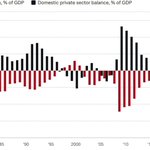
Public deficits are portrayed as economic disasters. Sectoral balances tell a different story: one sector's deficit is another's surplus. If households and firms want to save while the external sector runs a surplus, someone must run a deficit. Stop worshipping balanced budgets.
Pixel Research retweeted

craziest net worth chart i've ever seen


Pixel Research retweeted

This is a stupid argument. Since 1980, China's GDP per capita (PPP) has grown by 115 TIMES, South Korea's by 32 times, and Singapore's by 20 times. They have become developed, prosperous, technological powerhouses.
The main purpose of a fiat currency is not to serve as a store of value; it is more of a unit of account and medium of exchange that is effective at directing resources into productive sectors to facilitate economic growth and development (especially when combined with industrial policy and preferential lending for strategic sectors like advanced manufacturing).
This is why financial speculators make horrible economists and policymakers. Because their main priority is maximizing the wealth of the rich, not economic development.
Sure, the gold standard made currencies much more stable, but the economic impact was extremely deflationary, and it constrained growth and development. Recessions were also extremely painful for the vast majority of the population, and deflationary spirals were common. The economy as a whole was sacrificed so rich rentiers would not have their wealth diluted.


Performance of fiat currencies since 1971:
🇻🇪 Venezuela: -99.99%
🇹🇷 Turkey: -99.99%
🇵🇰 Pakistan: -99.2%
🇮🇳 India: -98%
🇰🇷 South Korea: -95%
🇬🇧 UK: -93%
🇺🇸 US: -87%
🇨🇦 Canada: -87%
🇨🇳 China: -86%
🇸🇦 Saudi Arabia: -81%
🇴🇲 Oman: -80%
🇸🇬 Singapore: -77%
🇯🇵 Japan: -71%
🇨🇭 Switzerland: -66%
This is a sign that the biggest threat to your savings isn't always a market crash but holding a currency that goes down in value every single year.